Chapter One Marketing:  Creating and Capturing Customer Value
Creating and Capturing Customer Value What Is Marketing? Understand the Marketplace and Customer Needs Designing a Customer-Driven Marketing Strategy Preparing an Integrated Marketing Plan and Program Building Customer Relationships Capturing Value from Customers The Changing Marketing Landscape Topic Outline
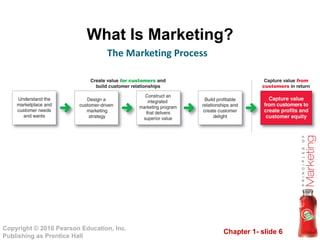
What Is Marketing? Marketing  is a process by which companies create value for customers and build strong customer relationships to capture value  from customers in return
The ________ is the nation’s twenty-fourth largest advertiser with an annual budget of more than $1 billion. Procter & Gamble Company Boeing Company Levi Strauss & Co. U.S. Government
The ________ is the nation’s 24 th  largest advertiser with an annual budget of more than $1 billion. Procter & Gamble Company Boeing Company Levi Strauss & Co. U.S. Government
What Is Marketing? The Marketing Process
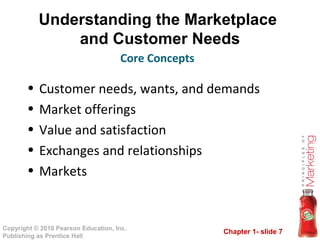
Understanding the Marketplace  and Customer Needs Customer needs, wants, and demands Market offerings Value and satisfaction Exchanges and relationships Markets Core Concepts
Marketing is ___________. the same as advertising and sales not used by small corporations about satisfying customer needs making a profit
Marketing is ________. the same as advertising and sales not used by small corporations about satisfying customer needs making a profit
Marketing is ________. 1. part of manufacturing 2. part of the finance department 3. managing customer relationships 4. sales promotion
Marketing is ________. 1. part of manufacturing 2. part of the finance department 3.  managing customer relationships 4. sales promotion
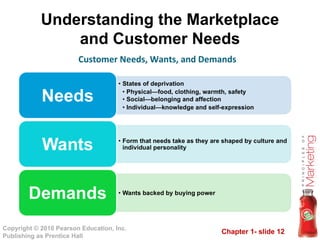
Understanding the Marketplace and Customer Needs Customer Needs, Wants, and Demands
The most basic concept underlying marketing is that of ________. profits products human needs services
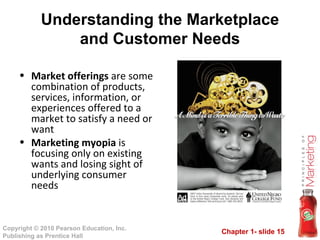
Understanding the Marketplace and Customer Needs Market offerings  are some combination of products, services, information, or experiences offered to a market to satisfy a need or want Marketing myopia  is focusing only on existing wants and losing sight of underlying consumer needs
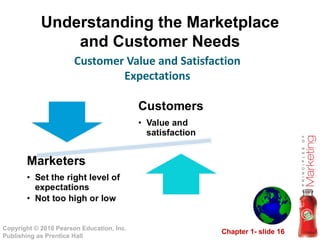
Understanding the Marketplace and Customer Needs Customer Value and Satisfaction Expectations
Exchange  is the act of obtaining a desired object from someone by offering something in return Understanding the Marketplace and Customer Needs
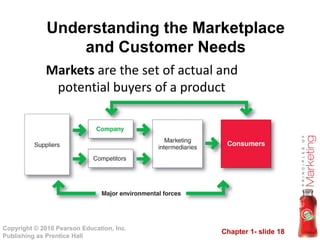
Understanding the Marketplace and Customer Needs Markets  are the set of actual and potential buyers of a product
Designing a Customer-Driven Marketing Strategy Marketing management  is the art and science of choosing target markets and building profitable relationships with them What customers will we serve? How can we best serve these customers?
The art and science of selecting target markets and developing profitable relationships with those markets is called marketing ________. profiles maneuvers selection management
Designing a Customer-Driven Marketing Strategy Market segmentation  refers to dividing the markets into segments of customers Target marketing  refers to which segments to go after Selecting Customers to Serve
Designing a Customer-Driven Marketing Strategy Demarketing  is marketing to reduce demand temporarily or permanently; the aim is not to destroy demand but to reduce or shift it Selecting Customers to Serve
Designing a Customer-Driven Marketing Strategy Choosing a Value Proposition The  value proposition  is the set of benefits or values a company promises to deliver to customers to satisfy their needs
The set of benefits/values a company promises to its customers is called __________. value proposition advertising supply and demand production concept
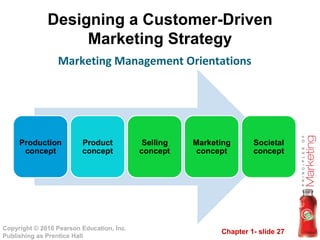
Designing a Customer-Driven Marketing Strategy Marketing Management Orientations
Designing a Customer-Driven Marketing Strategy Production concept  is the idea that consumers will favor products that are available or highly affordable Marketing Management Orientations
Designing a Customer-Driven Marketing Strategy Product concept  is the idea that consumers will favor products that offer the most quality, performance, and features.  Organization should therefore devote its energy to making continuous product improvements. Marketing Management Orientations
Designing a Customer-Driven Marketing Strategy Selling concept  is the idea that consumers will not buy enough of the firm’s products unless it undertakes a large scale selling and promotion effort Marketing Management Orientations
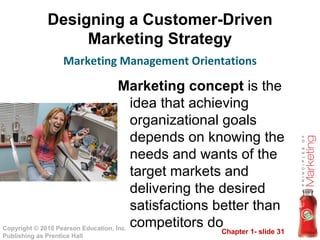
Designing a Customer-Driven Marketing Strategy Marketing Management Orientations Marketing concept  is the idea that achieving organizational goals depends on knowing the needs and wants of the target markets and delivering the desired satisfactions better than competitors do
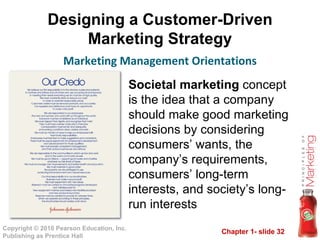
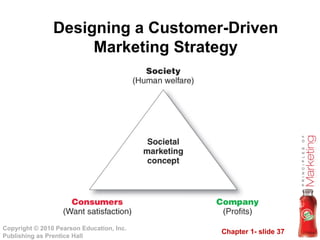
Designing a Customer-Driven Marketing Strategy Marketing Management Orientations Societal marketing  concept is the idea that a company should make good marketing decisions by considering consumers’ wants, the company’s requirements, consumers’ long-term interests, and society’s long-run interests
Human welfare, want satisfaction, and profits are the three considerations underlining the concept known as ________. societal marketing customer-driven sales-driven production
Which marketing philosophy purports that achieving corporate goals depends on knowing the needs/wants of your markets and delivering the desired satisfactions better than your competitors? Production concept Product concept Selling concept  Marketing concept
Designing a Customer-Driven Marketing Strategy
The marketing mix  is the set of tools (four Ps) the firm uses to implement its marketing strategy.It includes product, price, promotion, and place. Integrated marketing program  is a comprehensive plan that communicates and delivers the intended value to chosen customers. Preparing an Integrated Marketing Plan and Program
Building Customer Relationships The overall process of building and maintaining profitable customer relationships by delivering superior customer value and satisfaction Customer Relationship Management (CRM)
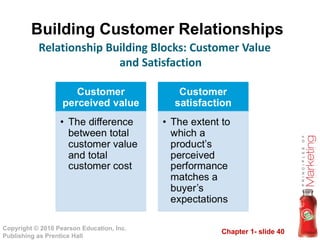
Building Customer Relationships Relationship Building Blocks: Customer Value and Satisfaction
To build  lasting customer relationships,  organizations should focus on delivering ________ and ________. high quality products; low prices customer value; customer satisfaction customer satisfaction; customer growth customer value; high profits
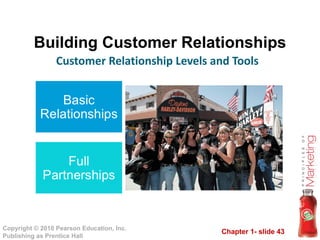
Building Customer Relationships Customer Relationship Levels and Tools
Building Customer Relationships Relating with more carefully selected customers uses selective relationship management to target fewer, more profitable customers Relating more deeply and interactively by incorporating more interactive two way relationships through blogs, Websites, online communities and social networks The Changing Nature of Customer Relationships
Partner relationship management  involves working closely with partners in other company departments and outside the company to jointly bring greater value to customers Building Customer Relationships
Building Customer Relationships Partners inside the company is every function area interacting with customers Electronically Cross-functional teams Partners outside the company is how marketers connect with their suppliers, channel partners, and competitors by developing partnerships Partner Relationship Management
Building Customer Relationships Supply chain is a channel that stretches from raw materials to components to final products to final buyers Supply management Strategic partners Strategic alliances Partner Relationship Management
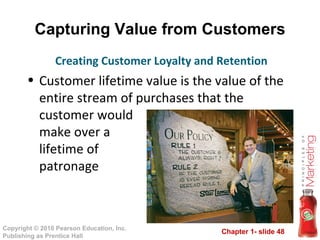
Capturing Value from Customers Customer lifetime value is the value of the entire stream of purchases that the customer would make over a  lifetime of  patronage Creating Customer Loyalty and Retention
Capturing Value from Customers Share of customer  is the portion of the customer’s purchasing that a company gets in its product categories Growing Share of Customer
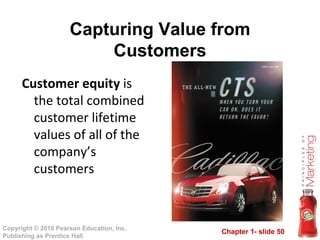
Capturing Value from Customers Customer equity  is the total combined customer lifetime values of all of the company’s customers
Capturing Value from Customers Building the right relationships with the right customers involves treating customers as assets that need to be managed and maximized Different types of customers require different relationship management strategies Build the right relationship with the right customers Building Customer Equity
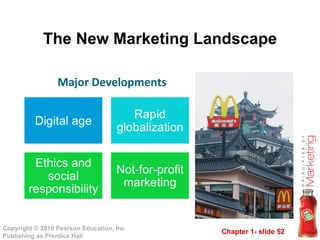
The New Marketing Landscape Major Developments
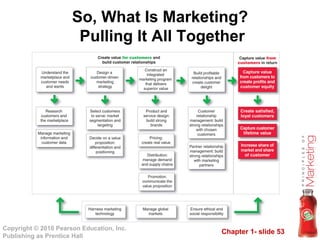
So, What Is Marketing?  Pulling It All Together
Which of the first four steps of the marketing process asks, “What consumers will we serve?” and “How can we best serve targeted customers?” Step 1: Understanding the marketplace Step 2: Designing the marketing strategy Step 3: Constructing the marketing  program 4. Step 4: Building profitable relationships  with customers
Which of the first four steps of the marketing process asks, “What consumers will we serve?” and “How can we best serve targeted customers?” Step 1: Understanding the marketplace Step 2:  Designing the marketing strategy Step 3: Constructing the marketing  program 4. Step 4: Building profitable relationships with customers
Which step of the marketing process is the most important? Step 1: Understanding the marketplace Step 2: Designing the marketing strategy Step 3: Constructing the marketing  program Step 4: Building profitable relationships  with customers
Which step of the marketing process is the most important? Step 1: Understanding the marketplace Step 2: Designing the marketing strategy Step 3: Constructing the marketing program Step 4:  Building profitable relationships  with customers
All rights reserved. No part of this publication may be reproduced, stored in a retrieval system, or transmitted, in any form or by any means, electronic, mechanical, photocopying, recording, or otherwise, without the prior written permission of the publisher. Printed in the United States of America. Copyright © 2010 Pearson Education, Inc.   Publishing as Prentice Hall

Kotler cha 1

  • 1.
    Chapter One Marketing: Creating and Capturing Customer Value
  • 2.
    Creating and CapturingCustomer Value What Is Marketing? Understand the Marketplace and Customer Needs Designing a Customer-Driven Marketing Strategy Preparing an Integrated Marketing Plan and Program Building Customer Relationships Capturing Value from Customers The Changing Marketing Landscape Topic Outline
  • 3.
    What Is Marketing?Marketing is a process by which companies create value for customers and build strong customer relationships to capture value from customers in return
  • 4.
    The ________ isthe nation’s twenty-fourth largest advertiser with an annual budget of more than $1 billion. Procter & Gamble Company Boeing Company Levi Strauss & Co. U.S. Government
  • 5.
    The ________ isthe nation’s 24 th largest advertiser with an annual budget of more than $1 billion. Procter & Gamble Company Boeing Company Levi Strauss & Co. U.S. Government
  • 6.
    What Is Marketing?The Marketing Process
  • 7.
    Understanding the Marketplace and Customer Needs Customer needs, wants, and demands Market offerings Value and satisfaction Exchanges and relationships Markets Core Concepts
  • 8.
    Marketing is ___________.the same as advertising and sales not used by small corporations about satisfying customer needs making a profit
  • 9.
    Marketing is ________.the same as advertising and sales not used by small corporations about satisfying customer needs making a profit
  • 10.
    Marketing is ________.1. part of manufacturing 2. part of the finance department 3. managing customer relationships 4. sales promotion
  • 11.
    Marketing is ________.1. part of manufacturing 2. part of the finance department 3. managing customer relationships 4. sales promotion
  • 12.
    Understanding the Marketplaceand Customer Needs Customer Needs, Wants, and Demands
  • 13.
    The most basicconcept underlying marketing is that of ________. profits products human needs services
  • 14.
    The most basicconcept underlying marketing is that of ________. profits products human needs services
  • 15.
    Understanding the Marketplaceand Customer Needs Market offerings are some combination of products, services, information, or experiences offered to a market to satisfy a need or want Marketing myopia is focusing only on existing wants and losing sight of underlying consumer needs
  • 16.
    Understanding the Marketplaceand Customer Needs Customer Value and Satisfaction Expectations
  • 17.
    Exchange isthe act of obtaining a desired object from someone by offering something in return Understanding the Marketplace and Customer Needs
  • 18.
    Understanding the Marketplaceand Customer Needs Markets are the set of actual and potential buyers of a product
  • 19.
    Designing a Customer-DrivenMarketing Strategy Marketing management is the art and science of choosing target markets and building profitable relationships with them What customers will we serve? How can we best serve these customers?
  • 20.
    The art andscience of selecting target markets and developing profitable relationships with those markets is called marketing ________. profiles maneuvers selection management
  • 21.
    The art andscience of selecting target markets and developing profitable relationships with those markets is called marketing ________. profiles maneuvers selection management
  • 22.
    Designing a Customer-DrivenMarketing Strategy Market segmentation refers to dividing the markets into segments of customers Target marketing refers to which segments to go after Selecting Customers to Serve
  • 23.
    Designing a Customer-DrivenMarketing Strategy Demarketing is marketing to reduce demand temporarily or permanently; the aim is not to destroy demand but to reduce or shift it Selecting Customers to Serve
  • 24.
    Designing a Customer-DrivenMarketing Strategy Choosing a Value Proposition The value proposition is the set of benefits or values a company promises to deliver to customers to satisfy their needs
  • 25.
    The set ofbenefits/values a company promises to its customers is called __________. value proposition advertising supply and demand production concept
  • 26.
    The set ofbenefits/values a company promises to its customers is called __________. value proposition advertising supply and demand production concept
  • 27.
    Designing a Customer-DrivenMarketing Strategy Marketing Management Orientations
  • 28.
    Designing a Customer-DrivenMarketing Strategy Production concept is the idea that consumers will favor products that are available or highly affordable Marketing Management Orientations
  • 29.
    Designing a Customer-DrivenMarketing Strategy Product concept is the idea that consumers will favor products that offer the most quality, performance, and features. Organization should therefore devote its energy to making continuous product improvements. Marketing Management Orientations
  • 30.
    Designing a Customer-DrivenMarketing Strategy Selling concept is the idea that consumers will not buy enough of the firm’s products unless it undertakes a large scale selling and promotion effort Marketing Management Orientations
  • 31.
    Designing a Customer-DrivenMarketing Strategy Marketing Management Orientations Marketing concept is the idea that achieving organizational goals depends on knowing the needs and wants of the target markets and delivering the desired satisfactions better than competitors do
  • 32.
    Designing a Customer-DrivenMarketing Strategy Marketing Management Orientations Societal marketing concept is the idea that a company should make good marketing decisions by considering consumers’ wants, the company’s requirements, consumers’ long-term interests, and society’s long-run interests
  • 33.
    Human welfare, wantsatisfaction, and profits are the three considerations underlining the concept known as ________. societal marketing customer-driven sales-driven production
  • 34.
    Human welfare, wantsatisfaction, and profits are the three considerations underlining the concept known as ________. societal marketing customer-driven sales-driven production
  • 35.
    Which marketing philosophypurports that achieving corporate goals depends on knowing the needs/wants of your markets and delivering the desired satisfactions better than your competitors? Production concept Product concept Selling concept Marketing concept
  • 36.
    Which marketing philosophypurports that achieving corporate goals depends on knowing the needs/wants of your markets and delivering the desired satisfactions better than your competitors? Production concept Product concept Selling concept Marketing concept
  • 37.
    Designing a Customer-DrivenMarketing Strategy
  • 38.
    The marketing mix is the set of tools (four Ps) the firm uses to implement its marketing strategy.It includes product, price, promotion, and place. Integrated marketing program is a comprehensive plan that communicates and delivers the intended value to chosen customers. Preparing an Integrated Marketing Plan and Program
  • 39.
    Building Customer RelationshipsThe overall process of building and maintaining profitable customer relationships by delivering superior customer value and satisfaction Customer Relationship Management (CRM)
  • 40.
    Building Customer RelationshipsRelationship Building Blocks: Customer Value and Satisfaction
  • 41.
    To build lasting customer relationships, organizations should focus on delivering ________ and ________. high quality products; low prices customer value; customer satisfaction customer satisfaction; customer growth customer value; high profits
  • 42.
    To build lasting customer relationships, organizations should focus on delivering ________ and ________. high quality products; low prices customer value; customer satisfaction customer satisfaction; customer growth customer value; high profits
  • 43.
    Building Customer RelationshipsCustomer Relationship Levels and Tools
  • 44.
    Building Customer RelationshipsRelating with more carefully selected customers uses selective relationship management to target fewer, more profitable customers Relating more deeply and interactively by incorporating more interactive two way relationships through blogs, Websites, online communities and social networks The Changing Nature of Customer Relationships
  • 45.
    Partner relationship management involves working closely with partners in other company departments and outside the company to jointly bring greater value to customers Building Customer Relationships
  • 46.
    Building Customer RelationshipsPartners inside the company is every function area interacting with customers Electronically Cross-functional teams Partners outside the company is how marketers connect with their suppliers, channel partners, and competitors by developing partnerships Partner Relationship Management
  • 47.
    Building Customer RelationshipsSupply chain is a channel that stretches from raw materials to components to final products to final buyers Supply management Strategic partners Strategic alliances Partner Relationship Management
  • 48.
    Capturing Value fromCustomers Customer lifetime value is the value of the entire stream of purchases that the customer would make over a lifetime of patronage Creating Customer Loyalty and Retention
  • 49.
    Capturing Value fromCustomers Share of customer is the portion of the customer’s purchasing that a company gets in its product categories Growing Share of Customer
  • 50.
    Capturing Value fromCustomers Customer equity is the total combined customer lifetime values of all of the company’s customers
  • 51.
    Capturing Value fromCustomers Building the right relationships with the right customers involves treating customers as assets that need to be managed and maximized Different types of customers require different relationship management strategies Build the right relationship with the right customers Building Customer Equity
  • 52.
    The New MarketingLandscape Major Developments
  • 53.
    So, What IsMarketing? Pulling It All Together
  • 54.
    Which of thefirst four steps of the marketing process asks, “What consumers will we serve?” and “How can we best serve targeted customers?” Step 1: Understanding the marketplace Step 2: Designing the marketing strategy Step 3: Constructing the marketing program 4. Step 4: Building profitable relationships with customers
  • 55.
    Which of thefirst four steps of the marketing process asks, “What consumers will we serve?” and “How can we best serve targeted customers?” Step 1: Understanding the marketplace Step 2: Designing the marketing strategy Step 3: Constructing the marketing program 4. Step 4: Building profitable relationships with customers
  • 56.
    Which step ofthe marketing process is the most important? Step 1: Understanding the marketplace Step 2: Designing the marketing strategy Step 3: Constructing the marketing program Step 4: Building profitable relationships with customers
  • 57.
    Which step ofthe marketing process is the most important? Step 1: Understanding the marketplace Step 2: Designing the marketing strategy Step 3: Constructing the marketing program Step 4: Building profitable relationships with customers
  • 58.
    All rights reserved.No part of this publication may be reproduced, stored in a retrieval system, or transmitted, in any form or by any means, electronic, mechanical, photocopying, recording, or otherwise, without the prior written permission of the publisher. Printed in the United States of America. Copyright © 2010 Pearson Education, Inc.   Publishing as Prentice Hall

Editor's Notes

  • #4 Note to Instructor: The text gives some excellent examples of companies that are successful in marketing. These examples include: Wal-Mart which has become the world’s largest retailer—and the world’s largest company— by delivering on its promise, “Save money. Live Better.” At Disney theme parks, “imagineers”work wonders in their quest to “make a dream come true today.” Apple fulfills its motto to “Think Different” with dazzling, customer-driven innovation that captures customer imaginations and loyalty. Its wildly successful iPod grabs more than 70 percent of the music player market; its iTunes music store captures nearly 90 percent of the song download business. Discussion Question Ask students for other examples of either national or local companies who are excellent at marketing and ask how they reflect the definition given in this slide.
  • #17 Note to Instructor: This Web link connects to online shoe retailer zappos.com. You can link to the site and see how this retailer creates value for the consumer. Explore features including customer reviews, online LIVE customer service, free shipping (including returns). Ask students what other online retailers deliver exceptional value and satisfaction. Discussion Question Why do marketer’s not always understand customer needs? How can they better identify customer needs? Marketer’s often work in a vacuum and do not consider the customer’s needs as much as they should. Future chapters will talk about market research and marketing information, important tools for understanding customer’s needs. Students might be familiar with survey research or focus groups as techniques for gathering information or they might be asked for their zip code when they purchase in certain retailers
  • #18 Note to Instructor: Marketing consists of actions taken to build and maintain desirable exchange relationships with target audiences involving a product, service, idea, or other object. Beyond simply attracting new customers and creating transactions, the goal is to retain customers and grow their business with the company.
  • #23 Note to Instructor: The link is to a Samsung phone called jitterbug. Their phones are very easy to use and are targeted to older users. You can click to the site and ask the students who they believe the target market would be for the product.
  • #33 Discussion Questions What companies can you identify with social Marketing? What do these companies do that ties to the societal marketing concept? Students might be familiar with many different companies that practice societal marketing through their Corporate Social Responsibility (CSR) initiatives. Students might be familiar with local retailers who are also involved in societal marketing. (Target, TOMS shoes). They will note that these companies donate, contribute, or offer services to charities and not-for-profit organizations.
  • #38 Note to Instructor This slide shows companies should balance three considerations in setting their marketing strategies. Johnson & Johnson does this well. Johnson & Johnson would rather take a big loss than ship a bad batch of one of its products. Consider the tragic tampering case in which eight people died in 1982 from swallowing cyanide-laced capsules of Tylenol, a Johnson & Johnson brand. Although Johnson & Johnson believed that the pills had been altered in only a few stores it recalled all of its product and launched an information campaign to instruct and reassure consumers. The recall cost the company $100 million in earnings. In the long run, however, the company’s swift recall of Tylenol strengthened consumer confidence and loyalty, and today Tylenol remains one of the nation’s leading brands of pain reliever. Discussion Question Ask students about other companies that have had serious problems with their products? How have these companies bounced back?
  • #44 Note to Instructor Basic Relationships are often used by a company with many low-margin customers For example, Procter & Gamble does not phone or call on all of its Tide consumers to get to know them personally. Instead, P&G creates relationships through brand-building advertising, sales promotions, and its Tide FabricCare Network Web site (www.Tide.com). Full Partnerships are used in markets with few customers and high margins, sellers want to create full partnerships with key customers. For example, P&G customer teams work closely with Wal-Mart, Safeway, and other large retailers. Discussion Question Ask students what frequency or club marketing programs they belong to and why?
  • #45 Note to Instructor This will be a point for a lively discussion. Discussion Question Ask students how marketers have used facebook, myspace, linkedin or other social networks for marketing purposes. Ask them about YouTube and how that has changed marketing.
  • #49 Note to Instructor Stew Leonard’s is an interesting example. Stew Leonard, who operates a highly profitable four-store supermarket in Connecticut and New York, says that he sees $50,000 flying out of his store every time he sees a sulking customer. Why? Because his average customer spends about $100 a week, shops 50 weeks a year, and remains in the area for about 10 years. If the marketing process, the company creates value for target customers and builds strong relationships with them. To keep customers coming back, Stew Leonard’s has created the “Disneyland of dairy stores.” Rule 1—the customer is always right. Rule 2—If the customer is ever wrong, reread Rule 1. You can find videos of Leonard’s stores on youtube.com which will give the students an idea of the atmosphere. Discussion Question Ask students if they know of other retailers build this kind of exciting environment.
  • #52 Note to Instructor A visit to the Coke Web site always offers examples of building customer equity. They usually have a unique way of engaging the customer whether it be online games, music studios, or virtual worlds.
  • #53 Notes to Instructor This is a good slide to prompt discussion on personal observations and experiences. Discussion Questions Ask if students are from other countries and how consumers and marketers differ in their country. Have students reflect on how marketers are integrating social responsibility in their marketing messages. Probe to see if students believe there are differences in marketing for a not-for-profit versus a for-profit company.