TIME MANGEMENT WORKSHOP


Presenter:
Dr. Maynard Brusman
Time Management Key Concepts
b   Personal Mission Statement:
b   Defining Your Life Goals:
b   Weekly Time Log:
b   Plan:
b   Scheduling:
b   To Do Lists:
b   Set Priorities:
b   80/20 Rule:
b   “Maynard’s Question”:
Time Management Stress Personalities

 Your Personality is reflected in the way you
                 handle time

b PERFECTIONISM:
b PLEASER:
b PROCRASTINATION:
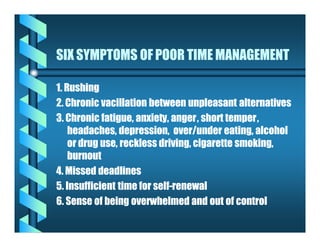
SIX SYMPTOMS OF POOR TIME MANAGEMENT

1. Rushing
2. Chronic vacillation between unpleasant alternatives
3. Chronic fatigue, anxiety, anger, short temper,
    headaches, depression, over/under eating, alcohol
    or drug use, reckless driving, cigarette smoking,
    burnout
4. Missed deadlines
5. Insufficient time for self-renewal
                         self-
6. Sense of being overwhelmed and out of control
TEN TIMELY TIPS
1. Create time for regular spiritual, mental and social/ emotional
    renewal
2. Learn to say NO!
3. Delegate
4. Institute a Quiet Hour
5. Focus on the A’s
6. Set aside an open door time
7. Set time limit for the papers on your desk
8. Create an Idea Factory
9. Are you an Lark or an Owl?
10.Stay flexible
Time Wasters
1. Management by crisis       11. Meetings
2. Telephone interruptions    12. Paperwork
                              13. Leaving tasks unfinished
3. Inadequate planning
                              14. Inadequate staff
4. Attempting too much
                              15. Socializing
5. Drop-in visitors
   Drop-
                              16. Confused responsibility or
6. Ineffective delegation         authority
7. Personal disorganization   17. Poor communication
8. Lack of self-discipline
           self-              18. Inadequate controls and progress
9. Inability to say no            reports
                              19. Incomplete communication
10. Procrastination
                              20. Travel
HOW TO OVERCOME
PROCRASTINATION


       Presented by:
       Dr. Maynard Brusman
Definition of Procrastination


b Procrastination is the mechanism for
  coping with the anxiety associated with
  starting or completing any task or decision
The Six Signs of Procrastination
1. Does life feel like a long series of obligations that
   cannot be met?
2. Are you unrealistic about time?
3. Are you vague about your goals and values?
4. Are you unfulfilled, frustrated, depressed?
5. Are you indecisive and afraid of making a
   mistake?
6. Do you have low self esteem and a lack of
   assertiveness?
Why we Procrastinate

b Procrastination is often a signal of inner
  conflict. Habitually postponing important
  or necessary tasks can be a way to
  sabotage success, avoid imagined failure,
  or express resentment of authority.
Common problems include:

b Doing quick or easy tasks before those that
  are more difficult or time-consuming
                        time-
b Putting enjoyable activities before things
  we don't like doing
b Waiting until the deadline is on top of you
  before getting started
PRODUCTIVE SELF-TALK
           SELF-
Procrastinators               Producers
1. “I have to”                “I choose to”
2. “I must finish”            “When can I start”
3. “This is so big”           “I can take one
                               small step”
4. “I must be perfect”        “I can be human”
5.”I don’t have time to play” “I must take time
                               to play”
ONE DOZEN WAYS TO OVERCOME
PROCRASTINATION
1. Practice telling time
2. Learn to use little bits of time
3. Allow for interruptions
4. Make a commitment to someone else
5.Give yourself a pep-talk
                   pep-
6.Clarify
ONE DOZEN WAYS TO OVERCOME
PROCRASTINATION
7. Take a stimulus change or a rest break
8. Reward yourself for task completion
9. Remember, “Nothing is either good or bad,
   but thinking makes it so”
10. Plan for pleasure
11. Identify personal prime time
12. Join the Procrastinators Club of America
          111 Broad-Locust Building
              Broad-
          Philadelphia, Pennsylvania 19102
ONE DOZEN WAYS TO OVERCOME
PROCRASTINATION

7. Take a stimulus change or a rest break
8. Reward yourself for task completion
9. Remember, “Nothing is either good or bad,
   but thinking makes it so”
10. Plan for pleasure
11. Identify personal prime time
12. Join the Procrastinators Club of America
          111 Broad-Locust Building
              Broad-
          Philadelphia, Pennsylvania 19102
Quadrant Approach to
Time Management
  U RG EN T                           N O T U R G EN T
  D e a d lin e s                     P la n n in g & o r g a n iz a tio n
  C r is e s                          P u r s u in g b ig id e a s
  P u ttin g o u t fir e s            P e r s o n a l & p r o f. G r o w th
  Som e Fed X                I   II   R e la tio n s h ip b u ild in g

  In te rru p tio n s    III     IV   R e a d in g ju n k m a il
  S o m e p h o n e c a lls           M o st TV
  S o m e m e e tin g s               S o m e p h o n e c a lls
  S o m e fa x e s & F e d X          B u s y w o rk

  “Important things are seldom urgent and urgent
  things are seldom important”
           Brian Tracy
           Time Management Expert
The Unschedule
Dr.
        Dr. Maynard Brusman
Consulting Psychologist & Executive Coach

Working Resources
P .O. Box 471525 San Francisco, California 94147
Tel: 415-546-1252
      415-546-
E-mail: mbrusman@workingresources.com
Web Site: http://www.workingresources.com
Subscribe to Working Resources Newsletter:
http://www.workingresources.com
Visit Maynard's Blog:
http://www.workingresourcesblog.com

Time/Self-management

  • 1.
  • 2.
    Time Management KeyConcepts b Personal Mission Statement: b Defining Your Life Goals: b Weekly Time Log: b Plan: b Scheduling: b To Do Lists: b Set Priorities: b 80/20 Rule: b “Maynard’s Question”:
  • 3.
    Time Management StressPersonalities Your Personality is reflected in the way you handle time b PERFECTIONISM: b PLEASER: b PROCRASTINATION:
  • 4.
    SIX SYMPTOMS OFPOOR TIME MANAGEMENT 1. Rushing 2. Chronic vacillation between unpleasant alternatives 3. Chronic fatigue, anxiety, anger, short temper, headaches, depression, over/under eating, alcohol or drug use, reckless driving, cigarette smoking, burnout 4. Missed deadlines 5. Insufficient time for self-renewal self- 6. Sense of being overwhelmed and out of control
  • 5.
    TEN TIMELY TIPS 1.Create time for regular spiritual, mental and social/ emotional renewal 2. Learn to say NO! 3. Delegate 4. Institute a Quiet Hour 5. Focus on the A’s 6. Set aside an open door time 7. Set time limit for the papers on your desk 8. Create an Idea Factory 9. Are you an Lark or an Owl? 10.Stay flexible
  • 6.
    Time Wasters 1. Managementby crisis 11. Meetings 2. Telephone interruptions 12. Paperwork 13. Leaving tasks unfinished 3. Inadequate planning 14. Inadequate staff 4. Attempting too much 15. Socializing 5. Drop-in visitors Drop- 16. Confused responsibility or 6. Ineffective delegation authority 7. Personal disorganization 17. Poor communication 8. Lack of self-discipline self- 18. Inadequate controls and progress 9. Inability to say no reports 19. Incomplete communication 10. Procrastination 20. Travel
  • 7.
    HOW TO OVERCOME PROCRASTINATION Presented by: Dr. Maynard Brusman
  • 8.
    Definition of Procrastination bProcrastination is the mechanism for coping with the anxiety associated with starting or completing any task or decision
  • 9.
    The Six Signsof Procrastination 1. Does life feel like a long series of obligations that cannot be met? 2. Are you unrealistic about time? 3. Are you vague about your goals and values? 4. Are you unfulfilled, frustrated, depressed? 5. Are you indecisive and afraid of making a mistake? 6. Do you have low self esteem and a lack of assertiveness?
  • 10.
    Why we Procrastinate bProcrastination is often a signal of inner conflict. Habitually postponing important or necessary tasks can be a way to sabotage success, avoid imagined failure, or express resentment of authority.
  • 11.
    Common problems include: bDoing quick or easy tasks before those that are more difficult or time-consuming time- b Putting enjoyable activities before things we don't like doing b Waiting until the deadline is on top of you before getting started
  • 12.
    PRODUCTIVE SELF-TALK SELF- Procrastinators Producers 1. “I have to” “I choose to” 2. “I must finish” “When can I start” 3. “This is so big” “I can take one small step” 4. “I must be perfect” “I can be human” 5.”I don’t have time to play” “I must take time to play”
  • 13.
    ONE DOZEN WAYSTO OVERCOME PROCRASTINATION 1. Practice telling time 2. Learn to use little bits of time 3. Allow for interruptions 4. Make a commitment to someone else 5.Give yourself a pep-talk pep- 6.Clarify
  • 14.
    ONE DOZEN WAYSTO OVERCOME PROCRASTINATION 7. Take a stimulus change or a rest break 8. Reward yourself for task completion 9. Remember, “Nothing is either good or bad, but thinking makes it so” 10. Plan for pleasure 11. Identify personal prime time 12. Join the Procrastinators Club of America 111 Broad-Locust Building Broad- Philadelphia, Pennsylvania 19102
  • 15.
    ONE DOZEN WAYSTO OVERCOME PROCRASTINATION 7. Take a stimulus change or a rest break 8. Reward yourself for task completion 9. Remember, “Nothing is either good or bad, but thinking makes it so” 10. Plan for pleasure 11. Identify personal prime time 12. Join the Procrastinators Club of America 111 Broad-Locust Building Broad- Philadelphia, Pennsylvania 19102
  • 16.
    Quadrant Approach to TimeManagement U RG EN T N O T U R G EN T D e a d lin e s P la n n in g & o r g a n iz a tio n C r is e s P u r s u in g b ig id e a s P u ttin g o u t fir e s P e r s o n a l & p r o f. G r o w th Som e Fed X I II R e la tio n s h ip b u ild in g In te rru p tio n s III IV R e a d in g ju n k m a il S o m e p h o n e c a lls M o st TV S o m e m e e tin g s S o m e p h o n e c a lls S o m e fa x e s & F e d X B u s y w o rk “Important things are seldom urgent and urgent things are seldom important” Brian Tracy Time Management Expert
  • 17.
  • 18.
    Dr. Dr. Maynard Brusman Consulting Psychologist & Executive Coach Working Resources P .O. Box 471525 San Francisco, California 94147 Tel: 415-546-1252 415-546- E-mail: mbrusman@workingresources.com Web Site: http://www.workingresources.com Subscribe to Working Resources Newsletter: http://www.workingresources.com Visit Maynard's Blog: http://www.workingresourcesblog.com