




Balancing life with work


  by Toronto Training and HR

        February 2012
3-4     Introduction to Toronto Training and HR
           5-6     Definitions
Contents   7-8
           9-11
                   Three categories of work-life balance
                   Rethinking the concept of work-life balance
           12-13   Types of initiative
           14-15   Five work-life domains to manage
           16-18   Top work-life challenges
           19-20   Barriers to a healthy lifestyle
           21-23   But I’m an entrepreneur!
           24-25   Questions that unleash work-life balance
           26-28   When is enough enough?
           29-30   How can financial management help
                   work-life balance?
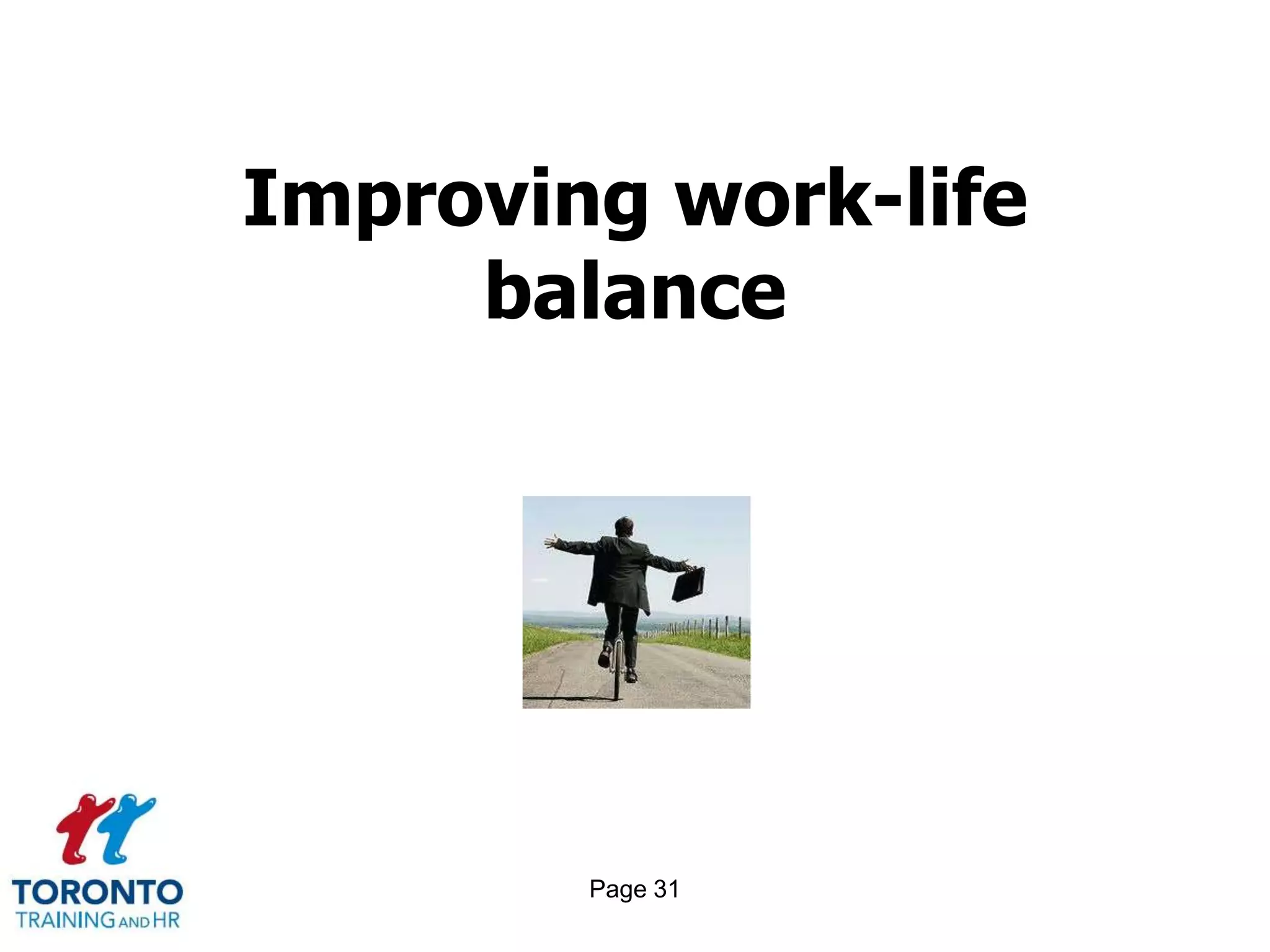
           31-34   Improving work-life balance
           35-36   Make the most of your time off
           37-38   Getting a proper break from work
           39-40   Presenteeism
           41-43   Commuting
           44-46   An example of rules
           47-52   Canadian trends for 2012
           53-58   Case studies
           59-60   Conclusion and questions
Introduction


     Page 3
Introduction to Toronto Training
            and HR
• Toronto Training and HR is a specialist training and human
  resources consultancy headed by Timothy Holden
• 10 years in banking
• 10 years in training and human resources
• Freelance practitioner since 2006
• The core services provided by Toronto Training and HR are:
              - Training course design
              - Training course delivery
              - Reducing costs
              - Saving time
              - Improving employee engagement & morale
              - Services for job seekers

                            Page 4
Definitions


    Page 5
Definitions
What is work-life balance?
What is work-life enrichment?


                       Page 6
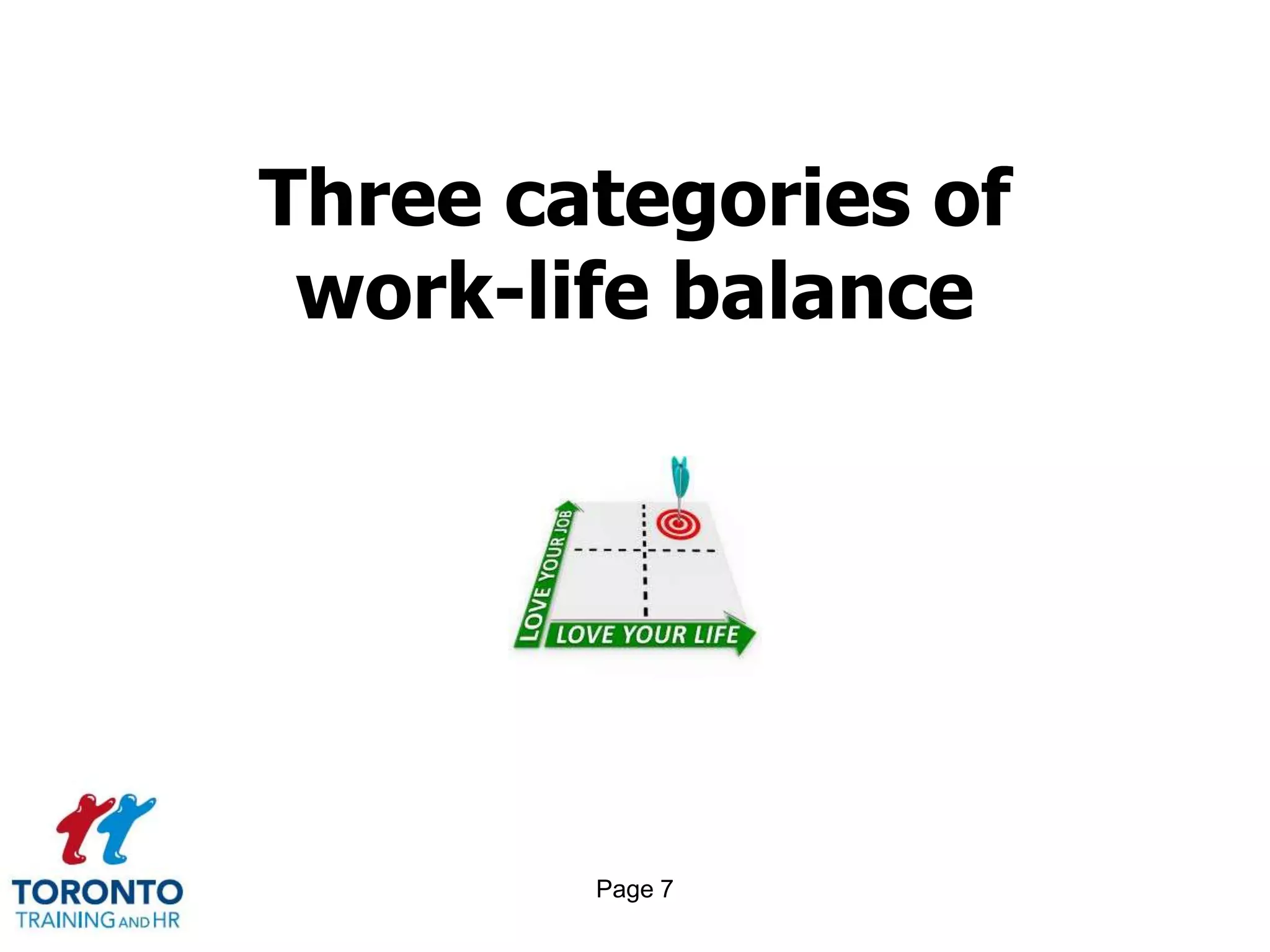
Three categories of
 work-life balance


        Page 7
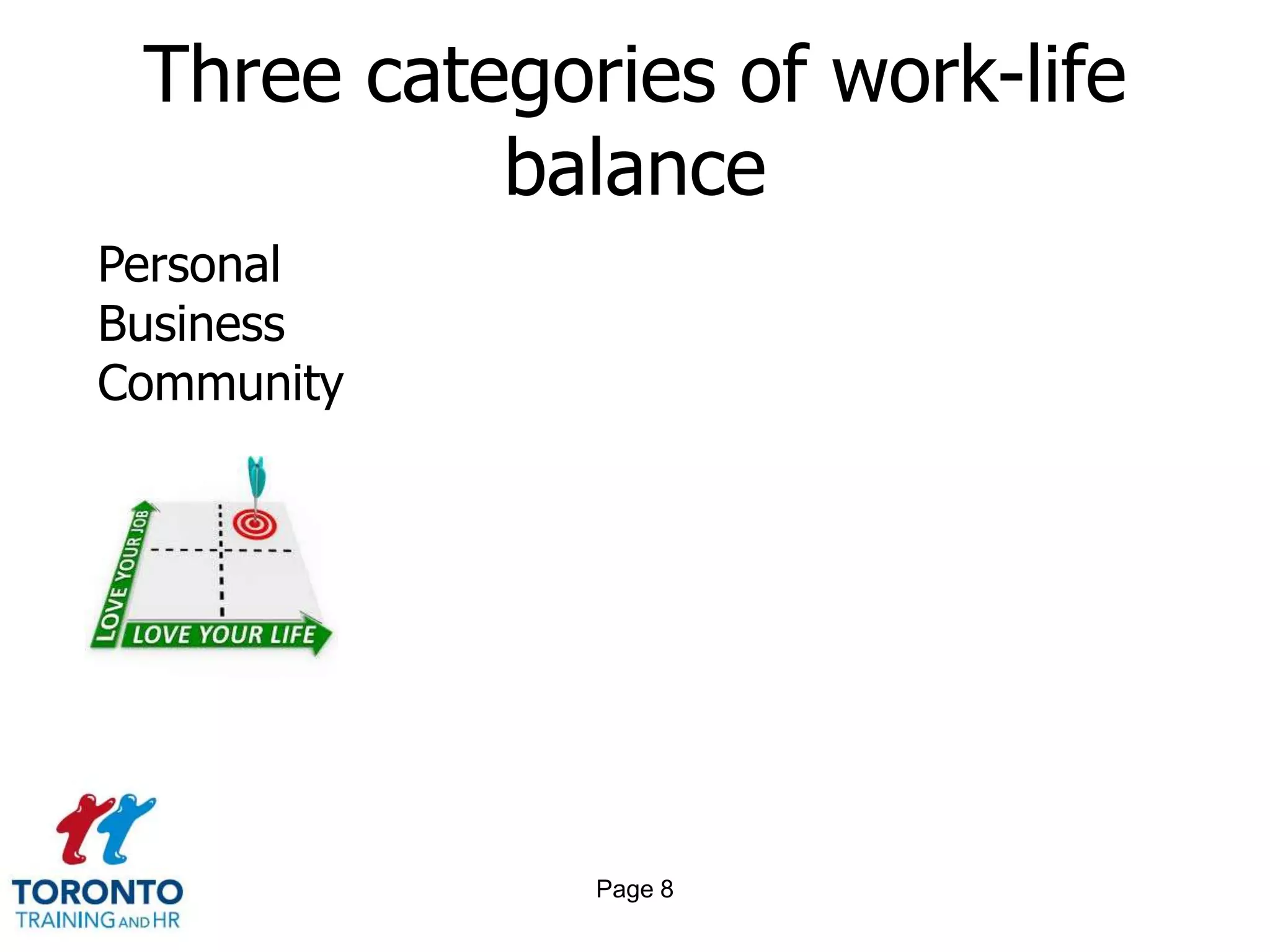
Three categories of work-life
           balance
Personal
Business
Community


              Page 8
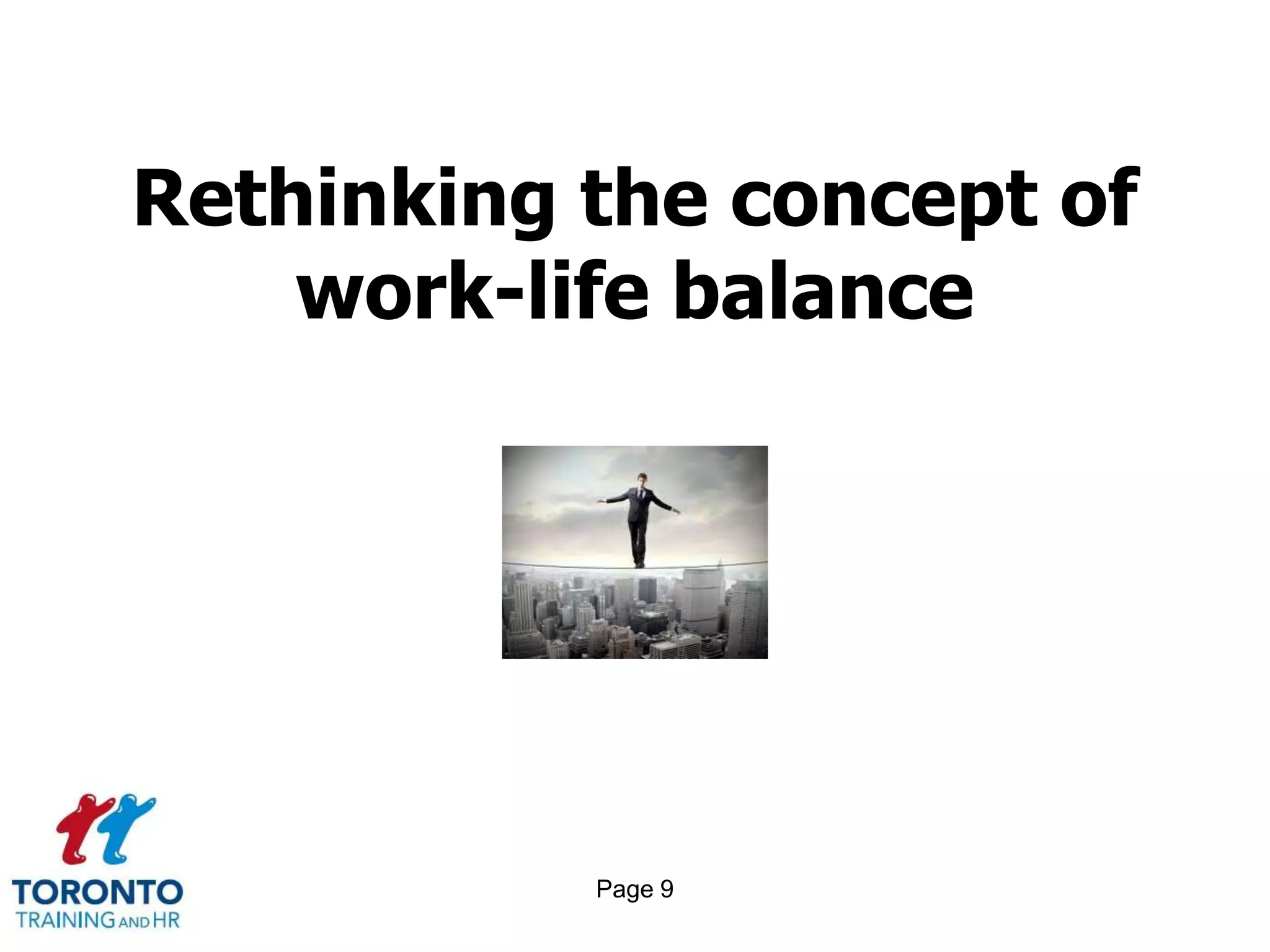
Rethinking the concept of
    work-life balance


           Page 9
Rethinking the concept of work-
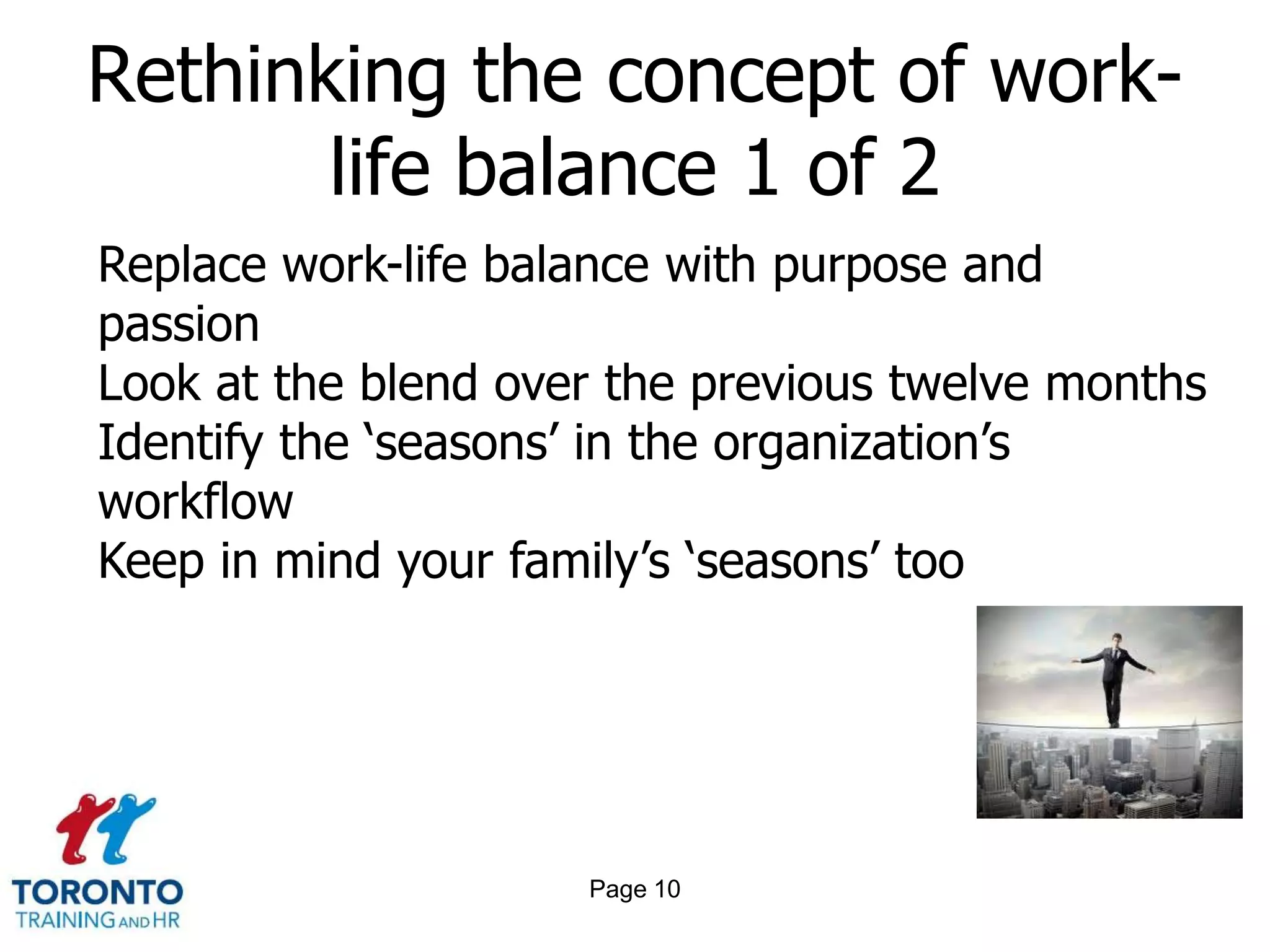
       life balance 1 of 2
Replace work-life balance with purpose and
passion
Look at the blend over the previous twelve months
Identify the ‘seasons’ in the organization’s
workflow
Keep in mind your family’s ‘seasons’ too


                     Page 10
Rethinking the concept of work-
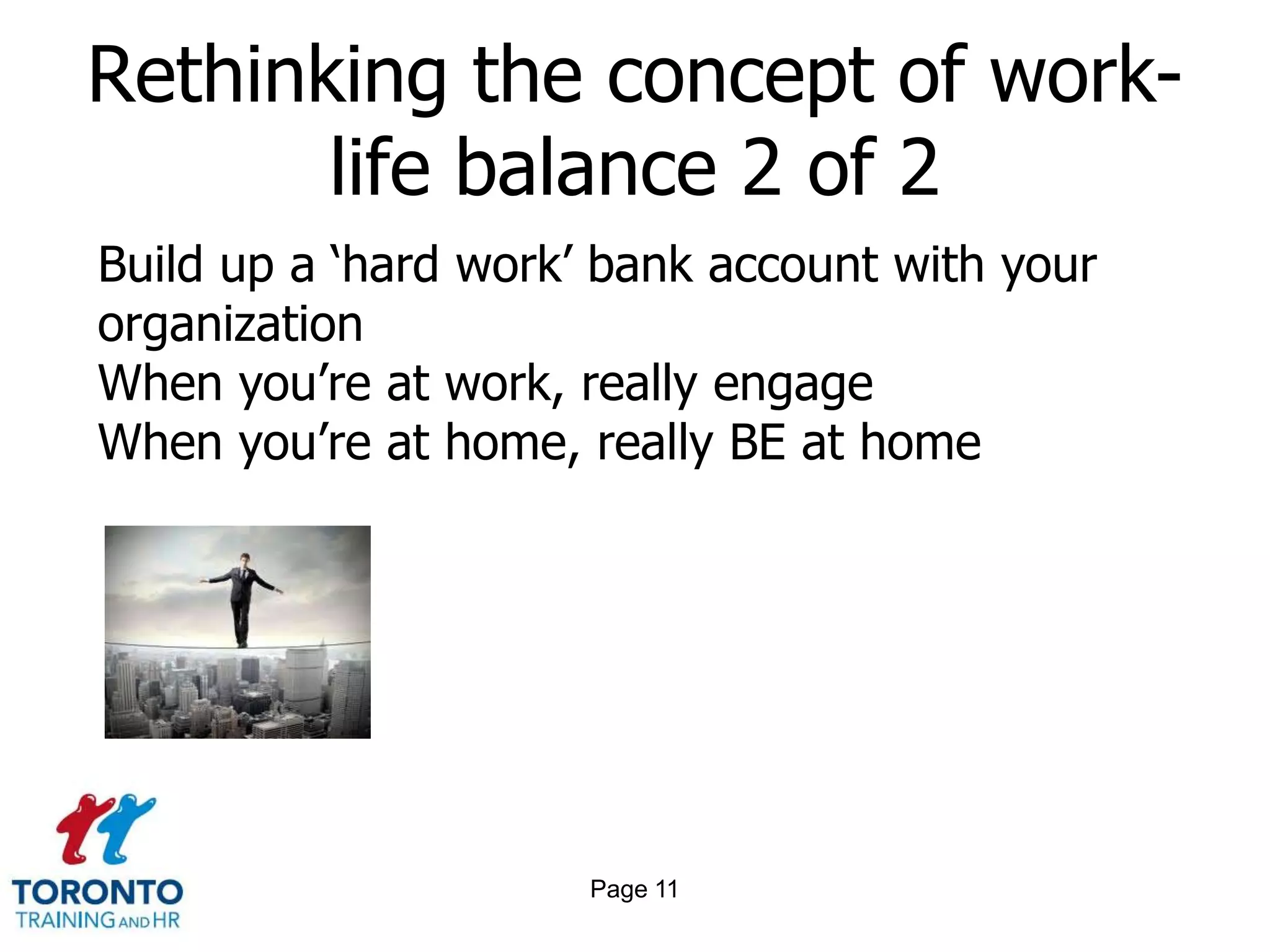
       life balance 2 of 2
Build up a ‘hard work’ bank account with your
organization
When you’re at work, really engage
When you’re at home, really BE at home


                      Page 11
Types of initiative


        Page 12
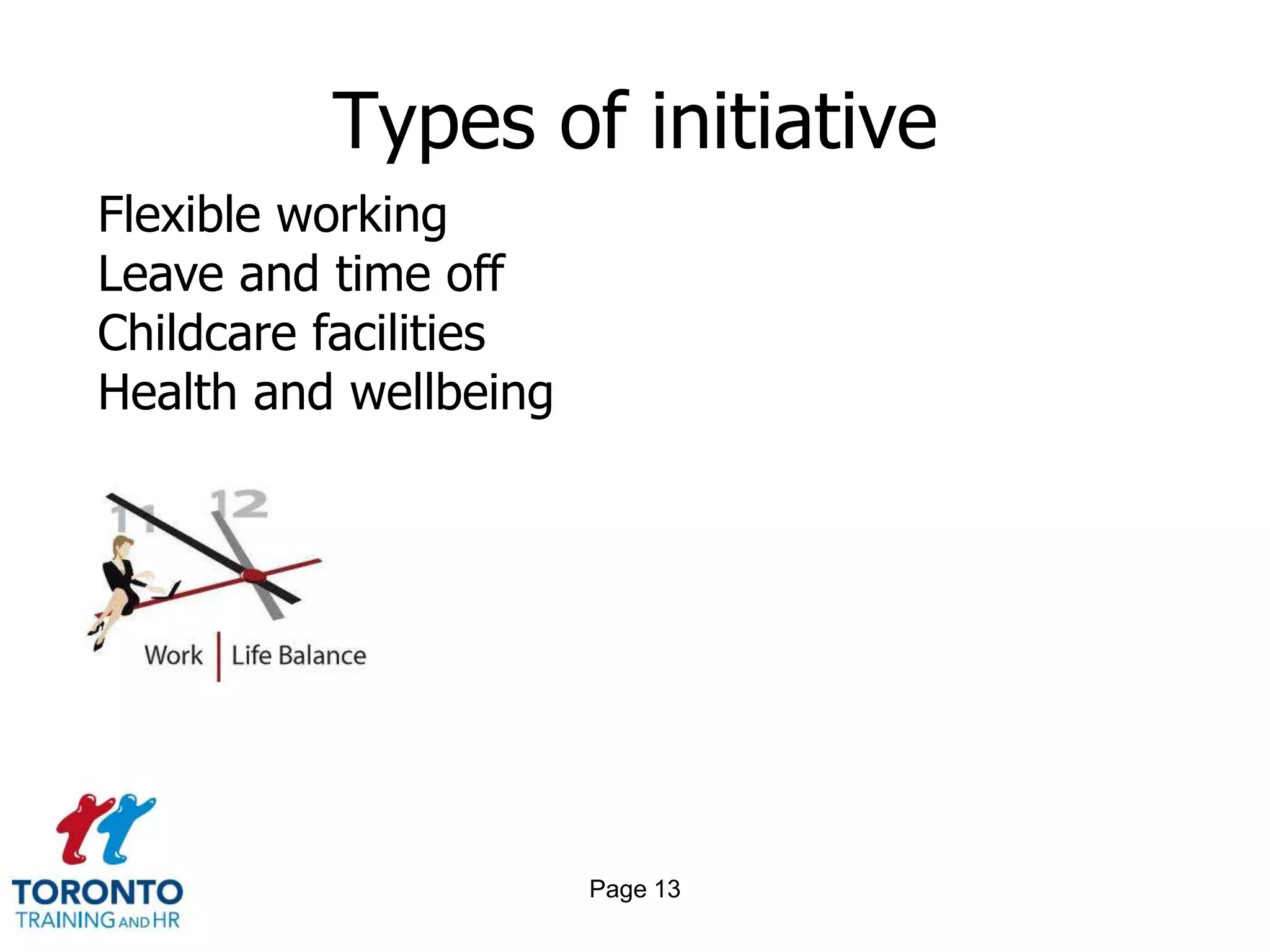
Types of initiative
Flexible working
Leave and time off
Childcare facilities
Health and wellbeing


                       Page 13
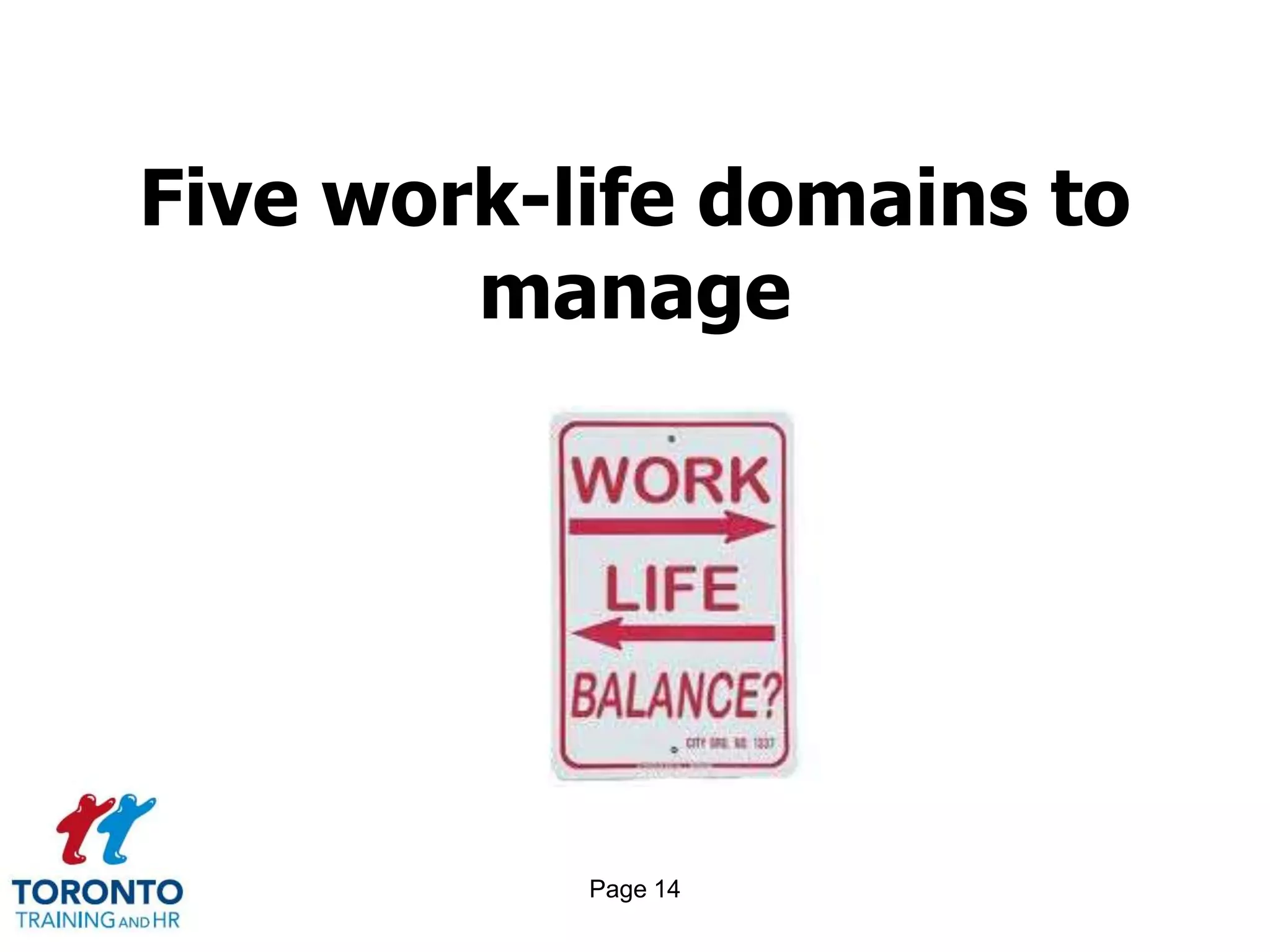
Five work-life domains to
        manage


           Page 14
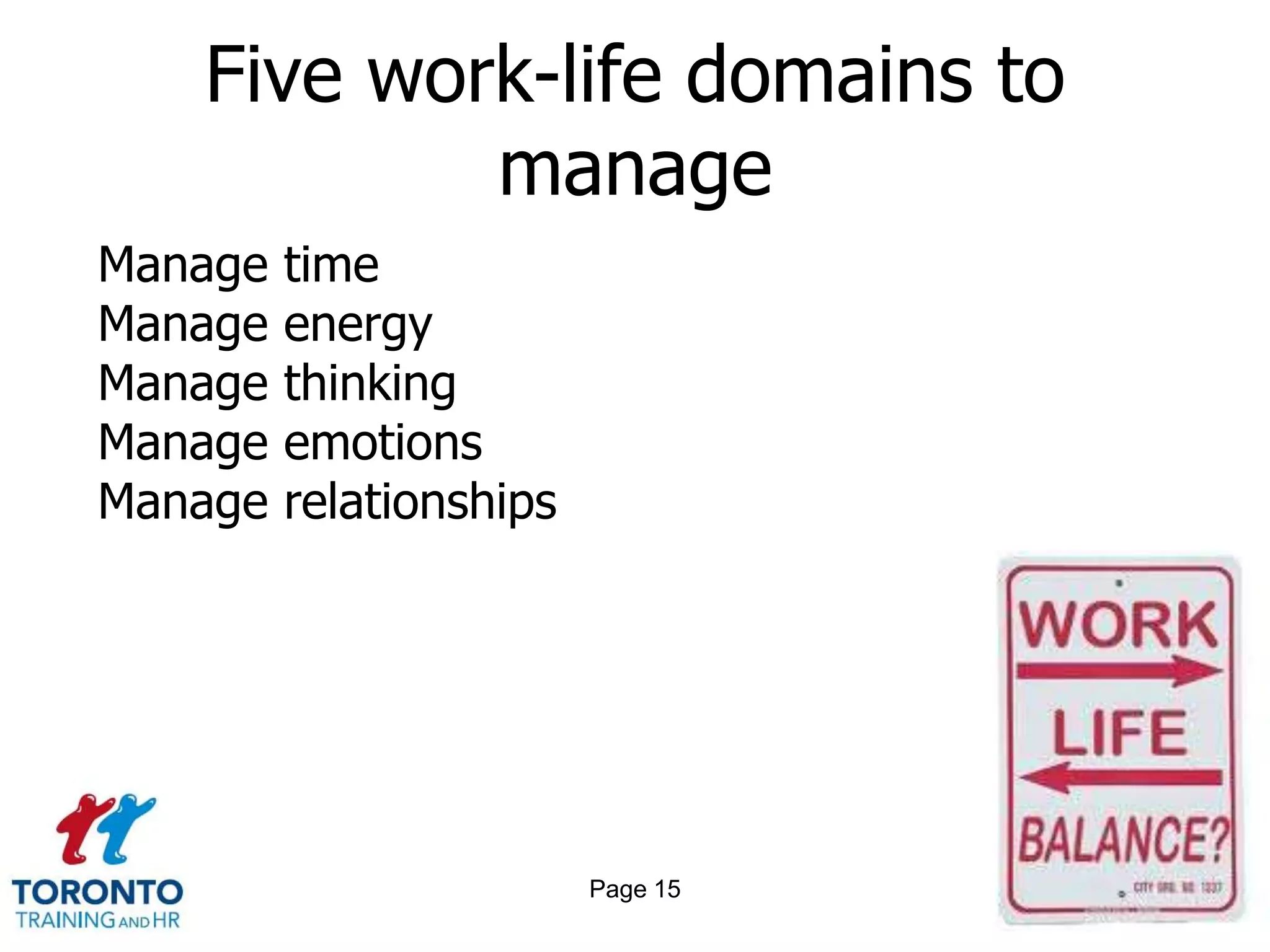
Five work-life domains to
           manage
Manage   time
Manage   energy
Manage   thinking
Manage   emotions
Manage   relationships


                         Page 15
Top
work-life challenges


        Page 16
Top work-life challenges 1 of 2
MEN
25%   spending time with family
23%   financial stress
23%   finding personal time
19%   finding time to exercise


                      Page 17
Top work-life challenges 2 of 2
WOMEN
24% financial stress
21% finding time to exercise
19% finding personal time
19% finding time to spend with family


                     Page 18
Barriers to a healthy
      lifestyle


         Page 19
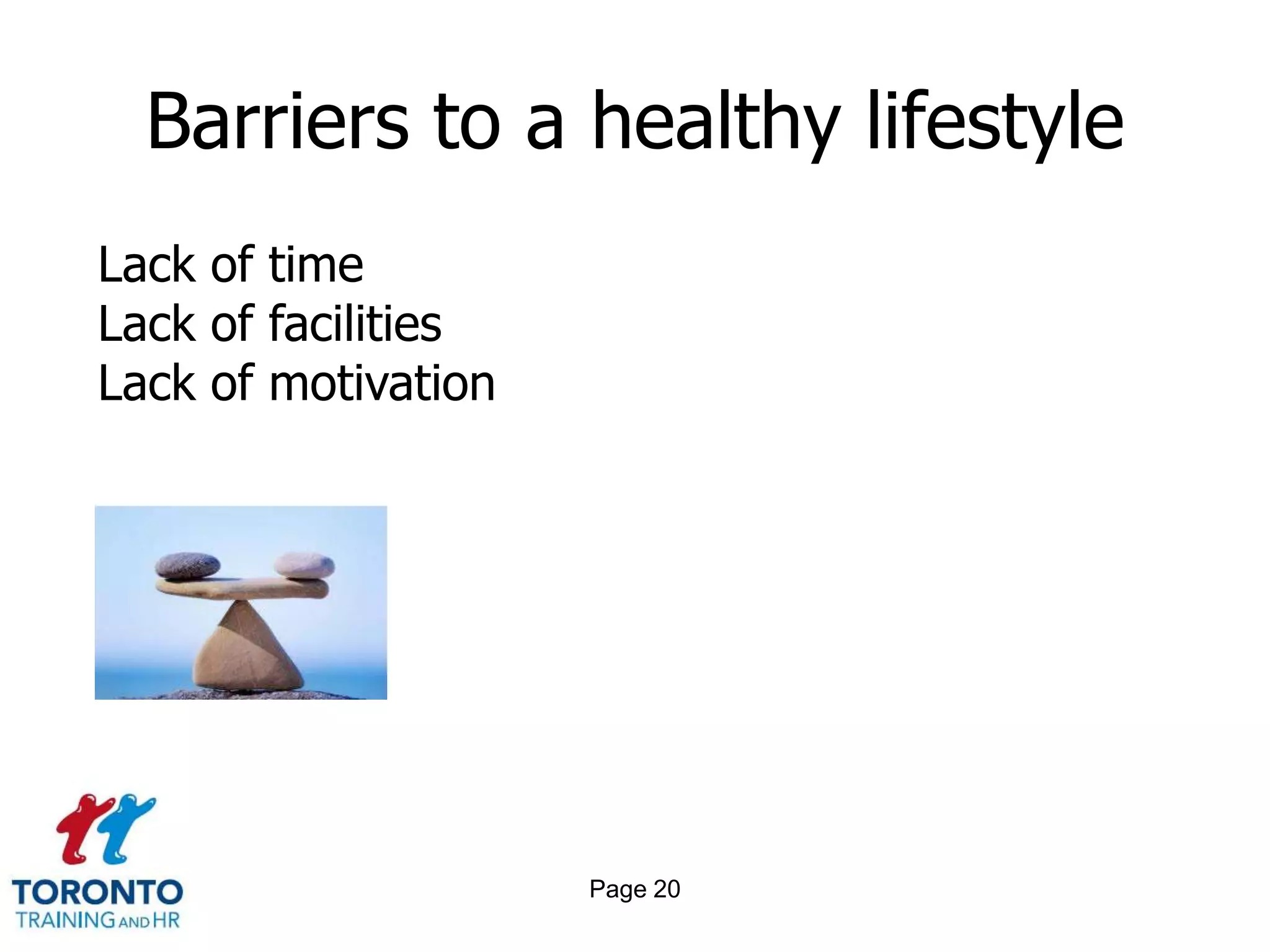
Barriers to a healthy lifestyle
Lack of time
Lack of facilities
Lack of motivation


                     Page 20
But I’m an entrepreneur!


          Page 21
But I’m an entrepreneur! 1 of 2
Keep a schedule
Allow for overlap
Establish boundaries
Take time off when you can
If you really want that break to feel like one, turn
off your technology
Recognize that you don’t need to revolutionize
your life with grand, sweeping changes in order to
achieve balance

                       Page 22
But I’m an entrepreneur! 2 of 2
Become a family business
Review your plans
Ask for help
Make work-life balance a priority


                      Page 23
Questions that unleash
  work-life balance


         Page 24
Questions that unleash work-life
            balance
What are the most valuable things to work on?
Are there ways to change the process to reduce
friction and create glide paths?
Can we tackle big things with little goals to flow
more value along the way?
How can I spend more time in my strengths, and
less time in my weaknesses?
 How can I help others to spend more time in their
strengths, and less time in their weaknesses?

                      Page 25
When is enough enough?


         Page 26
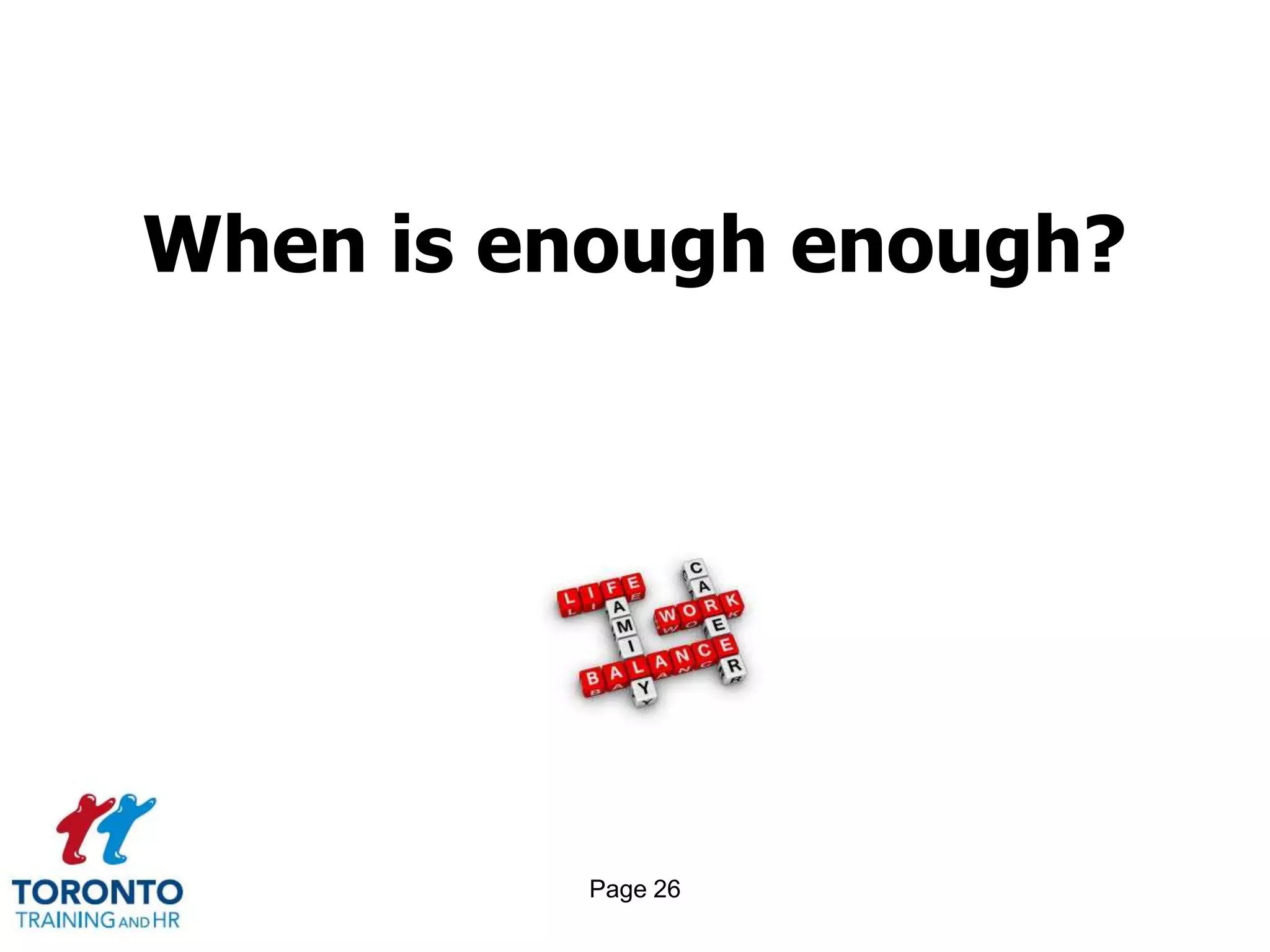
When is enough enough? 1 of 2
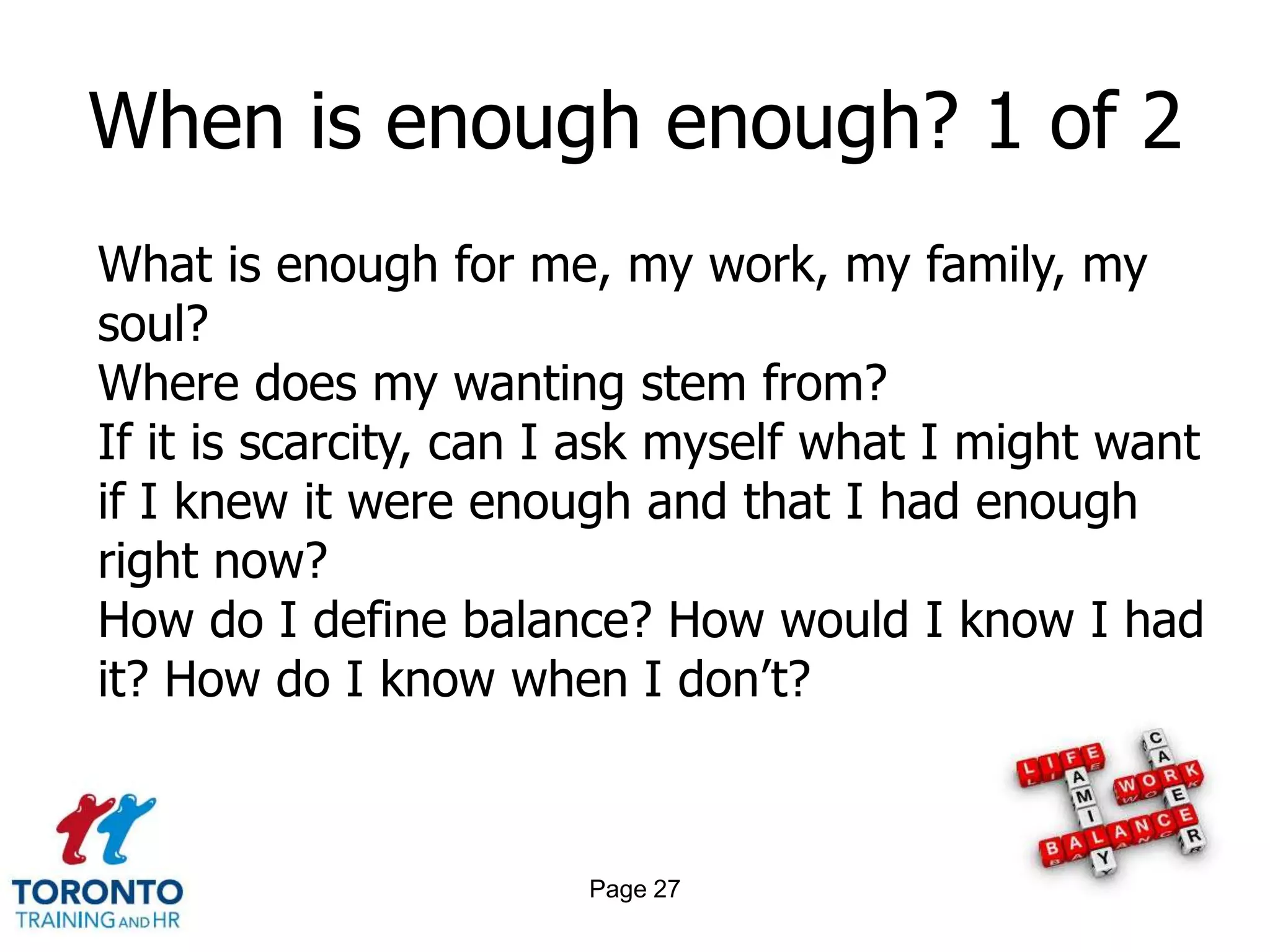
What is enough for me, my work, my family, my
soul?
Where does my wanting stem from?
If it is scarcity, can I ask myself what I might want
if I knew it were enough and that I had enough
right now?
How do I define balance? How would I know I had
it? How do I know when I don’t?


                       Page 27
When is enough enough? 2 of 2
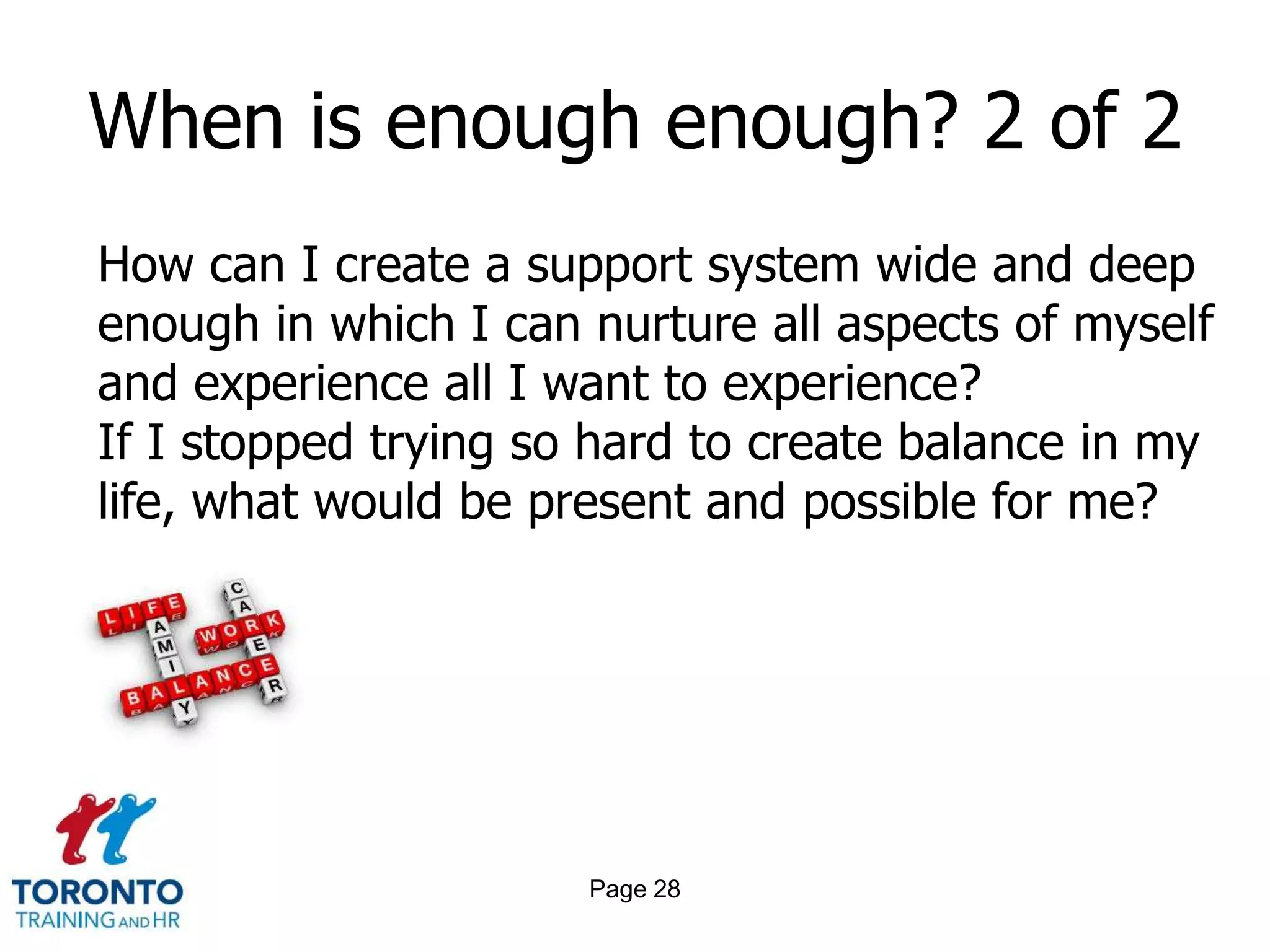
How can I create a support system wide and deep
enough in which I can nurture all aspects of myself
and experience all I want to experience?
If I stopped trying so hard to create balance in my
life, what would be present and possible for me?


                      Page 28
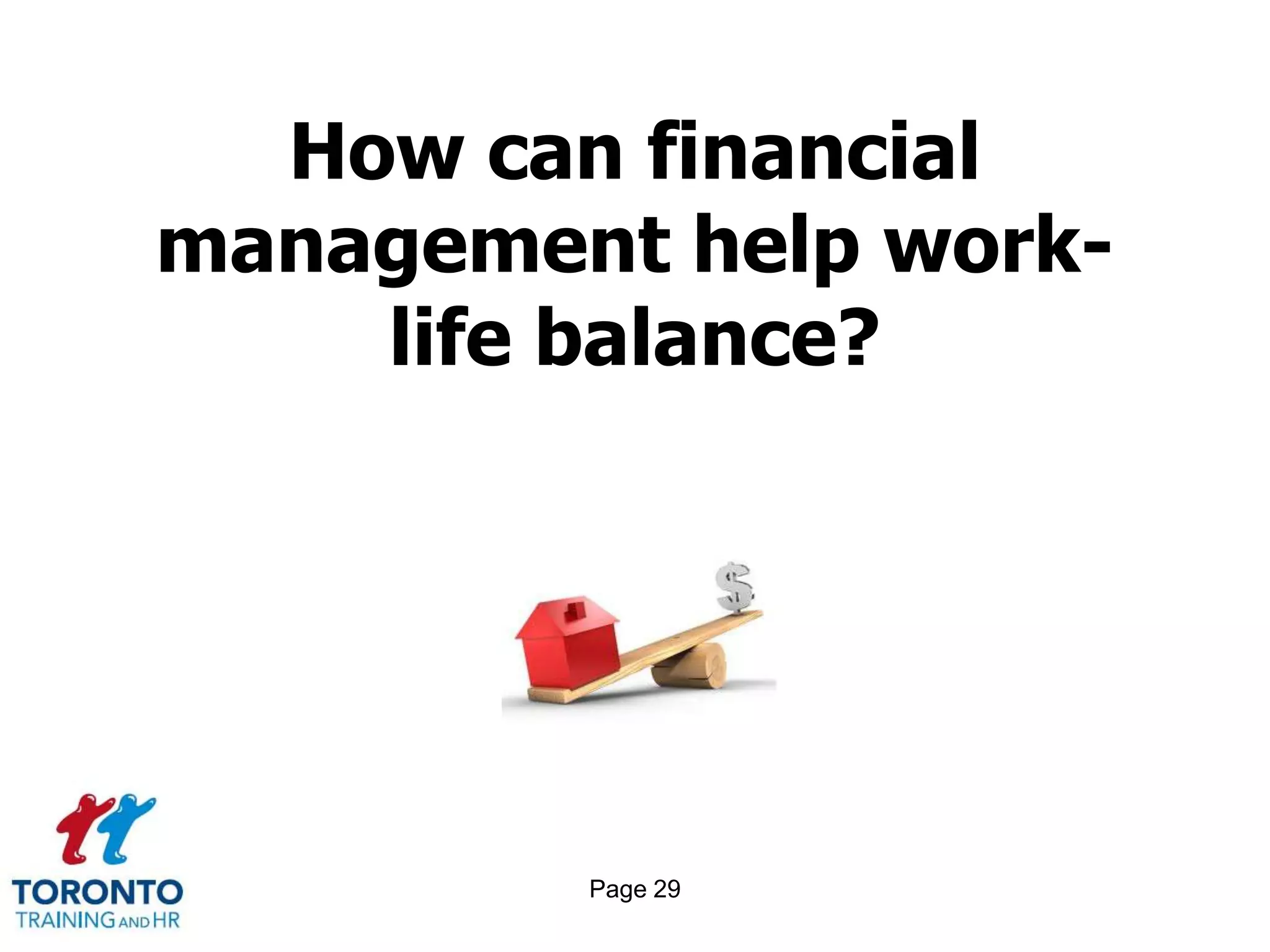
How can financial
management help work-
    life balance?


         Page 29
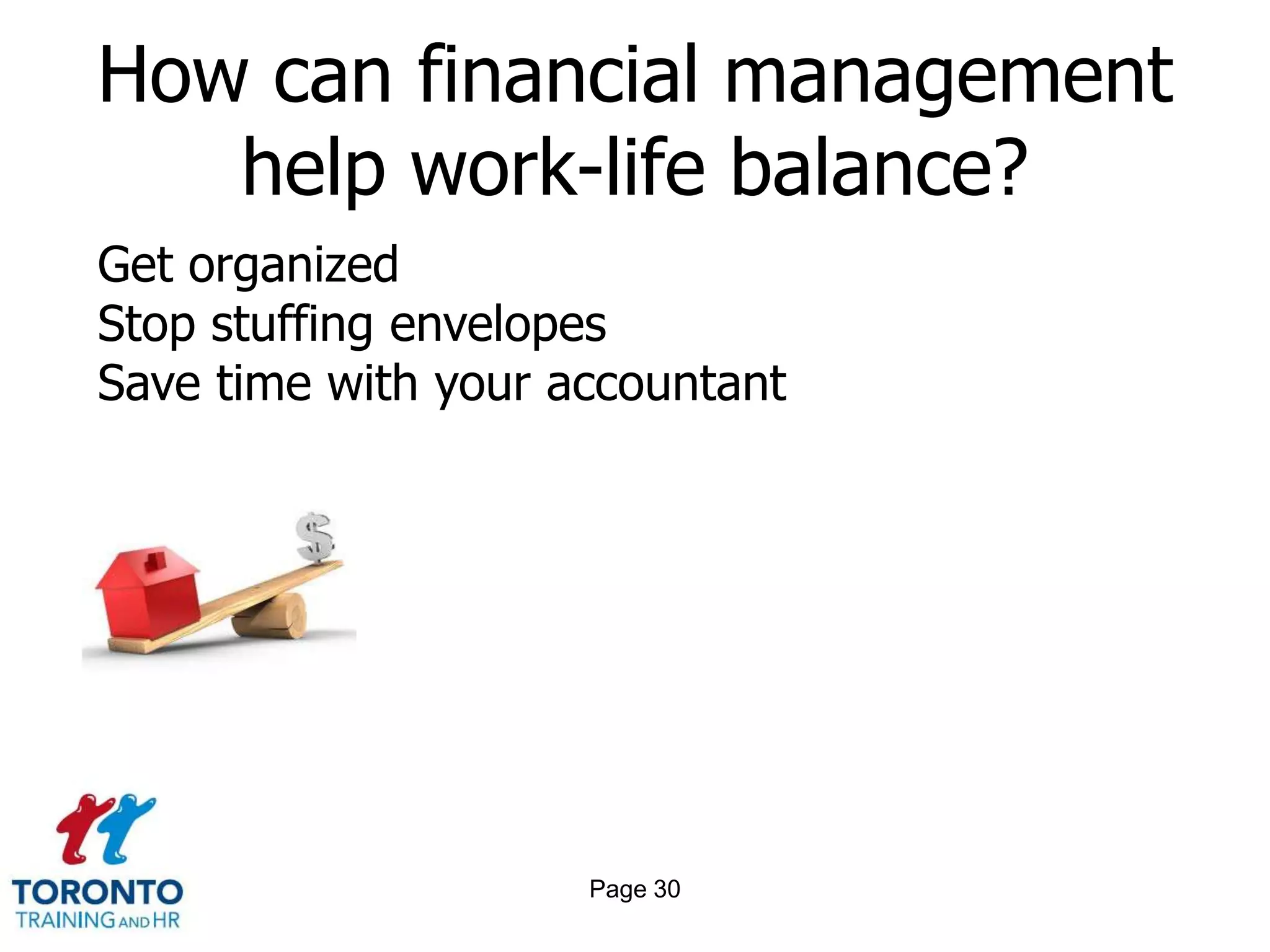
How can financial management
   help work-life balance?
Get organized
Stop stuffing envelopes
Save time with your accountant


                     Page 30
Improving work-life
     balance


        Page 31
Improving work-life balance
            1 of 3
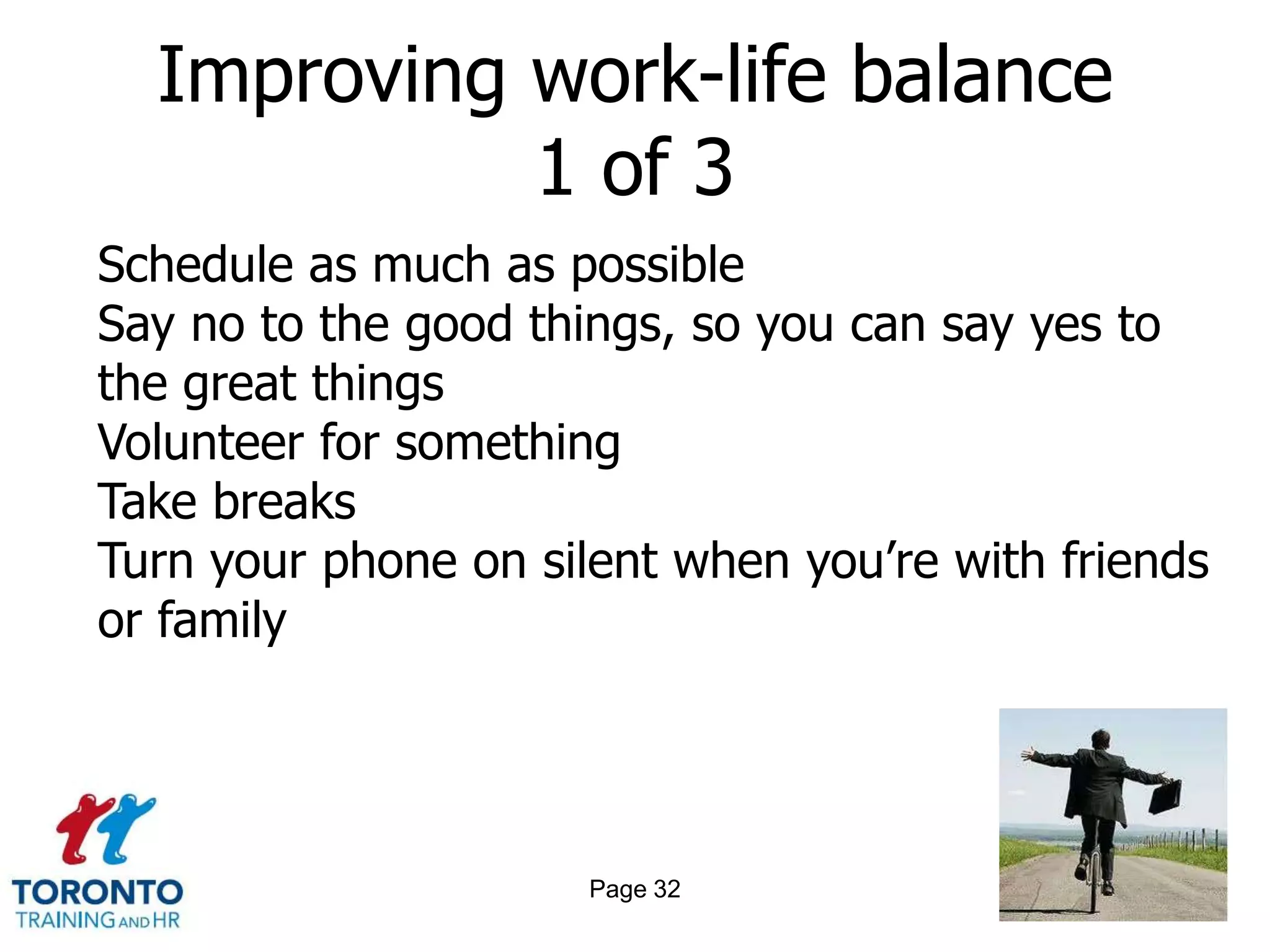
Schedule as much as possible
Say no to the good things, so you can say yes to
the great things
Volunteer for something
Take breaks
Turn your phone on silent when you’re with friends
or family


                      Page 32
Improving work-life balance
            2 of 3
WORK
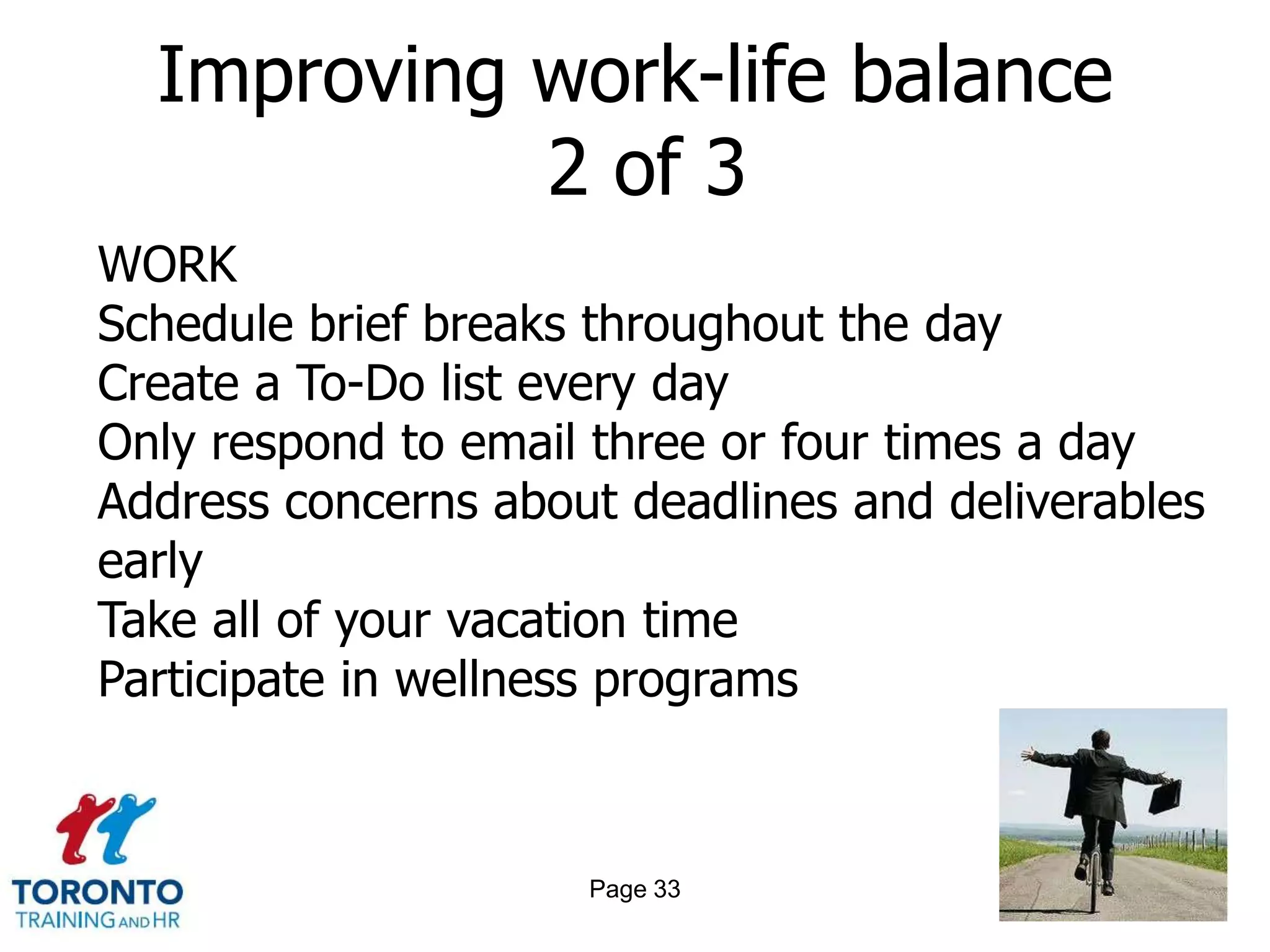
Schedule brief breaks throughout the day
Create a To-Do list every day
Only respond to email three or four times a day
Address concerns about deadlines and deliverables
early
Take all of your vacation time
Participate in wellness programs


                     Page 33
Improving work-life balance
            3 of 3
HOME
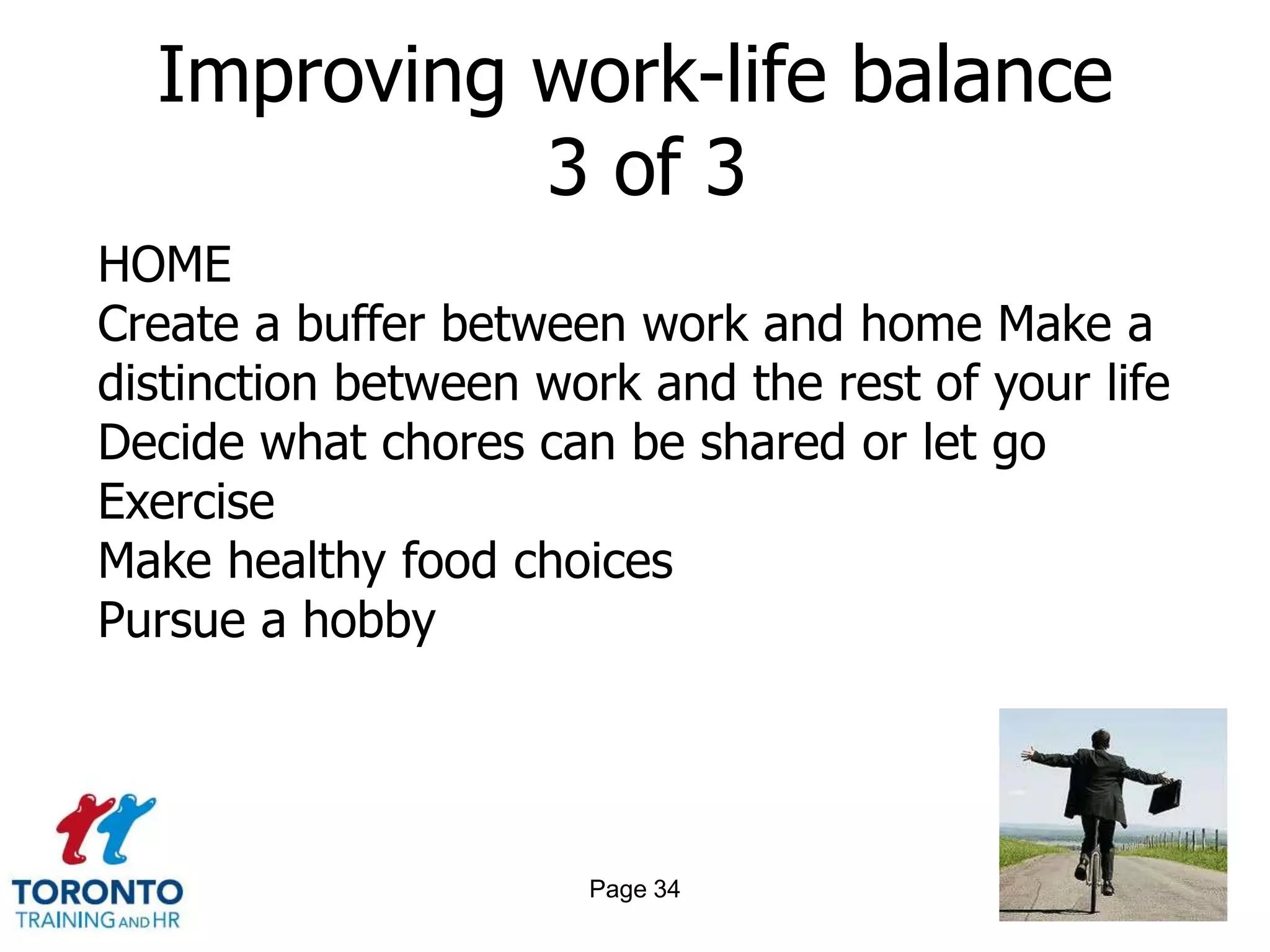
Create a buffer between work and home Make a
distinction between work and the rest of your life
Decide what chores can be shared or let go
Exercise
Make healthy food choices
Pursue a hobby


                      Page 34
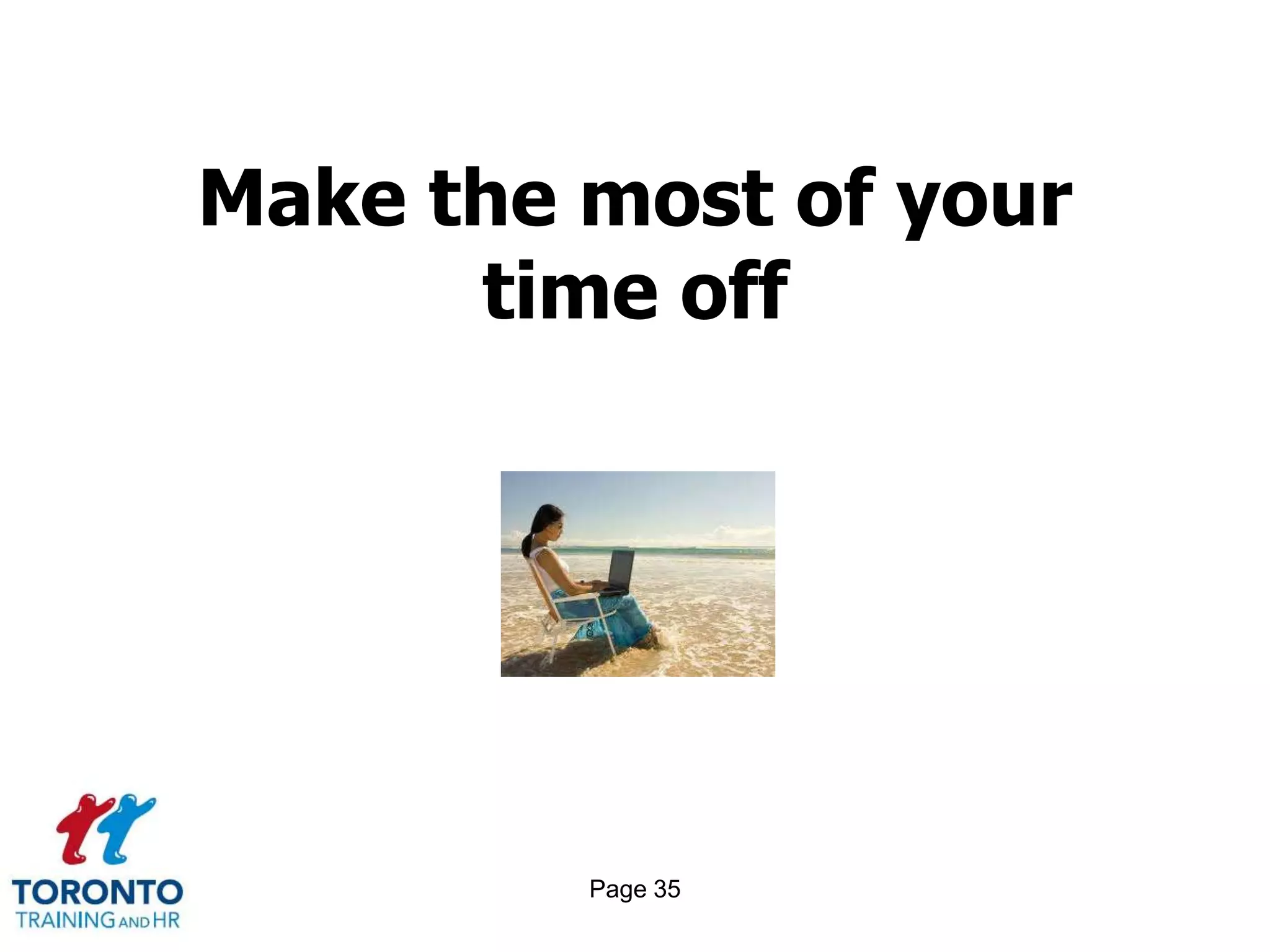
Make the most of your
      time off


         Page 35
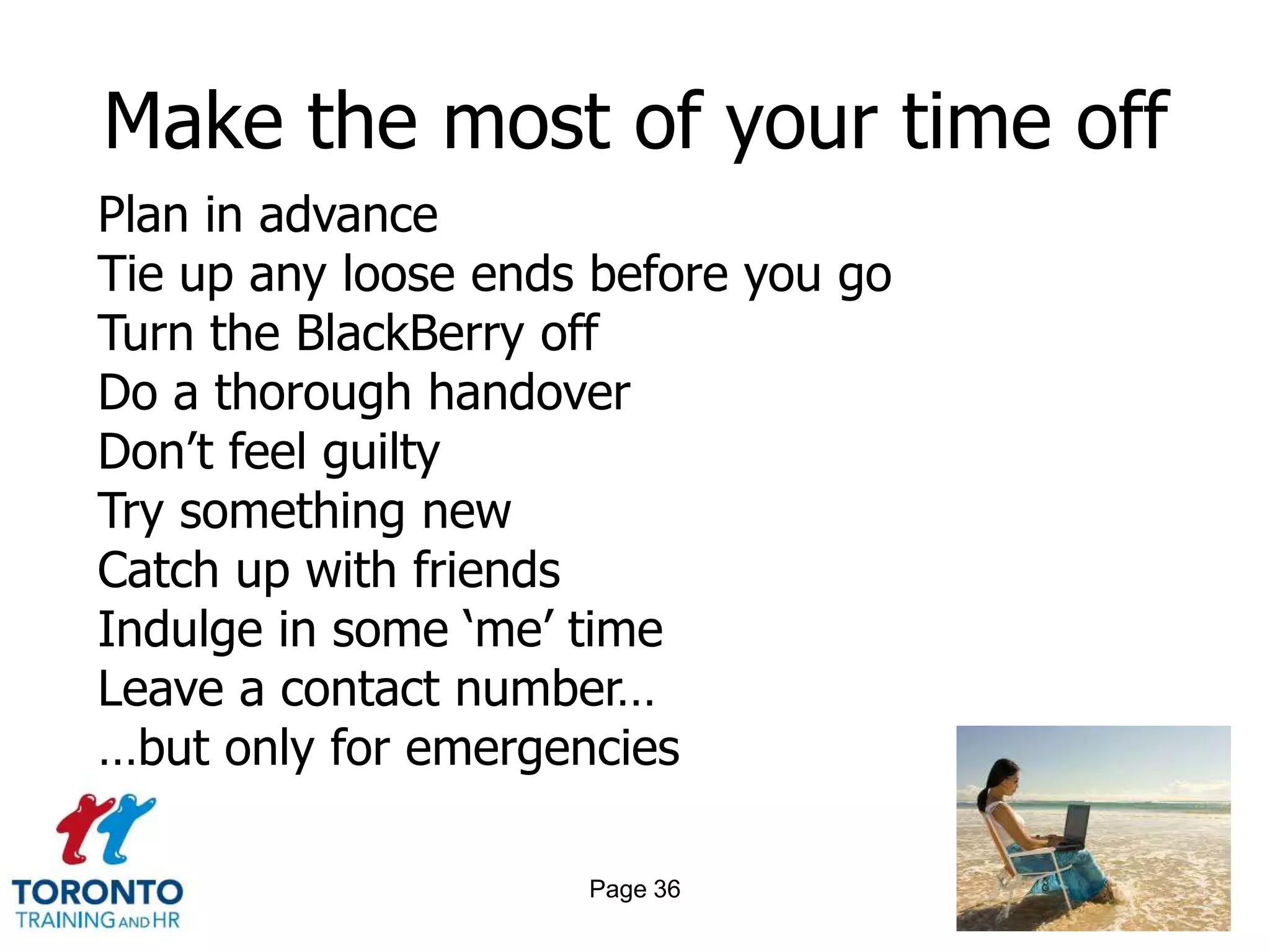
Make the most of your time off
Plan in advance
Tie up any loose ends before you go
Turn the BlackBerry off
Do a thorough handover
Don’t feel guilty
Try something new
Catch up with friends
Indulge in some ‘me’ time
Leave a contact number…
…but only for emergencies

                     Page 36
Getting a proper break
      from work


         Page 37
Getting a proper break from
              work
Get over the instant gratification
Managing emergencies and expectations
Take vacations from communications
Plan a sit down with your family
Introduce old school etiquette into the mix
Revisit your personal communications policy
regularly
It’s up to you to control the situation


                      Page 38
Presenteeism


    Page 39
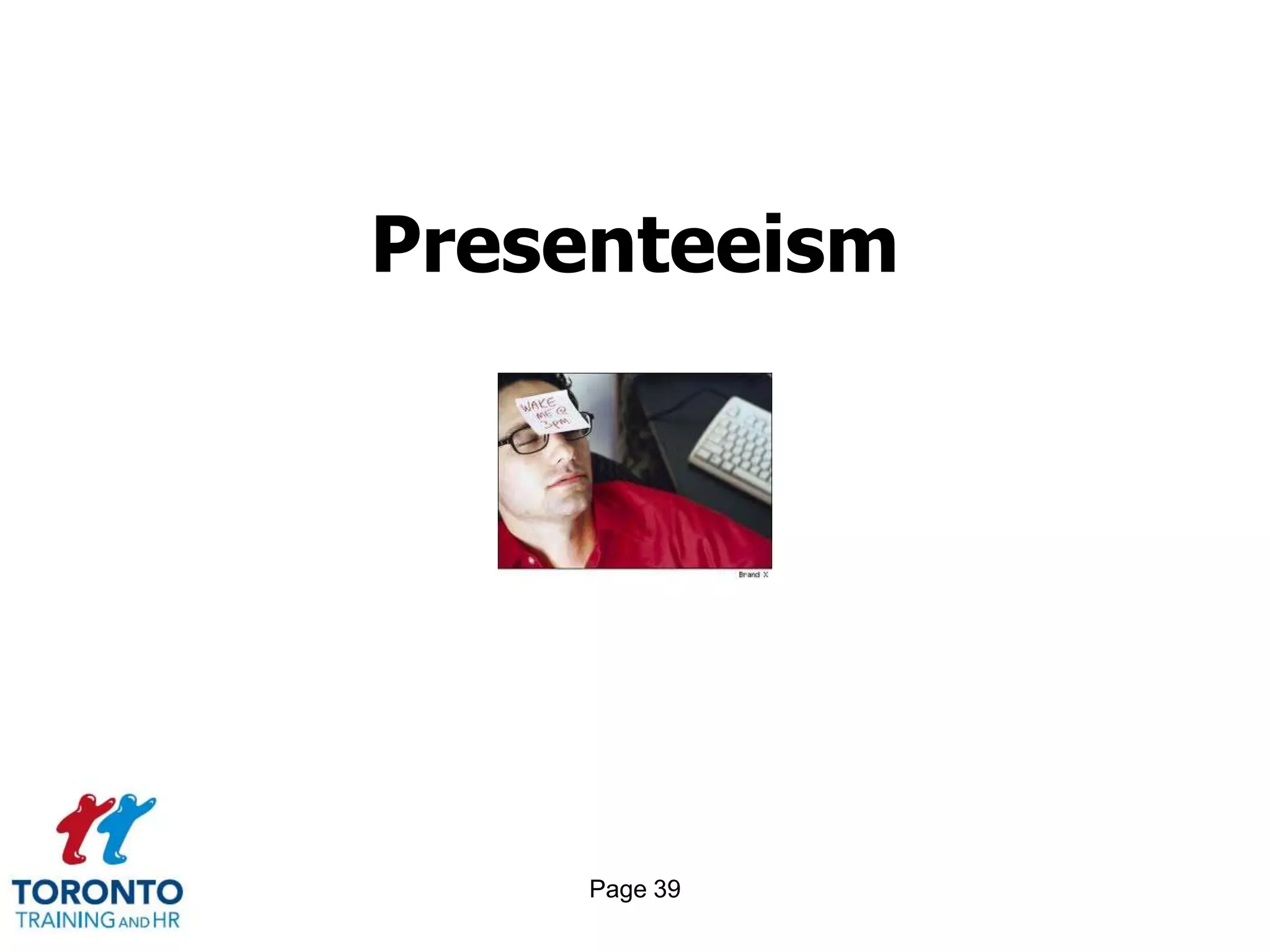
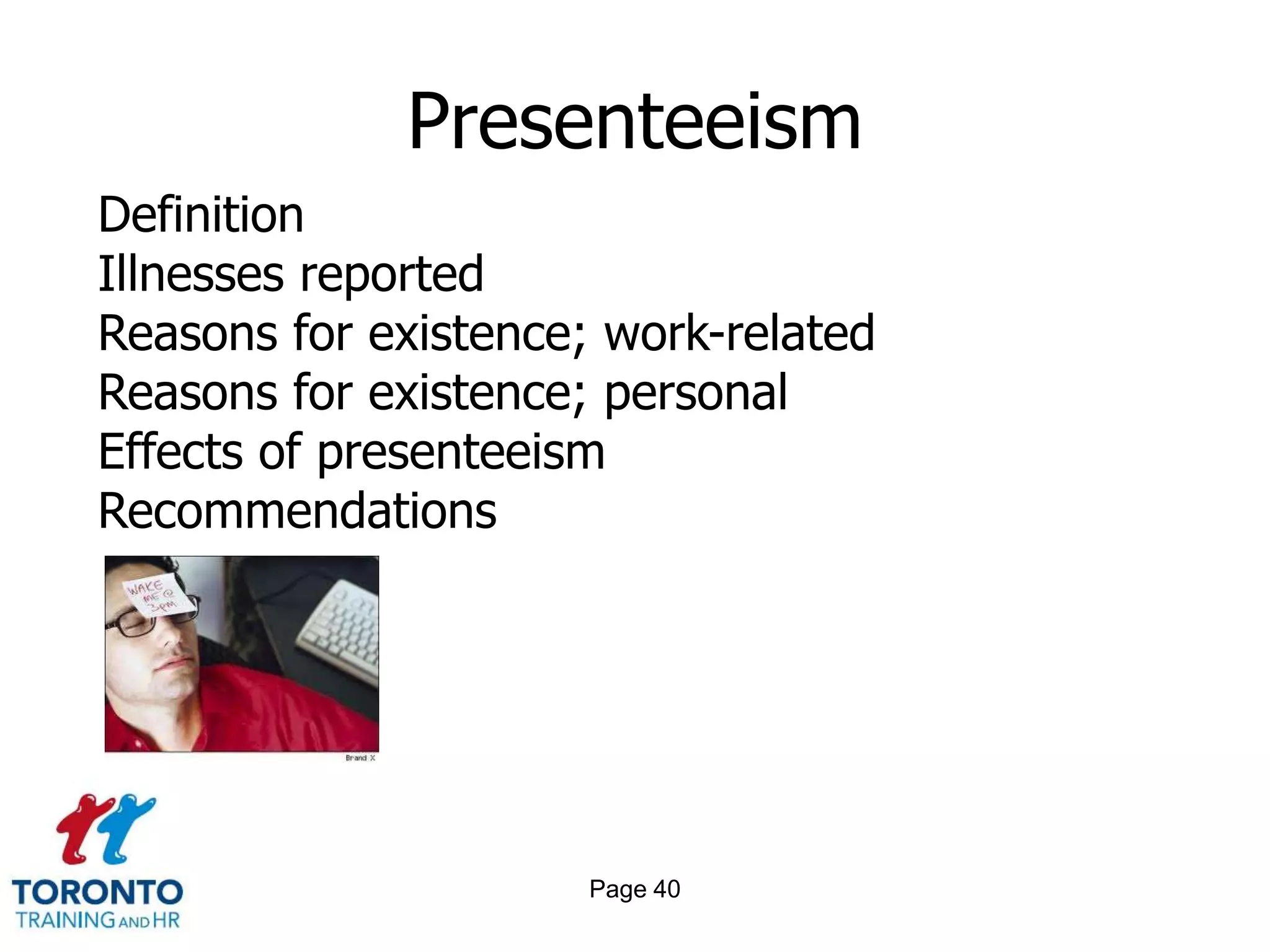
Presenteeism
Definition
Illnesses reported
Reasons for existence; work-related
Reasons for existence; personal
Effects of presenteeism
Recommendations


                      Page 40
Commuting


   Page 41
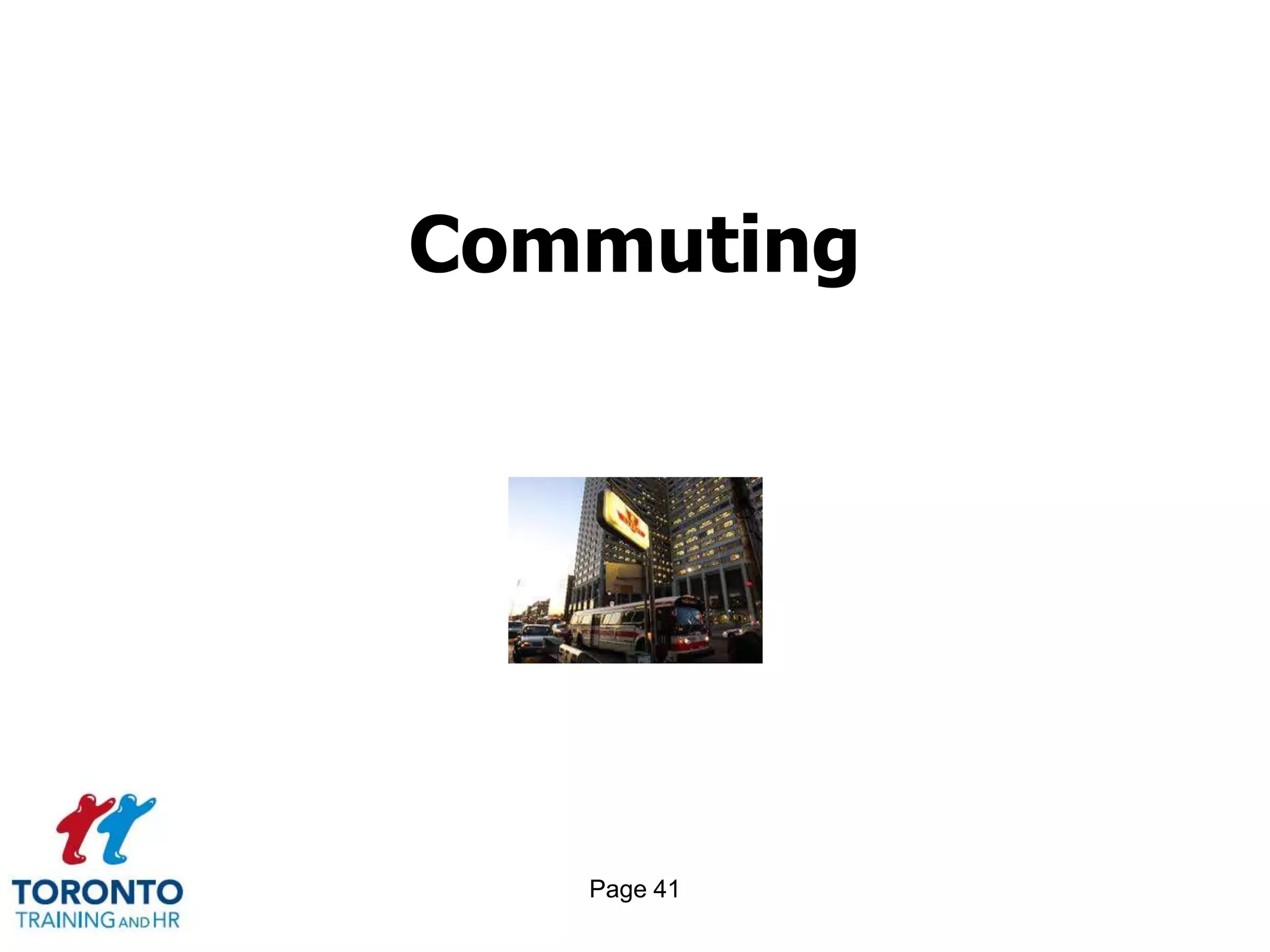
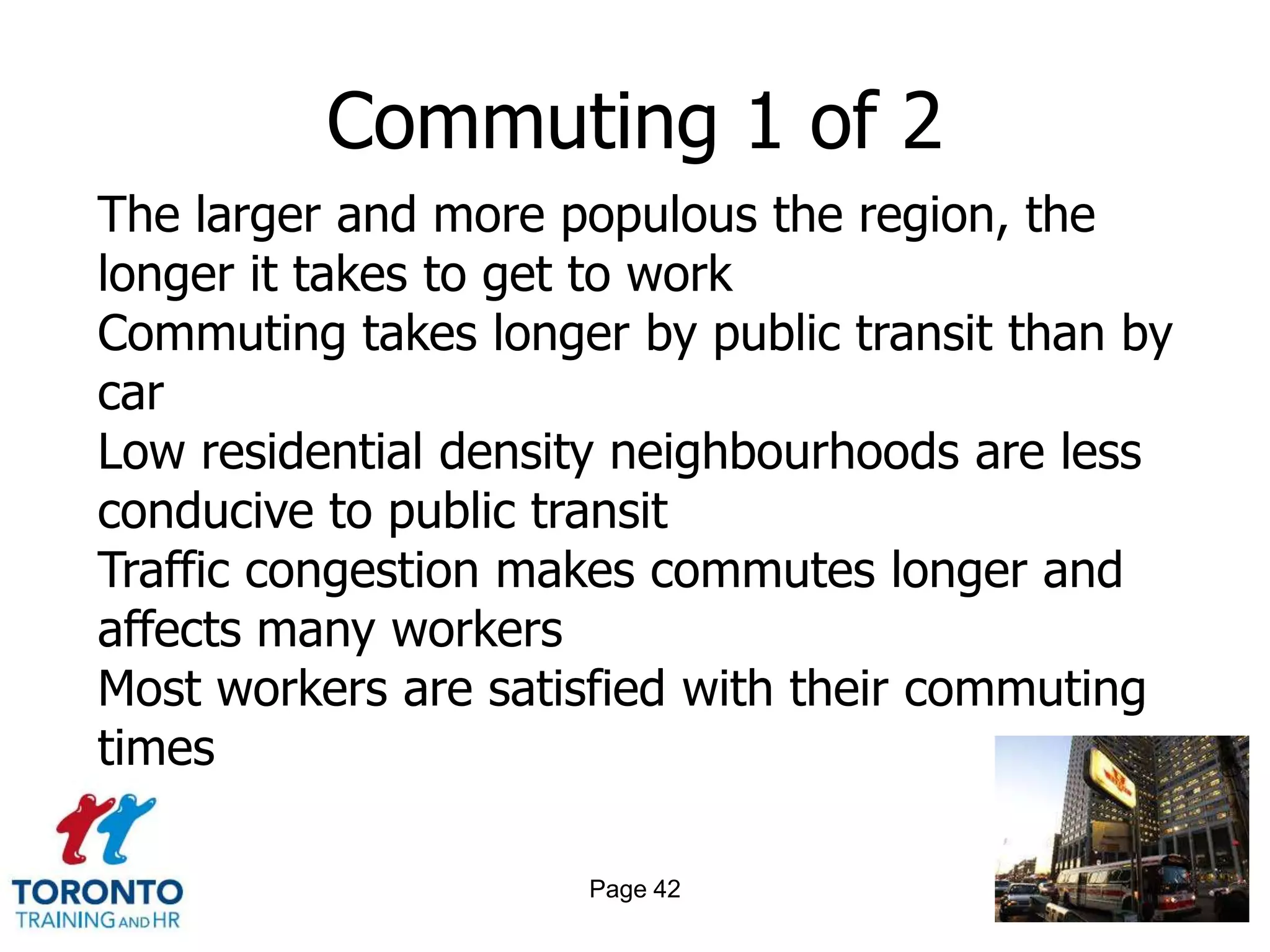
Commuting 1 of 2
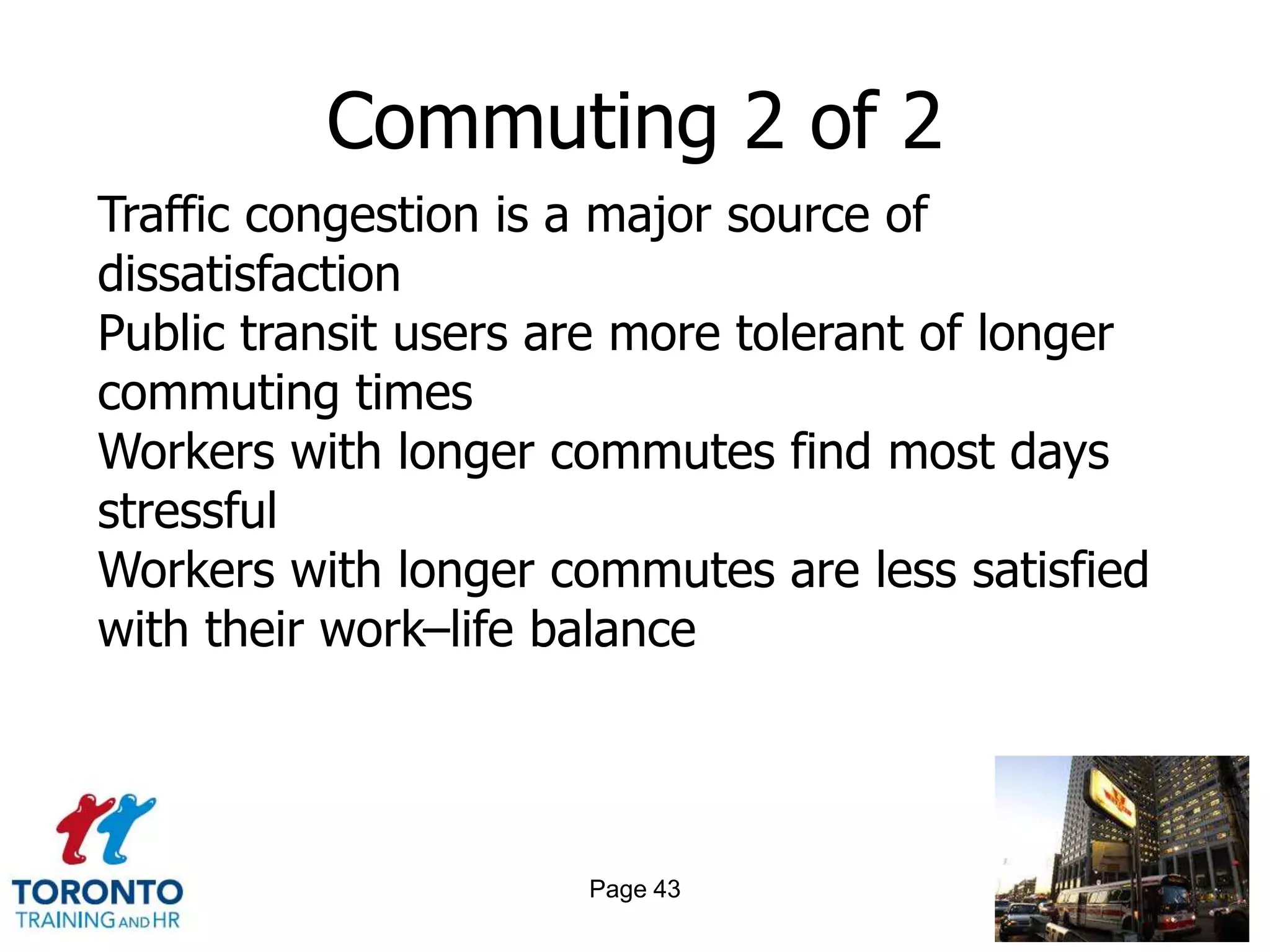
The larger and more populous the region, the
longer it takes to get to work
Commuting takes longer by public transit than by
car
Low residential density neighbourhoods are less
conducive to public transit
Traffic congestion makes commutes longer and
affects many workers
Most workers are satisfied with their commuting
times

                     Page 42
Commuting 2 of 2
Traffic congestion is a major source of
dissatisfaction
Public transit users are more tolerant of longer
commuting times
Workers with longer commutes find most days
stressful
Workers with longer commutes are less satisfied
with their work–life balance


                      Page 43
An example of rules


        Page 44
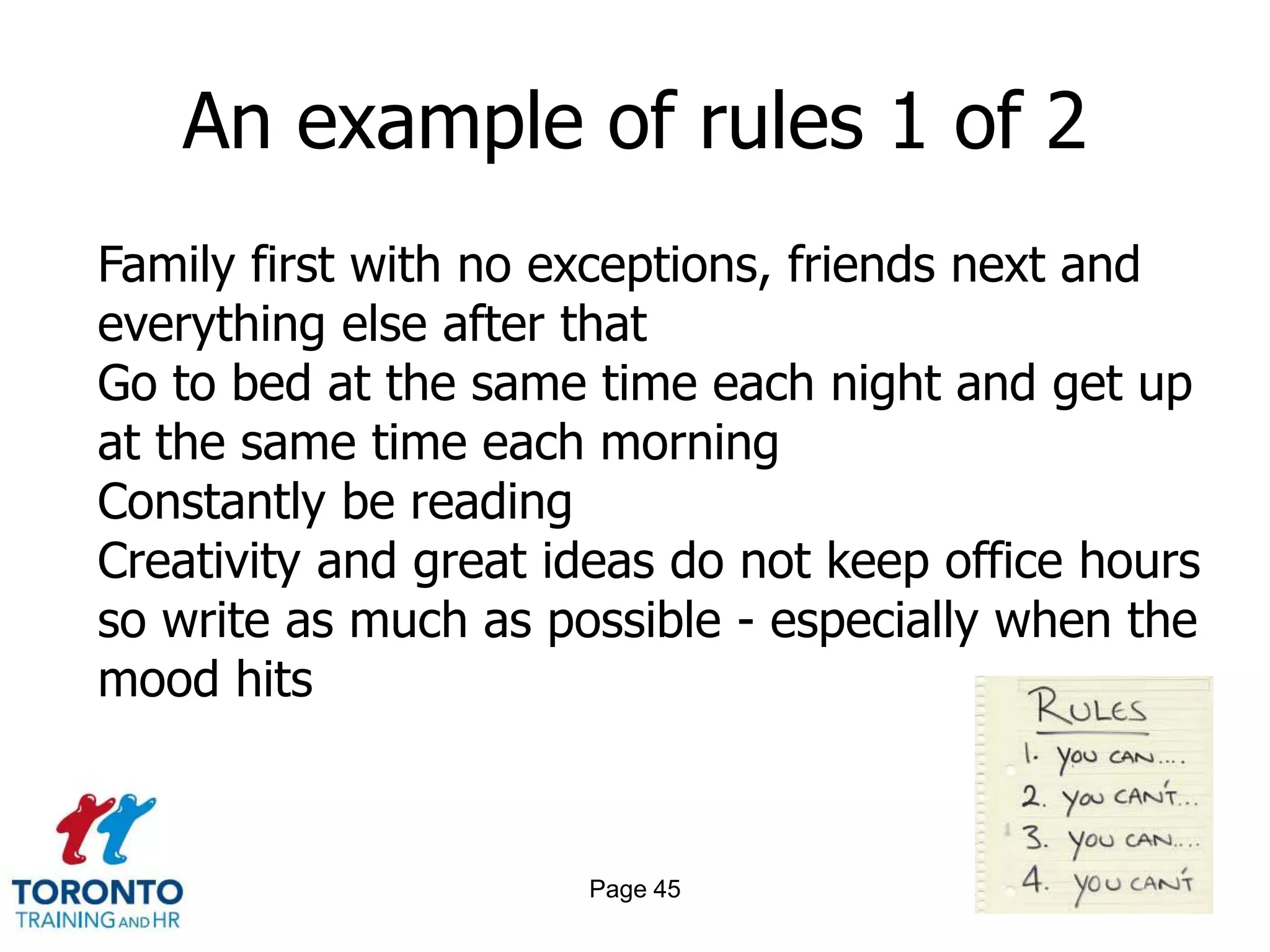
An example of rules 1 of 2
Family first with no exceptions, friends next and
everything else after that
Go to bed at the same time each night and get up
at the same time each morning
Constantly be reading
Creativity and great ideas do not keep office hours
so write as much as possible - especially when the
mood hits


                      Page 45
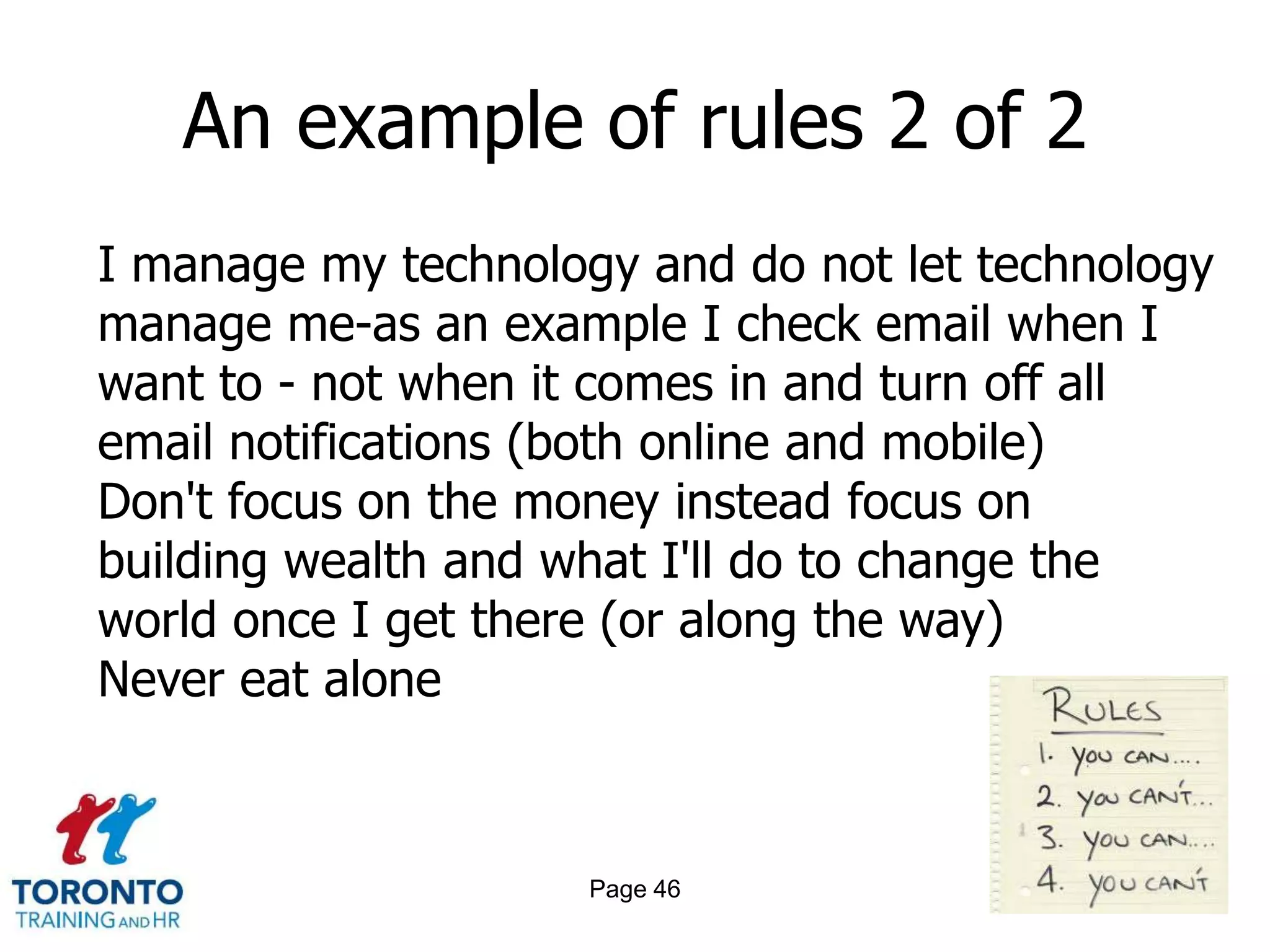
An example of rules 2 of 2
I manage my technology and do not let technology
manage me-as an example I check email when I
want to - not when it comes in and turn off all
email notifications (both online and mobile)
Don't focus on the money instead focus on
building wealth and what I'll do to change the
world once I get there (or along the way)
Never eat alone


                     Page 46
Canadian trends for 2012


          Page 47
Canadian trends for 2012 1 of 5
A greater demand by consumers for services in the
evenings, weekends and holidays
A lack of comprehensive childcare support for
many Canadians
An increase in urban sprawl
Greater innovation and adaptation of workplace
technologies
An increase in passive activities among children
and adolescents

                     Page 48
Canadian trends for 2012 2 of 5
An aging population
Leisure and culture activities are becoming more
expensive
Fewer Canadians are working long hours, but
more are working non-standard hours
More people are feeling caught in a ‘time crunch’
More Canadians – especially women – are
providing care to seniors


                      Page 49
Canadian trends for 2012 3 of 5
The percentage of retired adults 65 years of age
and over engaged in active leisure has remained
stable
Substantially more seniors are volunteering
We are spending less time on social leisure
activities
Arts performance and attendance have dropped
We volunteer less for culture and recreation
organizations

                      Page 50
Canadian trends for 2012 4 of 5
The percentage of children and adolescents
participating in organized, extracurricular activities
has stayed the same
Adolescents are increasingly exceeding
recommended times for TV, video games and
computer use-significantly fewer are having meals
at home with parents
The percentage of parents reading to pre-school
children has remained stable

                        Page 51
Canadian trends for 2012 5 of 5
Our participation in physical activities has tailed off
Visits to National Parks and Historic Sites are well
below pre-9/11 levels
We’re taking slightly longer vacations
We’re spending more on culture and recreation


                        Page 52
Case study A


    Page 53
Case study A


    Page 54
Case study B


    Page 55
Case study B


    Page 56
Case study C


    Page 57
Case study C


    Page 58
Conclusion and questions


          Page 59
Conclusion and questions
Summary
Videos
Questions


               Page 60

Balancing life with work February 2012

  • 1.
    Balancing life withwork by Toronto Training and HR February 2012
  • 2.
    3-4 Introduction to Toronto Training and HR 5-6 Definitions Contents 7-8 9-11 Three categories of work-life balance Rethinking the concept of work-life balance 12-13 Types of initiative 14-15 Five work-life domains to manage 16-18 Top work-life challenges 19-20 Barriers to a healthy lifestyle 21-23 But I’m an entrepreneur! 24-25 Questions that unleash work-life balance 26-28 When is enough enough? 29-30 How can financial management help work-life balance? 31-34 Improving work-life balance 35-36 Make the most of your time off 37-38 Getting a proper break from work 39-40 Presenteeism 41-43 Commuting 44-46 An example of rules 47-52 Canadian trends for 2012 53-58 Case studies 59-60 Conclusion and questions
  • 3.
  • 4.
    Introduction to TorontoTraining and HR • Toronto Training and HR is a specialist training and human resources consultancy headed by Timothy Holden • 10 years in banking • 10 years in training and human resources • Freelance practitioner since 2006 • The core services provided by Toronto Training and HR are: - Training course design - Training course delivery - Reducing costs - Saving time - Improving employee engagement & morale - Services for job seekers Page 4
  • 5.
  • 6.
    Definitions What is work-lifebalance? What is work-life enrichment? Page 6
  • 7.
    Three categories of work-life balance Page 7
  • 8.
    Three categories ofwork-life balance Personal Business Community Page 8
  • 9.
    Rethinking the conceptof work-life balance Page 9
  • 10.
    Rethinking the conceptof work- life balance 1 of 2 Replace work-life balance with purpose and passion Look at the blend over the previous twelve months Identify the ‘seasons’ in the organization’s workflow Keep in mind your family’s ‘seasons’ too Page 10
  • 11.
    Rethinking the conceptof work- life balance 2 of 2 Build up a ‘hard work’ bank account with your organization When you’re at work, really engage When you’re at home, really BE at home Page 11
  • 12.
  • 13.
    Types of initiative Flexibleworking Leave and time off Childcare facilities Health and wellbeing Page 13
  • 14.
    Five work-life domainsto manage Page 14
  • 15.
    Five work-life domainsto manage Manage time Manage energy Manage thinking Manage emotions Manage relationships Page 15
  • 16.
  • 17.
    Top work-life challenges1 of 2 MEN 25% spending time with family 23% financial stress 23% finding personal time 19% finding time to exercise Page 17
  • 18.
    Top work-life challenges2 of 2 WOMEN 24% financial stress 21% finding time to exercise 19% finding personal time 19% finding time to spend with family Page 18
  • 19.
    Barriers to ahealthy lifestyle Page 19
  • 20.
    Barriers to ahealthy lifestyle Lack of time Lack of facilities Lack of motivation Page 20
  • 21.
    But I’m anentrepreneur! Page 21
  • 22.
    But I’m anentrepreneur! 1 of 2 Keep a schedule Allow for overlap Establish boundaries Take time off when you can If you really want that break to feel like one, turn off your technology Recognize that you don’t need to revolutionize your life with grand, sweeping changes in order to achieve balance Page 22
  • 23.
    But I’m anentrepreneur! 2 of 2 Become a family business Review your plans Ask for help Make work-life balance a priority Page 23
  • 24.
    Questions that unleash work-life balance Page 24
  • 25.
    Questions that unleashwork-life balance What are the most valuable things to work on? Are there ways to change the process to reduce friction and create glide paths? Can we tackle big things with little goals to flow more value along the way? How can I spend more time in my strengths, and less time in my weaknesses? How can I help others to spend more time in their strengths, and less time in their weaknesses? Page 25
  • 26.
    When is enoughenough? Page 26
  • 27.
    When is enoughenough? 1 of 2 What is enough for me, my work, my family, my soul? Where does my wanting stem from? If it is scarcity, can I ask myself what I might want if I knew it were enough and that I had enough right now? How do I define balance? How would I know I had it? How do I know when I don’t? Page 27
  • 28.
    When is enoughenough? 2 of 2 How can I create a support system wide and deep enough in which I can nurture all aspects of myself and experience all I want to experience? If I stopped trying so hard to create balance in my life, what would be present and possible for me? Page 28
  • 29.
    How can financial managementhelp work- life balance? Page 29
  • 30.
    How can financialmanagement help work-life balance? Get organized Stop stuffing envelopes Save time with your accountant Page 30
  • 31.
    Improving work-life balance Page 31
  • 32.
    Improving work-life balance 1 of 3 Schedule as much as possible Say no to the good things, so you can say yes to the great things Volunteer for something Take breaks Turn your phone on silent when you’re with friends or family Page 32
  • 33.
    Improving work-life balance 2 of 3 WORK Schedule brief breaks throughout the day Create a To-Do list every day Only respond to email three or four times a day Address concerns about deadlines and deliverables early Take all of your vacation time Participate in wellness programs Page 33
  • 34.
    Improving work-life balance 3 of 3 HOME Create a buffer between work and home Make a distinction between work and the rest of your life Decide what chores can be shared or let go Exercise Make healthy food choices Pursue a hobby Page 34
  • 35.
    Make the mostof your time off Page 35
  • 36.
    Make the mostof your time off Plan in advance Tie up any loose ends before you go Turn the BlackBerry off Do a thorough handover Don’t feel guilty Try something new Catch up with friends Indulge in some ‘me’ time Leave a contact number… …but only for emergencies Page 36
  • 37.
    Getting a properbreak from work Page 37
  • 38.
    Getting a properbreak from work Get over the instant gratification Managing emergencies and expectations Take vacations from communications Plan a sit down with your family Introduce old school etiquette into the mix Revisit your personal communications policy regularly It’s up to you to control the situation Page 38
  • 39.
  • 40.
    Presenteeism Definition Illnesses reported Reasons forexistence; work-related Reasons for existence; personal Effects of presenteeism Recommendations Page 40
  • 41.
    Commuting Page 41
  • 42.
    Commuting 1 of2 The larger and more populous the region, the longer it takes to get to work Commuting takes longer by public transit than by car Low residential density neighbourhoods are less conducive to public transit Traffic congestion makes commutes longer and affects many workers Most workers are satisfied with their commuting times Page 42
  • 43.
    Commuting 2 of2 Traffic congestion is a major source of dissatisfaction Public transit users are more tolerant of longer commuting times Workers with longer commutes find most days stressful Workers with longer commutes are less satisfied with their work–life balance Page 43
  • 44.
    An example ofrules Page 44
  • 45.
    An example ofrules 1 of 2 Family first with no exceptions, friends next and everything else after that Go to bed at the same time each night and get up at the same time each morning Constantly be reading Creativity and great ideas do not keep office hours so write as much as possible - especially when the mood hits Page 45
  • 46.
    An example ofrules 2 of 2 I manage my technology and do not let technology manage me-as an example I check email when I want to - not when it comes in and turn off all email notifications (both online and mobile) Don't focus on the money instead focus on building wealth and what I'll do to change the world once I get there (or along the way) Never eat alone Page 46
  • 47.
    Canadian trends for2012 Page 47
  • 48.
    Canadian trends for2012 1 of 5 A greater demand by consumers for services in the evenings, weekends and holidays A lack of comprehensive childcare support for many Canadians An increase in urban sprawl Greater innovation and adaptation of workplace technologies An increase in passive activities among children and adolescents Page 48
  • 49.
    Canadian trends for2012 2 of 5 An aging population Leisure and culture activities are becoming more expensive Fewer Canadians are working long hours, but more are working non-standard hours More people are feeling caught in a ‘time crunch’ More Canadians – especially women – are providing care to seniors Page 49
  • 50.
    Canadian trends for2012 3 of 5 The percentage of retired adults 65 years of age and over engaged in active leisure has remained stable Substantially more seniors are volunteering We are spending less time on social leisure activities Arts performance and attendance have dropped We volunteer less for culture and recreation organizations Page 50
  • 51.
    Canadian trends for2012 4 of 5 The percentage of children and adolescents participating in organized, extracurricular activities has stayed the same Adolescents are increasingly exceeding recommended times for TV, video games and computer use-significantly fewer are having meals at home with parents The percentage of parents reading to pre-school children has remained stable Page 51
  • 52.
    Canadian trends for2012 5 of 5 Our participation in physical activities has tailed off Visits to National Parks and Historic Sites are well below pre-9/11 levels We’re taking slightly longer vacations We’re spending more on culture and recreation Page 52
  • 53.
  • 54.
  • 55.
  • 56.
  • 57.
  • 58.
  • 59.
  • 60.