Work / Life Balance & Time Management Andrea Danyluk Williams College Carla Schlatter Ellis Duke University
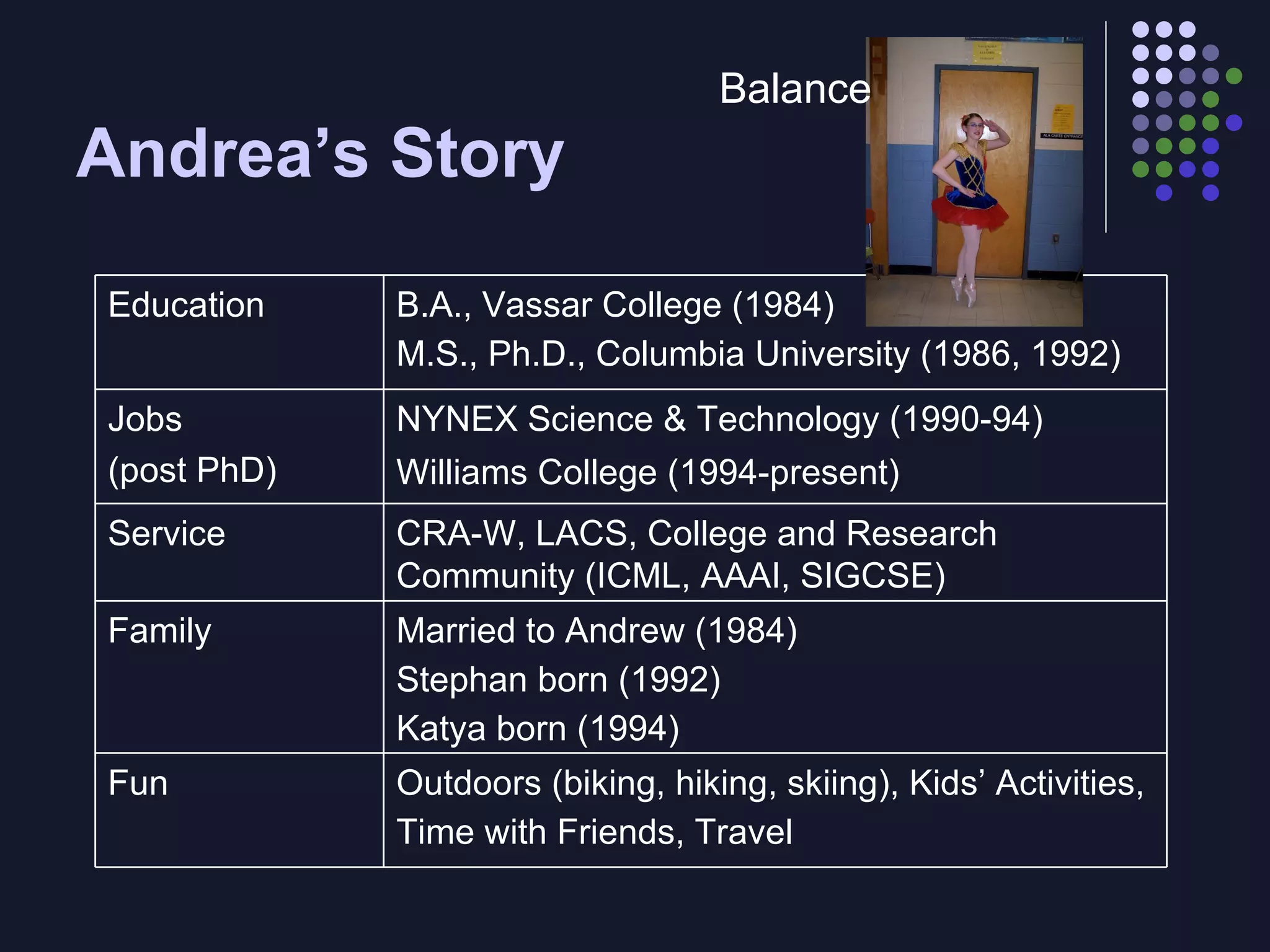
Andrea’s Story Balance Outdoors (biking, hiking, skiing), Kids’ Activities, Time with Friends, Travel Fun Married to Andrew (1984) Stephan born (1992) Katya born (1994) Family CRA-W, LACS, College and Research Community (ICML, AAAI, SIGCSE) Service NYNEX Science & Technology (1990-94) Williams College (1994-present) Jobs (post PhD) B.A., Vassar College (1984) M.S., Ph.D., Columbia University (1986, 1992) Education
Time Allocation of a Work Day 5:30  Alarm goes off.  Quiet time for email or work prep. 6:30  Everyone else is up. 7:15  Kids leave for school. Exercise 9:30  Work: teaching, research, meetings… Reserve 30-60 min for coffee or lunch with a friend 6:00 Quiet time at work - or - Participate in a kid’s activity 8:00 Family dinner time 9:00 Clean up email, paperwork at home 10:00 Work - or - Relax (Read, Crossword puzzle, tv…)
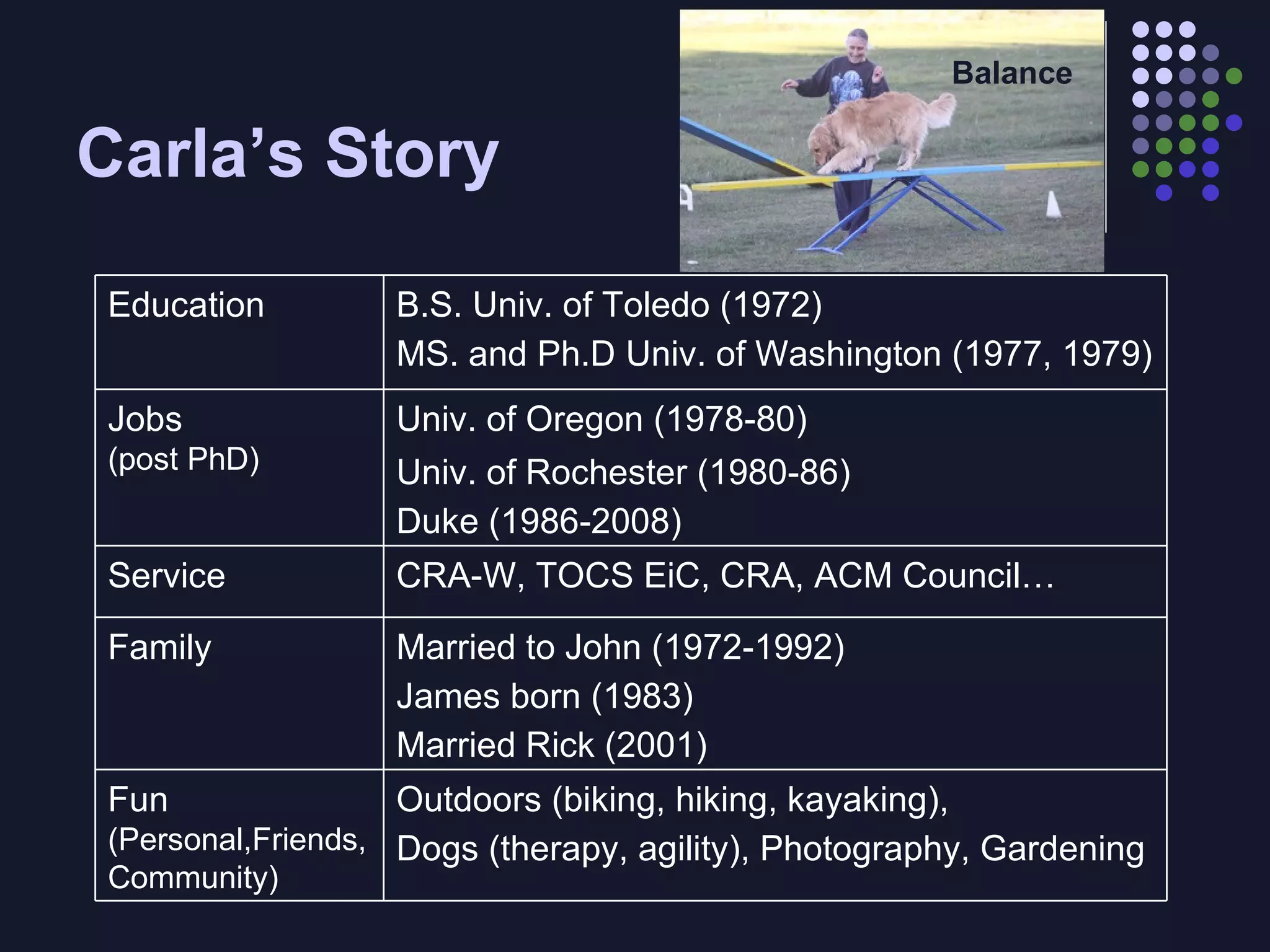
Carla’s Story Balance Outdoors (biking, hiking, kayaking),  Dogs (therapy, agility), Photography, Gardening Fun  (Personal,Friends, Community) Married to John (1972-1992)  James born (1983) Married Rick (2001) Family CRA-W, TOCS EiC, CRA, ACM Council… Service Univ. of Oregon (1978-80)  Univ. of Rochester (1980-86)  Duke (1986-2008) Jobs  (post PhD) B.S. Univ. of Toledo (1972) MS. and Ph.D Univ. of Washington (1977, 1979) Education
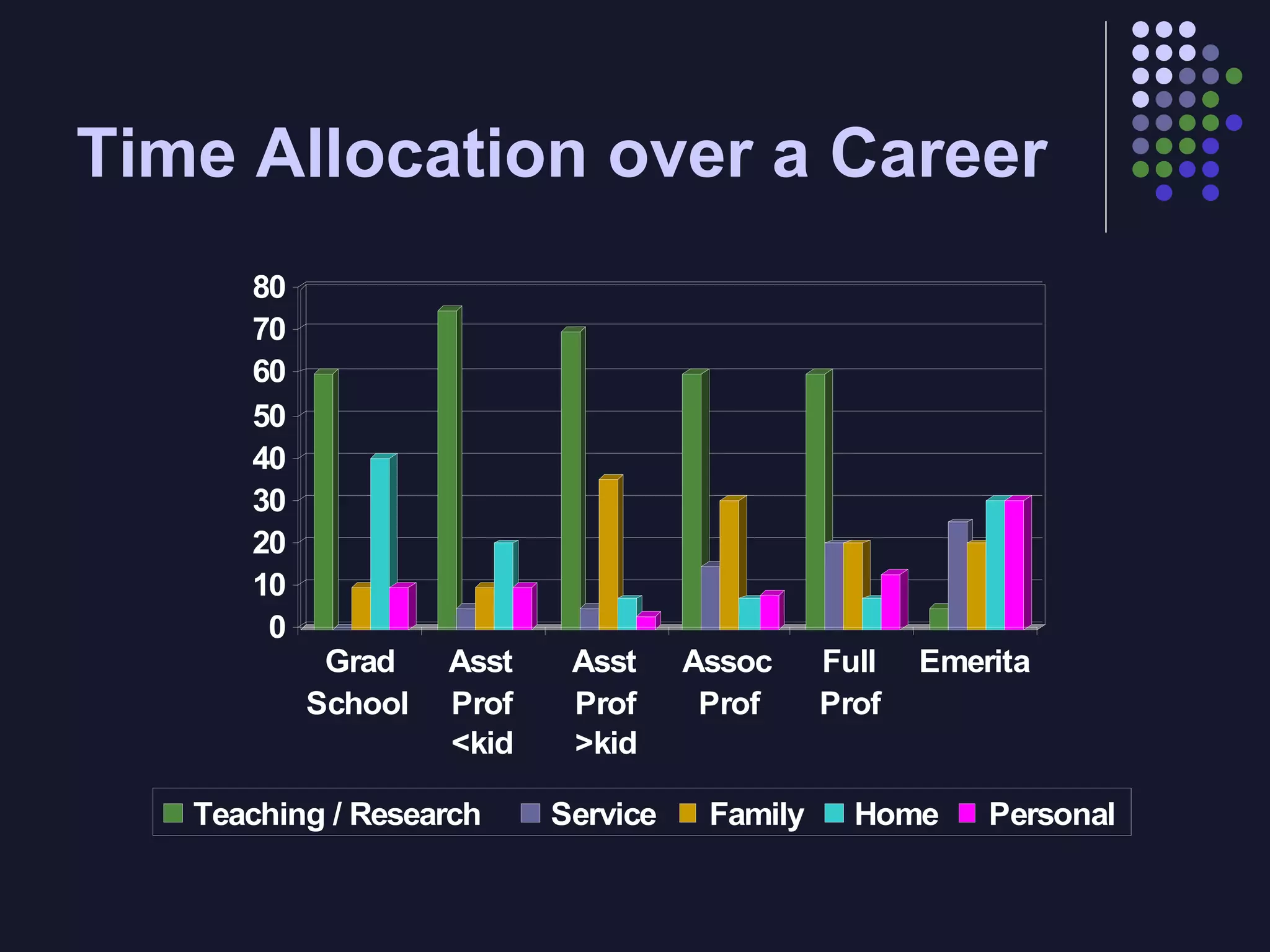
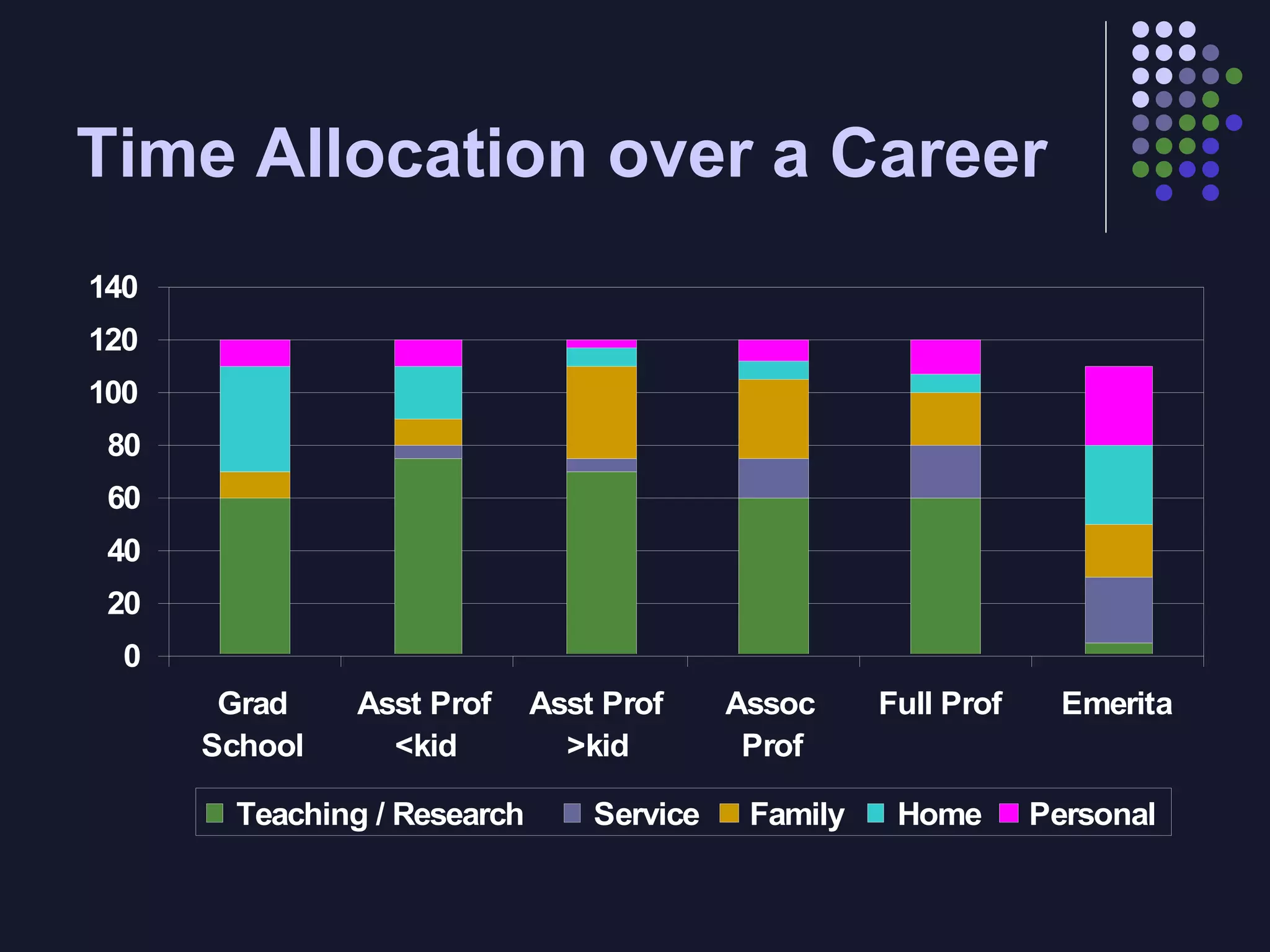
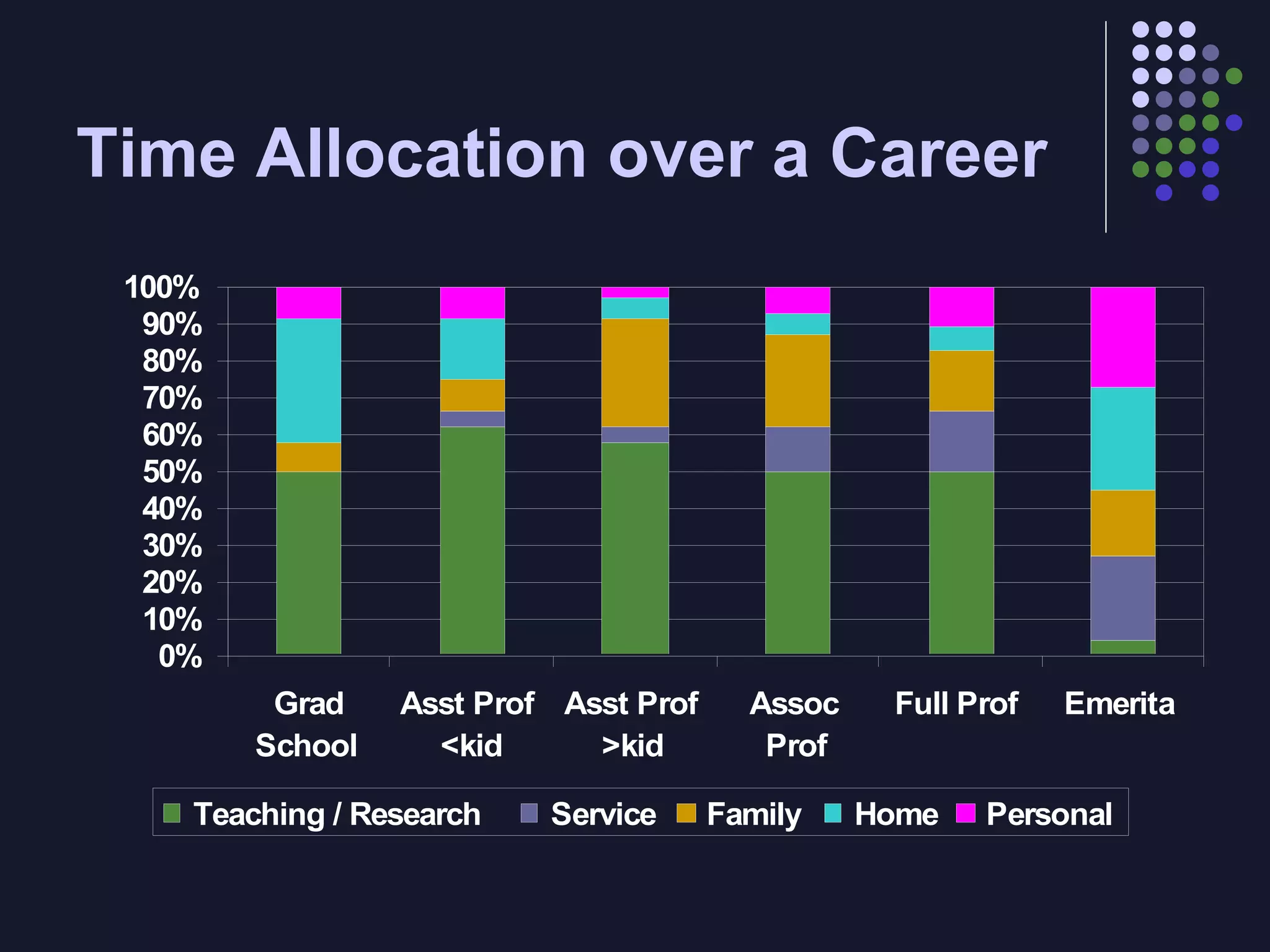
Time Allocation over a Career
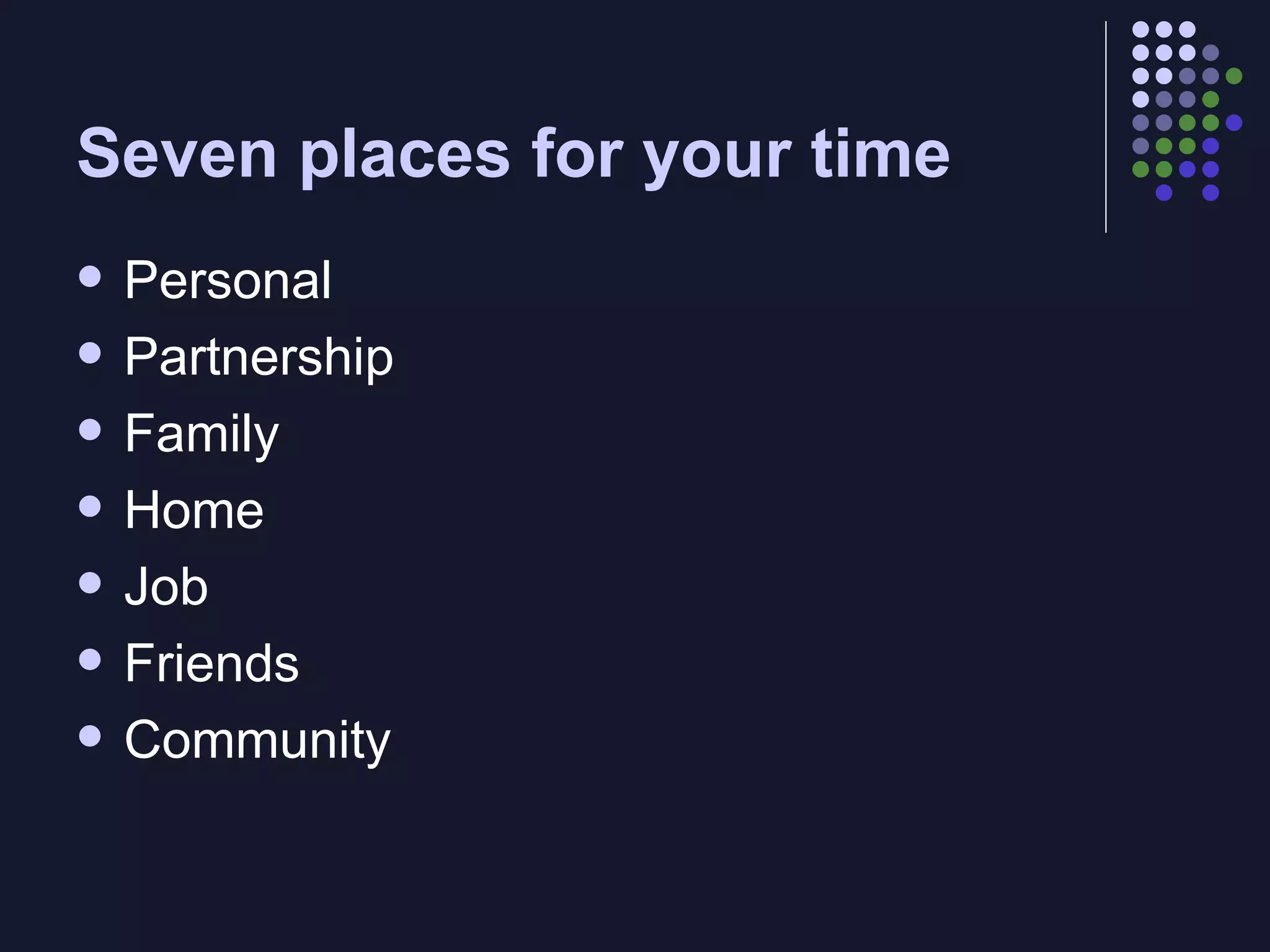
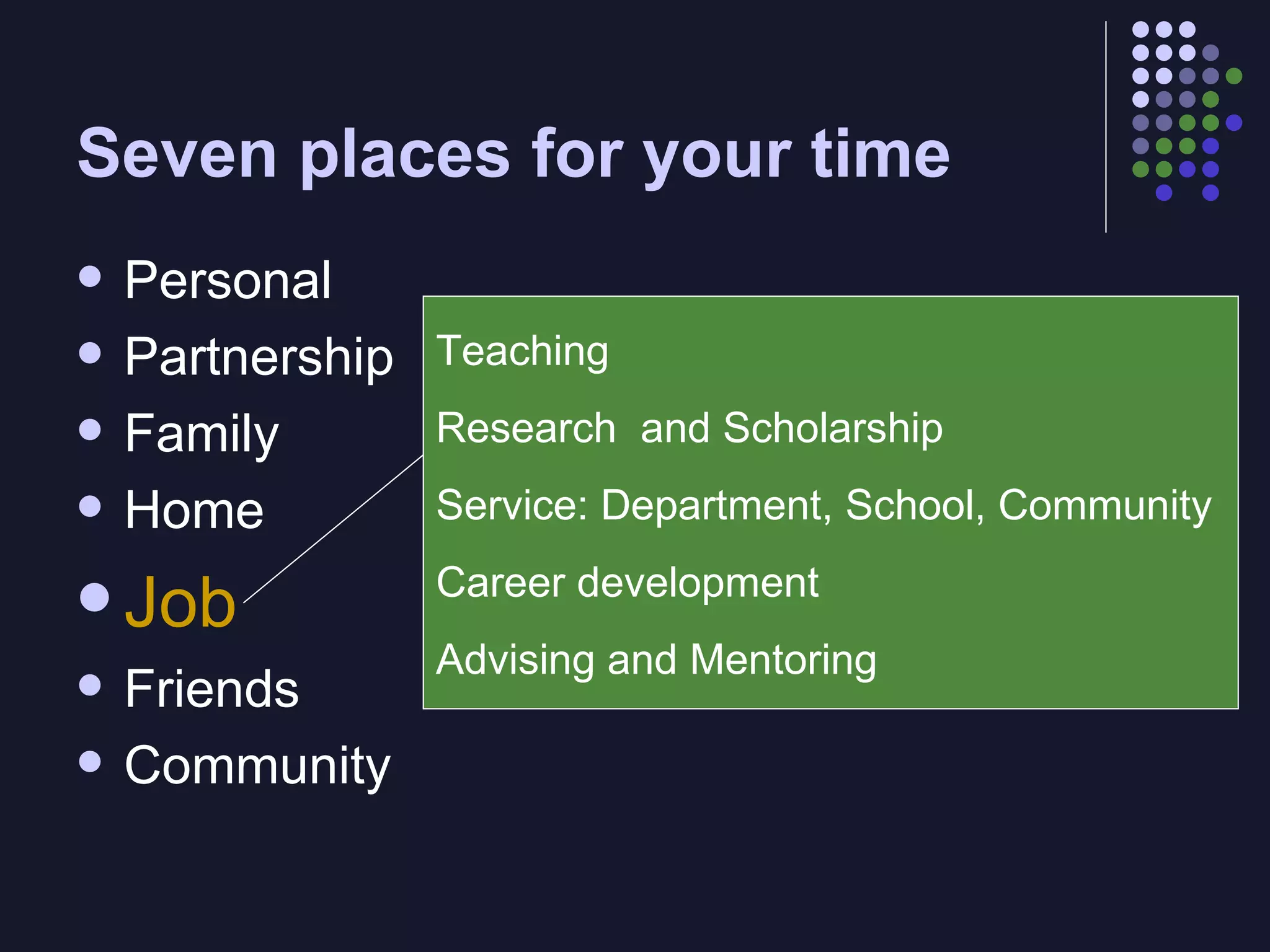
Seven places for your time Personal Partnership Family Home Job Friends Community
Seven places for your time Personal Partnership Family Home Job Friends Community Teaching Research  and Scholarship Service: Department, School, Community Career development Advising and Mentoring
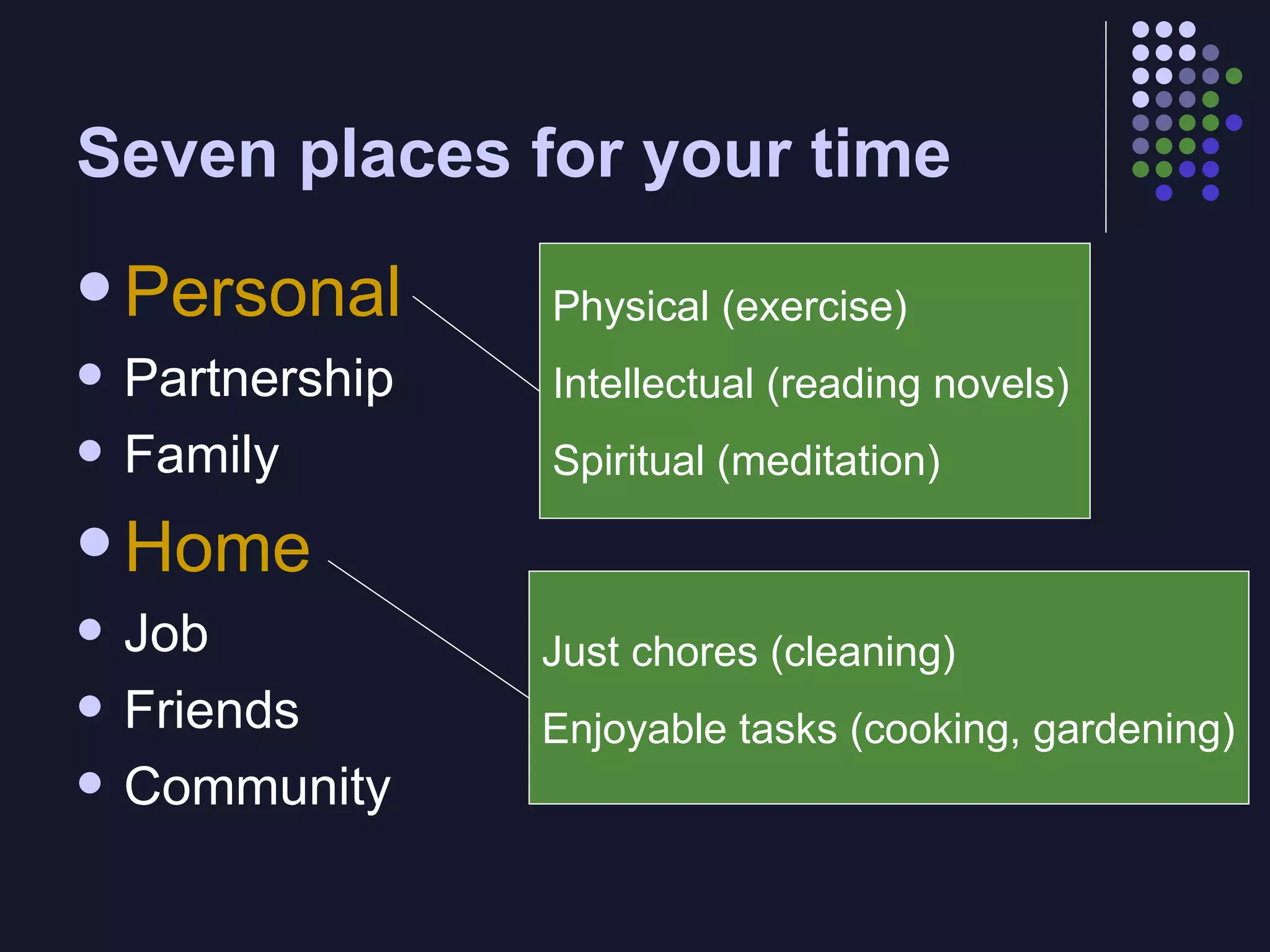
Seven places for your time Personal Partnership Family Home Job Friends Community Physical (exercise) Intellectual (reading novels) Spiritual (meditation) Just chores (cleaning) Enjoyable tasks (cooking, gardening)
Time commitments will differ Different focus at different colleges/universities Different focus at research labs vs. academia
Time commitments will change Status of career Grad student Pre/post tenure Assistant / Associate / Professor Technical / Managerial / Administrative Single/Married Ages of children, parents, …
Know your goals Know your long-term and short-term goals. Have goals for all your roles, not just work. Prioritize them. Post them where you can see them.
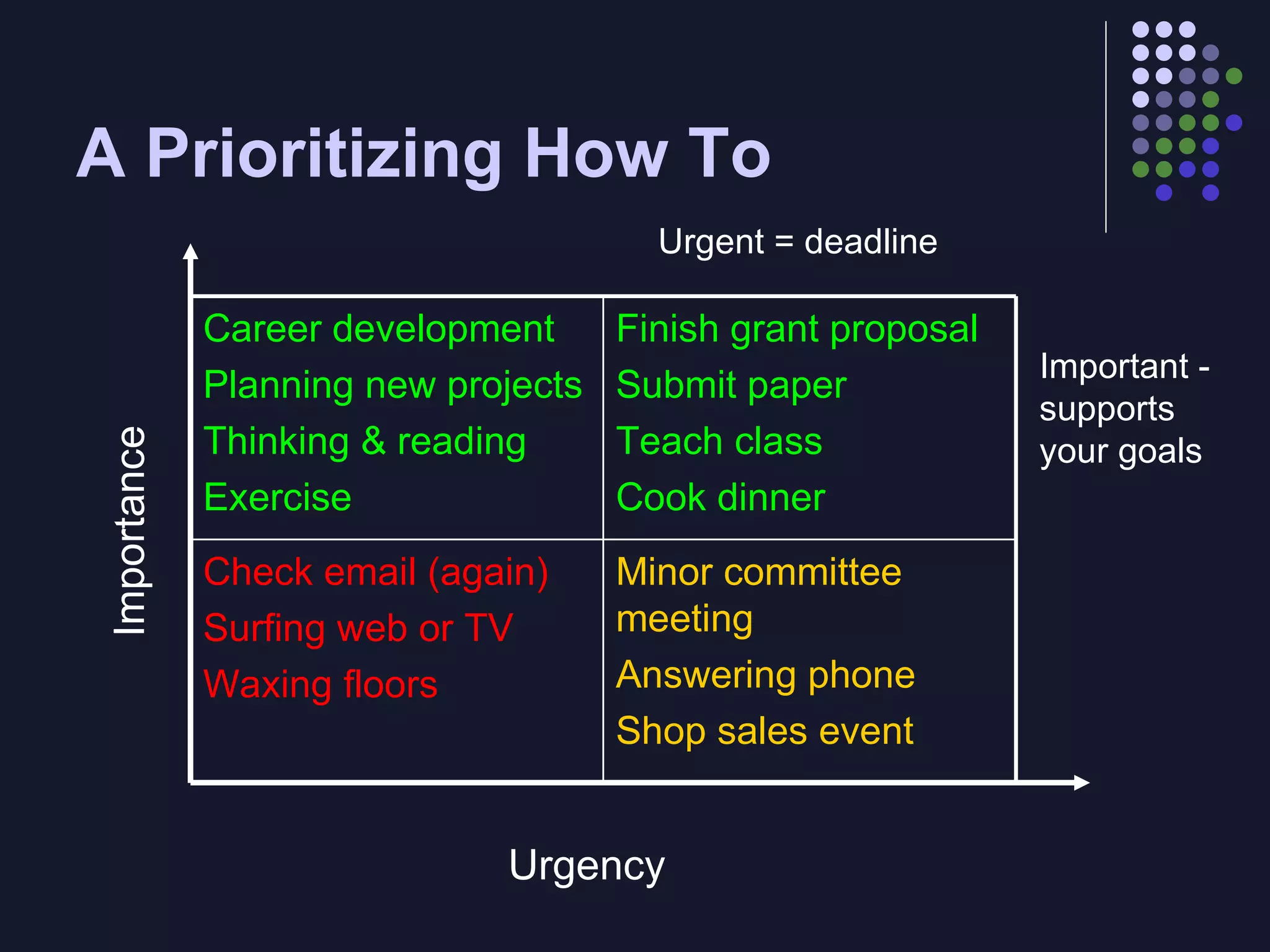
A Prioritizing How To Importance Urgency Urgent = deadline Important - supports your goals Minor committee meeting Answering phone Shop sales event Check email (again) Surfing web or TV Waxing floors Finish grant proposal Submit paper Teach class Cook dinner Career development Planning new projects Thinking & reading Exercise
“ It’s not enough to know the projects you’re working on.”  101 ways   to make every second count: time  management tips and techniques for more  success with less stress  by Robert W. Bly
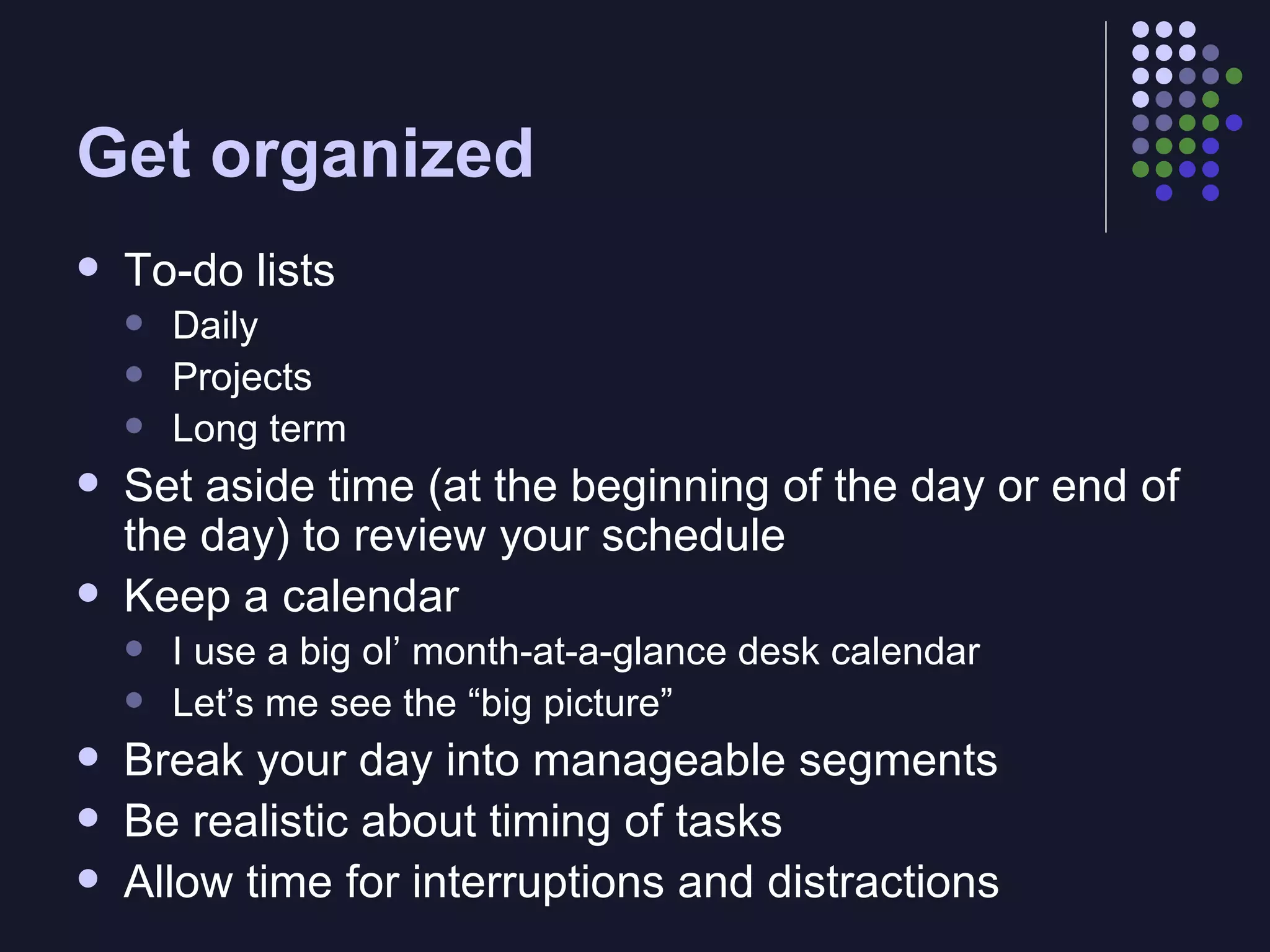
Get organized To-do lists Daily Projects Long term Set aside time (at the beginning of the day or end of the day) to review your schedule Keep a calendar I use a big ol’ month-at-a-glance desk calendar Let’s me see the “big picture” Break your day into manageable segments Be realistic about timing of tasks Allow time for interruptions and distractions
“ Why do hour increments work so well?  Precisely because they give you a deadline -  one hour - to get things done. Work expands  so as to fill time available for its completion.”  101 ways   to make every second count: time  management tips and techniques for more  success with less stress  by Robert W. Bly
Overcome procrastination Break your task/day into segments One-hour increments good Use a timer Reward yourself
Overcome perfectionism Break your task/day into segments One-hour increments good Use a timer Reward Stop yourself “ My flight will arrive in Chattanooga in 30 minutes.  That’s when I will need to be done.”
Design a good workspace A cluttered desk can mean a cluttered head Develop a filing system that works for you Make the space comfortable Don’t underestimate the importance of a good chair, pen, cup of coffee…
Avoid distractions Make a list of your bad habits Post it! Set aside quiet time It’s ok to close the door from time to time! Put it on your schedule/to-do list Set aside time for email, phone calls Or, if you’re like me and can’t resist email, find a productive workspace where it’s hard to read email Pick a time to work when others aren’t there If a stray worry, idea, to-do item pops into your head, write it down and deal with it later.
One cannot manage too many affairs: like pumpkins in the water, one pops up while you try to hold down the other. Chinese Proverb
Saying “yes” Saying “yes” to one thing means saying “no” to something else. Or, at least, it means having less time for the things you’ve already committed to do. Does it fit into your goals? Don’t fall victim to thinking you must take all career opportunities presented. Take some time before you decide. Don’t do it out of guilt Say “yes” or “no” to the task, not the person.
How to say “no” Do it as soon as possible. Suggest someone else who might be available and want to do it. (If you really want to say “yes”)  Decline but indicate that you’d like to be asked again.  Indicate when you’ll be available. Set parameters. “ I can’t review 10 papers, but I can do 5.” “ I could get it done in 6 weeks rather than 4.” “ I’d need such-and-such resources…”
“ You will never ‘find’ time for anything. If you want time, you must make it.” Charles Bruxton
Carving out personal time Put it on your to-do list. Schedule a regular activity (or a special one) with a partner or friend Get up 30-60 minutes earlier or go to bed a little later. Streamline & parallelize “ What?  No drapes?” Veggie washing marathon Cook while overseeing kids’ homework Hire help when you can Get good child care (peace of mind, guilt reduction) Share responsibilities with friends & family
References Bly, Robert W.  101 ways to make every second count: time management tips and techniques for more success with less stress. Prochaska-Cue, Kathy.  Thirteen Timely Tips for More Effective Personal Time Management. Covey, Stephen.   The 7 Habits of Highly Effective People.
With special thanks to Deborah Knox (2003) Joan Francioni (2005) Jan Cuny (2007) Kathleen Fisher, Anne Condon (2008) Carla Brodley, Judy Goldsmith, Tessa Lau (2009) Who put together terrific presentations from which we’ve borrowed extensively.
“ Forget the ‘shoulds’ and organize your way.” Kathy Prochaska-Cue
Your mileage may vary Good ideas for Getting out of a commitment gracefully? Allocating thinking time; setting aside longer periods of time for projects that have high start-up/shut-down cost. Dealing with a steady stream of students. Coordinating time management with others (colleagues, students, partners, family, friends) Reconciling your need to manage time with the culture of your Department.
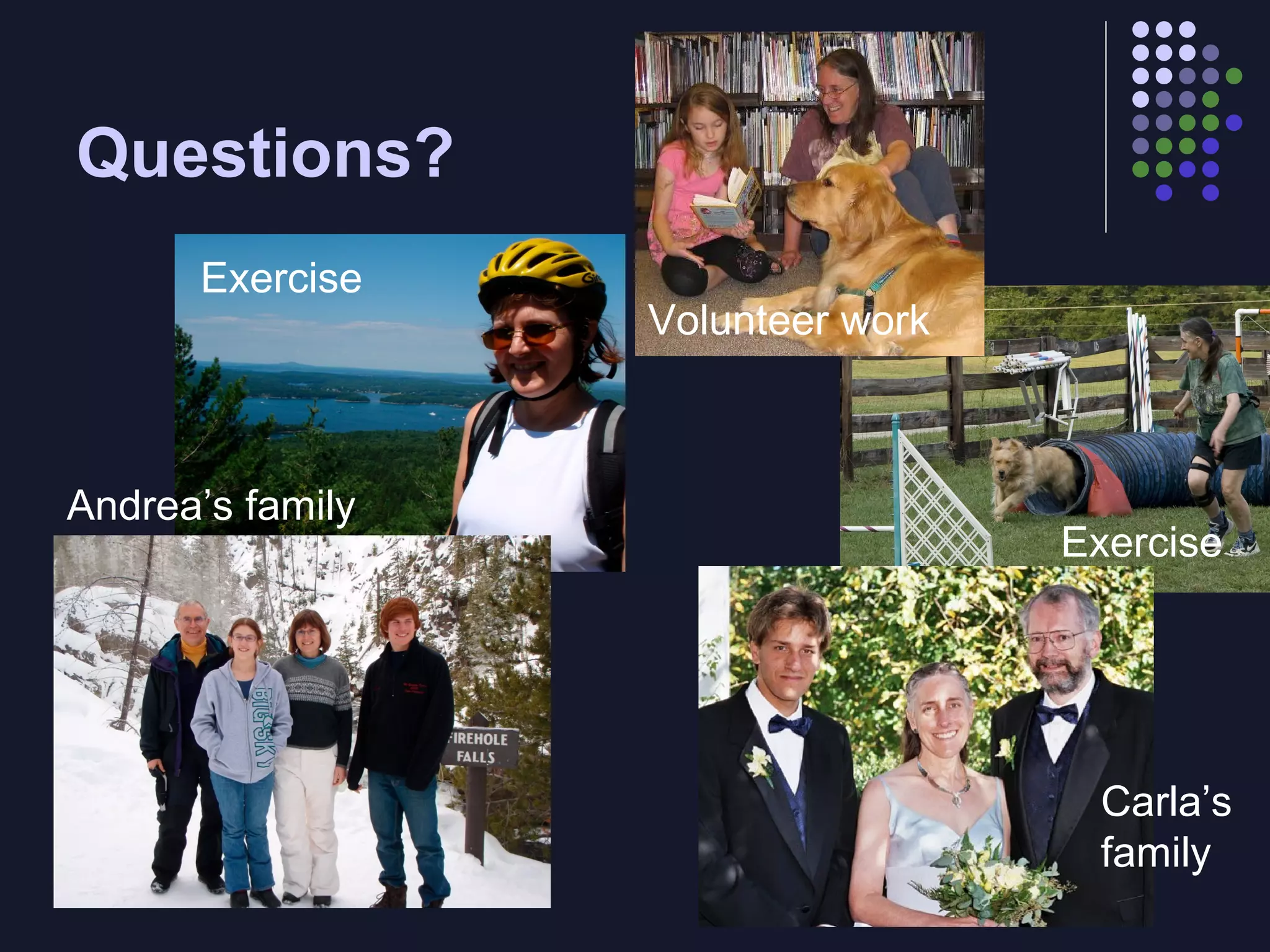
Questions? Carla’s family Volunteer work Exercise Exercise Andrea’s family

Work life balance and time management

  • 1.
    Work / LifeBalance & Time Management Andrea Danyluk Williams College Carla Schlatter Ellis Duke University
  • 2.
    Andrea’s Story BalanceOutdoors (biking, hiking, skiing), Kids’ Activities, Time with Friends, Travel Fun Married to Andrew (1984) Stephan born (1992) Katya born (1994) Family CRA-W, LACS, College and Research Community (ICML, AAAI, SIGCSE) Service NYNEX Science & Technology (1990-94) Williams College (1994-present) Jobs (post PhD) B.A., Vassar College (1984) M.S., Ph.D., Columbia University (1986, 1992) Education
  • 3.
    Time Allocation ofa Work Day 5:30 Alarm goes off. Quiet time for email or work prep. 6:30 Everyone else is up. 7:15 Kids leave for school. Exercise 9:30 Work: teaching, research, meetings… Reserve 30-60 min for coffee or lunch with a friend 6:00 Quiet time at work - or - Participate in a kid’s activity 8:00 Family dinner time 9:00 Clean up email, paperwork at home 10:00 Work - or - Relax (Read, Crossword puzzle, tv…)
  • 4.
    Carla’s Story BalanceOutdoors (biking, hiking, kayaking), Dogs (therapy, agility), Photography, Gardening Fun (Personal,Friends, Community) Married to John (1972-1992) James born (1983) Married Rick (2001) Family CRA-W, TOCS EiC, CRA, ACM Council… Service Univ. of Oregon (1978-80) Univ. of Rochester (1980-86) Duke (1986-2008) Jobs (post PhD) B.S. Univ. of Toledo (1972) MS. and Ph.D Univ. of Washington (1977, 1979) Education
  • 5.
  • 6.
  • 7.
  • 8.
    Seven places foryour time Personal Partnership Family Home Job Friends Community
  • 9.
    Seven places foryour time Personal Partnership Family Home Job Friends Community Teaching Research and Scholarship Service: Department, School, Community Career development Advising and Mentoring
  • 10.
    Seven places foryour time Personal Partnership Family Home Job Friends Community Physical (exercise) Intellectual (reading novels) Spiritual (meditation) Just chores (cleaning) Enjoyable tasks (cooking, gardening)
  • 11.
    Time commitments willdiffer Different focus at different colleges/universities Different focus at research labs vs. academia
  • 12.
    Time commitments willchange Status of career Grad student Pre/post tenure Assistant / Associate / Professor Technical / Managerial / Administrative Single/Married Ages of children, parents, …
  • 13.
    Know your goalsKnow your long-term and short-term goals. Have goals for all your roles, not just work. Prioritize them. Post them where you can see them.
  • 14.
    A Prioritizing HowTo Importance Urgency Urgent = deadline Important - supports your goals Minor committee meeting Answering phone Shop sales event Check email (again) Surfing web or TV Waxing floors Finish grant proposal Submit paper Teach class Cook dinner Career development Planning new projects Thinking & reading Exercise
  • 15.
    “ It’s notenough to know the projects you’re working on.” 101 ways to make every second count: time management tips and techniques for more success with less stress by Robert W. Bly
  • 16.
    Get organized To-dolists Daily Projects Long term Set aside time (at the beginning of the day or end of the day) to review your schedule Keep a calendar I use a big ol’ month-at-a-glance desk calendar Let’s me see the “big picture” Break your day into manageable segments Be realistic about timing of tasks Allow time for interruptions and distractions
  • 17.
    “ Why dohour increments work so well? Precisely because they give you a deadline - one hour - to get things done. Work expands so as to fill time available for its completion.” 101 ways to make every second count: time management tips and techniques for more success with less stress by Robert W. Bly
  • 18.
    Overcome procrastination Breakyour task/day into segments One-hour increments good Use a timer Reward yourself
  • 19.
    Overcome perfectionism Breakyour task/day into segments One-hour increments good Use a timer Reward Stop yourself “ My flight will arrive in Chattanooga in 30 minutes. That’s when I will need to be done.”
  • 20.
    Design a goodworkspace A cluttered desk can mean a cluttered head Develop a filing system that works for you Make the space comfortable Don’t underestimate the importance of a good chair, pen, cup of coffee…
  • 21.
    Avoid distractions Makea list of your bad habits Post it! Set aside quiet time It’s ok to close the door from time to time! Put it on your schedule/to-do list Set aside time for email, phone calls Or, if you’re like me and can’t resist email, find a productive workspace where it’s hard to read email Pick a time to work when others aren’t there If a stray worry, idea, to-do item pops into your head, write it down and deal with it later.
  • 22.
    One cannot managetoo many affairs: like pumpkins in the water, one pops up while you try to hold down the other. Chinese Proverb
  • 23.
    Saying “yes” Saying“yes” to one thing means saying “no” to something else. Or, at least, it means having less time for the things you’ve already committed to do. Does it fit into your goals? Don’t fall victim to thinking you must take all career opportunities presented. Take some time before you decide. Don’t do it out of guilt Say “yes” or “no” to the task, not the person.
  • 24.
    How to say“no” Do it as soon as possible. Suggest someone else who might be available and want to do it. (If you really want to say “yes”) Decline but indicate that you’d like to be asked again. Indicate when you’ll be available. Set parameters. “ I can’t review 10 papers, but I can do 5.” “ I could get it done in 6 weeks rather than 4.” “ I’d need such-and-such resources…”
  • 25.
    “ You willnever ‘find’ time for anything. If you want time, you must make it.” Charles Bruxton
  • 26.
    Carving out personaltime Put it on your to-do list. Schedule a regular activity (or a special one) with a partner or friend Get up 30-60 minutes earlier or go to bed a little later. Streamline & parallelize “ What? No drapes?” Veggie washing marathon Cook while overseeing kids’ homework Hire help when you can Get good child care (peace of mind, guilt reduction) Share responsibilities with friends & family
  • 27.
    References Bly, RobertW. 101 ways to make every second count: time management tips and techniques for more success with less stress. Prochaska-Cue, Kathy. Thirteen Timely Tips for More Effective Personal Time Management. Covey, Stephen. The 7 Habits of Highly Effective People.
  • 28.
    With special thanksto Deborah Knox (2003) Joan Francioni (2005) Jan Cuny (2007) Kathleen Fisher, Anne Condon (2008) Carla Brodley, Judy Goldsmith, Tessa Lau (2009) Who put together terrific presentations from which we’ve borrowed extensively.
  • 29.
    “ Forget the‘shoulds’ and organize your way.” Kathy Prochaska-Cue
  • 30.
    Your mileage mayvary Good ideas for Getting out of a commitment gracefully? Allocating thinking time; setting aside longer periods of time for projects that have high start-up/shut-down cost. Dealing with a steady stream of students. Coordinating time management with others (colleagues, students, partners, family, friends) Reconciling your need to manage time with the culture of your Department.
  • 31.
    Questions? Carla’s familyVolunteer work Exercise Exercise Andrea’s family

Editor's Notes

  • #6 Will use only one of the following 3 versions – others will be hidden or deleted once I decide.
  • #7 Currently the one not hidden
  • #10 Here “job” can mean “grad school”
  • #11 Similarly, categories within categories of non-work
  • #12 Note to Andrea – I added second bullet bc these aren’t all academics
  • #13 Note to Andrea – Added a bullet for labs
  • #14 Note to Andrea – I added a sub-bullet about goals
  • #15 Note to Andrea – new slide Easy to let important but not urgent (1 st quadrant) slip away – but it’s important! It’s easy to let deadlines drive you even if not important (4 th quadrant)
  • #17 Note to Carla: if you do this slide, you might want to change the bullets under “Keep a Calendar”. They’re specific to me.
  • #22 If you feel guilty about shutting the door, call it your “research time” As a grad student, took time off to exercise in the afternoon. Came back to work when others having dinner. Did something similar when Stephan too old for daycare but too young to be home alone. Nice to work from time to time on a Saturday night, Sunday morning. How many meetings have you sat through where all of a sudden you find yourself thinking “I need to make cupcakes for the PTA bake sale” or “I have to remember to buy milk on the way home.”
  • #27 Note to Andrea – some changes here having to do with kids. “ What? No drapes”: I’m a neat freak. So for me it makes more sense to forego draperies than worry about having them cleaned on a regular basis.