Science Laboratory Equipment
• Lab equipment is an important part of science
  in general.

• Since science is divided into pure and applied
  parts, experiments are very important.

• Equipment are used to carry out experiments
  with ease.
Classification
• Equipment can be classified into different
  categories usually based on the material they
  are made of.


         Glasswares            Porcelainwares


                      Others
Glasswares

Beaker
• Used to hold and heat liquids. Multipurpose
  and essential in the lab.
Test Tube
• Used by chemists to hold, mix, or heat small
  quantities of solid or liquid chemicals,
  especially for qualitative experiments.
Florence Flask
• Used for heating subtances that need to be
  heated evenly. The bulbed bottom allows the
  heat to distribute through the liquid more
  evenly. The Florence Flask is mostly used in
  distillation experiments

Erlenmeyer Flask
• Used to heat and store liquids. The advantage
  to the Erlenmeyer Flask is that the bottom is
  wider than the top so it will heat quicker
  because of the greater surface area exposed
  to the heat.
Funnel
• When lined with filter paper, used to filter
  suspended solids from a liquid.
Graduated Cylinder
• Used to make accurate measurements of
  liquid volumes.
Stirring Rod
• The stir rods are used to stir things. They are
  usually made of glass.
Watch Glass
• Convex-concave piece of glass used in
  chemistry as a surface to evaporate a
  liquid, to hold solids while being
  weighed, or as a cover for a beaker.
Petri Dish
• Used for holding a culture medium
  upon which cells, bacteria, and viruses
  can be grown and studied.
Porcelainwares

Crucible and Cover
• Used to heat chemicals (usually solids) to high
  temperatures. This may be necessary to dry a
  solid completely.
Evaporating Dish
• Used to evaporate the liquid away from a
  small volume of solution.
Mortar and Pestle
• Used to grind solid chemicals into smaller
  pieces. By grinding solid chemicals into
  smaller pieces, the solid may dissolve or react
  with other chemicals more quickly.
Spatula
• used for moving small amounts of solid from
  place to place
Others
• The “other” equipment can be further
  classified as ACCESSORY or for SPECIAL SET-
  ups.

• Some special Set-ups include distillation,
  titration, filtration etc.
Accessories

Brushes
• Coarse bristles to scrub and clean glassware
  and other equipment. They come in many
  different sizes, depending on the item being
  cleaned.
Crucible Tongs
• Used for handling crucibles, evaporating
  dishes, and other hot objects.
Test Tube Rack
• Used for holding test tubes upright when they
  contain chemicals, and also hold test
  tubes upside down to dry.
Test Tube holder
• Used to hold and transport hot test tubes.
Thermometer
• Used to measure the temperature of
  substances.
Set-Ups
• Equipment involved in set-ups are usually
  used for that special purpose alone.

• Basic set-ups are essential in performing
  experiments.
Heating

Clay Triangle
• Used to support crucibles when heating
  them.
Wire Gauze
• Used for supporting beakers and flasks when
  they are being heated with a Bunsen Burner
Bunsen burner/ Alcohol lamp
• Used for heating chemicals and equipment.
Iron ring
• Used to support laboratory equipment above
  the work surface.
Iron stand
• Used to provide support for other
  equipment and a means of raising equipment
  above the work surface.
Microscopy

Microscopes
• various powers are the most common of the
  biology lab equipments used in bio labs to see
  organisms and samples more closely.
Slides
In a biology lab, cells are gently smeared onto a
  glass slide, treated with a fixative so that the
  cellular component is seen clearly.
Distillation
• A method of separating mixtures based on
  differences in volatilities of components in a
  boiling liquid mixture.
Distilling Flask
• The distilling flask is used to separate liquid
  mixtures by distillation.
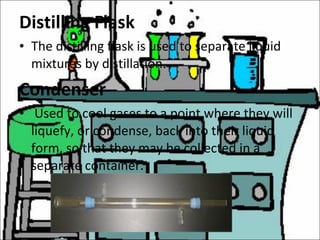
Condenser
• Used to cool gases to a point where they will
  liquefy, or condense, back into their liquid
  form, so that they may be collected in a
  separate container.
Titration
• A common laboratory method of quantitative
  chemical analysis that is used to determine
  the unknown concentration of an identified
  liquid.
Burette
• Used in titrations to measure
  precisely how much liquid is
  used.

Science laboratory equipment

  • 1.
  • 2.
    • Lab equipmentis an important part of science in general. • Since science is divided into pure and applied parts, experiments are very important. • Equipment are used to carry out experiments with ease.
  • 3.
    Classification • Equipment canbe classified into different categories usually based on the material they are made of. Glasswares Porcelainwares Others
  • 4.
    Glasswares Beaker • Used tohold and heat liquids. Multipurpose and essential in the lab. Test Tube • Used by chemists to hold, mix, or heat small quantities of solid or liquid chemicals, especially for qualitative experiments.
  • 5.
    Florence Flask • Usedfor heating subtances that need to be heated evenly. The bulbed bottom allows the heat to distribute through the liquid more evenly. The Florence Flask is mostly used in distillation experiments Erlenmeyer Flask • Used to heat and store liquids. The advantage to the Erlenmeyer Flask is that the bottom is wider than the top so it will heat quicker because of the greater surface area exposed to the heat.
  • 6.
    Funnel • When linedwith filter paper, used to filter suspended solids from a liquid. Graduated Cylinder • Used to make accurate measurements of liquid volumes. Stirring Rod • The stir rods are used to stir things. They are usually made of glass.
  • 7.
    Watch Glass • Convex-concavepiece of glass used in chemistry as a surface to evaporate a liquid, to hold solids while being weighed, or as a cover for a beaker. Petri Dish • Used for holding a culture medium upon which cells, bacteria, and viruses can be grown and studied.
  • 8.
    Porcelainwares Crucible and Cover •Used to heat chemicals (usually solids) to high temperatures. This may be necessary to dry a solid completely. Evaporating Dish • Used to evaporate the liquid away from a small volume of solution.
  • 9.
    Mortar and Pestle •Used to grind solid chemicals into smaller pieces. By grinding solid chemicals into smaller pieces, the solid may dissolve or react with other chemicals more quickly. Spatula • used for moving small amounts of solid from place to place
  • 10.
    Others • The “other”equipment can be further classified as ACCESSORY or for SPECIAL SET- ups. • Some special Set-ups include distillation, titration, filtration etc.
  • 11.
    Accessories Brushes • Coarse bristlesto scrub and clean glassware and other equipment. They come in many different sizes, depending on the item being cleaned. Crucible Tongs • Used for handling crucibles, evaporating dishes, and other hot objects.
  • 12.
    Test Tube Rack •Used for holding test tubes upright when they contain chemicals, and also hold test tubes upside down to dry. Test Tube holder • Used to hold and transport hot test tubes. Thermometer • Used to measure the temperature of substances.
  • 13.
    Set-Ups • Equipment involvedin set-ups are usually used for that special purpose alone. • Basic set-ups are essential in performing experiments.
  • 14.
    Heating Clay Triangle • Usedto support crucibles when heating them. Wire Gauze • Used for supporting beakers and flasks when they are being heated with a Bunsen Burner
  • 15.
    Bunsen burner/ Alcohollamp • Used for heating chemicals and equipment. Iron ring • Used to support laboratory equipment above the work surface. Iron stand • Used to provide support for other equipment and a means of raising equipment above the work surface.
  • 16.
    Microscopy Microscopes • various powersare the most common of the biology lab equipments used in bio labs to see organisms and samples more closely. Slides In a biology lab, cells are gently smeared onto a glass slide, treated with a fixative so that the cellular component is seen clearly.
  • 17.
    Distillation • A methodof separating mixtures based on differences in volatilities of components in a boiling liquid mixture.
  • 18.
    Distilling Flask • Thedistilling flask is used to separate liquid mixtures by distillation. Condenser • Used to cool gases to a point where they will liquefy, or condense, back into their liquid form, so that they may be collected in a separate container.
  • 19.
    Titration • A commonlaboratory method of quantitative chemical analysis that is used to determine the unknown concentration of an identified liquid.
  • 20.
    Burette • Used intitrations to measure precisely how much liquid is used.