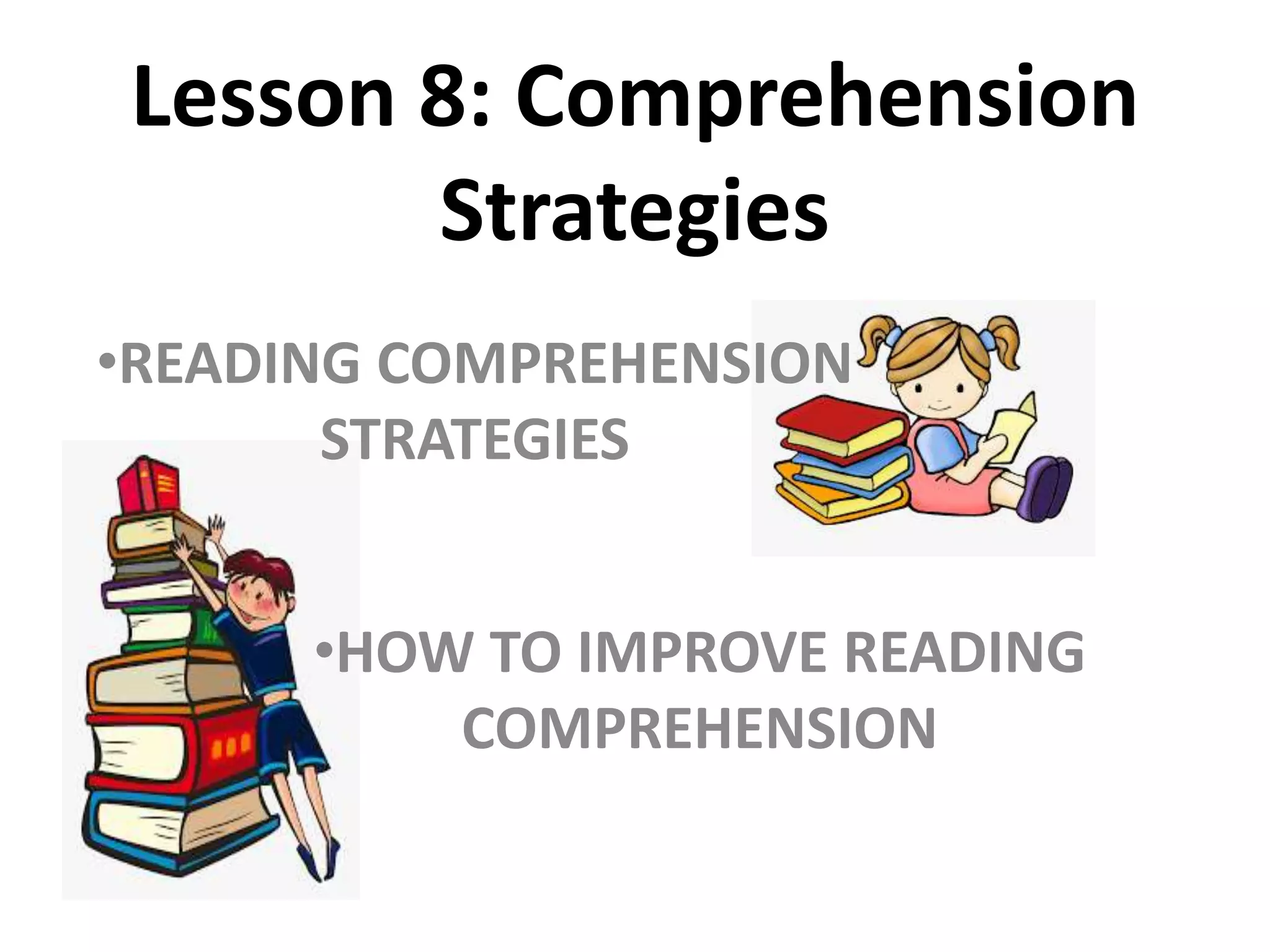
Lesson 8: Comprehension
Strategies
•HOW TO IMPROVE READING
COMPREHENSION
•READING COMPREHENSION
STRATEGIES
LET’S HAVE A READING ACTIVITY
•Find me in the
story!
“The Foolish
Donkey”
Instruction
Read the story carefully , while you’ll reading you
will notice “bold” letters , try to arrange the letters
into a word.
Any strategies are allowed .
You will be given 1 minute and 15 seconds to form
the word by reading the text.
15 seconds
left
Times
Up!
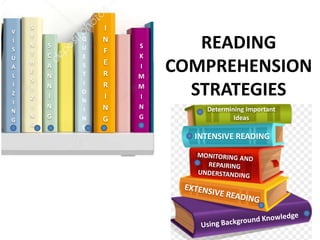
READING
COMPREHENSION
STRATEGIES
S
C
A
N
N
I
N
G
S
Y
N
T
H
E
S
I
Z
I
N
G
S
K
I
M
M
I
N
G
S
C
A
N
N
I
N
G
V
I
S
U
A
L
I
Z
I
N
G
I
N
F
E
R
R
I
N
G
S
Y
N
T
H
E
S
I
Z
I
N
G
INTENSIVE READING
Determining Important
Ideas
Q
U
E
S
T
I
O
N
I
N
G
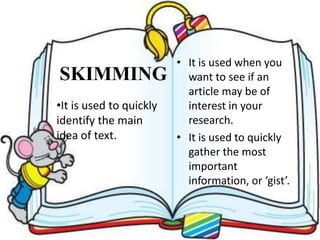
SKIMMING
• It is used when you
want to see if an
article may be of
interest in your
research.
• It is used to quickly
gather the most
important
information, or ‘gist’.
•It is used to quickly
identify the main
idea of text.
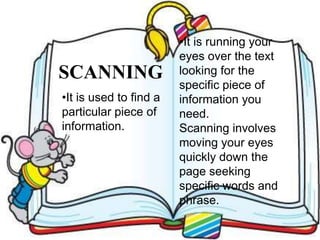
SCANNING
•It is running your
eyes over the text
looking for the
specific piece of
information you
need.
Scanning involves
moving your eyes
quickly down the
page seeking
specific words and
phrase.
•It is used to find a
particular piece of
information.
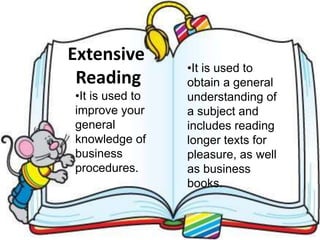
Extensive
Reading
•It is used to
improve your
general
knowledge of
business
procedures.
•It is used to
obtain a general
understanding of
a subject and
includes reading
longer texts for
pleasure, as well
as business
books.
•It is used on
shorter texts in
order to extract
specific
information
Intensive
Reading
includes very
close accurate
reading for detail.
•It is used to able
to create sensory
images in the
readers minds so
they will be more
Visualizing
engaged with the
content of the text
and will better
understand what
they read.
•This means
being to aware of
whether or not
understand what
Monitoring&
Repairing
Understanding
you read. Being able to
stop and use strategies
to clarify what is
confusing, whether it is
due to unfamiliar
vocabulary or lack of
background knowledge
is important to
achieving
comprehension.
Wake up!
Stretching time!
Follow her
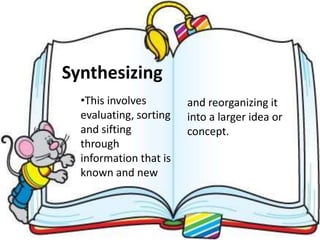
•This involves
evaluating, sorting
and sifting
through
information that is
known and new
Synthesizing
and reorganizing it
into a larger idea or
concept.
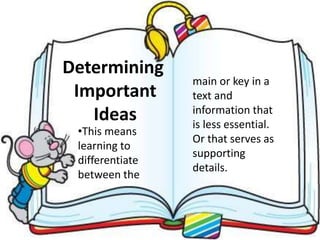
•This means
learning to
differentiate
between the
Determining
Important
Ideas
main or key in a
text and
information that
is less essential.
Or that serves as
supporting
details.
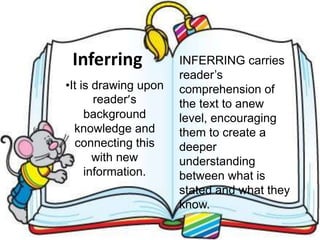
Inferring
•It is drawing upon
reader’s
background
knowledge and
connecting this
with new
information.
INFERRING carries
reader’s
comprehension of
the text to anew
level, encouraging
them to create a
deeper
understanding
between what is
stated and what they
know.
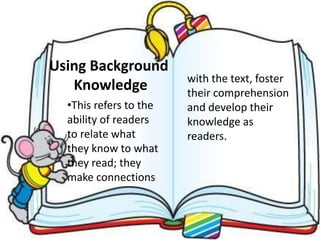
Using Background
Knowledge
•This refers to the
ability of readers
to relate what
they know to what
they read; they
make connections
with the text, foster
their comprehension
and develop their
knowledge as
readers.
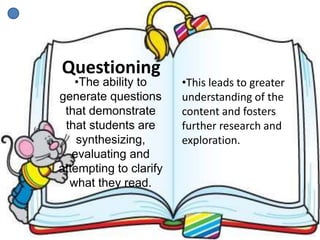
Questioning
•The ability to
generate questions
that demonstrate
that students are
synthesizing,
evaluating and
attempting to clarify
what they read.
•This leads to greater
understanding of the
content and fosters
further research and
exploration.
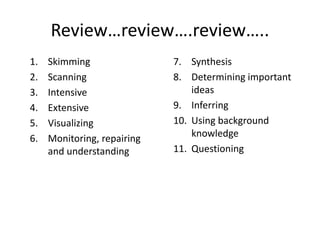
Review…review….review…..
1. Skimming
2. Scanning
3. Intensive
4. Extensive
5. Visualizing
6. Monitoring, repairing
and understanding
7. Synthesis
8. Determining important
ideas
9. Inferring
10. Using background
knowledge
11. Questioning
HOW TO IMPROVE READING
COMPREHENSION
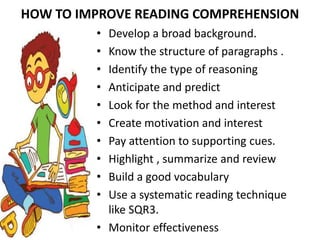
HOW TO IMPROVE READING COMPREHENSION
• Reading Comprehension requires motivation ,
mental frameworks for holding ideas, a
concentration and good study techniques .
• Martin (1991) suggests the following good
study techniques that will guarantee improved
comprehension ability
• Develop a broad background.
• Know the structure of paragraphs .
• Identify the type of reasoning
• Anticipate and predict
• Look for the method and interest
• Create motivation and interest
• Pay attention to supporting cues.
• Highlight , summarize and review
• Build a good vocabulary
• Use a systematic reading technique
like SQR3.
• Monitor effectiveness
HOW TO IMPROVE READING COMPREHENSION
Let’s have an activity!
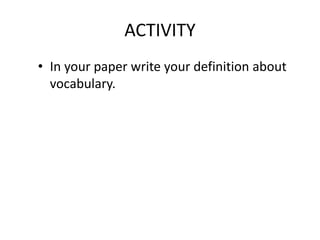
ACTIVITY
• In your paper write your definition about
vocabulary.
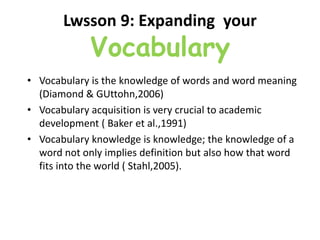
Lwsson 9: Expanding your
Vocabulary
• Vocabulary is the knowledge of words and word meaning
(Diamond & GUttohn,2006)
• Vocabulary acquisition is very crucial to academic
development ( Baker et al.,1991)
• Vocabulary knowledge is knowledge; the knowledge of a
word not only implies definition but also how that word
fits into the world ( Stahl,2005).
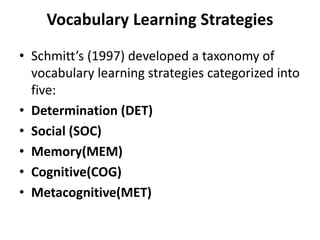
Vocabulary Learning Strategies
• Schmitt’s (1997) developed a taxonomy of
vocabulary learning strategies categorized into
five:
• Determination (DET)
• Social (SOC)
• Memory(MEM)
• Cognitive(COG)
• Metacognitive(MET)
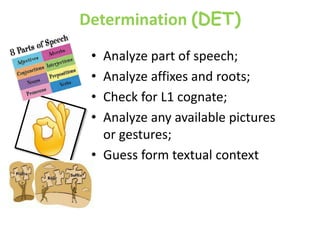
Determination (DET)
• Analyze part of speech;
• Analyze affixes and roots;
• Check for L1 cognate;
• Analyze any available pictures
or gestures;
• Guess form textual context
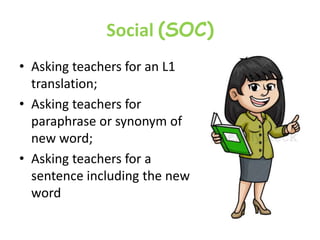
Social (SOC)
• Asking teachers for an L1
translation;
• Asking teachers for
paraphrase or synonym of
new word;
• Asking teachers for a
sentence including the new
word
Memory(MEM)
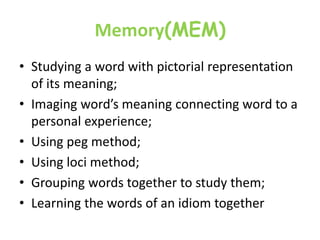
• Studying a word with pictorial representation
of its meaning;
• Imaging word’s meaning connecting word to a
personal experience;
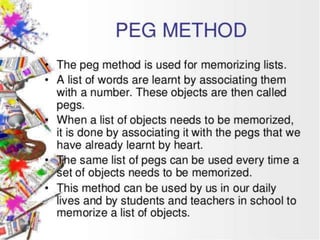
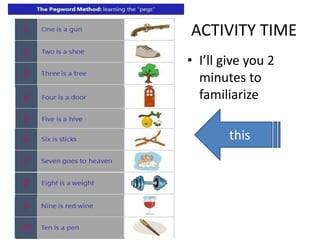
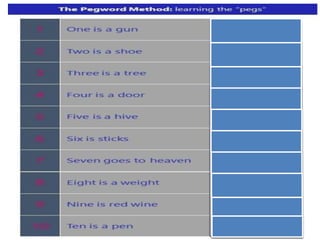
• Using peg method;
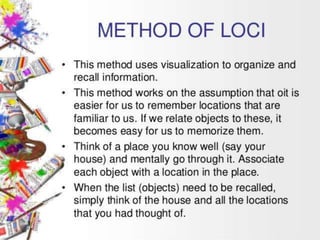
• Using loci method;
• Grouping words together to study them;
• Learning the words of an idiom together
Peg Method
ACTIVITY TIME
• I’ll give you 2
minutes to
familiarize
this
Cognitive(COG)
• Verbal repetition;
• Written repetition;
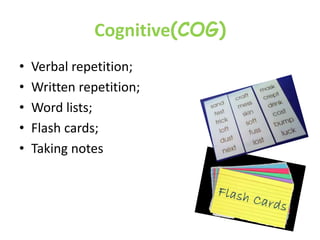
• Word lists;
• Flash cards;
• Taking notes
Metacognitive(MET)
• Using English
language media;
• Testing oneself with
word tests;
• Using spaced word
practice;
• Continuing to study
word over time.
Lesson 10 : Analyzing Roots
• Roots are base words to which other
characters or letters like prefixes and suffixes
are attached.
Prefixes –a word, letter, or number placed before
another.
Suffixes – a morpheme added at the end of a word
to form a derivative
• Roots consistently the same things and are the
base for related words. We often encounter
roots of Greek and Latin origin in subjects like
Science and English.
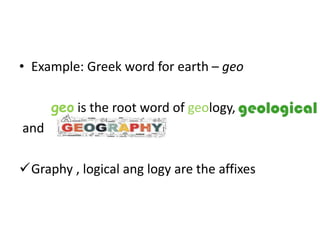
• Example: Greek word for earth – geo
geo is the root word of geology,
and
Graphy , logical ang logy are the affixes
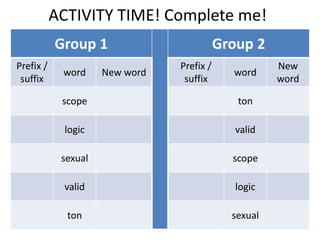
ACTIVITY TIME! Complete me!
Complete me !
Group 1 Group 2
Prefix /
suffix
word New word
Prefix /
suffix
word
New
word
Group 1 Group 2
Prefix /
suffix
word New word
Prefix /
suffix
word
New
word
scope ton
Group 1 Group 2
Prefix /
suffix
word New word
Prefix /
suffix
word
New
word
scope ton
logic valid
Group 1 Group 2
Prefix /
suffix
word New word
Prefix /
suffix
word
New
word
scope ton
logic valid
sexual scope
Group 1 Group 2
Prefix /
suffix
word New word
Prefix /
suffix
word
New
word
scope ton
logic valid
sexual scope
valid logic
Group 1 Group 2
Prefix /
suffix
word New word
Prefix /
suffix
word
New
word
scope ton
logic valid
sexual scope
valid logic
ton sexual
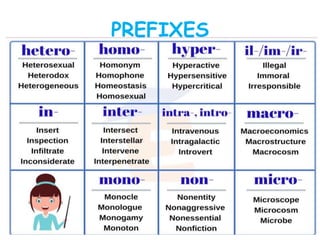
PREFIXES
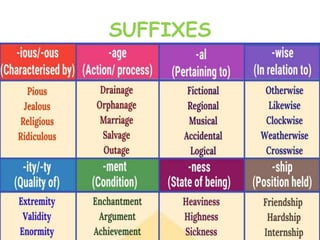
SUFFIXES
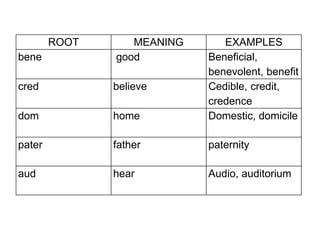
ROOT MEANING EXAMPLES
bene good Beneficial,
benevolent, benefit
cred believe Cedible, credit,
credence
dom home Domestic, domicile
pater father paternity
aud hear Audio, auditorium
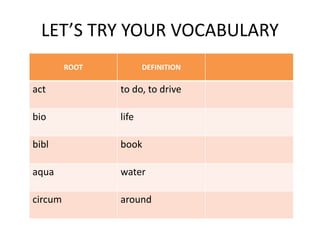
LET’S TRY YOUR VOCABULARY
ROOT DEFINITION
act to do, to drive
bio life
bibl book
aqua water
circum around

Comprehension strategies

  • 1.
    Lesson 8: Comprehension Strategies •HOWTO IMPROVE READING COMPREHENSION •READING COMPREHENSION STRATEGIES
  • 2.
    LET’S HAVE AREADING ACTIVITY
  • 3.
    •Find me inthe story! “The Foolish Donkey”
  • 4.
    Instruction Read the storycarefully , while you’ll reading you will notice “bold” letters , try to arrange the letters into a word. Any strategies are allowed . You will be given 1 minute and 15 seconds to form the word by reading the text.
  • 5.
  • 7.
  • 8.
    SKIMMING • It isused when you want to see if an article may be of interest in your research. • It is used to quickly gather the most important information, or ‘gist’. •It is used to quickly identify the main idea of text.
  • 9.
    SCANNING •It is runningyour eyes over the text looking for the specific piece of information you need. Scanning involves moving your eyes quickly down the page seeking specific words and phrase. •It is used to find a particular piece of information.
  • 10.
    Extensive Reading •It is usedto improve your general knowledge of business procedures. •It is used to obtain a general understanding of a subject and includes reading longer texts for pleasure, as well as business books.
  • 11.
    •It is usedon shorter texts in order to extract specific information Intensive Reading includes very close accurate reading for detail.
  • 12.
    •It is usedto able to create sensory images in the readers minds so they will be more Visualizing engaged with the content of the text and will better understand what they read.
  • 13.
    •This means being toaware of whether or not understand what Monitoring& Repairing Understanding you read. Being able to stop and use strategies to clarify what is confusing, whether it is due to unfamiliar vocabulary or lack of background knowledge is important to achieving comprehension.
  • 14.
  • 15.
    •This involves evaluating, sorting andsifting through information that is known and new Synthesizing and reorganizing it into a larger idea or concept.
  • 16.
    •This means learning to differentiate betweenthe Determining Important Ideas main or key in a text and information that is less essential. Or that serves as supporting details.
  • 17.
    Inferring •It is drawingupon reader’s background knowledge and connecting this with new information. INFERRING carries reader’s comprehension of the text to anew level, encouraging them to create a deeper understanding between what is stated and what they know.
  • 18.
    Using Background Knowledge •This refersto the ability of readers to relate what they know to what they read; they make connections with the text, foster their comprehension and develop their knowledge as readers.
  • 19.
    Questioning •The ability to generatequestions that demonstrate that students are synthesizing, evaluating and attempting to clarify what they read. •This leads to greater understanding of the content and fosters further research and exploration.
  • 20.
    Review…review….review….. 1. Skimming 2. Scanning 3.Intensive 4. Extensive 5. Visualizing 6. Monitoring, repairing and understanding 7. Synthesis 8. Determining important ideas 9. Inferring 10. Using background knowledge 11. Questioning
  • 21.
    HOW TO IMPROVEREADING COMPREHENSION
  • 22.
    HOW TO IMPROVEREADING COMPREHENSION • Reading Comprehension requires motivation , mental frameworks for holding ideas, a concentration and good study techniques . • Martin (1991) suggests the following good study techniques that will guarantee improved comprehension ability
  • 23.
    • Develop abroad background. • Know the structure of paragraphs . • Identify the type of reasoning • Anticipate and predict • Look for the method and interest • Create motivation and interest • Pay attention to supporting cues. • Highlight , summarize and review • Build a good vocabulary • Use a systematic reading technique like SQR3. • Monitor effectiveness HOW TO IMPROVE READING COMPREHENSION
  • 24.
    Let’s have anactivity!
  • 25.
    ACTIVITY • In yourpaper write your definition about vocabulary.
  • 26.
    Lwsson 9: Expandingyour Vocabulary • Vocabulary is the knowledge of words and word meaning (Diamond & GUttohn,2006) • Vocabulary acquisition is very crucial to academic development ( Baker et al.,1991) • Vocabulary knowledge is knowledge; the knowledge of a word not only implies definition but also how that word fits into the world ( Stahl,2005).
  • 27.
    Vocabulary Learning Strategies •Schmitt’s (1997) developed a taxonomy of vocabulary learning strategies categorized into five: • Determination (DET) • Social (SOC) • Memory(MEM) • Cognitive(COG) • Metacognitive(MET)
  • 28.
    Determination (DET) • Analyzepart of speech; • Analyze affixes and roots; • Check for L1 cognate; • Analyze any available pictures or gestures; • Guess form textual context
  • 29.
    Social (SOC) • Askingteachers for an L1 translation; • Asking teachers for paraphrase or synonym of new word; • Asking teachers for a sentence including the new word
  • 30.
    Memory(MEM) • Studying aword with pictorial representation of its meaning; • Imaging word’s meaning connecting word to a personal experience; • Using peg method; • Using loci method; • Grouping words together to study them; • Learning the words of an idiom together
  • 31.
  • 33.
    ACTIVITY TIME • I’llgive you 2 minutes to familiarize this
  • 35.
    Cognitive(COG) • Verbal repetition; •Written repetition; • Word lists; • Flash cards; • Taking notes
  • 36.
    Metacognitive(MET) • Using English languagemedia; • Testing oneself with word tests; • Using spaced word practice; • Continuing to study word over time.
  • 37.
    Lesson 10 :Analyzing Roots • Roots are base words to which other characters or letters like prefixes and suffixes are attached. Prefixes –a word, letter, or number placed before another. Suffixes – a morpheme added at the end of a word to form a derivative • Roots consistently the same things and are the base for related words. We often encounter roots of Greek and Latin origin in subjects like Science and English.
  • 38.
    • Example: Greekword for earth – geo geo is the root word of geology, and Graphy , logical ang logy are the affixes
  • 39.
    ACTIVITY TIME! Completeme! Complete me ! Group 1 Group 2 Prefix / suffix word New word Prefix / suffix word New word Group 1 Group 2 Prefix / suffix word New word Prefix / suffix word New word scope ton Group 1 Group 2 Prefix / suffix word New word Prefix / suffix word New word scope ton logic valid Group 1 Group 2 Prefix / suffix word New word Prefix / suffix word New word scope ton logic valid sexual scope Group 1 Group 2 Prefix / suffix word New word Prefix / suffix word New word scope ton logic valid sexual scope valid logic Group 1 Group 2 Prefix / suffix word New word Prefix / suffix word New word scope ton logic valid sexual scope valid logic ton sexual
  • 40.
  • 41.
  • 42.
    ROOT MEANING EXAMPLES benegood Beneficial, benevolent, benefit cred believe Cedible, credit, credence dom home Domestic, domicile pater father paternity aud hear Audio, auditorium
  • 43.
    LET’S TRY YOURVOCABULARY ROOT DEFINITION act to do, to drive bio life bibl book aqua water circum around