Pattern Recognition and Machine Learning
Eunho Lee
2017-01-03(Tue)
January 8, 2017 1 / 33
Outline
1 Introduction
Polynomial Curve Fitting
Probability Theory
The Curse of Dimensionality
Decision Theory
Information Theory
2 Appendix C - Properties of Matrices
Determinants
Matrix Derivatives
2.3. Eigenvector Equation
January 8, 2017 2 / 33
Introduction
1. Introduction
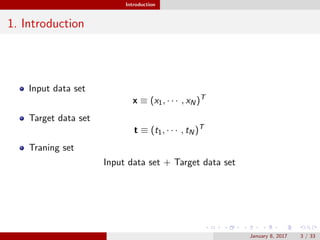
Input data set
x ≡ (x1, · · · , xN)T
Target data set
t ≡ (t1, · · · , tN)T
Traning set
Input data set + Target data set
January 8, 2017 3 / 33
Introduction
1. Introduction
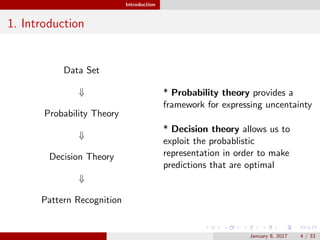
Data Set
⇓
Probability Theory
⇓
Decision Theory
⇓
Pattern Recognition
* Probability theory provides a
framework for expressing uncentainty
* Decision theory allows us to
exploit the probablistic
representation in order to make
predictions that are optimal
January 8, 2017 4 / 33
Introduction Polynomial Curve Fitting
1.1. Polynomial Curve Fitting
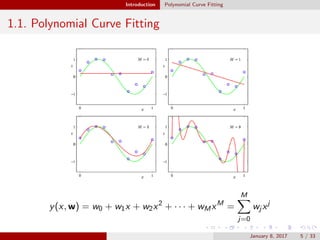
y(x, w) = w0 + w1x + w2x2
+ · · · + wMxM
=
M
j=0
wj xj
January 8, 2017 5 / 33
Introduction Polynomial Curve Fitting
1.1. Polynomial Curve Fitting
1.1.1. Error Functions
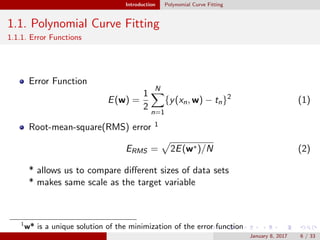
Error Function
E(w) =
1
2
N
n=1
{y(xn, w) − tn}2
(1)
Root-mean-square(RMS) error 1
ERMS = 2E(w∗)/N (2)
* allows us to compare different sizes of data sets
* makes same scale as the target variable
1
w* is a unique solution of the minimization of the error function
January 8, 2017 6 / 33
Introduction Polynomial Curve Fitting
1.1. Polynomial Curve Fitting
1.1.2. Over-Fitting
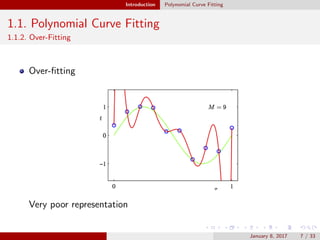
Over-fitting
Very poor representation
January 8, 2017 7 / 33
Introduction Polynomial Curve Fitting
1.1. Polynomial Curve Fitting
1.1.3. Modified Error Function
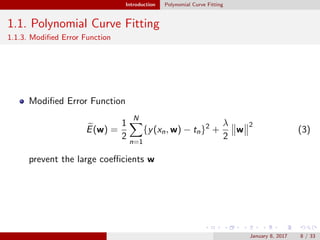
Modified Error Function
E(w) =
1
2
N
n=1
{y(xn, w) − tn}2
+
λ
2
w
2
(3)
prevent the large coefficients w
January 8, 2017 8 / 33
Introduction Probability Theory
1.2. Probability Theory
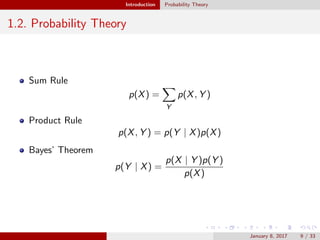
Sum Rule
p(X) =
Y
p(X, Y )
Product Rule
p(X, Y ) = p(Y | X)p(X)
Bayes’ Theorem
p(Y | X) =
p(X | Y )p(Y )
p(X)
January 8, 2017 9 / 33
Introduction Probability Theory
1.2. Probability Theory
Expectation
E[f ] =
x
p(x)f (x)
1
N
N
n=1
f (xn)
Variance
var[f ] = E[(f (x) − E[f (x)])2
]
January 8, 2017 10 / 33
Introduction Probability Theory
1.2. Probability Theory
1.2.1. Two Different Probabilities
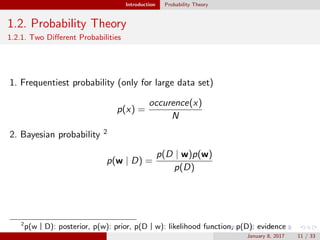
1. Frequentiest probability (only for large data set)
p(x) =
occurence(x)
N
2. Bayesian probability 2
p(w | D) =
p(D | w)p(w)
p(D)
2
p(wㅣD): posterior, p(w): prior, p(Dㅣw): likelihood function, p(D): evidence
January 8, 2017 11 / 33
Introduction Probability Theory
1.2. Probability Theory
1.2.2. The Gaussian Distribution
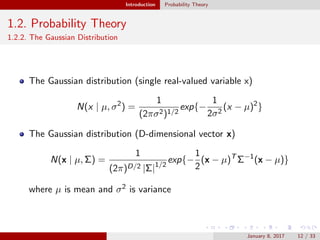
The Gaussian distribution (single real-valued variable x)
N(x | µ, σ2
) =
1
(2πσ2)1/2
exp{−
1
2σ2
(x − µ)2
}
The Gaussian distribution (D-dimensional vector x)
N(x | µ, Σ) =
1
(2π)D/2 |Σ|1/2
exp{−
1
2
(x − µ)T
Σ−1
(x − µ)}
where µ is mean and σ2 is variance
January 8, 2017 12 / 33
Introduction Probability Theory
1.2. Probability Theory
1.2.2. The Gaussian Distribution
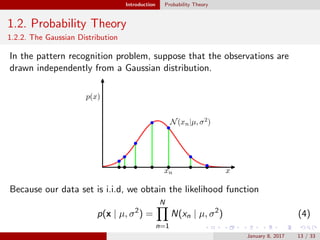
In the pattern recognition problem, suppose that the observations are
drawn independently from a Gaussian distribution.
Because our data set is i.i.d, we obtain the likelihood function
p(x | µ, σ2
) =
N
n=1
N(xn | µ, σ2
) (4)
January 8, 2017 13 / 33
Introduction Probability Theory
1.2. Probability Theory
1.2.2. The Gaussian Distribution
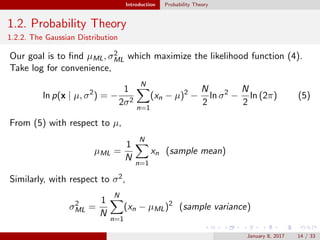
Our goal is to find µML, σ2
ML which maximize the likelihood function (4).
Take log for convenience,
ln p(x | µ, σ2
) = −
1
2σ2
N
n=1
(xn − µ)2
−
N
2
ln σ2
−
N
2
ln (2π) (5)
From (5) with respect to µ,
µML =
1
N
N
n=1
xn (sample mean)
Similarly, with respect to σ2,
σ2
ML =
1
N
N
n=1
(xn − µML)2
(sample variance)
January 8, 2017 14 / 33
Introduction Probability Theory
1.2. Probability Theory
1.2.2. The Gaussian Distribution
Therefore,
E[µML] = µ
E[σ2
ML] = (N−1
N )σ2
The figure shows that how variance is biased
January 8, 2017 15 / 33
Introduction Probability Theory
1.2. Probability Theory
1.2.3. Curve Fitting (re-visited)
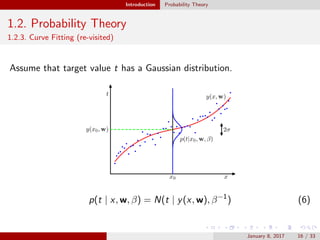
Assume that target value t has a Gaussian distribution.
p(t | x, w, β) = N(t | y(x, w), β−1
) (6)
January 8, 2017 16 / 33
Introduction Probability Theory
1.2. Probability Theory
1.2.3. Curve Fitting (re-visited)
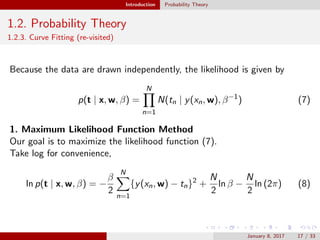
Because the data are drawn independently, the likelihood is given by
p(t | x, w, β) =
N
n=1
N(tn | y(xn, w), β−1
) (7)
1. Maximum Likelihood Function Method
Our goal is to maximize the likelihood function (7).
Take log for convenience,
ln p(t | x, w, β) = −
β
2
N
n=1
{y(xn, w) − tn}2
+
N
2
ln β −
N
2
ln (2π) (8)
January 8, 2017 17 / 33
Introduction Probability Theory
1.2. Probability Theory
1.2.3. Curve Fitting (re-visited)
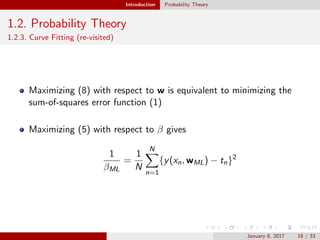
Maximizing (8) with respect to w is equivalent to minimizing the
sum-of-squares error function (1)
Maximizing (5) with respect to β gives
1
βML
=
1
N
N
n=1
{y(xn, wML) − tn}2
January 8, 2017 18 / 33
Introduction Probability Theory
1.2. Probability Theory
1.2.3. Curve Fitting (re-visited)
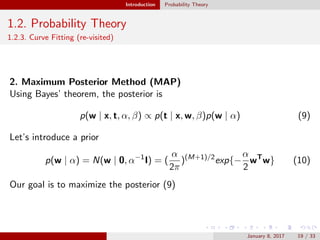
2. Maximum Posterior Method (MAP)
Using Bayes’ theorem, the posterior is
p(w | x, t, α, β) ∝ p(t | x, w, β)p(w | α) (9)
Let’s introduce a prior
p(w | α) = N(w | 0, α−1
I) = (
α
2π
)(M+1)/2
exp{−
α
2
wT
w} (10)
Our goal is to maximize the posterior (9)
January 8, 2017 19 / 33
Introduction Probability Theory
1.2. Probability Theory
1.2.3. Curve Fitting (re-visited)
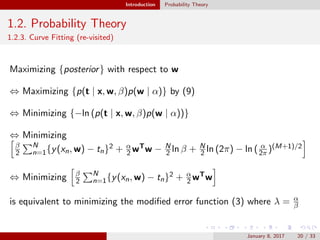
Maximizing {posterior} with respect to w
⇔ Maximizing {p(t | x, w, β)p(w | α)} by (9)
⇔ Minimizing {−ln (p(t | x, w, β)p(w | α))}
⇔ Minimizing
β
2
N
n=1{y(xn, w) − tn}2 + α
2 wTw − N
2 ln β + N
2 ln (2π) − ln ( α
2π )(M+1)/2
⇔ Minimizing β
2
N
n=1{y(xn, w) − tn}2 + α
2 wTw
is equivalent to minimizing the modified error function (3) where λ = α
β
January 8, 2017 20 / 33
Introduction Probability Theory
1.2. Probability Theory
1.2.4. Bayesian Curve Fitting
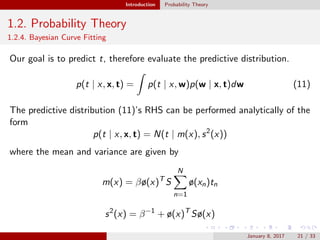
Our goal is to predict t, therefore evaluate the predictive distribution.
p(t | x, x, t) = p(t | x, w)p(w | x, t)dw (11)
The predictive distribution (11)’s RHS can be performed analytically of the
form
p(t | x, x, t) = N(t | m(x), s2
(x))
where the mean and variance are given by
m(x) = βø(x)T
S
N
n=1
ø(xn)tn
s2
(x) = β−1
+ ø(x)T
Sø(x)
January 8, 2017 21 / 33
Introduction The Curse of Dimensionality
1.3. The Curse of Dimensionality
The severe difficulty that can arise in spaces of many dimensions
How much data do i need to classify?
January 8, 2017 22 / 33
Introduction Decision Theory
1.4. Decision Theory
1.4.1. Minimizing the misclassification rate
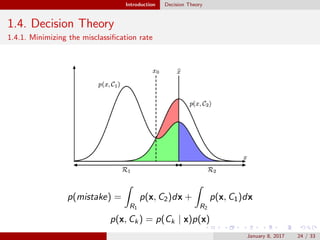
Rk is decision regions, Ck is k-th class
The boundaries between decision regions are called decision
boundaries
Each decision region need not be contiguous
Classify x to Cm which maximize p(x, Ck)
January 8, 2017 23 / 33
Introduction Decision Theory
1.4. Decision Theory
1.4.1. Minimizing the misclassification rate
p(mistake) =
R1
p(x, C2)dx +
R2
p(x, C1)dx
p(x, Ck) = p(Ck | x)p(x)
January 8, 2017 24 / 33
Introduction Decision Theory
1.4. Decision Theory
1.4.2. Minimizing the expected loss
Dicision’s value is different each other
Minimize the expected loss by using the loss matrix L
E[L] =
k j Rj
Lkj p(x, Ck)dx
January 8, 2017 25 / 33
Introduction Decision Theory
1.4. Decision Theory
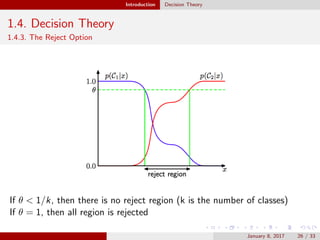
1.4.3. The Reject Option
If θ < 1/k, then there is no reject region (k is the number of classes)
If θ = 1, then all region is rejected
January 8, 2017 26 / 33
Introduction Information Theory
1.5. Infomation Theory
Entropy of the event x (the quantity of information)
h(x) = −log2p(x)
Entropy of the random variable x
H[x] = −
x
p(x)log2p(x)
The distribution that maximizes the differential entropy is the
Gaussian
January 8, 2017 27 / 33
Appendix C - Properties of Matrices
2. Appendix C - Properties of Matrices
Determinants
Matrix Derivatives
Eigenvector Equation
January 8, 2017 28 / 33
Appendix C - Properties of Matrices Determinants
2.1. Determinants
If A and B are matrices of size N × M, then
IN + ABT
= IM + AT
B
A useful special case is
IN + abT
= 1 + aT
B
where a and b are N-dimensional column vectors
January 8, 2017 29 / 33
Appendix C - Properties of Matrices Matrix Derivatives
2.2. Matrix Derivatives
1. ∂
∂x (xTa) = ∂
∂x (aTx) = a
2. ∂
∂x (AB) = ∂A
∂x B + A∂B
∂x
3. ∂
∂x (A−1) = −A−1 ∂A
∂x A−1
4. ∂
∂A Tr(AB) = BT
5. ∂
∂A Tr(A) = I
January 8, 2017 30 / 33
Appendix C - Properties of Matrices Eigenvector Equation
2.3. Eigenvector Equation
For a square matrix A, the eigenvector equation is defined by
Aui = λi ui
where ui is an eigenvector and λi is the corresponding eigenvalue
January 8, 2017 31 / 33
Appendix C - Properties of Matrices Eigenvector Equation
2.3. Eigenvector Equation
If A is diagonalized, we can say that
A = UΛUT
By using that equation, we obtain
1. |A| = M
i=1 λi
2. Tr(A) = M
i=1 λi
January 8, 2017 32 / 33
Appendix C - Properties of Matrices Eigenvector Equation
2.3. Eigenvector Equation
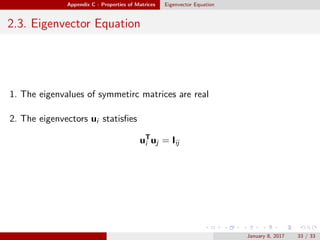
1. The eigenvalues of symmetirc matrices are real
2. The eigenvectors ui statisfies
uT
i uj = Iij
January 8, 2017 33 / 33

Pattern Recognition

  • 1.
    Pattern Recognition andMachine Learning Eunho Lee 2017-01-03(Tue) January 8, 2017 1 / 33
  • 2.
    Outline 1 Introduction Polynomial CurveFitting Probability Theory The Curse of Dimensionality Decision Theory Information Theory 2 Appendix C - Properties of Matrices Determinants Matrix Derivatives 2.3. Eigenvector Equation January 8, 2017 2 / 33
  • 3.
    Introduction 1. Introduction Input dataset x ≡ (x1, · · · , xN)T Target data set t ≡ (t1, · · · , tN)T Traning set Input data set + Target data set January 8, 2017 3 / 33
  • 4.
    Introduction 1. Introduction Data Set ⇓ ProbabilityTheory ⇓ Decision Theory ⇓ Pattern Recognition * Probability theory provides a framework for expressing uncentainty * Decision theory allows us to exploit the probablistic representation in order to make predictions that are optimal January 8, 2017 4 / 33
  • 5.
    Introduction Polynomial CurveFitting 1.1. Polynomial Curve Fitting y(x, w) = w0 + w1x + w2x2 + · · · + wMxM = M j=0 wj xj January 8, 2017 5 / 33
  • 6.
    Introduction Polynomial CurveFitting 1.1. Polynomial Curve Fitting 1.1.1. Error Functions Error Function E(w) = 1 2 N n=1 {y(xn, w) − tn}2 (1) Root-mean-square(RMS) error 1 ERMS = 2E(w∗)/N (2) * allows us to compare different sizes of data sets * makes same scale as the target variable 1 w* is a unique solution of the minimization of the error function January 8, 2017 6 / 33
  • 7.
    Introduction Polynomial CurveFitting 1.1. Polynomial Curve Fitting 1.1.2. Over-Fitting Over-fitting Very poor representation January 8, 2017 7 / 33
  • 8.
    Introduction Polynomial CurveFitting 1.1. Polynomial Curve Fitting 1.1.3. Modified Error Function Modified Error Function E(w) = 1 2 N n=1 {y(xn, w) − tn}2 + λ 2 w 2 (3) prevent the large coefficients w January 8, 2017 8 / 33
  • 9.
    Introduction Probability Theory 1.2.Probability Theory Sum Rule p(X) = Y p(X, Y ) Product Rule p(X, Y ) = p(Y | X)p(X) Bayes’ Theorem p(Y | X) = p(X | Y )p(Y ) p(X) January 8, 2017 9 / 33
  • 10.
    Introduction Probability Theory 1.2.Probability Theory Expectation E[f ] = x p(x)f (x) 1 N N n=1 f (xn) Variance var[f ] = E[(f (x) − E[f (x)])2 ] January 8, 2017 10 / 33
  • 11.
    Introduction Probability Theory 1.2.Probability Theory 1.2.1. Two Different Probabilities 1. Frequentiest probability (only for large data set) p(x) = occurence(x) N 2. Bayesian probability 2 p(w | D) = p(D | w)p(w) p(D) 2 p(wㅣD): posterior, p(w): prior, p(Dㅣw): likelihood function, p(D): evidence January 8, 2017 11 / 33
  • 12.
    Introduction Probability Theory 1.2.Probability Theory 1.2.2. The Gaussian Distribution The Gaussian distribution (single real-valued variable x) N(x | µ, σ2 ) = 1 (2πσ2)1/2 exp{− 1 2σ2 (x − µ)2 } The Gaussian distribution (D-dimensional vector x) N(x | µ, Σ) = 1 (2π)D/2 |Σ|1/2 exp{− 1 2 (x − µ)T Σ−1 (x − µ)} where µ is mean and σ2 is variance January 8, 2017 12 / 33
  • 13.
    Introduction Probability Theory 1.2.Probability Theory 1.2.2. The Gaussian Distribution In the pattern recognition problem, suppose that the observations are drawn independently from a Gaussian distribution. Because our data set is i.i.d, we obtain the likelihood function p(x | µ, σ2 ) = N n=1 N(xn | µ, σ2 ) (4) January 8, 2017 13 / 33
  • 14.
    Introduction Probability Theory 1.2.Probability Theory 1.2.2. The Gaussian Distribution Our goal is to find µML, σ2 ML which maximize the likelihood function (4). Take log for convenience, ln p(x | µ, σ2 ) = − 1 2σ2 N n=1 (xn − µ)2 − N 2 ln σ2 − N 2 ln (2π) (5) From (5) with respect to µ, µML = 1 N N n=1 xn (sample mean) Similarly, with respect to σ2, σ2 ML = 1 N N n=1 (xn − µML)2 (sample variance) January 8, 2017 14 / 33
  • 15.
    Introduction Probability Theory 1.2.Probability Theory 1.2.2. The Gaussian Distribution Therefore, E[µML] = µ E[σ2 ML] = (N−1 N )σ2 The figure shows that how variance is biased January 8, 2017 15 / 33
  • 16.
    Introduction Probability Theory 1.2.Probability Theory 1.2.3. Curve Fitting (re-visited) Assume that target value t has a Gaussian distribution. p(t | x, w, β) = N(t | y(x, w), β−1 ) (6) January 8, 2017 16 / 33
  • 17.
    Introduction Probability Theory 1.2.Probability Theory 1.2.3. Curve Fitting (re-visited) Because the data are drawn independently, the likelihood is given by p(t | x, w, β) = N n=1 N(tn | y(xn, w), β−1 ) (7) 1. Maximum Likelihood Function Method Our goal is to maximize the likelihood function (7). Take log for convenience, ln p(t | x, w, β) = − β 2 N n=1 {y(xn, w) − tn}2 + N 2 ln β − N 2 ln (2π) (8) January 8, 2017 17 / 33
  • 18.
    Introduction Probability Theory 1.2.Probability Theory 1.2.3. Curve Fitting (re-visited) Maximizing (8) with respect to w is equivalent to minimizing the sum-of-squares error function (1) Maximizing (5) with respect to β gives 1 βML = 1 N N n=1 {y(xn, wML) − tn}2 January 8, 2017 18 / 33
  • 19.
    Introduction Probability Theory 1.2.Probability Theory 1.2.3. Curve Fitting (re-visited) 2. Maximum Posterior Method (MAP) Using Bayes’ theorem, the posterior is p(w | x, t, α, β) ∝ p(t | x, w, β)p(w | α) (9) Let’s introduce a prior p(w | α) = N(w | 0, α−1 I) = ( α 2π )(M+1)/2 exp{− α 2 wT w} (10) Our goal is to maximize the posterior (9) January 8, 2017 19 / 33
  • 20.
    Introduction Probability Theory 1.2.Probability Theory 1.2.3. Curve Fitting (re-visited) Maximizing {posterior} with respect to w ⇔ Maximizing {p(t | x, w, β)p(w | α)} by (9) ⇔ Minimizing {−ln (p(t | x, w, β)p(w | α))} ⇔ Minimizing β 2 N n=1{y(xn, w) − tn}2 + α 2 wTw − N 2 ln β + N 2 ln (2π) − ln ( α 2π )(M+1)/2 ⇔ Minimizing β 2 N n=1{y(xn, w) − tn}2 + α 2 wTw is equivalent to minimizing the modified error function (3) where λ = α β January 8, 2017 20 / 33
  • 21.
    Introduction Probability Theory 1.2.Probability Theory 1.2.4. Bayesian Curve Fitting Our goal is to predict t, therefore evaluate the predictive distribution. p(t | x, x, t) = p(t | x, w)p(w | x, t)dw (11) The predictive distribution (11)’s RHS can be performed analytically of the form p(t | x, x, t) = N(t | m(x), s2 (x)) where the mean and variance are given by m(x) = βø(x)T S N n=1 ø(xn)tn s2 (x) = β−1 + ø(x)T Sø(x) January 8, 2017 21 / 33
  • 22.
    Introduction The Curseof Dimensionality 1.3. The Curse of Dimensionality The severe difficulty that can arise in spaces of many dimensions How much data do i need to classify? January 8, 2017 22 / 33
  • 23.
    Introduction Decision Theory 1.4.Decision Theory 1.4.1. Minimizing the misclassification rate Rk is decision regions, Ck is k-th class The boundaries between decision regions are called decision boundaries Each decision region need not be contiguous Classify x to Cm which maximize p(x, Ck) January 8, 2017 23 / 33
  • 24.
    Introduction Decision Theory 1.4.Decision Theory 1.4.1. Minimizing the misclassification rate p(mistake) = R1 p(x, C2)dx + R2 p(x, C1)dx p(x, Ck) = p(Ck | x)p(x) January 8, 2017 24 / 33
  • 25.
    Introduction Decision Theory 1.4.Decision Theory 1.4.2. Minimizing the expected loss Dicision’s value is different each other Minimize the expected loss by using the loss matrix L E[L] = k j Rj Lkj p(x, Ck)dx January 8, 2017 25 / 33
  • 26.
    Introduction Decision Theory 1.4.Decision Theory 1.4.3. The Reject Option If θ < 1/k, then there is no reject region (k is the number of classes) If θ = 1, then all region is rejected January 8, 2017 26 / 33
  • 27.
    Introduction Information Theory 1.5.Infomation Theory Entropy of the event x (the quantity of information) h(x) = −log2p(x) Entropy of the random variable x H[x] = − x p(x)log2p(x) The distribution that maximizes the differential entropy is the Gaussian January 8, 2017 27 / 33
  • 28.
    Appendix C -Properties of Matrices 2. Appendix C - Properties of Matrices Determinants Matrix Derivatives Eigenvector Equation January 8, 2017 28 / 33
  • 29.
    Appendix C -Properties of Matrices Determinants 2.1. Determinants If A and B are matrices of size N × M, then IN + ABT = IM + AT B A useful special case is IN + abT = 1 + aT B where a and b are N-dimensional column vectors January 8, 2017 29 / 33
  • 30.
    Appendix C -Properties of Matrices Matrix Derivatives 2.2. Matrix Derivatives 1. ∂ ∂x (xTa) = ∂ ∂x (aTx) = a 2. ∂ ∂x (AB) = ∂A ∂x B + A∂B ∂x 3. ∂ ∂x (A−1) = −A−1 ∂A ∂x A−1 4. ∂ ∂A Tr(AB) = BT 5. ∂ ∂A Tr(A) = I January 8, 2017 30 / 33
  • 31.
    Appendix C -Properties of Matrices Eigenvector Equation 2.3. Eigenvector Equation For a square matrix A, the eigenvector equation is defined by Aui = λi ui where ui is an eigenvector and λi is the corresponding eigenvalue January 8, 2017 31 / 33
  • 32.
    Appendix C -Properties of Matrices Eigenvector Equation 2.3. Eigenvector Equation If A is diagonalized, we can say that A = UΛUT By using that equation, we obtain 1. |A| = M i=1 λi 2. Tr(A) = M i=1 λi January 8, 2017 32 / 33
  • 33.
    Appendix C -Properties of Matrices Eigenvector Equation 2.3. Eigenvector Equation 1. The eigenvalues of symmetirc matrices are real 2. The eigenvectors ui statisfies uT i uj = Iij January 8, 2017 33 / 33