CS229 Lecture notes 
Andrew Ng 
Part X 
Factor analysis 
When we have data x(i) ∈ Rn that comes from a mixture of several Gaussians, 
the EM algorithm can be applied to fit a mixture model. In this setting, we 
usually imagine problems where we have sufficient data to be able to discern 
the multiple-Gaussian structure in the data. For instance, this would be the 
case if our training set size m was significantly larger than the dimension n 
of the data. 
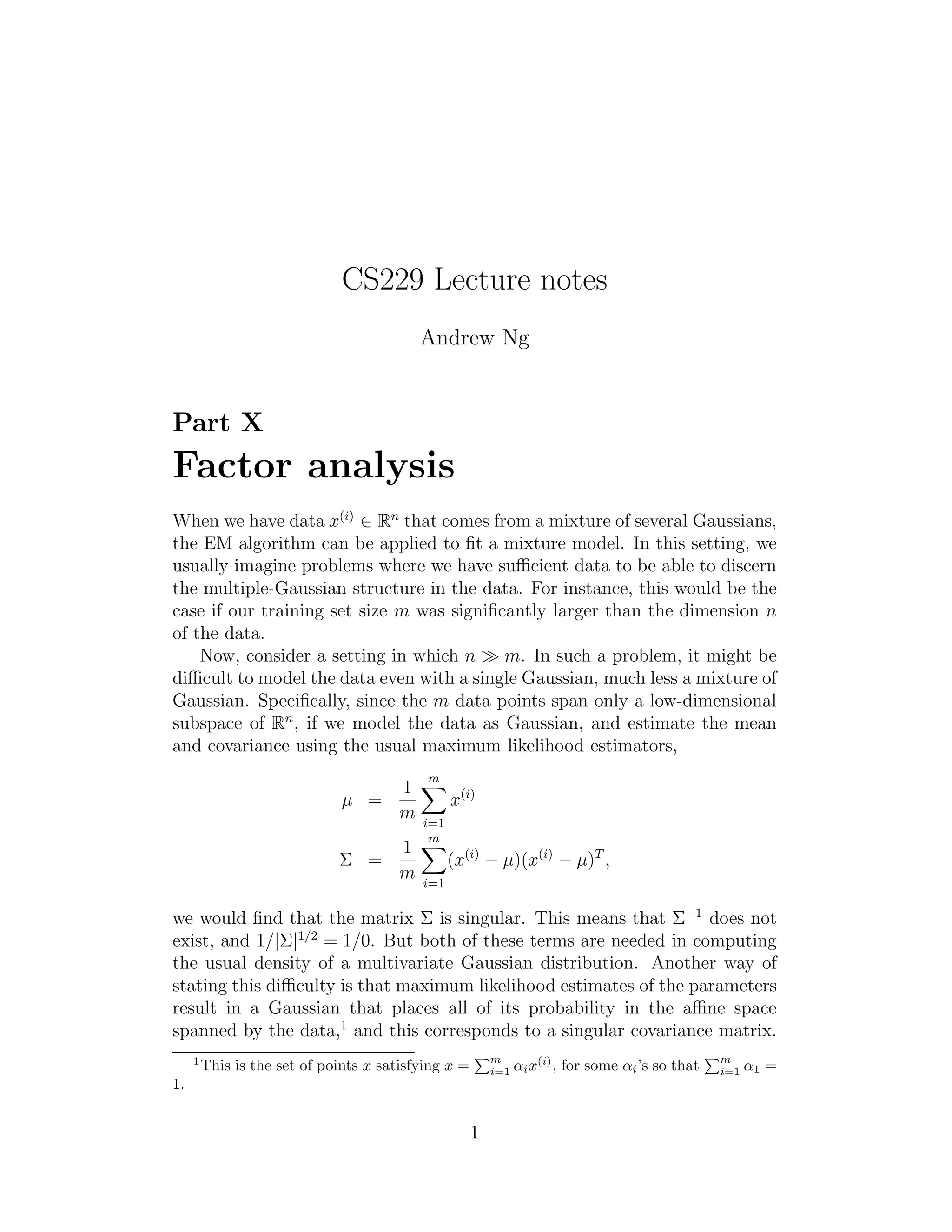
Now, consider a setting in which n ≫ m. In such a problem, it might be 
difficult to model the data even with a single Gaussian, much less a mixture of 
Gaussian. Specifically, since the m data points span only a low-dimensional 
subspace of Rn, if we model the data as Gaussian, and estimate the mean 
and covariance using the usual maximum likelihood estimators, 
μ = 
1 
m 
Xm 
i=1 
x(i) 
 = 
1 
m 
Xm 
i=1 
(x(i) − μ)(x(i) − μ)T , 
we would find that the matrix  is singular. This means that −1 does not 
exist, and 1/||1/2 = 1/0. But both of these terms are needed in computing 
the usual density of a multivariate Gaussian distribution. Another way of 
stating this difficulty is that maximum likelihood estimates of the parameters 
result in a Gaussian that places all of its probability in the affine space 
spanned by the data,1 and this corresponds to a singular covariance matrix. 
1This is the set of points x satisfying x = 
Pm 
i=1 ix(i), for some i’s so that 
Pm 
i=1 1 = 
1. 
1
2 
More generally, unless m exceeds n by some reasonable amount, the max- 
imum likelihood estimates of the mean and covariance may be quite poor. 
Nonetheless, we would still like to be able to fit a reasonable Gaussian model 
to the data, and perhaps capture some interesting covariance structure in 
the data. How can we do this? 
In the next section, we begin by reviewing two possible restrictions on 
, ones that allow us to fit  with small amounts of data but neither of 
which will give a satisfactory solution to our problem. We next discuss some 
properties of Gaussians that will be needed later; specifically, how to find 
marginal and conditonal distributions of Gaussians. Finally, we present the 
factor analysis model, and EM for it. 
1 Restrictions of  
If we do not have sufficient data to fit a full covariance matrix, we may 
place some restrictions on the space of matrices  that we will consider. For 
instance, we may choose to fit a covariance matrix  that is diagonal. In this 
setting, the reader may easily verify that the maximum likelihood estimate 
of the covariance matrix is given by the diagonal matrix  satisfying 
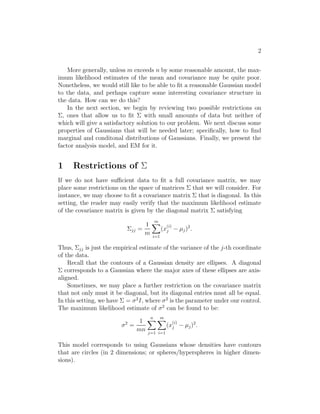
jj = 
1 
m 
Xm 
i=1 
(x(i) 
j − μj)2. 
Thus, jj is just the empirical estimate of the variance of the j-th coordinate 
of the data. 
Recall that the contours of a Gaussian density are ellipses. A diagonal 
 corresponds to a Gaussian where the major axes of these ellipses are axis- 
aligned. 
Sometimes, we may place a further restriction on the covariance matrix 
that not only must it be diagonal, but its diagonal entries must all be equal. 
In this setting, we have  = σ2I, where σ2 is the parameter under our control. 
The maximum likelihood estimate of σ2 can be found to be: 
σ2 = 
1 
mn 
Xn 
j=1 
Xm 
i=1 
(x(i) 
j − μj)2. 
This model corresponds to using Gaussians whose densities have contours 
that are circles (in 2 dimensions; or spheres/hyperspheres in higher dimen- 
sions).
3 
If we were fitting a full, unconstrained, covariance matrix  to data, it 
was necessary that m ≥ n + 1 in order for the maximum likelihood estimate 
of  not to be singular. Under either of the two restrictions above, we may 
obtain non-singular  when m ≥ 2. 
However, restricting  to be diagonal also means modeling the different 
coordinates xi, xj of the data as being uncorrelated and independent. Often, 
it would be nice to be able to capture some interesting correlation structure 
in the data. If we were to use either of the restrictions on  described above, 
we would therefore fail to do so. In this set of notes, we will describe the 
factor analysis model, which uses more parameters than the diagonal  and 
captures some correlations in the data, but also without having to fit a full 
covariance matrix. 
2 Marginals and conditionals of Gaussians 
Before describing factor analysis, we digress to talk about how to find condi- 
tional and marginal distributions of random variables with a joint multivari- 
ate Gaussian distribution. 
Suppose we have a vector-valued random variable 
x = 
 
x1 
x2 
 
, 
where x1 ∈ Rr, x2 ∈ Rs, and x ∈ Rr+s. Suppose x ∼ N(μ,), where 
μ = 
 
μ1 
μ2 
 
,  = 
 
11 12 
21 22 
 
. 
Here, μ1 ∈ Rr, μ2 ∈ Rs, 11 ∈ Rr×r, 12 ∈ Rr×s, and so on. Note that since 
covariance matrices are symmetric, 12 = T 21. 
Under our assumptions, x1 and x2 are jointly multivariate Gaussian. 
What is the marginal distribution of x1? It is not hard to see that E[x1] = μ1, 
and that Cov(x1) = E[(x1 − μ1)(x1 − μ1)] = 11. To see that the latter is 
true, note that by definition of the joint covariance of x1 and x2, we have
4 
that 
Cov(x) =  
= 
 
11 12 
21 22 
 
= E[(x − μ)(x − μ)T ] 
= E 
 
x1 − μ1 
x2 − μ2 
 
x1 − μ1 
x2 − μ2 
T 
# 
= E 
 
(x1 − μ1)(x1 − μ1)T (x1 − μ1)(x2 − μ2)T 
(x2 − μ2)(x1 − μ1)T (x2 − μ2)(x2 − μ2)T 
 
. 
Matching the upper-left subblocks in the matrices in the second and the last 
lines above gives the result. 
Since marginal distributions of Gaussians are themselves Gaussian, we 
therefore have that the marginal distribution of x1 is given by x1 ∼ N(μ1,11). 
Also, we can ask, what is the conditional distribution of x1 given x2? By 
referring to the definition of the multivariate Gaussian distribution, it can 
be shown that x1|x2 ∼ N(μ1|2,1|2), where 
μ1|2 = μ1 + 12−1 
22 (x2 − μ2), (1) 
1|2 = 11 − 12−1 
22 21. (2) 
When working with the factor analysis model in the next section, these 
formulas for finding conditional and marginal distributions of Gaussians will 
be very useful. 
3 The Factor analysis model 
In the factor analysis model, we posit a joint distribution on (x, z) as follows, 
where z ∈ Rk is a latent random variable: 
z ∼ N(0, I) 
x|z ∼ N(μ + z,	). 
Here, the parameters of our model are the vector μ ∈ Rn, the matrix 
 ∈ Rn×k, and the diagonal matrix 	 ∈ Rn×n. The value of k is usually 
chosen to be smaller than n.
5 
Thus, we imagine that each datapoint x(i) is generated by sampling a k 
dimension multivariate Gaussian z(i). Then, it is mapped to a k-dimensional 
affine space of Rn by computing μ+z(i). Lastly, x(i) is generated by adding 
covariance 	 noise to μ + z(i). 
Equivalently (convince yourself that this is the case), we can therefore 
also define the factor analysis model according to 
z ∼ N(0, I) 
ǫ ∼ N(0,	) 
x = μ + z + ǫ. 
where ǫ and z are independent. 
Let’s work out exactly what distribution our model defines. Our random 
variables z and x have a joint Gaussian distribution 
 
z 
x 
 
∼ N(μzx,). 
We will now find μzx and . 
We know that E[z] = 0, from the fact that z ∼ N(0, I). Also, we have 
that 
E[x] = E[μ + z + ǫ] 
= μ + E[z] + E[ǫ] 
= μ. 
Putting these together, we obtain 
μzx = 
 
~0 
μ 
 
Next, to find, , we need to calculate zz = E[(z − E[z])(z − E[z])T ] (the 
upper-left block of ), zx = E[(z − E[z])(x − E[x])T ] (upper-right block), 
and xx = E[(x − E[x])(x − E[x])T ] (lower-right block). 
Now, since z ∼ N(0, I), we easily find that zz = Cov(z) = I. Also, 
E[(z − E[z])(x − E[x])T ] = E[z(μ + z + ǫ − μ)T ] 
= E[zzT ]T + E[zǫT ] 
= T . 
In the last step, we used the fact that E[zzT ] = Cov(z) (since z has zero 
mean), and E[zǫT ] = E[z]E[ǫT ] = 0 (since z and ǫ are independent, and
6 
hence the expectation of their product is the product of their expectations). 
Similarly, we can find xx as follows: 
E[(x − E[x])(x − E[x])T ] = E[(μ + z + ǫ − μ)(μ + z + ǫ − μ)T ] 
= E[zzTT + ǫzTT + zǫT + ǫǫT ] 
= E[zzT ]T + E[ǫǫT ] 
= T + 	. 
Putting everything together, we therefore have that 
 
z 
x 
 
∼ N 
 
~0 
μ 
 
, 
 
I T 
 T + 	 
 
. (3) 
Hence, we also see that the marginal distribution of x is given by x ∼ 
N(μ, T +	). Thus, given a training set {x(i); i = 1, . . . ,m}, we can write 
down the log likelihood of the parameters: 
ℓ(μ, ,	) = log 
Ym 
i=1 
1 
(2π)n/2|T + 	|1/2 exp 
 
− 
1 
2 
(x(i) − μ)T (T + 	)−1(x(i) − μ) 
 
. 
To perform maximum likelihood estimation, we would like to maximize this 
quantity with respect to the parameters. But maximizing this formula ex- 
plicitly is hard (try it yourself), and we are aware of no algorithm that does 
so in closed-form. So, we will instead use to the EM algorithm. In the next 
section, we derive EM for factor analysis. 
4 EM for factor analysis 
The derivation for the E-step is easy. We need to compute Qi(z(i)) = 
p(z(i)|x(i); μ, ,	). By substituting the distribution given in Equation (3) 
into the formulas (1-2) used for finding the conditional distribution of a 
Gaussian, we find that z(i)|x(i); μ, ,	 ∼ N(μz(i)|x(i) ,z(i)|x(i)), where 
μz(i)|x(i) = T (T + 	)−1(x(i) − μ), 
z(i)|x(i) = I − T (T + 	)−1. 
So, using these definitions for μz(i)|x(i) and z(i)|x(i) , we have 
Qi(z(i)) = 
1 
(2π)k/2|z(i)|x(i) |1/2 exp 
 
− 
1 
2 
(z(i) − μz(i)|x(i))T−1 
z(i)|x(i)(z(i) − μz(i)|x(i)) 
 
.
7 
Let’s now work out the M-step. Here, we need to maximize 
Xm 
i=1 
Z 
z(i) 
Qi(z(i)) log 
p(x(i), z(i); μ, ,	) 
Qi(z(i)) 
dz(i) (4) 
with respect to the parameters μ, ,	. We will work out only the optimiza- 
tion with respect to , and leave the derivations of the updates for μ and 	 
as an exercise to the reader. 
We can simplify Equation (4) as follows: 
Xm 
i=1 
Z 
z(i) 
Qi(z(i)) 
 
log p(x(i)|z(i); μ, ,	) + log p(z(i)) − logQi(z(i)) 
 
dz(i) (5) 
= 
Xm 
i=1 
Ez(i)Qi 
 
log p(x(i)|z(i); μ, ,	) + log p(z(i)) − logQi(z(i)) 
 
(6) 
Here, the “z(i) ∼ Qi” subscript indicates that the expectation is with respect 
to z(i) drawn from Qi. In the subsequent development, we will omit this 
subscript when there is no risk of ambiguity. Dropping terms that do not 
depend on the parameters, we find that we need to maximize: 
Xm 
i=1 
E 
 
log p(x(i)|z(i); μ, ,	) 
 
= 
Xm 
i=1 
E 
 
log 
1 
(2π)n/2|	|1/2 exp 
 
− 
1 
2 
(x(i) − μ − z(i))T	−1(x(i) − μ − z(i)) 
 
= 
Xm 
i=1 
E 
 
− 
1 
2 
log |	| − 
n 
2 
log(2π) − 
1 
2 
(x(i) − μ − z(i))T	−1(x(i) − μ − z(i)) 
 
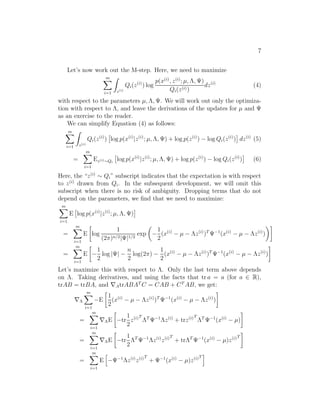
Let’s maximize this with respect to . Only the last term above depends 
on . Taking derivatives, and using the facts that tr a = a (for a ∈ R), 
trAB = trBA, and ∇AtrABATC = CAB + CTAB, we get: 
∇ 
Xm 
i=1 
−E 
 
1 
2 
(x(i) − μ − z(i))T	−1(x(i) − μ − z(i)) 
 
= 
Xm 
i=1 
∇E 
 
−tr 
1 
2 
z(i)T 
T	−1z(i) + trz(i)T 
T	−1(x(i) − μ) 
 
= 
Xm 
i=1 
∇E 
 
−tr 
1 
2 
T	−1z(i)z(i)T 
+ trT	−1(x(i) − μ)z(i)T 
 
= 
Xm 
i=1 
E 
h 
−	−1z(i)z(i)T 
+ 	−1(x(i) − μ)z(i)T 
i
8 
Setting this to zero and simplifying, we get: 
Xm 
i=1 
Ez(i)Qi 
h 
z(i)z(i)T 
i 
= 
Xm 
i=1 
(x(i) − μ)Ez(i)Qi 
h 
z(i)T 
i 
. 
Hence, solving for , we obtain 
 = 
  
Xm 
i=1 
(x(i) − μ)Ez(i)Qi 
h 
z(i)T 
i!  
Xm 
i=1 
Ez(i)Qi 
h 
z(i)z(i)T 
i!−1 
. (7) 
It is interesting to note the close relationship between this equation and the 
normal equation that we’d derived for least squares regression, 
“θT = (yTX)(XTX)−1.” 
The analogy is that here, the x’s are a linear function of the z’s (plus noise). 
Given the “guesses” for z that the E-step has found, we will now try to 
estimate the unknown linearity  relating the x’s and z’s. It is therefore 
no surprise that we obtain something similar to the normal equation. There 
is, however, one important difference between this and an algorithm that 
performs least squares using just the “best guesses” of the z’s; we will see 
this difference shortly. 
To complete our M-step update, let’s work out the values of the expecta- 
tions in Equation (7). From our definition of Qi being Gaussian with mean 
μz(i)|x(i) and covariance z(i)|x(i) , we easily find 
Ez(i)Qi 
h 
z(i)T 
i 
= μT 
z(i)|x(i) 
Ez(i)Qi 
h 
z(i)z(i)T 
i 
= μz(i)|x(i)μT 
z(i)|x(i) + z(i)|x(i) . 
The latter comes from the fact that, for a random variable Y , Cov(Y ) = 
E[Y Y T ]−E[Y ]E[Y ]T , and hence E[Y Y T ] = E[Y ]E[Y ]T +Cov(Y ). Substitut- 
ing this back into Equation (7), we get the M-step update for : 
 = 
  
Xm 
i=1 
(x(i) − μ)μT 
z(i)|x(i) 
!  
Xm 
i=1 
μz(i)|x(i)μT 
z(i)|x(i) + z(i)|x(i) 
!−1 
. (8) 
It is important to note the presence of the z(i)|x(i) on the right hand side of 
this equation. This is the covariance in the posterior distribution p(z(i)|x(i)) 
of z(i) give x(i), and the M-step must take into account this uncertainty
9 
about z(i) in the posterior. A common mistake in deriving EM is to assume 
that in the E-step, we need to calculate only expectation E[z] of the latent 
random variable z, and then plug that into the optimization in the M-step 
everywhere z occurs. While this worked for simple problems such as the 
mixture of Gaussians, in our derivation for factor analysis, we needed E[zzT ] 
as well E[z]; and as we saw, E[zzT ] and E[z]E[z]T differ by the quantity z|x. 
Thus, the M-step update must take into account the covariance of z in the 
posterior distribution p(z(i)|x(i)). 
Lastly, we can also find the M-step optimizations for the parameters μ 
and 	. It is not hard to show that the first is given by 
μ = 
1 
m 
Xm 
i=1 
x(i). 
Since this doesn’t change as the parameters are varied (i.e., unlike the update 
for , the right hand side does not depend on Qi(z(i)) = p(z(i)|x(i); μ, ,	), 
which in turn depends on the parameters), this can be calculated just once 
and needs not be further updated as the algorithm is run. Similarly, the 
diagonal 	 can be found by calculating 
 = 
1 
m 
Xm 
i=1 
x(i)x(i)T 
−x(i)μT 
z(i)|x(i)T−μz(i)|x(i)x(i)T 
+(μz(i)|x(i)μT 
z(i)|x(i)+z(i)|x(i))T , 
and setting 	ii = ii (i.e., letting 	 be the diagonal matrix containing only 
the diagonal entries of ).

Machine learning (10)

  • 1.
    CS229 Lecture notes Andrew Ng Part X Factor analysis When we have data x(i) ∈ Rn that comes from a mixture of several Gaussians, the EM algorithm can be applied to fit a mixture model. In this setting, we usually imagine problems where we have sufficient data to be able to discern the multiple-Gaussian structure in the data. For instance, this would be the case if our training set size m was significantly larger than the dimension n of the data. Now, consider a setting in which n ≫ m. In such a problem, it might be difficult to model the data even with a single Gaussian, much less a mixture of Gaussian. Specifically, since the m data points span only a low-dimensional subspace of Rn, if we model the data as Gaussian, and estimate the mean and covariance using the usual maximum likelihood estimators, μ = 1 m Xm i=1 x(i) = 1 m Xm i=1 (x(i) − μ)(x(i) − μ)T , we would find that the matrix is singular. This means that −1 does not exist, and 1/||1/2 = 1/0. But both of these terms are needed in computing the usual density of a multivariate Gaussian distribution. Another way of stating this difficulty is that maximum likelihood estimates of the parameters result in a Gaussian that places all of its probability in the affine space spanned by the data,1 and this corresponds to a singular covariance matrix. 1This is the set of points x satisfying x = Pm i=1 ix(i), for some i’s so that Pm i=1 1 = 1. 1
  • 2.
    2 More generally,unless m exceeds n by some reasonable amount, the max- imum likelihood estimates of the mean and covariance may be quite poor. Nonetheless, we would still like to be able to fit a reasonable Gaussian model to the data, and perhaps capture some interesting covariance structure in the data. How can we do this? In the next section, we begin by reviewing two possible restrictions on , ones that allow us to fit with small amounts of data but neither of which will give a satisfactory solution to our problem. We next discuss some properties of Gaussians that will be needed later; specifically, how to find marginal and conditonal distributions of Gaussians. Finally, we present the factor analysis model, and EM for it. 1 Restrictions of If we do not have sufficient data to fit a full covariance matrix, we may place some restrictions on the space of matrices that we will consider. For instance, we may choose to fit a covariance matrix that is diagonal. In this setting, the reader may easily verify that the maximum likelihood estimate of the covariance matrix is given by the diagonal matrix satisfying jj = 1 m Xm i=1 (x(i) j − μj)2. Thus, jj is just the empirical estimate of the variance of the j-th coordinate of the data. Recall that the contours of a Gaussian density are ellipses. A diagonal corresponds to a Gaussian where the major axes of these ellipses are axis- aligned. Sometimes, we may place a further restriction on the covariance matrix that not only must it be diagonal, but its diagonal entries must all be equal. In this setting, we have = σ2I, where σ2 is the parameter under our control. The maximum likelihood estimate of σ2 can be found to be: σ2 = 1 mn Xn j=1 Xm i=1 (x(i) j − μj)2. This model corresponds to using Gaussians whose densities have contours that are circles (in 2 dimensions; or spheres/hyperspheres in higher dimen- sions).
  • 3.
    3 If wewere fitting a full, unconstrained, covariance matrix to data, it was necessary that m ≥ n + 1 in order for the maximum likelihood estimate of not to be singular. Under either of the two restrictions above, we may obtain non-singular when m ≥ 2. However, restricting to be diagonal also means modeling the different coordinates xi, xj of the data as being uncorrelated and independent. Often, it would be nice to be able to capture some interesting correlation structure in the data. If we were to use either of the restrictions on described above, we would therefore fail to do so. In this set of notes, we will describe the factor analysis model, which uses more parameters than the diagonal and captures some correlations in the data, but also without having to fit a full covariance matrix. 2 Marginals and conditionals of Gaussians Before describing factor analysis, we digress to talk about how to find condi- tional and marginal distributions of random variables with a joint multivari- ate Gaussian distribution. Suppose we have a vector-valued random variable x = x1 x2 , where x1 ∈ Rr, x2 ∈ Rs, and x ∈ Rr+s. Suppose x ∼ N(μ,), where μ = μ1 μ2 , = 11 12 21 22 . Here, μ1 ∈ Rr, μ2 ∈ Rs, 11 ∈ Rr×r, 12 ∈ Rr×s, and so on. Note that since covariance matrices are symmetric, 12 = T 21. Under our assumptions, x1 and x2 are jointly multivariate Gaussian. What is the marginal distribution of x1? It is not hard to see that E[x1] = μ1, and that Cov(x1) = E[(x1 − μ1)(x1 − μ1)] = 11. To see that the latter is true, note that by definition of the joint covariance of x1 and x2, we have
  • 4.
    4 that Cov(x)= = 11 12 21 22 = E[(x − μ)(x − μ)T ] = E x1 − μ1 x2 − μ2 x1 − μ1 x2 − μ2 T # = E (x1 − μ1)(x1 − μ1)T (x1 − μ1)(x2 − μ2)T (x2 − μ2)(x1 − μ1)T (x2 − μ2)(x2 − μ2)T . Matching the upper-left subblocks in the matrices in the second and the last lines above gives the result. Since marginal distributions of Gaussians are themselves Gaussian, we therefore have that the marginal distribution of x1 is given by x1 ∼ N(μ1,11). Also, we can ask, what is the conditional distribution of x1 given x2? By referring to the definition of the multivariate Gaussian distribution, it can be shown that x1|x2 ∼ N(μ1|2,1|2), where μ1|2 = μ1 + 12−1 22 (x2 − μ2), (1) 1|2 = 11 − 12−1 22 21. (2) When working with the factor analysis model in the next section, these formulas for finding conditional and marginal distributions of Gaussians will be very useful. 3 The Factor analysis model In the factor analysis model, we posit a joint distribution on (x, z) as follows, where z ∈ Rk is a latent random variable: z ∼ N(0, I) x|z ∼ N(μ + z, ). Here, the parameters of our model are the vector μ ∈ Rn, the matrix ∈ Rn×k, and the diagonal matrix ∈ Rn×n. The value of k is usually chosen to be smaller than n.
  • 5.
    5 Thus, weimagine that each datapoint x(i) is generated by sampling a k dimension multivariate Gaussian z(i). Then, it is mapped to a k-dimensional affine space of Rn by computing μ+z(i). Lastly, x(i) is generated by adding covariance noise to μ + z(i). Equivalently (convince yourself that this is the case), we can therefore also define the factor analysis model according to z ∼ N(0, I) ǫ ∼ N(0, ) x = μ + z + ǫ. where ǫ and z are independent. Let’s work out exactly what distribution our model defines. Our random variables z and x have a joint Gaussian distribution z x ∼ N(μzx,). We will now find μzx and . We know that E[z] = 0, from the fact that z ∼ N(0, I). Also, we have that E[x] = E[μ + z + ǫ] = μ + E[z] + E[ǫ] = μ. Putting these together, we obtain μzx = ~0 μ Next, to find, , we need to calculate zz = E[(z − E[z])(z − E[z])T ] (the upper-left block of ), zx = E[(z − E[z])(x − E[x])T ] (upper-right block), and xx = E[(x − E[x])(x − E[x])T ] (lower-right block). Now, since z ∼ N(0, I), we easily find that zz = Cov(z) = I. Also, E[(z − E[z])(x − E[x])T ] = E[z(μ + z + ǫ − μ)T ] = E[zzT ]T + E[zǫT ] = T . In the last step, we used the fact that E[zzT ] = Cov(z) (since z has zero mean), and E[zǫT ] = E[z]E[ǫT ] = 0 (since z and ǫ are independent, and
  • 6.
    6 hence theexpectation of their product is the product of their expectations). Similarly, we can find xx as follows: E[(x − E[x])(x − E[x])T ] = E[(μ + z + ǫ − μ)(μ + z + ǫ − μ)T ] = E[zzTT + ǫzTT + zǫT + ǫǫT ] = E[zzT ]T + E[ǫǫT ] = T + . Putting everything together, we therefore have that z x ∼ N ~0 μ , I T T + . (3) Hence, we also see that the marginal distribution of x is given by x ∼ N(μ, T + ). Thus, given a training set {x(i); i = 1, . . . ,m}, we can write down the log likelihood of the parameters: ℓ(μ, , ) = log Ym i=1 1 (2π)n/2|T + |1/2 exp − 1 2 (x(i) − μ)T (T + )−1(x(i) − μ) . To perform maximum likelihood estimation, we would like to maximize this quantity with respect to the parameters. But maximizing this formula ex- plicitly is hard (try it yourself), and we are aware of no algorithm that does so in closed-form. So, we will instead use to the EM algorithm. In the next section, we derive EM for factor analysis. 4 EM for factor analysis The derivation for the E-step is easy. We need to compute Qi(z(i)) = p(z(i)|x(i); μ, , ). By substituting the distribution given in Equation (3) into the formulas (1-2) used for finding the conditional distribution of a Gaussian, we find that z(i)|x(i); μ, , ∼ N(μz(i)|x(i) ,z(i)|x(i)), where μz(i)|x(i) = T (T + )−1(x(i) − μ), z(i)|x(i) = I − T (T + )−1. So, using these definitions for μz(i)|x(i) and z(i)|x(i) , we have Qi(z(i)) = 1 (2π)k/2|z(i)|x(i) |1/2 exp − 1 2 (z(i) − μz(i)|x(i))T−1 z(i)|x(i)(z(i) − μz(i)|x(i)) .
  • 7.
    7 Let’s nowwork out the M-step. Here, we need to maximize Xm i=1 Z z(i) Qi(z(i)) log p(x(i), z(i); μ, , ) Qi(z(i)) dz(i) (4) with respect to the parameters μ, , . We will work out only the optimiza- tion with respect to , and leave the derivations of the updates for μ and as an exercise to the reader. We can simplify Equation (4) as follows: Xm i=1 Z z(i) Qi(z(i)) log p(x(i)|z(i); μ, , ) + log p(z(i)) − logQi(z(i)) dz(i) (5) = Xm i=1 Ez(i)Qi log p(x(i)|z(i); μ, , ) + log p(z(i)) − logQi(z(i)) (6) Here, the “z(i) ∼ Qi” subscript indicates that the expectation is with respect to z(i) drawn from Qi. In the subsequent development, we will omit this subscript when there is no risk of ambiguity. Dropping terms that do not depend on the parameters, we find that we need to maximize: Xm i=1 E log p(x(i)|z(i); μ, , ) = Xm i=1 E log 1 (2π)n/2| |1/2 exp − 1 2 (x(i) − μ − z(i))T −1(x(i) − μ − z(i)) = Xm i=1 E − 1 2 log | | − n 2 log(2π) − 1 2 (x(i) − μ − z(i))T −1(x(i) − μ − z(i)) Let’s maximize this with respect to . Only the last term above depends on . Taking derivatives, and using the facts that tr a = a (for a ∈ R), trAB = trBA, and ∇AtrABATC = CAB + CTAB, we get: ∇ Xm i=1 −E 1 2 (x(i) − μ − z(i))T −1(x(i) − μ − z(i)) = Xm i=1 ∇E −tr 1 2 z(i)T T −1z(i) + trz(i)T T −1(x(i) − μ) = Xm i=1 ∇E −tr 1 2 T −1z(i)z(i)T + trT −1(x(i) − μ)z(i)T = Xm i=1 E h − −1z(i)z(i)T + −1(x(i) − μ)z(i)T i
  • 8.
    8 Setting thisto zero and simplifying, we get: Xm i=1 Ez(i)Qi h z(i)z(i)T i = Xm i=1 (x(i) − μ)Ez(i)Qi h z(i)T i . Hence, solving for , we obtain = Xm i=1 (x(i) − μ)Ez(i)Qi h z(i)T i! Xm i=1 Ez(i)Qi h z(i)z(i)T i!−1 . (7) It is interesting to note the close relationship between this equation and the normal equation that we’d derived for least squares regression, “θT = (yTX)(XTX)−1.” The analogy is that here, the x’s are a linear function of the z’s (plus noise). Given the “guesses” for z that the E-step has found, we will now try to estimate the unknown linearity relating the x’s and z’s. It is therefore no surprise that we obtain something similar to the normal equation. There is, however, one important difference between this and an algorithm that performs least squares using just the “best guesses” of the z’s; we will see this difference shortly. To complete our M-step update, let’s work out the values of the expecta- tions in Equation (7). From our definition of Qi being Gaussian with mean μz(i)|x(i) and covariance z(i)|x(i) , we easily find Ez(i)Qi h z(i)T i = μT z(i)|x(i) Ez(i)Qi h z(i)z(i)T i = μz(i)|x(i)μT z(i)|x(i) + z(i)|x(i) . The latter comes from the fact that, for a random variable Y , Cov(Y ) = E[Y Y T ]−E[Y ]E[Y ]T , and hence E[Y Y T ] = E[Y ]E[Y ]T +Cov(Y ). Substitut- ing this back into Equation (7), we get the M-step update for : = Xm i=1 (x(i) − μ)μT z(i)|x(i) ! Xm i=1 μz(i)|x(i)μT z(i)|x(i) + z(i)|x(i) !−1 . (8) It is important to note the presence of the z(i)|x(i) on the right hand side of this equation. This is the covariance in the posterior distribution p(z(i)|x(i)) of z(i) give x(i), and the M-step must take into account this uncertainty
  • 9.
    9 about z(i)in the posterior. A common mistake in deriving EM is to assume that in the E-step, we need to calculate only expectation E[z] of the latent random variable z, and then plug that into the optimization in the M-step everywhere z occurs. While this worked for simple problems such as the mixture of Gaussians, in our derivation for factor analysis, we needed E[zzT ] as well E[z]; and as we saw, E[zzT ] and E[z]E[z]T differ by the quantity z|x. Thus, the M-step update must take into account the covariance of z in the posterior distribution p(z(i)|x(i)). Lastly, we can also find the M-step optimizations for the parameters μ and . It is not hard to show that the first is given by μ = 1 m Xm i=1 x(i). Since this doesn’t change as the parameters are varied (i.e., unlike the update for , the right hand side does not depend on Qi(z(i)) = p(z(i)|x(i); μ, , ), which in turn depends on the parameters), this can be calculated just once and needs not be further updated as the algorithm is run. Similarly, the diagonal can be found by calculating = 1 m Xm i=1 x(i)x(i)T −x(i)μT z(i)|x(i)T−μz(i)|x(i)x(i)T +(μz(i)|x(i)μT z(i)|x(i)+z(i)|x(i))T , and setting ii = ii (i.e., letting be the diagonal matrix containing only the diagonal entries of ).