12.3 Directory Implementation
The selection of directory-allocation and directory-management
algorithms has a large effect on the efficiency, performance, and reliability
of the file system.
There are two methods :-
1. Linear List
2. Hash Table
1.Linear List
The simplest method of implementing a directory is to use a linear list
of file names with pointers to the data blocks.
A linear list of directory entries requires a linear search to find a
particular entry.
This method is simple to program but time-consuming to execute.
 To create a new file, we must first search the directory to be sure that
no existing file has the same name. Then, we add a new entry at the end
of the directory.
To delete a file, we search the directory for the named file, then
release the space allocated to it.
To reuse the directory entry, we can do one of several things.
 We can mark the entry as unused or
 we can attach it to a list of free directory entries.
 A third alternative is to copy the last entry in the directory into
the freed location, and to decrease the length of the directory.

Continues…
A linked list can also be used to decrease the time to delete a file.
 The real disadvantage of a linear list of directory entries is the linear
search to find a file.
Time-consuming to search for file name in (long) lists
Hash Table
In this method, a linear list stores the directory entries, but a hash data
structure is also used.
The hash table takes a value computed from the file name and returns
a pointer to the file name in the linear list.
Therefore, it can greatly decrease the directory search time.
 Insertion and deletion are also fairly straightforward.
Collisions – situations where two file names hash to the same location
The major difficulties with a hash table are its generally fixed size and
the dependence of the hash function on that size.
Example for hash table
For example, assume that we make a hash table that holds 64 entries.
The hash function converts file names into integers from 0 to 63, for
instance, by using the remainder of a division by 64.
 If we later try to create a 65th file, we must enlarge the directory hash
table-say, to 128 entries.
As a result, we need a new hash function that must map file names to
the range 0 to 127, and we must reorganize the existing directory entries
to reflect their new hash-function values.
 Alternately, a chained-overflow hash table can be used. Each hash
entry can be a linked list instead of an individual value, and we can resolve
collisions by adding the new entry to the linked list.
Allocation Methods
The allocation methods define how the files are stored in the disk blocks.
There are three main disk space or file allocation methods.
1. Contiguous Allocation
2. Linked Allocation
3. Indexed Allocation
The main idea behind these methods is to provide:
Efficient disk space utilization.
Fast access to the file blocks.
All the three methods have their own advantages and disadvantages as
discussed below:
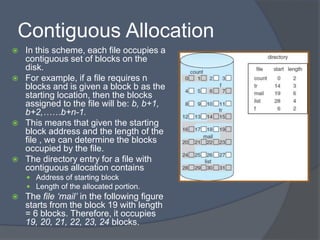
Contiguous Allocation
 In this scheme, each file occupies a
contiguous set of blocks on the
disk.
 For example, if a file requires n
blocks and is given a block b as the
starting location, then the blocks
assigned to the file will be: b, b+1,
b+2,……b+n-1.
 This means that given the starting
block address and the length of the
file , we can determine the blocks
occupied by the file.
 The directory entry for a file with
contiguous allocation contains
 Address of starting block
 Length of the allocated portion.
 The file ‘mail’ in the following figure
starts from the block 19 with length
= 6 blocks. Therefore, it occupies
19, 20, 21, 22, 23, 24 blocks.
Contiguous Allocation
(cont’d)
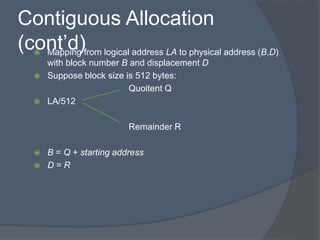
 Mapping from logical address LA to physical address (B,D)
with block number B and displacement D
 Suppose block size is 512 bytes:
Quoitent Q
 LA/512
Remainder R
 B = Q + starting address
 D = R
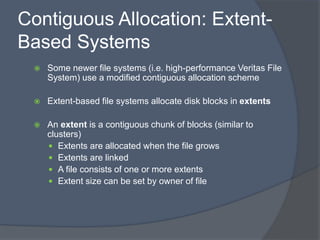
Contiguous Allocation: Extent-
Based Systems
 Some newer file systems (i.e. high-performance Veritas File
System) use a modified contiguous allocation scheme
 Extent-based file systems allocate disk blocks in extents
 An extent is a contiguous chunk of blocks (similar to
clusters)
 Extents are allocated when the file grows
 Extents are linked
 A file consists of one or more extents
 Extent size can be set by owner of file
Advantages &
Disadvantages
Advantages:
Both the Sequential and Direct Accesses are supported by this. For
direct access, the address of the kth block of the file which starts at
block b can easily be obtained as (b+k).
This is extremely fast since the number of seeks are minimal
because of contiguous allocation of file blocks.
Disadvantages:
This method suffers from both internal and external fragmentation.
This makes it inefficient in terms of memory utilization.
Increasing file size is difficult because it depends on the availability of
contiguous memory at a particular instance.
Determining the amount of space needed for a file, when the file is
created is very difficult to estimate.
Linked Allocation
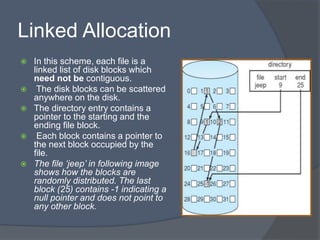
 In this scheme, each file is a
linked list of disk blocks which
need not be contiguous.
 The disk blocks can be scattered
anywhere on the disk.
 The directory entry contains a
pointer to the starting and the
ending file block.
 Each block contains a pointer to
the next block occupied by the
file.
 The file ‘jeep’ in following image
shows how the blocks are
randomly distributed. The last
block (25) contains -1 indicating a
null pointer and does not point to
any other block.
Linked Allocation (Cont.)
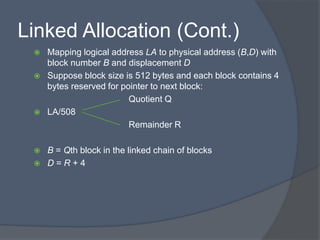
 Mapping logical address LA to physical address (B,D) with
block number B and displacement D
 Suppose block size is 512 bytes and each block contains 4
bytes reserved for pointer to next block:
Quotient Q
 LA/508
Remainder R
 B = Qth block in the linked chain of blocks
 D = R + 4
File-Allocation Table (FAT)
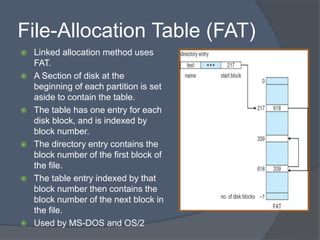
 Linked allocation method uses
FAT.
 A Section of disk at the
beginning of each partition is set
aside to contain the table.
 The table has one entry for each
disk block, and is indexed by
block number.
 The directory entry contains the
block number of the first block of
the file.
 The table entry indexed by that
block number then contains the
block number of the next block in
the file.
 Used by MS-DOS and OS/2
Advantages &
Disadvantages
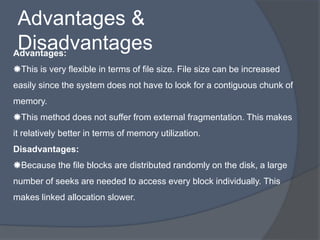
Advantages:
This is very flexible in terms of file size. File size can be increased
easily since the system does not have to look for a contiguous chunk of
memory.
This method does not suffer from external fragmentation. This makes
it relatively better in terms of memory utilization.
Disadvantages:
Because the file blocks are distributed randomly on the disk, a large
number of seeks are needed to access every block individually. This
makes linked allocation slower.
Advantages &
Disadvantages
It does not support random or direct access. A block k of a file can be
accessed by traversing k blocks sequentially from the starting block of
the file via block pointers.
Pointers required in the linked allocation incur some extra overhead.
Another problem in linked allocation is reliability. If a pointer were lost
or damaged, it might result in picking up the wrong pointer.
Indexed Allocation
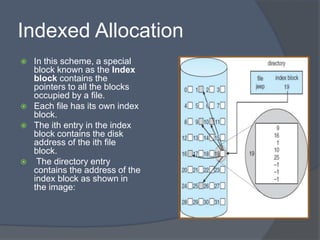
 In this scheme, a special
block known as the Index
block contains the
pointers to all the blocks
occupied by a file.
 Each file has its own index
block.
 The ith entry in the index
block contains the disk
address of the ith file
block.
 The directory entry
contains the address of the
index block as shown in
the image:
Indexed Allocation (Cont.)
 Mapping from logical address LA to physical address (B,D)
 Assume block size of 512 bytes
 Need one block for index table with 128 pointers
(assuming pointers of 4 bytes each)
 Files have maximum size of 64K bytes
Q
 LA/512
R
 4 x Q = displacement into the index table to obtain B
 D = R = displacement into block
For files that are very large, single index block may not be able to hold
all the pointers.
Following mechanisms can be used to resolve this:
Linked scheme: This scheme links two or more index blocks together
for holding the pointers. Every index block would then contain a pointer
or the address to the next index block.
Multilevel index: In this policy, a first level index block is used to point
to the second level index blocks which in turn points to the disk blocks
occupied by the file. This can be extended to 3 or more levels
depending on the maximum file size.
Combined Scheme: In this scheme, a special block called the Inode
(information Node) contains all the information about the file such as
the name, size, authority, etc and the remaining space of Inode is used to
store the Disk Block addresses which contain the actual file as shown in
the image below.
The first few of these pointers in Inode point to the direct blocks i.e the
pointers contain the addresses of the disk blocks that contain data of the
file. The next few pointers point to indirect blocks. Indirect blocks may be
single indirect, double indirect or triple indirect.
Single Indirect block is the disk block that does not contain the file data
but the disk address of the blocks that contain the file data. Similarly,
double indirect blocks do not contain the file data but the disk address
of the blocks that contain the address of the blocks containing the file
Advantages &
Disadvantages
Advantages:
•This supports direct access to the blocks occupied by the file and
therefore provides fast access to the file blocks.
•It overcomes the problem of external fragmentation.
Disadvantages:
•The pointer overhead for indexed allocation is greater than linked
allocation.
•For very small files, say files that expand only 2-3 blocks, the indexed
allocation would keep one entire block (index block) for the pointers
which is inefficient in terms of memory utilization. However, in linked
allocation we lose the space of only 1 pointer per block.
THANKYO
U

File System Implementation.pptx

  • 2.
    12.3 Directory Implementation Theselection of directory-allocation and directory-management algorithms has a large effect on the efficiency, performance, and reliability of the file system. There are two methods :- 1. Linear List 2. Hash Table
  • 3.
    1.Linear List The simplestmethod of implementing a directory is to use a linear list of file names with pointers to the data blocks. A linear list of directory entries requires a linear search to find a particular entry. This method is simple to program but time-consuming to execute.  To create a new file, we must first search the directory to be sure that no existing file has the same name. Then, we add a new entry at the end of the directory. To delete a file, we search the directory for the named file, then release the space allocated to it. To reuse the directory entry, we can do one of several things.  We can mark the entry as unused or  we can attach it to a list of free directory entries.  A third alternative is to copy the last entry in the directory into the freed location, and to decrease the length of the directory. 
  • 4.
    Continues… A linked listcan also be used to decrease the time to delete a file.  The real disadvantage of a linear list of directory entries is the linear search to find a file. Time-consuming to search for file name in (long) lists
  • 5.
    Hash Table In thismethod, a linear list stores the directory entries, but a hash data structure is also used. The hash table takes a value computed from the file name and returns a pointer to the file name in the linear list. Therefore, it can greatly decrease the directory search time.  Insertion and deletion are also fairly straightforward. Collisions – situations where two file names hash to the same location The major difficulties with a hash table are its generally fixed size and the dependence of the hash function on that size.
  • 6.
    Example for hashtable For example, assume that we make a hash table that holds 64 entries. The hash function converts file names into integers from 0 to 63, for instance, by using the remainder of a division by 64.  If we later try to create a 65th file, we must enlarge the directory hash table-say, to 128 entries. As a result, we need a new hash function that must map file names to the range 0 to 127, and we must reorganize the existing directory entries to reflect their new hash-function values.  Alternately, a chained-overflow hash table can be used. Each hash entry can be a linked list instead of an individual value, and we can resolve collisions by adding the new entry to the linked list.
  • 7.
    Allocation Methods The allocationmethods define how the files are stored in the disk blocks. There are three main disk space or file allocation methods. 1. Contiguous Allocation 2. Linked Allocation 3. Indexed Allocation The main idea behind these methods is to provide: Efficient disk space utilization. Fast access to the file blocks. All the three methods have their own advantages and disadvantages as discussed below:
  • 8.
    Contiguous Allocation  Inthis scheme, each file occupies a contiguous set of blocks on the disk.  For example, if a file requires n blocks and is given a block b as the starting location, then the blocks assigned to the file will be: b, b+1, b+2,……b+n-1.  This means that given the starting block address and the length of the file , we can determine the blocks occupied by the file.  The directory entry for a file with contiguous allocation contains  Address of starting block  Length of the allocated portion.  The file ‘mail’ in the following figure starts from the block 19 with length = 6 blocks. Therefore, it occupies 19, 20, 21, 22, 23, 24 blocks.
  • 9.
    Contiguous Allocation (cont’d)  Mappingfrom logical address LA to physical address (B,D) with block number B and displacement D  Suppose block size is 512 bytes: Quoitent Q  LA/512 Remainder R  B = Q + starting address  D = R
  • 10.
    Contiguous Allocation: Extent- BasedSystems  Some newer file systems (i.e. high-performance Veritas File System) use a modified contiguous allocation scheme  Extent-based file systems allocate disk blocks in extents  An extent is a contiguous chunk of blocks (similar to clusters)  Extents are allocated when the file grows  Extents are linked  A file consists of one or more extents  Extent size can be set by owner of file
  • 11.
    Advantages & Disadvantages Advantages: Both theSequential and Direct Accesses are supported by this. For direct access, the address of the kth block of the file which starts at block b can easily be obtained as (b+k). This is extremely fast since the number of seeks are minimal because of contiguous allocation of file blocks. Disadvantages: This method suffers from both internal and external fragmentation. This makes it inefficient in terms of memory utilization. Increasing file size is difficult because it depends on the availability of contiguous memory at a particular instance. Determining the amount of space needed for a file, when the file is created is very difficult to estimate.
  • 12.
    Linked Allocation  Inthis scheme, each file is a linked list of disk blocks which need not be contiguous.  The disk blocks can be scattered anywhere on the disk.  The directory entry contains a pointer to the starting and the ending file block.  Each block contains a pointer to the next block occupied by the file.  The file ‘jeep’ in following image shows how the blocks are randomly distributed. The last block (25) contains -1 indicating a null pointer and does not point to any other block.
  • 13.
    Linked Allocation (Cont.) Mapping logical address LA to physical address (B,D) with block number B and displacement D  Suppose block size is 512 bytes and each block contains 4 bytes reserved for pointer to next block: Quotient Q  LA/508 Remainder R  B = Qth block in the linked chain of blocks  D = R + 4
  • 14.
    File-Allocation Table (FAT) Linked allocation method uses FAT.  A Section of disk at the beginning of each partition is set aside to contain the table.  The table has one entry for each disk block, and is indexed by block number.  The directory entry contains the block number of the first block of the file.  The table entry indexed by that block number then contains the block number of the next block in the file.  Used by MS-DOS and OS/2
  • 15.
    Advantages & Disadvantages Advantages: This isvery flexible in terms of file size. File size can be increased easily since the system does not have to look for a contiguous chunk of memory. This method does not suffer from external fragmentation. This makes it relatively better in terms of memory utilization. Disadvantages: Because the file blocks are distributed randomly on the disk, a large number of seeks are needed to access every block individually. This makes linked allocation slower.
  • 16.
    Advantages & Disadvantages It doesnot support random or direct access. A block k of a file can be accessed by traversing k blocks sequentially from the starting block of the file via block pointers. Pointers required in the linked allocation incur some extra overhead. Another problem in linked allocation is reliability. If a pointer were lost or damaged, it might result in picking up the wrong pointer.
  • 17.
    Indexed Allocation  Inthis scheme, a special block known as the Index block contains the pointers to all the blocks occupied by a file.  Each file has its own index block.  The ith entry in the index block contains the disk address of the ith file block.  The directory entry contains the address of the index block as shown in the image:
  • 18.
    Indexed Allocation (Cont.) Mapping from logical address LA to physical address (B,D)  Assume block size of 512 bytes  Need one block for index table with 128 pointers (assuming pointers of 4 bytes each)  Files have maximum size of 64K bytes Q  LA/512 R  4 x Q = displacement into the index table to obtain B  D = R = displacement into block
  • 19.
    For files thatare very large, single index block may not be able to hold all the pointers. Following mechanisms can be used to resolve this: Linked scheme: This scheme links two or more index blocks together for holding the pointers. Every index block would then contain a pointer or the address to the next index block. Multilevel index: In this policy, a first level index block is used to point to the second level index blocks which in turn points to the disk blocks occupied by the file. This can be extended to 3 or more levels depending on the maximum file size.
  • 20.
    Combined Scheme: Inthis scheme, a special block called the Inode (information Node) contains all the information about the file such as the name, size, authority, etc and the remaining space of Inode is used to store the Disk Block addresses which contain the actual file as shown in the image below. The first few of these pointers in Inode point to the direct blocks i.e the pointers contain the addresses of the disk blocks that contain data of the file. The next few pointers point to indirect blocks. Indirect blocks may be single indirect, double indirect or triple indirect. Single Indirect block is the disk block that does not contain the file data but the disk address of the blocks that contain the file data. Similarly, double indirect blocks do not contain the file data but the disk address of the blocks that contain the address of the blocks containing the file
  • 22.
    Advantages & Disadvantages Advantages: •This supportsdirect access to the blocks occupied by the file and therefore provides fast access to the file blocks. •It overcomes the problem of external fragmentation. Disadvantages: •The pointer overhead for indexed allocation is greater than linked allocation. •For very small files, say files that expand only 2-3 blocks, the indexed allocation would keep one entire block (index block) for the pointers which is inefficient in terms of memory utilization. However, in linked allocation we lose the space of only 1 pointer per block.
  • 23.