Greedy Algorithm – Knapsack Problem
Mrs.S.RAJAPRIYA, M.S(IT).,
Assistant Professor,
Department of Computer Science (self)
V.V.Vanniaperumal College for Women,
Virudhunagar
Greedy Method
 The greedy method is a simple strategy of
progressively building up a solution, one
element at a time, by choosing the best
possible element at each stage.
 At each stage, a decision is made regarding
whether or not a particular input is in an
optimal solution.
 This is done by considering the inputs in an
order determined by some selection procedure.
 If the inclusion of the next input, into the
partially constructed optimal solution will
result in an infeasible solution then this input is
not added to the partial solution.
Greedy Method
 The selection procedure itself is based on some
optimization measure.
 This version of greedy technique is called
subset paradigm.
Knapsack Problem
Definition:
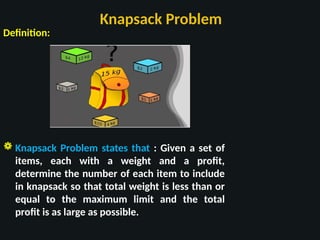
 Knapsack Problem states that : Given a set of
items, each with a weight and a profit,
determine the number of each item to include
in knapsack so that total weight is less than or
equal to the maximum limit and the total
profit is as large as possible.
Versions of Knapsack
Fractional Knapsack using Greedy
Method
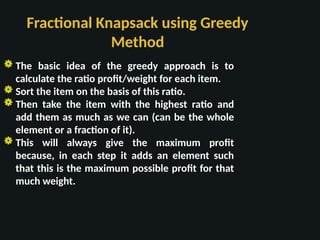
 The basic idea of the greedy approach is to
calculate the ratio profit/weight for each item.
 Sort the item on the basis of this ratio.
 Then take the item with the highest ratio and
add them as much as we can (can be the whole
element or a fraction of it).
 This will always give the maximum profit
because, in each step it adds an element such
that this is the maximum possible profit for that
much weight.
Example
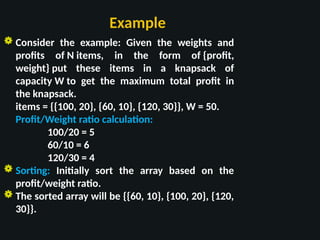
 Consider the example: Given the weights and
profits of N items, in the form of {profit,
weight} put these items in a knapsack of
capacity W to get the maximum total profit in
the knapsack.
items = {{100, 20}, {60, 10}, {120, 30}}, W = 50.
Profit/Weight ratio calculation:
100/20 = 5
60/10 = 6
120/30 = 4
 Sorting: Initially sort the array based on the
profit/weight ratio.
 The sorted array will be {{60, 10}, {100, 20}, {120,
30}}.
Example
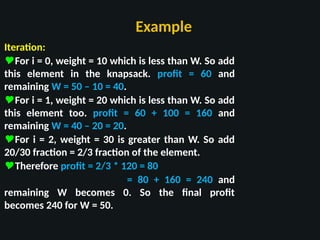
Iteration:
For i = 0, weight = 10 which is less than W. So add
this element in the knapsack. profit = 60 and
remaining W = 50 – 10 = 40.
For i = 1, weight = 20 which is less than W. So add
this element too. profit = 60 + 100 = 160 and
remaining W = 40 – 20 = 20.
For i = 2, weight = 30 is greater than W. So add
20/30 fraction = 2/3 fraction of the element.
Therefore profit = 2/3 * 120 = 80
= 80 + 160 = 240 and
remaining W becomes 0. So the final profit
becomes 240 for W = 50.
Algorithm
Running time
The objects are to be sorted into descending order
of pi / wi ratio.
But if we disregard the time to initially sort the
objects, the algorithm requires only O(n) time
Thank You

Knapsack problem using Greedy method.pptx

  • 1.
    Greedy Algorithm –Knapsack Problem Mrs.S.RAJAPRIYA, M.S(IT)., Assistant Professor, Department of Computer Science (self) V.V.Vanniaperumal College for Women, Virudhunagar
  • 2.
    Greedy Method  Thegreedy method is a simple strategy of progressively building up a solution, one element at a time, by choosing the best possible element at each stage.  At each stage, a decision is made regarding whether or not a particular input is in an optimal solution.  This is done by considering the inputs in an order determined by some selection procedure.  If the inclusion of the next input, into the partially constructed optimal solution will result in an infeasible solution then this input is not added to the partial solution.
  • 3.
    Greedy Method  Theselection procedure itself is based on some optimization measure.  This version of greedy technique is called subset paradigm.
  • 4.
    Knapsack Problem Definition:  KnapsackProblem states that : Given a set of items, each with a weight and a profit, determine the number of each item to include in knapsack so that total weight is less than or equal to the maximum limit and the total profit is as large as possible.
  • 5.
  • 6.
    Fractional Knapsack usingGreedy Method  The basic idea of the greedy approach is to calculate the ratio profit/weight for each item.  Sort the item on the basis of this ratio.  Then take the item with the highest ratio and add them as much as we can (can be the whole element or a fraction of it).  This will always give the maximum profit because, in each step it adds an element such that this is the maximum possible profit for that much weight.
  • 7.
    Example  Consider theexample: Given the weights and profits of N items, in the form of {profit, weight} put these items in a knapsack of capacity W to get the maximum total profit in the knapsack. items = {{100, 20}, {60, 10}, {120, 30}}, W = 50. Profit/Weight ratio calculation: 100/20 = 5 60/10 = 6 120/30 = 4  Sorting: Initially sort the array based on the profit/weight ratio.  The sorted array will be {{60, 10}, {100, 20}, {120, 30}}.
  • 8.
    Example Iteration: For i =0, weight = 10 which is less than W. So add this element in the knapsack. profit = 60 and remaining W = 50 – 10 = 40. For i = 1, weight = 20 which is less than W. So add this element too. profit = 60 + 100 = 160 and remaining W = 40 – 20 = 20. For i = 2, weight = 30 is greater than W. So add 20/30 fraction = 2/3 fraction of the element. Therefore profit = 2/3 * 120 = 80 = 80 + 160 = 240 and remaining W becomes 0. So the final profit becomes 240 for W = 50.
  • 9.
  • 10.
    Running time The objectsare to be sorted into descending order of pi / wi ratio. But if we disregard the time to initially sort the objects, the algorithm requires only O(n) time
  • 11.