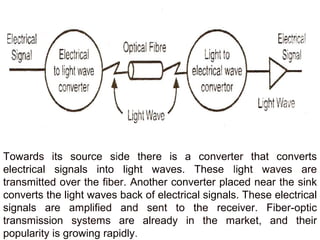
Towards its source side there is a converter that converts 
electrical signals into light waves. These light waves are 
transmitted over the fiber. Another converter placed near the sink 
converts the light waves back of electrical signals. These electrical 
signals are amplified and sent to the receiver. Fiber-optic 
transmission systems are already in the market, and their 
popularity is growing rapidly.
1. Advantages 
1. Higher bandwidth 
Fiber-optic cable can support dramatically higher 
bandwidths (and hence data rates) than either twisted-pair 
or coaxial cable. 
2. Less signal attenuation 
Fiber-optic transmission distance is significantly greater 
than that of other guided media. A signal can run for 50 
km without requiring regeneration. We need repeaters 
every 5 km for coaxial or twisted-pair cable. 
3. Provide high quality (low error rate) transmission.
4. Immunity to electromagnetic interference 
Electromagnetic noise can not affect fiber-optic cables. 
5. Resistance to corrosive materials 
Glass is more resistant to corrosive materials than 
copper. 
6. Light Weight 
7. Can be used for both analog and digital data 
transmission. 
8. There are no chances of any sparking, which 
results into a safer system. 
9. Glass is immune to corrosive and oxide 
degradation and thus will standup well in hostile 
environments.
Disadvantages 
1. High Cost 
The cable and the interfaces are relatively more expensive than 
those of other guided media. 
2. Unidirectional light propagation 
Since optical transmission is inherently unidirectional, two -way 
communication requires either two fibers or two frequency bands 
on one fiber. 
3. Installation and Maintenance 
Fiber is an unfamiliar technology requiring skills, most engineers 
do not possess. 
4. It is limited to fixed point-to-point ground installations
Unguided Media 
It refers to the method of Transmission through the 
air/atmosphere. In this Media there is no Cabling. The signals are 
broadcast in the air and thus are available to anyone, who has a 
device capable of receiving them.
Radio waves have frequencies between 10kHz and 1 gigahertz. 
The range of electromagnetic spectrum between 10kHz and 1 
GHz is called radio frequency (RF). 
Radio waves, for the most part, are omni directional. When an 
antenna transmits radio waves, they are propagated in all 
directions. This means that the sending and receiving antennas 
do not have to be aligned. A sending antenna sends waves that 
can be received by any receiving antenna. Based on the 
wavelength, strength, and the purpose of transmission, we can 
have several types of antennas as shown in figure 4.8. 
Radio waves, particularly those waves that propagate in the sky 
mode, can travel long distances. Radio waves, particularly 
those of low and medium frequencies, can penetrate walls. 
Therefore, an AM radio can receive signals inside a building 
also.
Radio waves are very easy to generate and they can travel 
long distances. Due to these reasons, they are widely used 
for indoor and outdoor communication. 
These are the waves through which your walky-talky sets 
and radio operates. Defense people on the fronts also use 
this type of communication.
Applications 
1. AM and FM radio 
2. TV 
3. Cordless Phones 
4. Paging 
5 Walky-Talky sets
Advantages 
1. Radio waves offer mobility at cheaper cost. 
2. It has a very low setup cost as it does not require 
digging and laying the cables. 
3. Radio waves can travel long distances. 
4. Radio waves can penetrate wall, so we can also 
receive signals inside a building. 
5. No land acquisition right is needed. 
It offers ease of communication in difficult geographical 
conditions
Disadvantages 
1. It is an insecure and easy to tap communication. 
2. It gets effected by weather effects like rains, thunder 
storms etc.
Main characteristic of Microwaves are: 
1. Microwaves are unidirectional. the sending and 
receiving antennas need to be aligned. 
2. Microwave propagation is line-of-sight 
3. Very high-frequency microwaves cannot penetrate 
walls. 
4. The microwave band is relatively wide, almost 299 
GHz. Therefore wider sub bands can be assigned, and a high 
data rate is possible. 
5. Use of certain portions of the band requires permission 
from authorities.
Main applications of microwaves are 
1. Cellular phones 
2. Satellite networks 
3. Wireless LAN
Advantages 
1. High data transmission rate. 
2. High capacity to carry large quantities of data. 
3. Lower error rate thus making it more reliable as 
compared to wire-cable. 
5. Microwaves offer communication over very long 
distances. 
6. They have better performance in bad weather conditions 
than radio waves.
Disadvantages 
1. Very costly 
2. Electromagnetic waves cannot bend or pass through 
obstacles like mountains etc. 
3·Microwave signals are vulnerable to electromagnetic 
interference (EML). 
4. Microwave systems are also affected by atmospheric 
conditions. 
5. It is also an insecure and easy to tap communication. 
6. This communication offers limited bandwidth
Infrared Transmission 
Infrared waves, with frequencies from 300 GHz to 400 THz 
can be used for short-range communication. 
You must have used this communication while changing a 
channel of television using remote control or while 
transferring data from your mobile to your computer. Both 
these communications use infrared communication. 
Infrared waves, having high frequencies, cannot penetrate 
walls, therefore a short-range communication system in one 
room cannot be affected by another system in the next 
room. However, this same characteristic makes infrared 
signals useless for long-range communication. 
In addition, we cannot use infrared waves outside a building 
because the sun's rays contain infrared waves that can 
interfere with the communication.
Applications 
• Infrared signals can be used for short-range communication. 
• Wireless alternative to connecting devices such as laptop to a 
printer. 
• In remote control devices for TV, AC, DVD etc. 
• cordless devices like keyboards, mice, joysticks, printers etc. 
use Infrared signals for communication 
• Now-a-days, some manufacturers provide a special port called 
IrDA port that allows a wireless keyboard to communicate with 
a PC. 
• Infrared band can be used in development of very high speed 
wireless LANs in future.
Advantages 
1. High speed 
2. Large bandwidth 
3. Very cheep 
4. Easy to generate 
5. Provide wireless connection between 
two devices. 
6. No license is required to use it.
Disadvantages 
1 Cannot penetrate walls. 
2. We cannot use infrared waves outside a 
building. 
3. Cannot used for long-range communication.

Ta 104-media-2

  • 1.
    Towards its sourceside there is a converter that converts electrical signals into light waves. These light waves are transmitted over the fiber. Another converter placed near the sink converts the light waves back of electrical signals. These electrical signals are amplified and sent to the receiver. Fiber-optic transmission systems are already in the market, and their popularity is growing rapidly.
  • 2.
    1. Advantages 1.Higher bandwidth Fiber-optic cable can support dramatically higher bandwidths (and hence data rates) than either twisted-pair or coaxial cable. 2. Less signal attenuation Fiber-optic transmission distance is significantly greater than that of other guided media. A signal can run for 50 km without requiring regeneration. We need repeaters every 5 km for coaxial or twisted-pair cable. 3. Provide high quality (low error rate) transmission.
  • 3.
    4. Immunity toelectromagnetic interference Electromagnetic noise can not affect fiber-optic cables. 5. Resistance to corrosive materials Glass is more resistant to corrosive materials than copper. 6. Light Weight 7. Can be used for both analog and digital data transmission. 8. There are no chances of any sparking, which results into a safer system. 9. Glass is immune to corrosive and oxide degradation and thus will standup well in hostile environments.
  • 4.
    Disadvantages 1. HighCost The cable and the interfaces are relatively more expensive than those of other guided media. 2. Unidirectional light propagation Since optical transmission is inherently unidirectional, two -way communication requires either two fibers or two frequency bands on one fiber. 3. Installation and Maintenance Fiber is an unfamiliar technology requiring skills, most engineers do not possess. 4. It is limited to fixed point-to-point ground installations
  • 5.
    Unguided Media Itrefers to the method of Transmission through the air/atmosphere. In this Media there is no Cabling. The signals are broadcast in the air and thus are available to anyone, who has a device capable of receiving them.
  • 6.
    Radio waves havefrequencies between 10kHz and 1 gigahertz. The range of electromagnetic spectrum between 10kHz and 1 GHz is called radio frequency (RF). Radio waves, for the most part, are omni directional. When an antenna transmits radio waves, they are propagated in all directions. This means that the sending and receiving antennas do not have to be aligned. A sending antenna sends waves that can be received by any receiving antenna. Based on the wavelength, strength, and the purpose of transmission, we can have several types of antennas as shown in figure 4.8. Radio waves, particularly those waves that propagate in the sky mode, can travel long distances. Radio waves, particularly those of low and medium frequencies, can penetrate walls. Therefore, an AM radio can receive signals inside a building also.
  • 7.
    Radio waves arevery easy to generate and they can travel long distances. Due to these reasons, they are widely used for indoor and outdoor communication. These are the waves through which your walky-talky sets and radio operates. Defense people on the fronts also use this type of communication.
  • 8.
    Applications 1. AMand FM radio 2. TV 3. Cordless Phones 4. Paging 5 Walky-Talky sets
  • 9.
    Advantages 1. Radiowaves offer mobility at cheaper cost. 2. It has a very low setup cost as it does not require digging and laying the cables. 3. Radio waves can travel long distances. 4. Radio waves can penetrate wall, so we can also receive signals inside a building. 5. No land acquisition right is needed. It offers ease of communication in difficult geographical conditions
  • 10.
    Disadvantages 1. Itis an insecure and easy to tap communication. 2. It gets effected by weather effects like rains, thunder storms etc.
  • 11.
    Main characteristic ofMicrowaves are: 1. Microwaves are unidirectional. the sending and receiving antennas need to be aligned. 2. Microwave propagation is line-of-sight 3. Very high-frequency microwaves cannot penetrate walls. 4. The microwave band is relatively wide, almost 299 GHz. Therefore wider sub bands can be assigned, and a high data rate is possible. 5. Use of certain portions of the band requires permission from authorities.
  • 12.
    Main applications ofmicrowaves are 1. Cellular phones 2. Satellite networks 3. Wireless LAN
  • 13.
    Advantages 1. Highdata transmission rate. 2. High capacity to carry large quantities of data. 3. Lower error rate thus making it more reliable as compared to wire-cable. 5. Microwaves offer communication over very long distances. 6. They have better performance in bad weather conditions than radio waves.
  • 14.
    Disadvantages 1. Verycostly 2. Electromagnetic waves cannot bend or pass through obstacles like mountains etc. 3·Microwave signals are vulnerable to electromagnetic interference (EML). 4. Microwave systems are also affected by atmospheric conditions. 5. It is also an insecure and easy to tap communication. 6. This communication offers limited bandwidth
  • 15.
    Infrared Transmission Infraredwaves, with frequencies from 300 GHz to 400 THz can be used for short-range communication. You must have used this communication while changing a channel of television using remote control or while transferring data from your mobile to your computer. Both these communications use infrared communication. Infrared waves, having high frequencies, cannot penetrate walls, therefore a short-range communication system in one room cannot be affected by another system in the next room. However, this same characteristic makes infrared signals useless for long-range communication. In addition, we cannot use infrared waves outside a building because the sun's rays contain infrared waves that can interfere with the communication.
  • 16.
    Applications • Infraredsignals can be used for short-range communication. • Wireless alternative to connecting devices such as laptop to a printer. • In remote control devices for TV, AC, DVD etc. • cordless devices like keyboards, mice, joysticks, printers etc. use Infrared signals for communication • Now-a-days, some manufacturers provide a special port called IrDA port that allows a wireless keyboard to communicate with a PC. • Infrared band can be used in development of very high speed wireless LANs in future.
  • 17.
    Advantages 1. Highspeed 2. Large bandwidth 3. Very cheep 4. Easy to generate 5. Provide wireless connection between two devices. 6. No license is required to use it.
  • 18.
    Disadvantages 1 Cannotpenetrate walls. 2. We cannot use infrared waves outside a building. 3. Cannot used for long-range communication.