adeel_khurram@ymail.com
Network Communications&Standards 
 ANSI and IEEE (pronounced I triple E) propose, 
develop, and approve network standards. A 
network standard defines guidelines that specify the 
way computers access the medium to which they are 
attached, the type(s) of medium used, the speeds 
used on different types of networks, and the 
type(s) of physical cable and/or the wireless 
technology used. A standard that outlines 
characteristics of how two network devices 
communicate is called a protocol. a protocol 
may define data format, coding schemes, error 
handling, and sequencing techniques. 
adeel_khurram@ymail.com
Widely Used Standards 
 widely used network communications 
standards and protocols for both wired and 
wireless networks including Ethernet, token 
ring, TCP/IP, Wi-Fi, Bluetooth, UWB, IrDA, 
RFID, WiMAX, and WAP. 
adeel_khurram@ymail.com
 Ethernet is a network standard that specifies 
no central computer or device on the network 
(nodes) should control when data can be 
transmitted; that is, each node attempts to 
transmit data when it determines the network is 
available to receive communications. Ethernet is 
based on a bus topology, but Ethernet networks 
can be wired in a star pattern. 
adeel_khurram@ymail.com
Ethernet networks often use cables to transmit 
data. At a 10 Mbps (million bits per second) 
data transfer rate, the original Ethernet 
standard is not very fast by today’s standards. 
A more recent Ethernet standard, called Fast 
Ethernet, has a data transfer rate of 100 
Mbps, ten times faster than the original 
standard. 
adeel_khurram@ymail.com
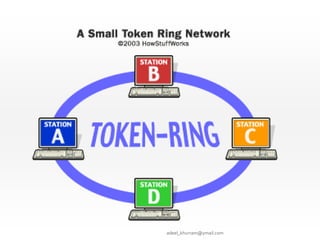
Token Ring 
adeel_khurram@ymail.com
 Short forTransmission Control Protocol/ 
Internet Protocol, TCP/IP is a network standard, 
specifically a protocol, that defines how messages 
(data) are routed from one end of a network to the 
other, ensuring the data arrives correctly. TCP/IP 
describes rules for dividing messages into small 
pieces, called packets; providing addresses for 
each packet; checking for and detecting errors; 
sequencing packets; 
adeel_khurram@ymail.com
adeel_khurram@ymail.com 
Bluetooth is a network standard, 
specifically 
a protocol, that defines how two 
Bluetooth devices use short-range radio 
waves to transmit data. The data 
transfers between devices at a rate of up 
to 3 Mbps. To communicate with each 
other, Bluetooth devices often must be 
within about 10 meters (about 33 feet) but 
can be extended to 100 meters with
adeel_khurram@ymail.com
RFID (radio frequency identification) is a standard, 
specifically a protocol, that defines how a network 
uses radio signals to communicate with a tag placed 
in or attached to an object, an animal, or a person. 
The tag, called a transponder, consists of an antenna 
and a memory chip that contains the information to 
be transmitted via radio waves. Through an antenna, 
an RFID reader, also called a transceiver, reads the 
radio signals and transfers the information to a 
computer or computing device. adeel_khurram@ymail.com
WiMAX (Worldwide Interoperability for 
Microwave Access), also known as 802.16, is 
a network standard developed by IEEE that 
specifies how wireless devices communicate 
over the air in a wide area. Using the WiMAX 
standard, computers or devices with the 
appropriate WiMAX wireless capability 
communicate via radio waves with other 
computers or devices via a WiMAX tower. 
adeel_khurram@ymail.com
Fixed-Wireless WiMAX 
With fixed wireless WiMAX, a customer 
accesses the Internet from a desktop 
computer at home or other permanent 
location. 
Mobile WiMAX 
Mobile wireless WiMAX, 
by contrast, enables users to access the 
WiMAX network with mobile computers and 
mobile devices such as smart phones. 
adeel_khurram@ymail.com

Network communication standards

  • 1.
  • 2.
  • 3.
  • 4.
    Network Communications&Standards ANSI and IEEE (pronounced I triple E) propose, develop, and approve network standards. A network standard defines guidelines that specify the way computers access the medium to which they are attached, the type(s) of medium used, the speeds used on different types of networks, and the type(s) of physical cable and/or the wireless technology used. A standard that outlines characteristics of how two network devices communicate is called a protocol. a protocol may define data format, coding schemes, error handling, and sequencing techniques. adeel_khurram@ymail.com
  • 5.
    Widely Used Standards  widely used network communications standards and protocols for both wired and wireless networks including Ethernet, token ring, TCP/IP, Wi-Fi, Bluetooth, UWB, IrDA, RFID, WiMAX, and WAP. adeel_khurram@ymail.com
  • 6.
     Ethernet isa network standard that specifies no central computer or device on the network (nodes) should control when data can be transmitted; that is, each node attempts to transmit data when it determines the network is available to receive communications. Ethernet is based on a bus topology, but Ethernet networks can be wired in a star pattern. adeel_khurram@ymail.com
  • 7.
  • 8.
    Ethernet networks oftenuse cables to transmit data. At a 10 Mbps (million bits per second) data transfer rate, the original Ethernet standard is not very fast by today’s standards. A more recent Ethernet standard, called Fast Ethernet, has a data transfer rate of 100 Mbps, ten times faster than the original standard. adeel_khurram@ymail.com
  • 9.
  • 10.
  • 11.
     Short forTransmissionControl Protocol/ Internet Protocol, TCP/IP is a network standard, specifically a protocol, that defines how messages (data) are routed from one end of a network to the other, ensuring the data arrives correctly. TCP/IP describes rules for dividing messages into small pieces, called packets; providing addresses for each packet; checking for and detecting errors; sequencing packets; adeel_khurram@ymail.com
  • 12.
  • 13.
  • 14.
  • 15.
    adeel_khurram@ymail.com Bluetooth isa network standard, specifically a protocol, that defines how two Bluetooth devices use short-range radio waves to transmit data. The data transfers between devices at a rate of up to 3 Mbps. To communicate with each other, Bluetooth devices often must be within about 10 meters (about 33 feet) but can be extended to 100 meters with
  • 16.
  • 17.
  • 18.
    RFID (radio frequencyidentification) is a standard, specifically a protocol, that defines how a network uses radio signals to communicate with a tag placed in or attached to an object, an animal, or a person. The tag, called a transponder, consists of an antenna and a memory chip that contains the information to be transmitted via radio waves. Through an antenna, an RFID reader, also called a transceiver, reads the radio signals and transfers the information to a computer or computing device. adeel_khurram@ymail.com
  • 19.
    WiMAX (Worldwide Interoperabilityfor Microwave Access), also known as 802.16, is a network standard developed by IEEE that specifies how wireless devices communicate over the air in a wide area. Using the WiMAX standard, computers or devices with the appropriate WiMAX wireless capability communicate via radio waves with other computers or devices via a WiMAX tower. adeel_khurram@ymail.com
  • 20.
    Fixed-Wireless WiMAX Withfixed wireless WiMAX, a customer accesses the Internet from a desktop computer at home or other permanent location. Mobile WiMAX Mobile wireless WiMAX, by contrast, enables users to access the WiMAX network with mobile computers and mobile devices such as smart phones. adeel_khurram@ymail.com
  • 21.