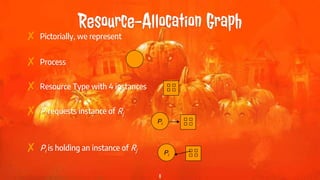
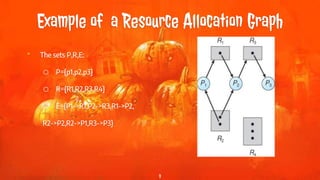
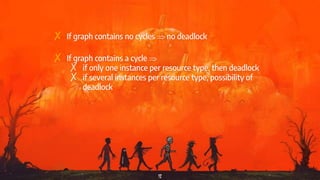
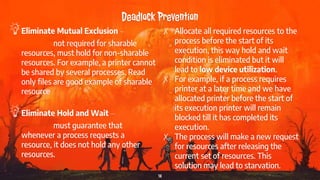
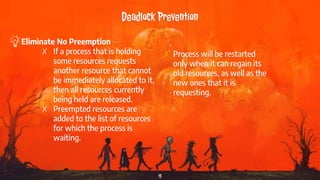
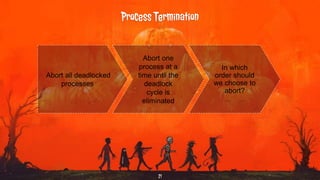
This document discusses deadlock prevention and recovery in computer systems. It begins by defining deadlock and describing the conditions required for deadlock to occur. It then presents a system model and characterizes deadlocks using resource allocation graphs. The document outlines four main methods for handling deadlocks: prevention, avoidance, detection, and recovery. It focuses on prevention, describing four different approaches to ensure at least one deadlock condition does not hold: eliminating mutual exclusion, hold and wait, no preemption, or circular wait. The document also briefly discusses deadlock detection and two recovery methods: process termination and resource preemption.














![Operating_System_Deadlocks_(1)333[1].ppt](https://cdn.slidesharecdn.com/ss_thumbnails/operatingsystemdeadlocks11-251208053003-20ffa599-thumbnail.jpg?width=640&height=640&fit=bounds)


