Security In Wireless Sensor Network    By      09bce053         AditPathak              09bce057         Mihir  Shah
Presentation  flowWhat is WSN?Threats to WSNWSN operational paradigmsKey distribution techniques for WSNVarious key distribution schemes
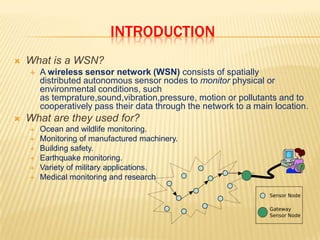
INTRODUCTIONWhat is a WSN?A wireless sensor network (WSN) consists of spatially distributed autonomous sensor nodes to monitor physical or environmental conditions, such as temprature,sound,vibration,pressure, motion or pollutants and to cooperatively pass their data through the network to a main location.What are they used for?Ocean and wildlife monitoring.Monitoring of manufactured machinery.Building safety.Earthquake monitoring.Variety of military applications.Medical monitoring and research
Threats to a WSNPassive Information Gathering : The powerful receiver         can passively pick off data.Subversion of a node:  Capturing of sensor node  & compromised sensor nodeFalse node: Robust device which impersonates a sensor nodeNode Malfunction:  Generate inaccurate data,drop the data.Detecion of these nodes is an issue.Node outage:  Node stops functioningDoS  (Jamming,BlackHole,Resource Exhaustion)
WSN  OPERATIONAL PARADIGMSSimple  Collection and TransmittalForwardingReceive and Process CommandsSelf OrganizationData Aggregation
SIMple collection & transmittalSensor takes periodic measurements & transmit the associated data directly to the collection point.Immediate or scheduled transmissionEach node is only concerned with its transmission to base station , which is assumed to be within the range.No routing & co-operation among nodes
VulnerabilitiesJammingSpoofing (Counterfeit  data source broadcasts spurious  information)Loss of confidentiality  due to passive  monitoringPhysical attacks(capturing  of a node & subversion)
 SolutionsData encryption(symmetric key)Predeployed keys are shared between & unique to the collection point & individual node.Each node uses its key to encrypt data before transmission & the collection point decrypts the data using the shared key corresponding to that node.Spread spectrum communications may be used to offset efforts to jam the frequency band.Use of temper assistant technologies  which may transmit an alert  and/or self destruct when tempering is detected.
forwardingAllows sensor nodes far away from collection point to transmit data to neighboring nodes , which in turn forward the data toward the collection point.Forwarding process may span multiple sensor nodes on the path between the source & collection point.Solves the radio range problem presented in the Simple Collection and Transmittal paradigm.
VulnerabilitiesSingle shared key won’t doBlack Hole : Sensor node drops packetsData Corruption: Node modifies the dataResource Exhaustion: Attacker maliciously transmits an inordinate amount of data to be forwarded ,causing the intermediate node(s) to exhaust their power supply.
 SolutionsSystem utilizes pre-built headers encrypted under intermediate node’s key. The entire frame is encrypted under senders key and inserted into another frame that is prepended with the pre-built headers and forwards.When intermediate node receives the frame,it strips-off the prepended header and forwards it. At the end it is decrypted by collection point.The algorithm is used to deal with other attacks.The algorithm tracks the absence of expected data from each sensor,quantifies the amount of corrupted data received at the controller from each sensor,and compares those values to acceptable statistical noms.If controller determines a sensor node to be aberrant,it is culled.
Receive and process commandsPrevious paradigms described many-to-one communication for unsolicited data & may reduce lifetime of WSN due to unnecessary data transmissionRPC is one-to-many communication model in which the controller transmits commands to sensor nodesInitially sensor nodes are in idle mode(low power)-controller broadcasts(or unicast)  wakeup  command- getdatacommand-instruct sensor nodes to idle
VulnerabilitiesAuthentication of command from controllerIntegrity of the message received from its neighbors
 SolutionsUse of shared secrets between the controller and the individual sensor nodeDistributing encrypted identities of sensor nodes within radio range of controller  among the nodes that are beyond the radio range of controller by using  pre-built headers as was in Forwarding.
SELF ORGANIZATIONIt requires that the WSN achieve organizational structure without human intervention.
It consists of three tasks:
Node discovery
Route establishment
Topology maintenance.
Node discovery is made by HELLO-REPLY message.
To ensure continuous connectivity, multiple routes between two nodes are discovered.
Here as new nodes are added or older ones exhaust, the topology is re configuared.VulnerabilitiesPrevious attacks seen.
Flooding
Sinkhole attacks.SOLUTIONSRouting information distributed throughout the WSN needs to be encrypted, by an anti-replay mechanism and authentication of source.
Moreover as a sensor contains cryptographic material, it needs to be configured so that tampering will erase the keys and leave the sensor inoperable.AGGREGATIONIn previous protocols, the sensors transmit information to the    collection  point which performs large calculations due to         thousands of data streams and causes it to be a bottleneck.
For controlling data streams, we aggregate data within the WSN and transmitting aggregate to the controller.
This results in a substantial energy savings in the WSN.
The operations can include MAX, MIN, AVG, SUM etc. For example, measuring a temperature.VulnerabilitiesAuthentication of the downstream peers becomes a necessity.
Here the nodes trust each other. Hence a malicious node can get itself elected as an aggregation point.

Security in wireless sensor network

  • 1.
    Security In WirelessSensor Network By 09bce053 AditPathak 09bce057 Mihir Shah
  • 2.
    Presentation flowWhatis WSN?Threats to WSNWSN operational paradigmsKey distribution techniques for WSNVarious key distribution schemes
  • 3.
    INTRODUCTIONWhat is aWSN?A wireless sensor network (WSN) consists of spatially distributed autonomous sensor nodes to monitor physical or environmental conditions, such as temprature,sound,vibration,pressure, motion or pollutants and to cooperatively pass their data through the network to a main location.What are they used for?Ocean and wildlife monitoring.Monitoring of manufactured machinery.Building safety.Earthquake monitoring.Variety of military applications.Medical monitoring and research
  • 4.
    Threats to aWSNPassive Information Gathering : The powerful receiver can passively pick off data.Subversion of a node: Capturing of sensor node & compromised sensor nodeFalse node: Robust device which impersonates a sensor nodeNode Malfunction: Generate inaccurate data,drop the data.Detecion of these nodes is an issue.Node outage: Node stops functioningDoS (Jamming,BlackHole,Resource Exhaustion)
  • 5.
    WSN OPERATIONALPARADIGMSSimple Collection and TransmittalForwardingReceive and Process CommandsSelf OrganizationData Aggregation
  • 6.
    SIMple collection &transmittalSensor takes periodic measurements & transmit the associated data directly to the collection point.Immediate or scheduled transmissionEach node is only concerned with its transmission to base station , which is assumed to be within the range.No routing & co-operation among nodes
  • 7.
    VulnerabilitiesJammingSpoofing (Counterfeit data source broadcasts spurious information)Loss of confidentiality due to passive monitoringPhysical attacks(capturing of a node & subversion)
  • 8.
    SolutionsData encryption(symmetrickey)Predeployed keys are shared between & unique to the collection point & individual node.Each node uses its key to encrypt data before transmission & the collection point decrypts the data using the shared key corresponding to that node.Spread spectrum communications may be used to offset efforts to jam the frequency band.Use of temper assistant technologies which may transmit an alert and/or self destruct when tempering is detected.
  • 9.
    forwardingAllows sensor nodesfar away from collection point to transmit data to neighboring nodes , which in turn forward the data toward the collection point.Forwarding process may span multiple sensor nodes on the path between the source & collection point.Solves the radio range problem presented in the Simple Collection and Transmittal paradigm.
  • 10.
    VulnerabilitiesSingle shared keywon’t doBlack Hole : Sensor node drops packetsData Corruption: Node modifies the dataResource Exhaustion: Attacker maliciously transmits an inordinate amount of data to be forwarded ,causing the intermediate node(s) to exhaust their power supply.
  • 11.
    SolutionsSystem utilizespre-built headers encrypted under intermediate node’s key. The entire frame is encrypted under senders key and inserted into another frame that is prepended with the pre-built headers and forwards.When intermediate node receives the frame,it strips-off the prepended header and forwards it. At the end it is decrypted by collection point.The algorithm is used to deal with other attacks.The algorithm tracks the absence of expected data from each sensor,quantifies the amount of corrupted data received at the controller from each sensor,and compares those values to acceptable statistical noms.If controller determines a sensor node to be aberrant,it is culled.
  • 12.
    Receive and processcommandsPrevious paradigms described many-to-one communication for unsolicited data & may reduce lifetime of WSN due to unnecessary data transmissionRPC is one-to-many communication model in which the controller transmits commands to sensor nodesInitially sensor nodes are in idle mode(low power)-controller broadcasts(or unicast) wakeup command- getdatacommand-instruct sensor nodes to idle
  • 13.
    VulnerabilitiesAuthentication of commandfrom controllerIntegrity of the message received from its neighbors
  • 14.
    SolutionsUse ofshared secrets between the controller and the individual sensor nodeDistributing encrypted identities of sensor nodes within radio range of controller among the nodes that are beyond the radio range of controller by using pre-built headers as was in Forwarding.
  • 15.
    SELF ORGANIZATIONIt requiresthat the WSN achieve organizational structure without human intervention.
  • 16.
    It consists ofthree tasks:
  • 17.
  • 18.
  • 19.
  • 20.
    Node discovery ismade by HELLO-REPLY message.
  • 21.
    To ensure continuousconnectivity, multiple routes between two nodes are discovered.
  • 22.
    Here as newnodes are added or older ones exhaust, the topology is re configuared.VulnerabilitiesPrevious attacks seen.
  • 23.
  • 24.
    Sinkhole attacks.SOLUTIONSRouting informationdistributed throughout the WSN needs to be encrypted, by an anti-replay mechanism and authentication of source.
  • 25.
    Moreover as asensor contains cryptographic material, it needs to be configured so that tampering will erase the keys and leave the sensor inoperable.AGGREGATIONIn previous protocols, the sensors transmit information to the collection point which performs large calculations due to thousands of data streams and causes it to be a bottleneck.
  • 26.
    For controlling datastreams, we aggregate data within the WSN and transmitting aggregate to the controller.
  • 27.
    This results ina substantial energy savings in the WSN.
  • 28.
    The operations caninclude MAX, MIN, AVG, SUM etc. For example, measuring a temperature.VulnerabilitiesAuthentication of the downstream peers becomes a necessity.
  • 29.
    Here the nodestrust each other. Hence a malicious node can get itself elected as an aggregation point.