APPENDAGES OF THORAX (LEGS & WINGS) AND
THEIR MODIFICATIONS, ABDOMEN (MALE AND
FEMALE GENITALIA)
Dr. Muhammad Hamid Bashir
Assistant Professor
Department of Entomology
University of Agriculture, Faisalabad
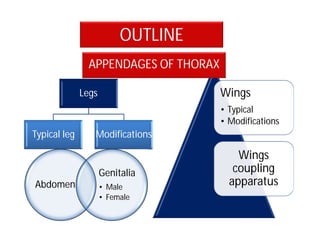
OUTLINE
Legs
Typical leg Modifications
Wings
• Typical
• Modifications
Wings
coupling
apparatusAbdomen
Genitalia
• Male
• Female
APPENDAGES OF THORAX
FUN FACTS ABOUT INSECTS
Most successful creatures on the planet
Insects have been around for at least 350 million years
Over 900,000 described species (75% of all
animal species)
Biomass
•Diversified Habitat from aquatic to terrestrial
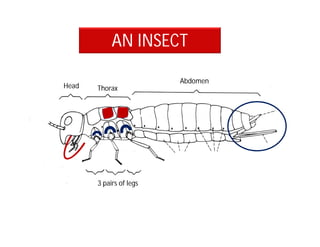
AN INSECT
Head Thorax
Abdomen
3 pairs of legs
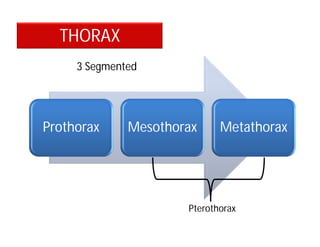
THORAX
Prothorax Mesothorax Metathorax
Pterothorax
3 Segmented
Prothorax
Mesothorax Metathorax
Leg I Leg II Leg III
Pterothorax
Thorax
Fore wing
Hind wing
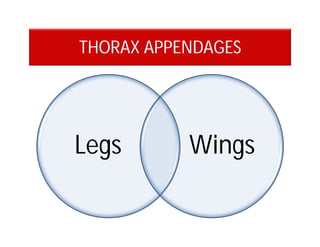
THORAX APPENDAGES
Legs Wings
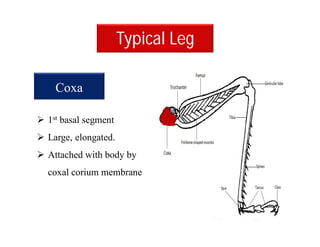
Typical Leg
 1st basal segment
 Large, elongated.
 Attached with body by
coxal corium membrane
Coxa
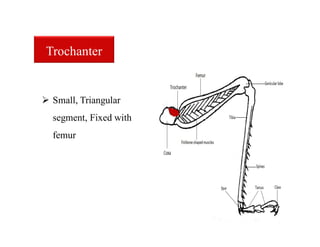
 Small, Triangular
segment, Fixed with
femur
Trochanter
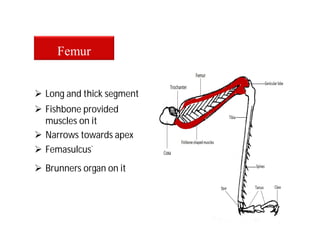
 Long and thick segment
Femur
 Fishbone provided
muscles on it
 Narrows towards apex
 Femasulcus`
 Brunners organ on it
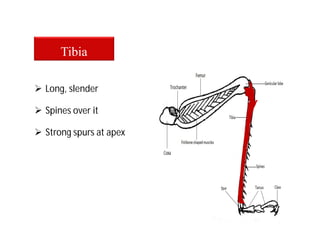
 Long, slender
Tibia
 Spines over it
 Strong spurs at apex
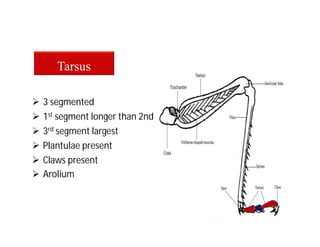
 3 segmented
Tarsus
 1st segment longer than 2nd
 3rd segment largest
 Plantulae present
 Claws present
 Arolium
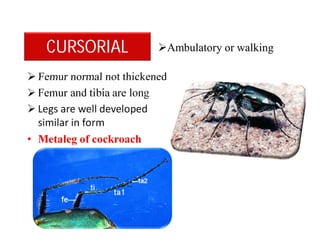
CURSORIAL
 Femur normal not thickened
 Femur and tibia are long
 Legs are well developed
similar in form
• Metaleg of cockroach
Ambulatory or walking
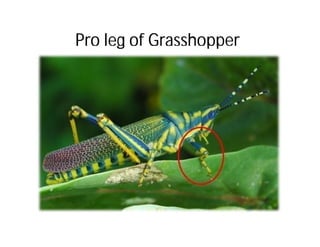
Pro leg of Grasshopper
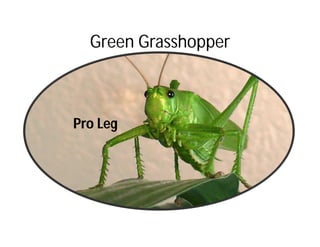
Green Grasshopper
Pro Leg
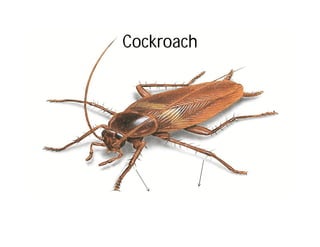
Cockroach
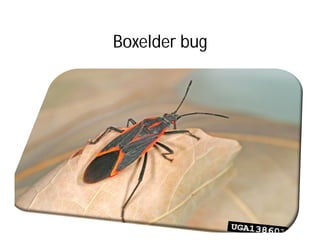
Boxelder bug
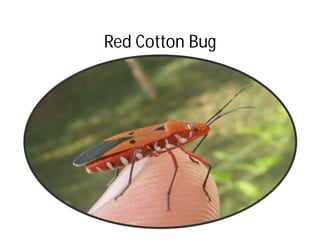
Red Cotton Bug
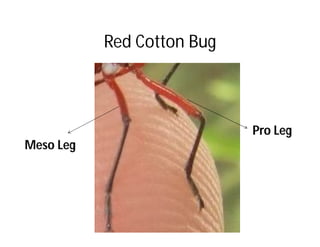
Red Cotton Bug
Pro Leg
Meso Leg
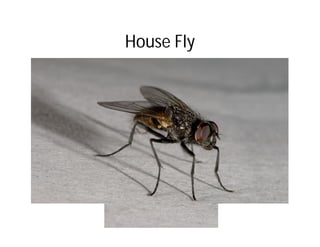
House Fly
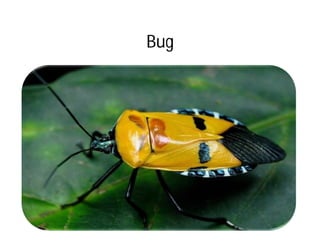
Bug
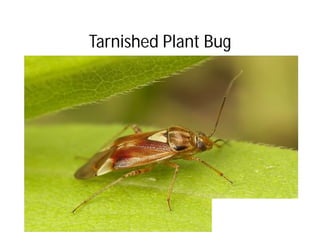
Tarnished Plant Bug
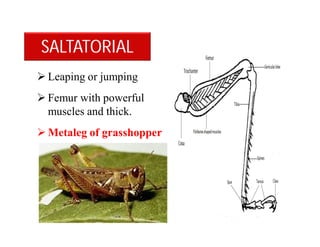
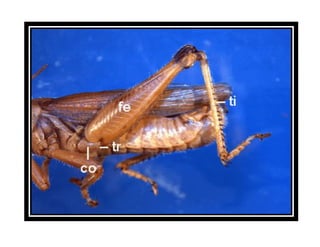
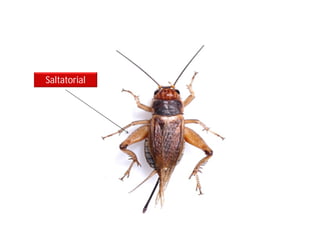
 Leaping or jumping
 Femur with powerful
muscles and thick.
 Metaleg of grasshopper
SALTATORIAL
Saltatorial
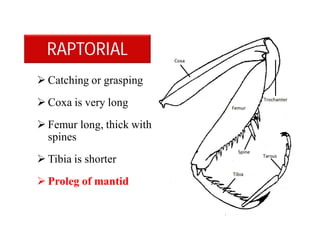
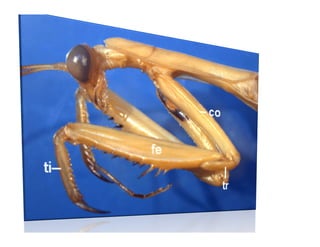
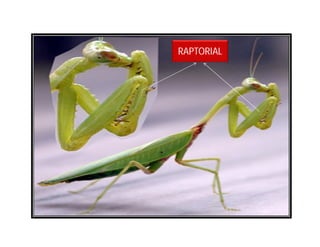
 Catching or grasping
 Coxa is very long
 Femur long, thick with
spines
 Tibia is shorter
 Proleg of mantid
RAPTORIAL
RAPTORIAL
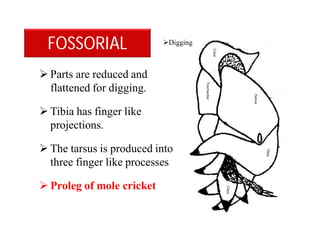
 Parts are reduced and
flattened for digging.
 Tibia has finger like
projections.
 The tarsus is produced into
three finger like processes
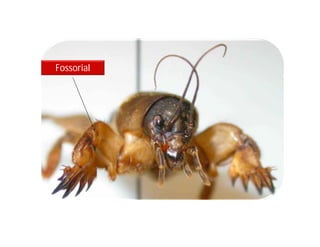
 Proleg of mole cricket
FOSSORIAL Digging
Fossorial
Fossorial
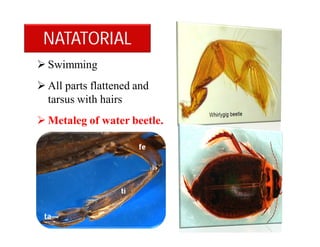
 Swimming
 All parts flattened and
tarsus with hairs
 Metaleg of water beetle.
NATATORIAL
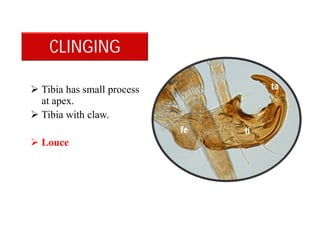
 Tibia has small process
at apex.
 Tibia with claw.
 Louce
CLINGING
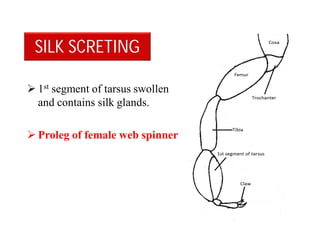
 1st segment of tarsus swollen
and contains silk glands.
 Proleg of female web spinner
SILK SCRETING
SILK SCRETING
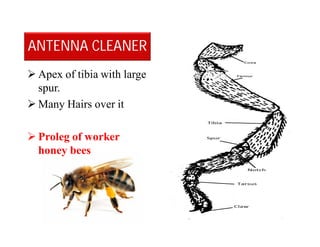
 Apex of tibia with large
spur.
 Many Hairs over it
 Proleg of worker
honey bees
ANTENNA CLEANER
Antenna Cleaner
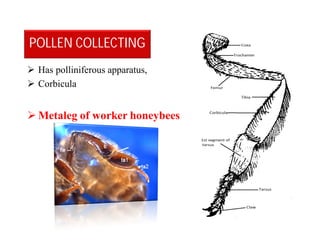
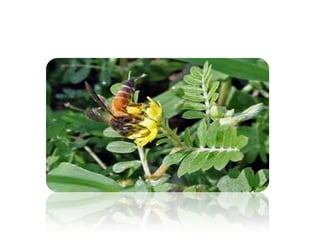
 Has polliniferous apparatus,
 Corbicula
 Metaleg of worker honeybees
POLLEN COLLECTING
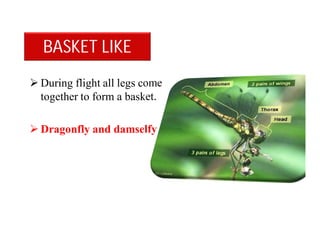
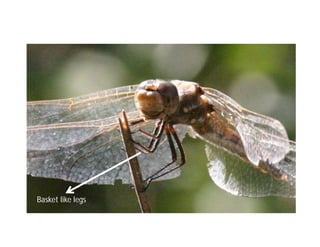
 During flight all legs come
together to form a basket.
 Dragonfly and damselfy
BASKET LIKE
Basket like legs
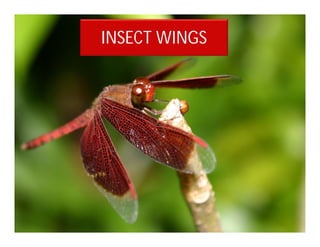
INSECT WINGS
Wing development
• Apterous (without wings)
• Brachypterous (Reduced wings)
• Macropterous (Well developed wings)
• Wing pads (In nymphs of Exopterygota)
WINGS MARGINS AND AREAS
Disc
With maximum veins
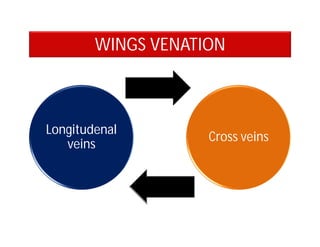
Longitudenal
veins
Cross veins
WINGS VENATION
Longitudenal veins
Costa (C)
Subcosta (Sc)
Radius (R)
Media (M)
Cubitus (Cu)
Anals (A)
Unbranced
2-branced
5-branced
6-branced
2-branced
3 or 4 anals
unbranched
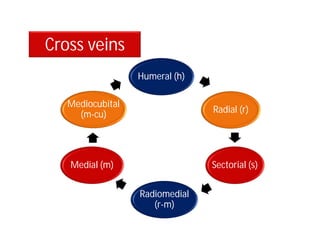
Humeral (h)
Radial (r)
Sectorial (s)
Radiomedial
(r-m)
Medial (m)
Mediocubital
(m-cu)
Cross veins
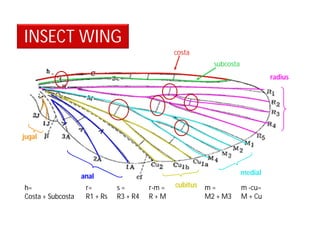
INSECT WING
costa
subcosta
radius
medial
cubitus
anal
jugal
h=
Costa + Subcosta
r=
R1 + Rs
s =
R3 + R4
r-m =
R + M
m =
M2 + M3
m -cu=
M + Cu
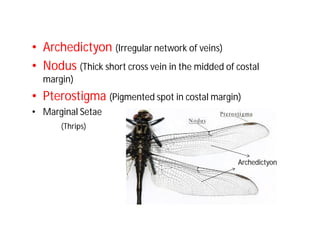
• Archedictyon (Irregular network of veins)
• Nodus (Thick short cross vein in the midded of costal
margin)
• Pterostigma (Pigmented spot in costal margin)
• Marginal Setae
(Thrips)
Archedictyon
Cells of Wings
• Open Cells (Area extends to the margin of the wing)
• Closed Cells (Area completely surrounded by
veins)
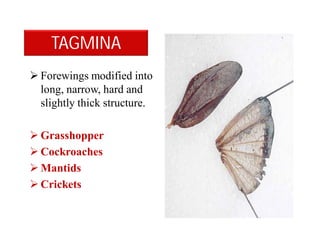
TAGMINA
 Forewings modified into
long, narrow, hard and
slightly thick structure.
 Grasshopper
 Cockroaches
 Mantids
 Crickets
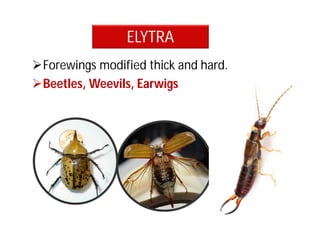
ELYTRA
Forewings modified thick and hard.
Beetles, Weevils, Earwigs
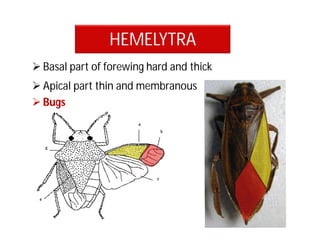
HEMELYTRA
 Basal part of forewing hard and thick
 Apical part thin and membranous
 Bugs
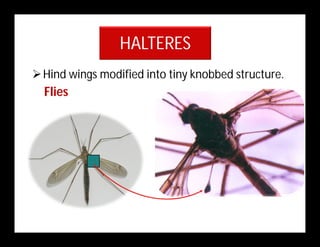
HALTERES
Hind wings modified into tiny knobbed structure.
Flies
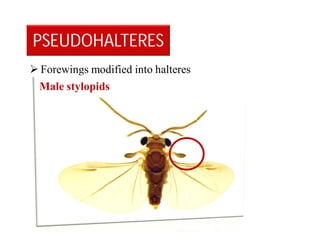
PSEUDOHALTERES
 Forewings modified into halteres
Male stylopids
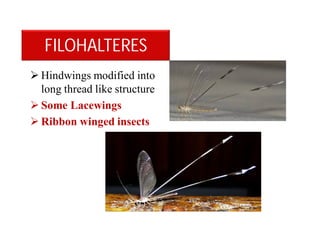
FILOHALTERES
 Hindwings modified into
long thread like structure
 Some Lacewings
 Ribbon winged insects
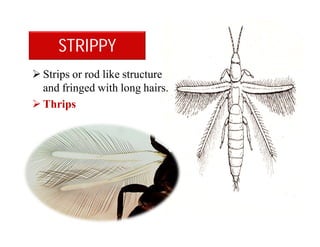
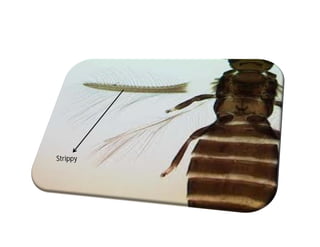
STRIPPY
 Strips or rod like structure
and fringed with long hairs.
 Thrips
Strippy
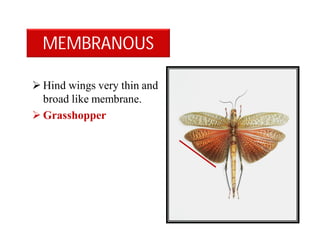
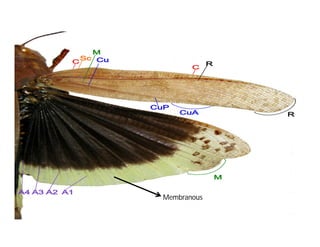
MEMBRANOUS
 Hind wings very thin and
broad like membrane.
 Grasshopper
Membranous
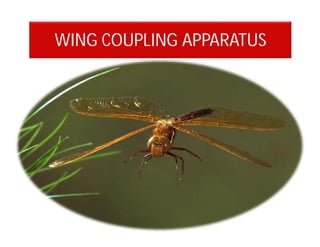
WING COUPLING APPARATUS
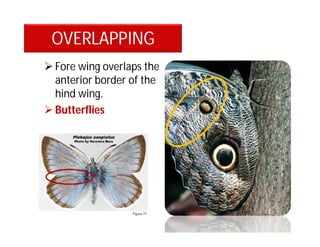
OVERLAPPING
 Fore wing overlaps the
anterior border of the
hind wing.
 Butterflies
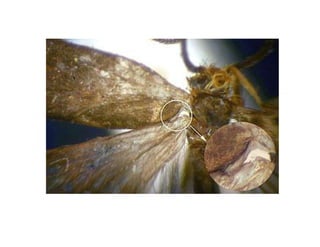
FRENULUM & RETINACULUM
Frenulum
(Geomatrid Moth)
Retinaculum
(Geomatrid Moth)
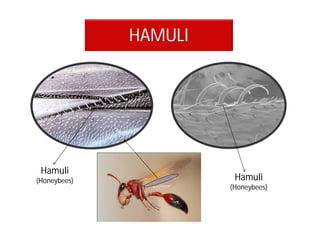
HAMULI
Hamuli
(Honeybees)
Hamuli
(Honeybees)
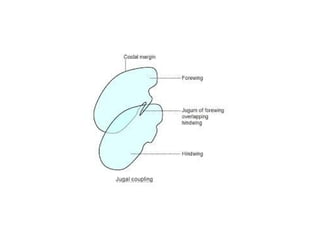
JUGUM
Jugum
(Lepidoptera)
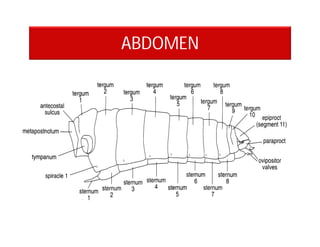
ABDOMEN
ABDOMEN
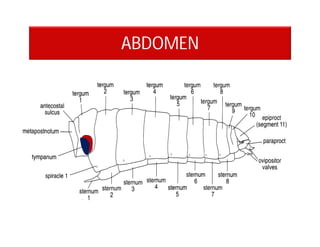
TYMPANUM
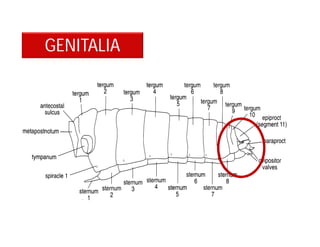
GENITALIA
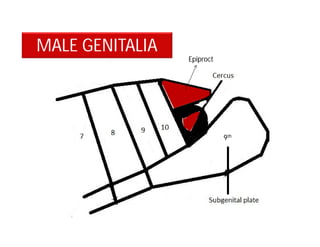
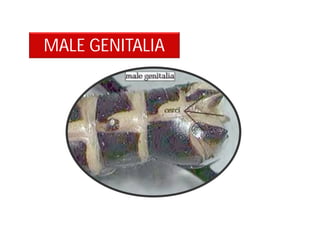
MALE GENITALIA
Epiproct
9th
MALE GENITALIA
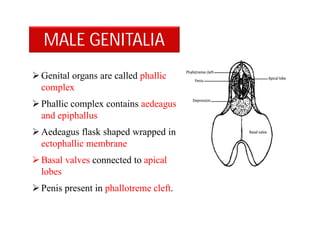
Genital organs are called phallic
complex
Phallic complex contains aedeagus
and epiphallus
Aedeagus flask shaped wrapped in
ectophallic membrane
Basal valves connected to apical
lobes
Penis present in phallotreme cleft.
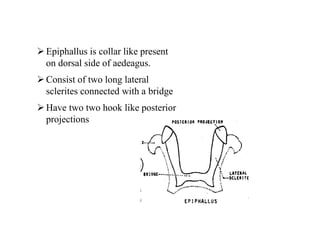
Epiphallus is collar like present
on dorsal side of aedeagus.
Consist of two long lateral
sclerites connected with a bridge
Have two two hook like posterior
projections
MALE GENITALIA
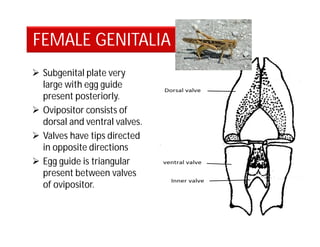
FEMALE GENITALIA
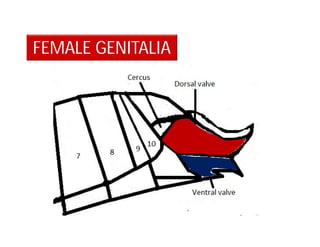
 Subgenital plate very
large with egg guide
present posteriorly.
 Ovipositor consists of
dorsal and ventral valves.
 Valves have tips directed
in opposite directions
 Egg guide is triangular
present between valves
of ovipositor.
FEMALE GENITALIA
QUESTIONS???????

Appendages of thorax