Entomology
353 Bio
T. Amani Alsharidah
1441 – 2019
Lecture 5
The chest and its composition
The Thorax
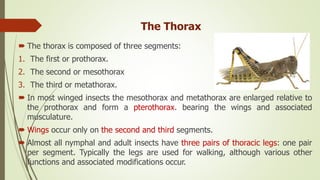
 The thorax is composed of three segments:
1. The first or prothorax.
2. The second or mesothorax
3. The third or metathorax.
 In most winged insects the mesothorax and metathorax are enlarged relative to
the prothorax and form a pterothorax. bearing the wings and associated
musculature.
 Wings occur only on the second and third segments.
 Almost all nymphal and adult insects have three pairs of thoracic legs: one pair
per segment. Typically the legs are used for walking, although various other
functions and associated modifications occur.
The thorax
The thorax
 Openings spiracles of the gas-exchange, or tracheal system are present laterally
on the second and third thoracic segments at most with one pair per segment.
The Thorax
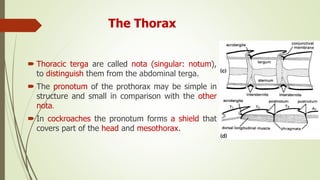
 Thoracic terga are called nota (singular: notum),
to distinguish them from the abdominal terga.
 The pronotum of the prothorax may be simple in
structure and small in comparison with the other
nota.
 In cockroaches the pronotum forms a shield that
covers part of the head and mesothorax.
The Thorax
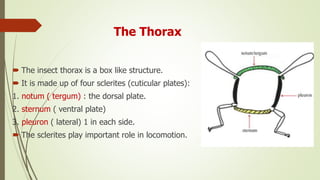
 The insect thorax is a box like structure.
 It is made up of four sclerites (cuticular plates):
1. notum ( tergum) : the dorsal plate.
2. sternum ( ventral plate)
3. pleuron ( lateral) 1 in each side.
 The sclerites play important role in locomotion.
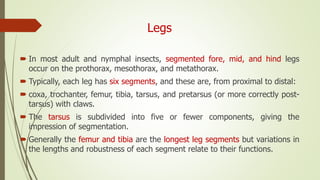
Legs
 In most adult and nymphal insects, segmented fore, mid, and hind legs
occur on the prothorax, mesothorax, and metathorax.
 Typically, each leg has six segments, and these are, from proximal to distal:
 coxa, trochanter, femur, tibia, tarsus, and pretarsus (or more correctly post-
tarsus) with claws.
 The tarsus is subdivided into five or fewer components, giving the
impression of segmentation.
 Generally the femur and tibia are the longest leg segments but variations in
the lengths and robustness of each segment relate to their functions.
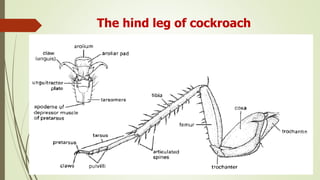
Leg segments
1. The coxa is most often cone like, and is the point of articulation with the
thorax, and has varying degrees of mobility depending on the insect group.
2. Trochanter articulate the coxa to the femur, usually small and triangular.
3. Femur is generally small in larval insects, but in most adult insects is the most
robust segment of the leg.
4. Tibia is the long shank of the leg and it moves in the vertical plane.
5. Tarsus the tarsus is divided into 1-5sub-segments, which are called tarsomeres.
The tarsomeres can move independently.
6. Pretarsus is the apical most segment, and the smallest. It is the point of
contact between the insect and its environment. It is most often composed of
1-2 claws, and there may be a lobe-like structure between the claws, called the
arolium, which has a supporting or attaching function.
The hind leg of cockroach
Legs modification
1-walking leg
 Femur normal not thickened.
 Femur and tibia are long.
 Legs are well developed.
 Example: cockroach
Legs modification
2- jumping leg
 Insects such as grasshoppers have
disproportionately developed hind
femora and tibiae.
 Femur with powerful muscles and
thick.
 Example: hind leg of grasshoppers.
Leg modification
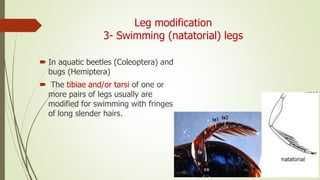
3- Swimming (natatorial) legs
 In aquatic beetles (Coleoptera) and
bugs (Hemiptera)
 The tibiae and/or tarsi of one or
more pairs of legs usually are
modified for swimming with fringes
of long slender hairs.
Leg modification
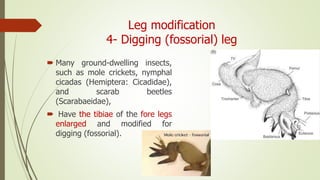
4- Digging (fossorial) leg
 Many ground-dwelling insects,
such as mole crickets, nymphal
cicadas (Hemiptera: Cicadidae),
and scarab beetles
(Scarabaeidae),
 Have the tibiae of the fore legs
enlarged and modified for
digging (fossorial).
Leg modification
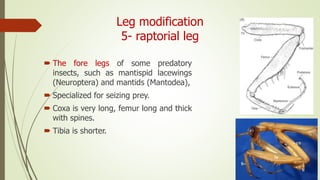
5- raptorial leg
 The fore legs of some predatory
insects, such as mantispid lacewings
(Neuroptera) and mantids (Mantodea),
 Specialized for seizing prey.
 Coxa is very long, femur long and thick
with spines.
 Tibia is shorter.
Leg modification
6- collecting pollen and cleaning
 There are three pairs of legs
which are densely covered with
hairs, which besides walking,
help in collecting pollen and are
variously modified
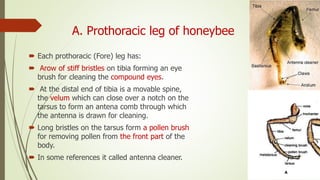
A. Prothoracic leg of honeybee
 Each prothoracic (Fore) leg has:
 Arow of stiff bristles on tibia forming an eye
brush for cleaning the compound eyes.
 At the distal end of tibia is a movable spine,
the velum which can close over a notch on the
tarsus to form an antena comb through which
the antenna is drawn for cleaning.
 Long bristles on the tarsus form a pollen brush
for removing pollen from the front part of the
body.
 In some references it called antenna cleaner.
b. Mesothoracic leg in honeybees
 Each mesothoracic (middle) leg
has a pollen brush on the tarsus.
 The end of the tibia has a spur
like a spine for removing pollen
from the pollen basket and wax
from abdomen.
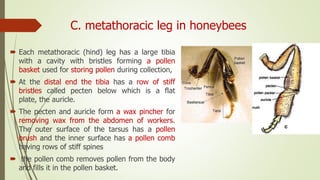
C. metathoracic leg in honeybees
 Each metathoracic (hind) leg has a large tibia
with a cavity with bristles forming a pollen
basket used for storing pollen during collection,
 At the distal end the tibia has a row of stiff
bristles called pecten below which is a flat
plate, the auricle.
 The pecten and auricle form a wax pincher for
removing wax from the abdomen of workers.
The outer surface of the tarsus has a pollen
brush and the inner surface has a pollen comb
having rows of stiff spines
 the pollen comb removes pollen from the body
and fills it in the pollen basket.
Wings
 Insects were the first animals to evolve flight and are the only
invertebrates that have the ability to fly.
 Wings are developed fully only in the adult.
 functional wings are flap-like cuticular projections supported by
tubular, sclerotized veins.
 The venation network allows for fluid and nutrient transport across
the structure while providing a mechanical skeleton that stiffens the
wing.
 wings show a range of hierarchies of complexity, varying greatly in
size and venation, stiffness and flexibility, pigmentation and flight
behaviors.
Type of insect wings
1-Membranous wings
 Example: Dragons Fly, Honeybees.
 Wings are thin and transparent.
 They are supported by a system of
tubular veins.
 They are useful in flight.
Type of insect wings
2-Fringed wings
 Example: Thrips
 Wing lamina is usually reduced in
size.
 Wing margins fringed with long
setae.
Type of wings
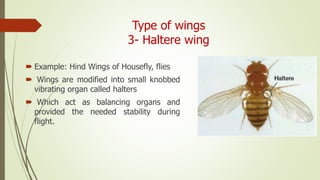
3- Haltere wing
 Example: Hind Wings of Housefly, flies
 Wings are modified into small knobbed
vibrating organ called halters
 Which act as balancing organs and
provided the needed stability during
flight.
Type of wings
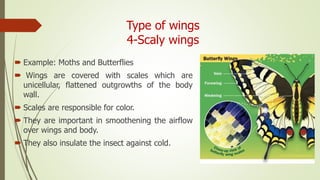
4-Scaly wings
 Example: Moths and Butterflies
 Wings are covered with scales which are
unicellular, flattened outgrowths of the body
wall.
 Scales are responsible for color.
 They are important in smoothening the airflow
over wings and body.
 They also insulate the insect against cold.
Type of wings
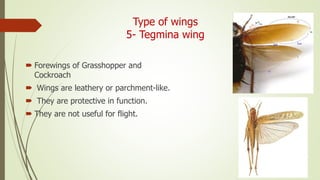
5- Tegmina wing
 Forewings of Grasshopper and
Cockroach
 Wings are leathery or parchment-like.
 They are protective in function.
 They are not useful for flight.
Type of wings
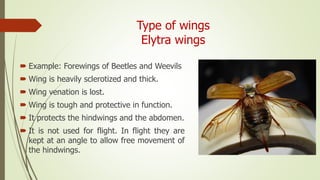
Elytra wings
 Example: Forewings of Beetles and Weevils
 Wing is heavily sclerotized and thick.
 Wing venation is lost.
 Wing is tough and protective in function.
 It protects the hindwings and the abdomen.
 It is not used for flight. In flight they are
kept at an angle to allow free movement of
the hindwings.
Type of wings
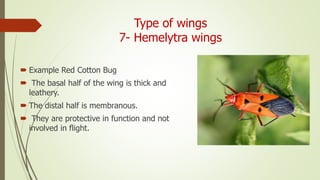
7- Hemelytra wings
 Example Red Cotton Bug
 The basal half of the wing is thick and
leathery.
 The distal half is membranous.
 They are protective in function and not
involved in flight.

The Insect Chest

  • 1.
    Entomology 353 Bio T. AmaniAlsharidah 1441 – 2019
  • 2.
    Lecture 5 The chestand its composition
  • 3.
    The Thorax  Thethorax is composed of three segments: 1. The first or prothorax. 2. The second or mesothorax 3. The third or metathorax.  In most winged insects the mesothorax and metathorax are enlarged relative to the prothorax and form a pterothorax. bearing the wings and associated musculature.  Wings occur only on the second and third segments.  Almost all nymphal and adult insects have three pairs of thoracic legs: one pair per segment. Typically the legs are used for walking, although various other functions and associated modifications occur.
  • 4.
  • 5.
    The thorax  Openingsspiracles of the gas-exchange, or tracheal system are present laterally on the second and third thoracic segments at most with one pair per segment.
  • 6.
    The Thorax  Thoracicterga are called nota (singular: notum), to distinguish them from the abdominal terga.  The pronotum of the prothorax may be simple in structure and small in comparison with the other nota.  In cockroaches the pronotum forms a shield that covers part of the head and mesothorax.
  • 7.
    The Thorax  Theinsect thorax is a box like structure.  It is made up of four sclerites (cuticular plates): 1. notum ( tergum) : the dorsal plate. 2. sternum ( ventral plate) 3. pleuron ( lateral) 1 in each side.  The sclerites play important role in locomotion.
  • 8.
    Legs  In mostadult and nymphal insects, segmented fore, mid, and hind legs occur on the prothorax, mesothorax, and metathorax.  Typically, each leg has six segments, and these are, from proximal to distal:  coxa, trochanter, femur, tibia, tarsus, and pretarsus (or more correctly post- tarsus) with claws.  The tarsus is subdivided into five or fewer components, giving the impression of segmentation.  Generally the femur and tibia are the longest leg segments but variations in the lengths and robustness of each segment relate to their functions.
  • 9.
    Leg segments 1. Thecoxa is most often cone like, and is the point of articulation with the thorax, and has varying degrees of mobility depending on the insect group. 2. Trochanter articulate the coxa to the femur, usually small and triangular. 3. Femur is generally small in larval insects, but in most adult insects is the most robust segment of the leg. 4. Tibia is the long shank of the leg and it moves in the vertical plane. 5. Tarsus the tarsus is divided into 1-5sub-segments, which are called tarsomeres. The tarsomeres can move independently. 6. Pretarsus is the apical most segment, and the smallest. It is the point of contact between the insect and its environment. It is most often composed of 1-2 claws, and there may be a lobe-like structure between the claws, called the arolium, which has a supporting or attaching function.
  • 10.
    The hind legof cockroach
  • 11.
    Legs modification 1-walking leg Femur normal not thickened.  Femur and tibia are long.  Legs are well developed.  Example: cockroach
  • 12.
    Legs modification 2- jumpingleg  Insects such as grasshoppers have disproportionately developed hind femora and tibiae.  Femur with powerful muscles and thick.  Example: hind leg of grasshoppers.
  • 13.
    Leg modification 3- Swimming(natatorial) legs  In aquatic beetles (Coleoptera) and bugs (Hemiptera)  The tibiae and/or tarsi of one or more pairs of legs usually are modified for swimming with fringes of long slender hairs.
  • 14.
    Leg modification 4- Digging(fossorial) leg  Many ground-dwelling insects, such as mole crickets, nymphal cicadas (Hemiptera: Cicadidae), and scarab beetles (Scarabaeidae),  Have the tibiae of the fore legs enlarged and modified for digging (fossorial).
  • 15.
    Leg modification 5- raptorialleg  The fore legs of some predatory insects, such as mantispid lacewings (Neuroptera) and mantids (Mantodea),  Specialized for seizing prey.  Coxa is very long, femur long and thick with spines.  Tibia is shorter.
  • 16.
    Leg modification 6- collectingpollen and cleaning  There are three pairs of legs which are densely covered with hairs, which besides walking, help in collecting pollen and are variously modified
  • 17.
    A. Prothoracic legof honeybee  Each prothoracic (Fore) leg has:  Arow of stiff bristles on tibia forming an eye brush for cleaning the compound eyes.  At the distal end of tibia is a movable spine, the velum which can close over a notch on the tarsus to form an antena comb through which the antenna is drawn for cleaning.  Long bristles on the tarsus form a pollen brush for removing pollen from the front part of the body.  In some references it called antenna cleaner.
  • 18.
    b. Mesothoracic legin honeybees  Each mesothoracic (middle) leg has a pollen brush on the tarsus.  The end of the tibia has a spur like a spine for removing pollen from the pollen basket and wax from abdomen.
  • 19.
    C. metathoracic legin honeybees  Each metathoracic (hind) leg has a large tibia with a cavity with bristles forming a pollen basket used for storing pollen during collection,  At the distal end the tibia has a row of stiff bristles called pecten below which is a flat plate, the auricle.  The pecten and auricle form a wax pincher for removing wax from the abdomen of workers. The outer surface of the tarsus has a pollen brush and the inner surface has a pollen comb having rows of stiff spines  the pollen comb removes pollen from the body and fills it in the pollen basket.
  • 20.
    Wings  Insects werethe first animals to evolve flight and are the only invertebrates that have the ability to fly.  Wings are developed fully only in the adult.  functional wings are flap-like cuticular projections supported by tubular, sclerotized veins.  The venation network allows for fluid and nutrient transport across the structure while providing a mechanical skeleton that stiffens the wing.  wings show a range of hierarchies of complexity, varying greatly in size and venation, stiffness and flexibility, pigmentation and flight behaviors.
  • 21.
    Type of insectwings 1-Membranous wings  Example: Dragons Fly, Honeybees.  Wings are thin and transparent.  They are supported by a system of tubular veins.  They are useful in flight.
  • 22.
    Type of insectwings 2-Fringed wings  Example: Thrips  Wing lamina is usually reduced in size.  Wing margins fringed with long setae.
  • 23.
    Type of wings 3-Haltere wing  Example: Hind Wings of Housefly, flies  Wings are modified into small knobbed vibrating organ called halters  Which act as balancing organs and provided the needed stability during flight.
  • 24.
    Type of wings 4-Scalywings  Example: Moths and Butterflies  Wings are covered with scales which are unicellular, flattened outgrowths of the body wall.  Scales are responsible for color.  They are important in smoothening the airflow over wings and body.  They also insulate the insect against cold.
  • 25.
    Type of wings 5-Tegmina wing  Forewings of Grasshopper and Cockroach  Wings are leathery or parchment-like.  They are protective in function.  They are not useful for flight.
  • 26.
    Type of wings Elytrawings  Example: Forewings of Beetles and Weevils  Wing is heavily sclerotized and thick.  Wing venation is lost.  Wing is tough and protective in function.  It protects the hindwings and the abdomen.  It is not used for flight. In flight they are kept at an angle to allow free movement of the hindwings.
  • 27.
    Type of wings 7-Hemelytra wings  Example Red Cotton Bug  The basal half of the wing is thick and leathery.  The distal half is membranous.  They are protective in function and not involved in flight.

Editor's Notes

  • #5 للفهم
  • #6 للفهم
  • #7 الرسمة للفهم
  • #11 الرسمة للفهم
  • #12 ليس بالفاينل
  • #13 ليس بالفاينل
  • #14 معاكم
  • #15 ليس بالفاينل
  • #23 ليس بالفاينل
  • #24 بدون رسمة
  • #25 بدون رسمة
  • #26 ليس بالفاينل
  • #28 ليس من ضمن الفاينل