Wind Energy
• Howwind is formed?
• Winds are caused by the (i) uneven heating of the atmosphere by the Sun (ii)
irregularities of the Earth surface (iii) rotation of the Earth.
• Wind energy is a form of renewable energy produced through machines (or
turbines).
• “Wind energy is only possible because of the Sun”.
1
2.
Wind Energy
2
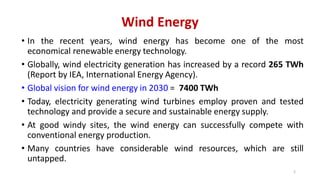
• Inthe recent years, wind energy has become one of the most
economical renewable energy technology.
• Globally, wind electricity generation has increased by a record 265 TWh
(Report by IEA, International Energy Agency).
• Global vision for wind energy in 2030 = 7400 TWh
• Today, electricity generating wind turbines employ proven and tested
technology and provide a secure and sustainable energy supply.
• At good windy sites, the wind energy can successfully compete with
conventional energy production.
• Many countries have considerable wind resources, which are still
untapped.
Wind Energy
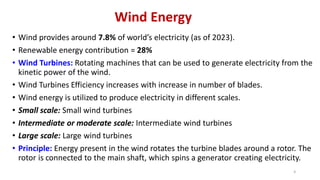
• Windprovides around 7.8% of world’s electricity (as of 2023).
• Renewable energy contribution = 28%
• Wind Turbines: Rotating machines that can be used to generate electricity from the
kinetic power of the wind.
• Wind Turbines Efficiency increases with increase in number of blades.
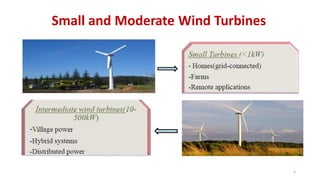
• Wind energy is utilized to produce electricity in different scales.
• Small scale: Small wind turbines
• Intermediate or moderate scale: Intermediate wind turbines
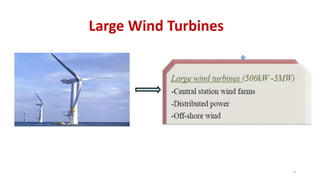
• Large scale: Large wind turbines
• Principle: Energy present in the wind rotates the turbine blades around a rotor. The
rotor is connected to the main shaft, which spins a generator creating electricity.
4
Components of WindTurbine
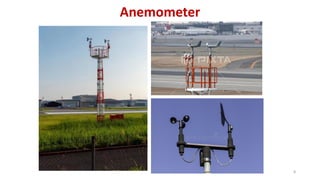
1. Anemometer: Measures wind speed and transmits
wind speed data to the controller.
• Working principle: The arms are attached to a
vertical rod. As the wind blows, the cups rotate,
making the rod spin. The stronger the wind blows,
the faster the rod spins. The anemometer counts
the number of rotations per unit time, which is used
to calculate wind speed.
7
Components of WindTurbine
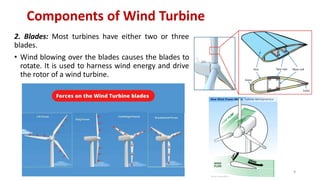
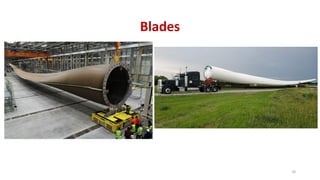
2. Blades: Most turbines have either two or three
blades.
• Wind blowing over the blades causes the blades to
rotate. It is used to harness wind energy and drive
the rotor of a wind turbine.
9
Components of WindTurbine
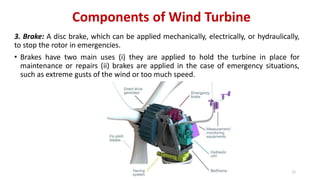
3. Brake: A disc brake, which can be applied mechanically, electrically, or hydraulically,
to stop the rotor in emergencies.
• Brakes have two main uses (i) they are applied to hold the turbine in place for
maintenance or repairs (ii) brakes are applied in the case of emergency situations,
such as extreme gusts of the wind or too much speed.
11
12.
Components of WindTurbine
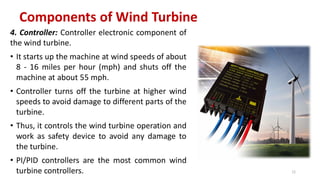
4. Controller: Controller electronic component of
the wind turbine.
• It starts up the machine at wind speeds of about
8 - 16 miles per hour (mph) and shuts off the
machine at about 55 mph.
• Controller turns off the turbine at higher wind
speeds to avoid damage to different parts of the
turbine.
• Thus, it controls the wind turbine operation and
work as safety device to avoid any damage to
the turbine.
• PI/PID controllers are the most common wind
turbine controllers. 12
13.
Components of WindTurbine
5. Gear box: Wind turbines rotate typically
between 40 - 60 rpm.
• Generators typically rotate at 1200 to 1800
rpm.
• Thus, most wind turbines require a step-up
gear-box for efficient generator operation
(or electricity production).
• Gears connect the low-speed shaft to the
high-speed shaft and increase the rotational
speeds from about 40 to 60 rotations per
minute (rpm) to about 1000 to 1800 rpm,
the rotational speed required by most
generators to produce electricity. 13
1-casing,
2-sun gear,
3-turbine's rotor,
4-planetary arm,
5-ring gear,
6-planetry gear;
there are a total of
three planets in all,
7-sun shaft,
8-wheel,
9-middle shaft, and
10-high-speed shaft
14.
Components of WindTurbine
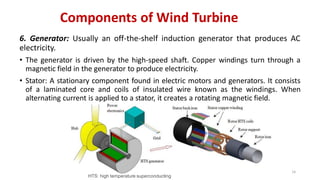
6. Generator: Usually an off-the-shelf induction generator that produces AC
electricity.
• The generator is driven by the high-speed shaft. Copper windings turn through a
magnetic field in the generator to produce electricity.
• Stator: A stationary component found in electric motors and generators. It consists
of a laminated core and coils of insulated wire known as the windings. When
alternating current is applied to a stator, it creates a rotating magnetic field.
14
HTS: high temperature superconducting
Wind Speed
• Fasterthe wind, stronger is the wind force. The higher amount of
power can be generated.
• Too much wind speed is also not good, since it might harm the
wind turbine.
• Wind speed depends on the different regions.
• Thus, it is important to understand the relation between power
generation and wind speed.
17
18.
Obstruction
• Wind speedbecome slow while passing through trees,
building, etc.
• The obstacles enable all kind of friction that restrict free air
flow.
• It is advisable to measure wind speed regularly at the wind
turbine site to determine the project viability.
18
19.
Altitude
• The placesof higher altitude have faster wind speed because
of various atmospheric factors.
• Higher places also have lesser obstructions.
• Wind speed increases by 12% when the altitude (or vertical
distance) between turbine and ground become double.
19
20.
Air Temperature
• Thepower generation of a wind turbine changes by 16% as
the air temperature changes ± 20 ᵒC.
• Colder air is denser and hence increases the power output.
• It is advisable to have cold and windy air for good
performance of a wind turbine.
20
21.
Blade Aerodynamics
• Theshape of wind turbine blades must be accurately selected
to get maximum efficiency.
• The amount of lift for a airfoil depends on the angle it makes
with the direction of wind (known as “angle of attack”).
• If angle of attack gets too large, turbulence develops and drag
increases, while lift decreases.
21
22.
Advantages of WingTurbine
• Very low carbon dioxide emissions (effectively zero once wind turbine
is constructed).
• No air or water pollution.
• No environmental impacts from mining or drilling.
• Completely sustainable—unlike fossil fuels, wind will never run out.
• Turbines work almost anywhere in the world where it's reliably windy,
unlike fossil-fuel deposits that are concentrated only in certain regions.
• Wind energy operating costs are predictable in years in advance.
• New jobs in construction, operation, and manufacture of turbines.
23.
Disadvantages of WindTurbine
• It is site specific (Suited to a particular region).
• Creates noise and disturbances.
• Prediction of wind is difficult.
• Thread to life as it can kill birds.
• High initial cost.
• Large requirement of land.
• Turbine interfere with television and communication signals.
24.
Applications and Efficiencyof Wind Energy
• Most modern wind power is generated in the form of electricity by
converting rotation of turbine blades into electrical current.
• Applications of Wind Energy:
• To supply electricity: Wind power is used in large-scale for national
electrical grids as well as in small individual turbines for providing
electricity to rural residences or grid-isolated locations.
• In water desalination: The electrical power supplied by wind energy
can use to run vapour compression, reverse osmosis for water
desalination.
• In water pumps: Application of electrical power driven by wind to
pumped the water from wells as deep as 200 m to the surface.








![EEE 483[Wind Energy ,use of wind energy].pdf](https://cdn.slidesharecdn.com/ss_thumbnails/eee483windenergy-240506111938-7f084448-thumbnail.jpg?width=640&height=640&fit=bounds)


