POWER SYSTEM
CONTROLS
OPERATIONAL OBJECTIVES
• Continual matching of load demand
• Certain level of reliability and
quality
• Electrical energy at low cost with a
low environmental impact
HIERARCHY OF CONTROLS
• Well defined hierarchy of controls, automatic/manual
• Generators have a wide array of automatic feedback control
systems
• Most of the controllers are decentralized
• Some decentralized controllers need system-wide coordination
• Reference values: closed-loop controllers/system operators
/energy control center
• A large power system may consist of autonomous control areas,
controlled independently
• Exchange pre-decided amounts of power with other areas through
interconnecting tie lines or DC links.
• However, during transients and abnormal conditions, they are
expected to act in co-ordination with each other.
OWNERSHIP AND CO-ORDINATION
• Scheduling of references may have economic and technical
consequences
• Ownership of generation, transmission and distribution systems
can be different and hence there may be multiple control center
obeying a certain hierarchy with a strictly defined authority.
Ownership of power system components is an important issue in
grid co-ordination.
• A typical power system consists of several "control areas". They
have an obligation to serve customers in their respective areas and
have complete authority over all activities in generation,
transmission and distribution in their domain of operation
("vertically integrated utilities").
• Inter-state and some other major transmission links may be owned
by an independent entity
• functions and ownership of the vertical integrated utilities are
divided by forming separate companies
• Overall operational co-ordination in an area is done by a load
dispatch center.
• Inter-area exchanges are coordinated by a central load dispatch
center.
• No part of an interconnected grid is totally independent of another.
All entities are required to co-operate to run a grid smoothly.
POWER NETWORK
• Transmission system: (i) all major generating stations and main
load centers, (ii) voltage levels (typically, 230 kV and above).
• Sub-transmission system: (i)transmits the transmission
substations to the distribution substations, (ii)Large industrial
customers
• Distribution system: (i) power to the individual customers,
(ii)between 4.0 kV and 34.5 kV
OPERATING STATES AND
NATURE OF CONTROL ACTIONS
• Is the demanded load being met?
• Are all equipment within their
current and voltage limits?
• Can the system withstand stresses
due a possible contingency (leading
to a loss of equipment)?
OPERATIONAL STATES
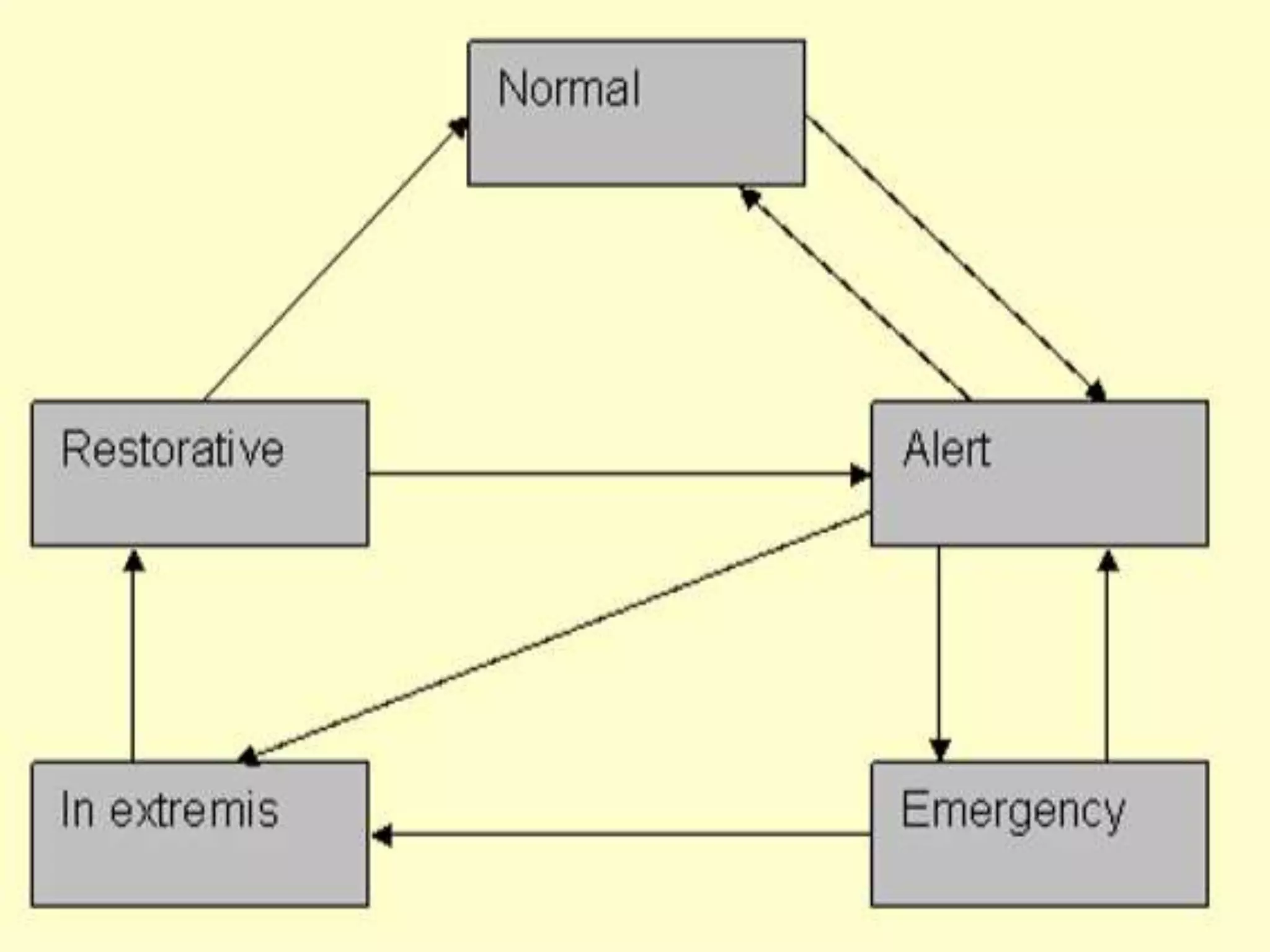
• Normal state: all system variables are within the normal range
• Alert state: security level falls below a certain limit of adequacy
because of a disturbance; generation shifting (security dispatch) ,
Increased reserve
• Emergency state: severe disturbance; fault clearing, generation
tripping, load curtailment
• In extremis: cascading outages; load shedding and controlled
system separation
• Restorative state: control action is being taken to reconnect all
the facilities and to restore system load.
Power System Control

Power System Control

  • 1.
  • 2.
    OPERATIONAL OBJECTIVES • Continualmatching of load demand • Certain level of reliability and quality • Electrical energy at low cost with a low environmental impact
  • 3.
    HIERARCHY OF CONTROLS •Well defined hierarchy of controls, automatic/manual • Generators have a wide array of automatic feedback control systems • Most of the controllers are decentralized • Some decentralized controllers need system-wide coordination • Reference values: closed-loop controllers/system operators /energy control center
  • 4.
    • A largepower system may consist of autonomous control areas, controlled independently • Exchange pre-decided amounts of power with other areas through interconnecting tie lines or DC links. • However, during transients and abnormal conditions, they are expected to act in co-ordination with each other.
  • 6.
    OWNERSHIP AND CO-ORDINATION •Scheduling of references may have economic and technical consequences • Ownership of generation, transmission and distribution systems can be different and hence there may be multiple control center obeying a certain hierarchy with a strictly defined authority. Ownership of power system components is an important issue in grid co-ordination. • A typical power system consists of several "control areas". They have an obligation to serve customers in their respective areas and have complete authority over all activities in generation, transmission and distribution in their domain of operation ("vertically integrated utilities").
  • 7.
    • Inter-state andsome other major transmission links may be owned by an independent entity • functions and ownership of the vertical integrated utilities are divided by forming separate companies • Overall operational co-ordination in an area is done by a load dispatch center. • Inter-area exchanges are coordinated by a central load dispatch center. • No part of an interconnected grid is totally independent of another. All entities are required to co-operate to run a grid smoothly.
  • 8.
    POWER NETWORK • Transmissionsystem: (i) all major generating stations and main load centers, (ii) voltage levels (typically, 230 kV and above). • Sub-transmission system: (i)transmits the transmission substations to the distribution substations, (ii)Large industrial customers • Distribution system: (i) power to the individual customers, (ii)between 4.0 kV and 34.5 kV
  • 10.
    OPERATING STATES AND NATUREOF CONTROL ACTIONS • Is the demanded load being met? • Are all equipment within their current and voltage limits? • Can the system withstand stresses due a possible contingency (leading to a loss of equipment)?
  • 11.
    OPERATIONAL STATES • Normalstate: all system variables are within the normal range • Alert state: security level falls below a certain limit of adequacy because of a disturbance; generation shifting (security dispatch) , Increased reserve • Emergency state: severe disturbance; fault clearing, generation tripping, load curtailment • In extremis: cascading outages; load shedding and controlled system separation • Restorative state: control action is being taken to reconnect all the facilities and to restore system load.