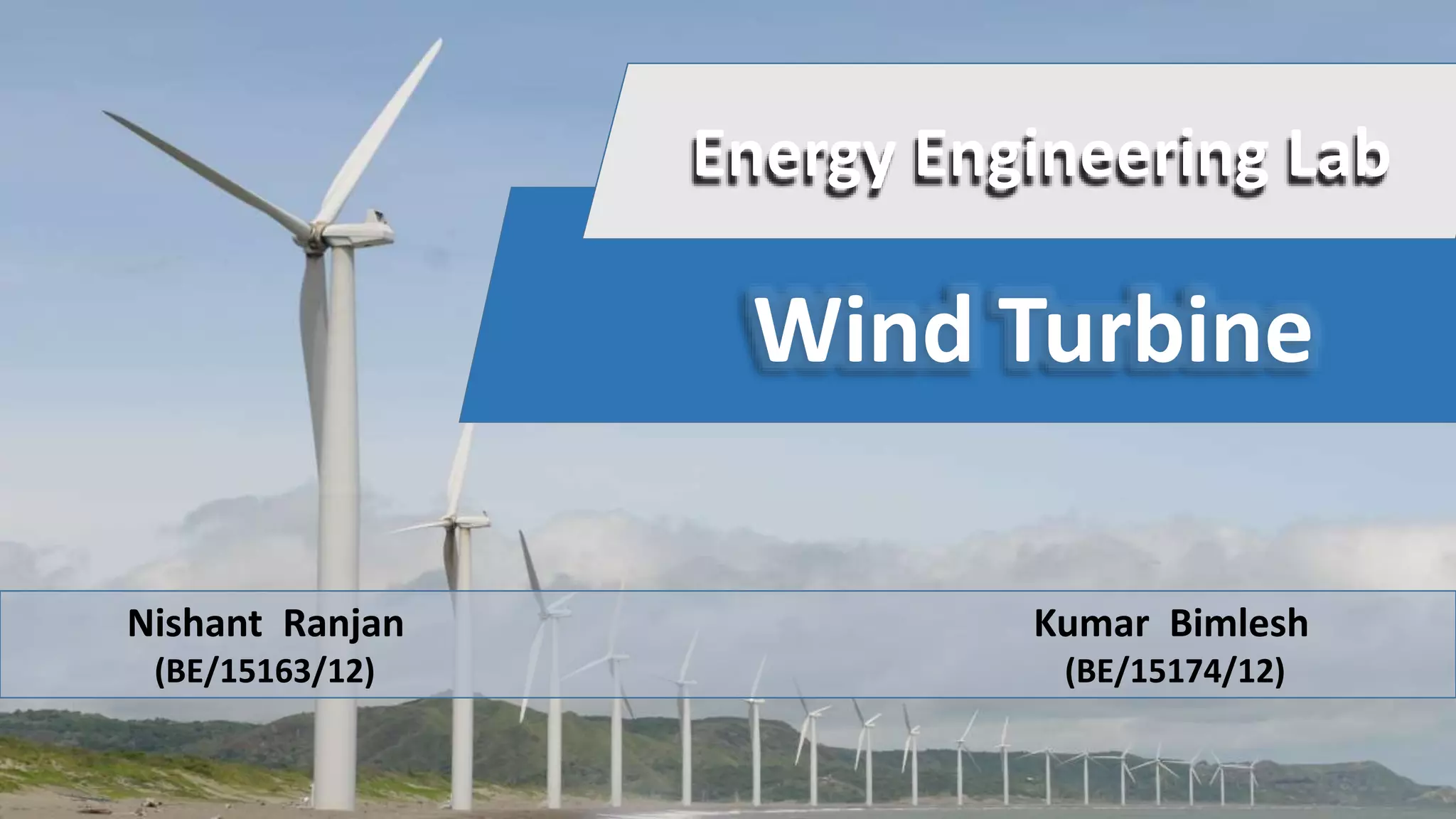
Wind Turbine
Nishant Ranjan Kumar Bimlesh
Energy Engineering Lab
(BE/15163/12) (BE/15174/12)
INTRODUCTION
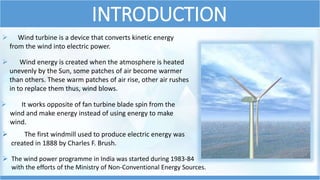
 Wind energy is created when the atmosphere is heated
unevenly by the Sun, some patches of air become warmer
than others. These warm patches of air rise, other air rushes
in to replace them thus, wind blows.
 Wind turbine is a device that converts kinetic energy
from the wind into electric power.
 It works opposite of fan turbine blade spin from the
wind and make energy instead of using energy to make
wind.
 The first windmill used to produce electric energy was
created in 1888 by Charles F. Brush.
 The wind power programme in India was started during 1983-84
with the efforts of the Ministry of Non-Conventional Energy Sources.
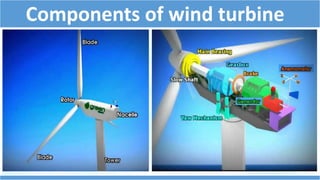
Components of wind turbine
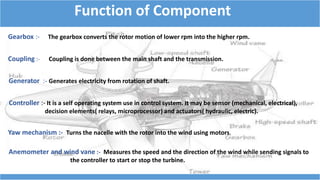
Function of Component
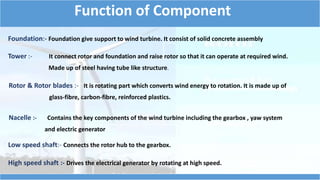
Foundation:- Foundation give support to wind turbine. It consist of solid concrete assembly
Tower :- It connect rotor and foundation and raise rotor so that it can operate at required wind.
Made up of steel having tube like structure.
Nacelle :- Contains the key components of the wind turbine including the gearbox , yaw system
and electric generator
Rotor & Rotor blades :- It is rotating part which converts wind energy to rotation. It is made up of
glass-fibre, carbon-fibre, reinforced plastics.
Low speed shaft:- Connects the rotor hub to the gearbox.
High speed shaft :- Drives the electrical generator by rotating at high speed.
Function of Component
Gearbox :- The gearbox converts the rotor motion of lower rpm into the higher rpm.
Coupling :- Coupling is done between the main shaft and the transmission.
Generator :- Generates electricity from rotation of shaft.
Controller :- It is a self operating system use in control system. It may be sensor (mechanical, electrical),
decision elements( relays, microprocessor) and actuators( hydraulic, electric).
Yaw mechanism :- Turns the nacelle with the rotor into the wind using motors.
Anemometer and wind vane :- Measures the speed and the direction of the wind while sending signals to
the controller to start or stop the turbine.
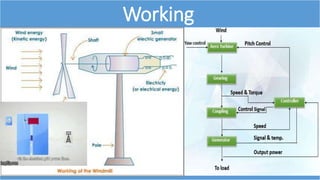
Working
Types of wind turbine
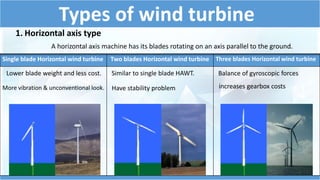
1. Horizontal axis type
A horizontal axis machine has its blades rotating on an axis parallel to the ground.
Single blade Horizontal wind turbine Two blades Horizontal wind turbine Three blades Horizontal wind turbine
Lower blade weight and less cost.
More vibration & unconventional look.
Similar to single blade HAWT.
Have stability problem increases gearbox costs
Balance of gyroscopic forces
Types of wind turbine
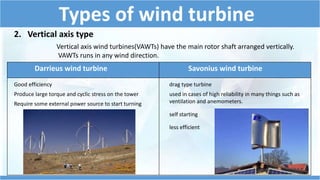
2. Vertical axis type
Darrieus wind turbine Savonius wind turbine
Vertical axis wind turbines(VAWTs) have the main rotor shaft arranged vertically.
VAWTs runs in any wind direction.
Good efficiency
Produce large torque and cyclic stress on the tower
Require some external power source to start turning
drag type turbine
self starting
less efficient
used in cases of high reliability in many things such as
ventilation and anemometers.
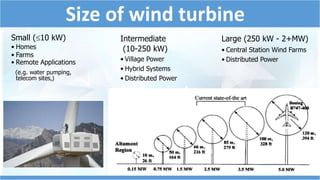
Size of wind turbine
Small (10 kW)
• Homes
• Farms
• Remote Applications
(e.g. water pumping,
telecom sites,)
Large (250 kW - 2+MW)
• Central Station Wind Farms
• Distributed Power
Intermediate
(10-250 kW)
• Village Power
• Hybrid Systems
• Distributed Power
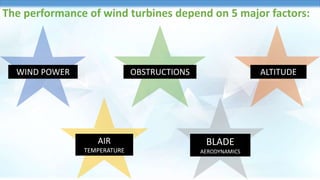
The performance of wind turbines depend on 5 major factors:
WIND POWER
AIR
TEMPERATURE
BLADE
AERODYNAMICS
OBSTRUCTIONS ALTITUDE
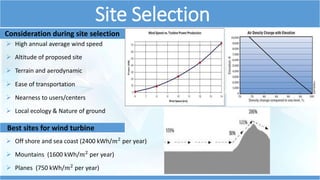
Site Selection
Consideration during site selection
 High annual average wind speed
 Altitude of proposed site
 Terrain and aerodynamic
 Ease of transportation
 Nearness to users/centers
Best sites for wind turbine
 Off shore and sea coast (2400 kWh/𝑚2 per year)
 Mountains (1600 kWh/𝑚2 per year)
 Planes (750 kWh/𝑚2 per year)
 Local ecology & Nature of ground
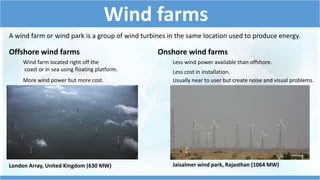
Wind farms
A wind farm or wind park is a group of wind turbines in the same location used to produce energy.
Offshore wind farms
Wind farm located right off the
coast or in sea using floating platform.
More wind power but more cost.
Onshore wind farms
Less wind power available than offshore.
Less cost in installation.
Usually near to user but create noise and visual problems.
Jaisalmer wind park, Rajasthan (1064 MW)
London Array, United Kingdom (630 MW)
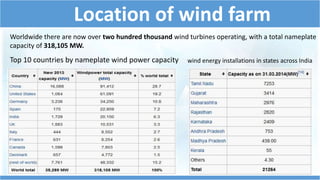
Location of wind farm
Worldwide there are now over two hundred thousand wind turbines operating, with a total nameplate
capacity of 318,105 MW.
Top 10 countries by nameplate wind power capacity wind energy installations in states across India
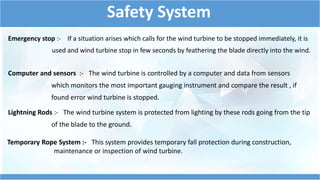
Safety System
Emergency stop :- If a situation arises which calls for the wind turbine to be stopped immediately, it is
used and wind turbine stop in few seconds by feathering the blade directly into the wind.
Computer and sensors :- The wind turbine is controlled by a computer and data from sensors
which monitors the most important gauging instrument and compare the result , if
found error wind turbine is stopped.
Lightning Rods :- The wind turbine system is protected from lighting by these rods going from the tip
of the blade to the ground.
Temporary Rope System :- This system provides temporary fall protection during construction,
maintenance or inspection of wind turbine.
ADVANTAGE
 Good for environment as it uses renewable source of
energy as wind.
 Wind is freely available in nature.
 Can be setup in remote areas where electricity
through transmission wire cannot be reached.
 Clean source of energy as it does not produce any
green house gases or any other pollutants.
 Once setup is completed the cost of generation
electricity become less.
 Can be combined with solar electricity to give
reliable supply of electricity.
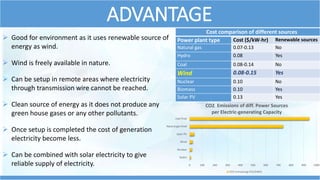
Cost comparison of different sources
Power plant type Cost ($/kW-hr) Renewable sources
Natural gas 0.07-0.13 No
Hydro 0.08 Yes
Coal 0.08-0.14 No
Wind 0.08-0.15 Yes
Nuclear 0.10 No
Biomass 0.10 Yes
Solar PV 0.13 Yes
0 100 200 300 400 500 600 700 800 900 1000
Hydro
Nuclear
Wind
Solar PV
Natural gas fired
coal fired
CO2 Emissions of diff. Power Sources
per Electric-generating Capacity
CO2 emission(g-CO2/kWh)
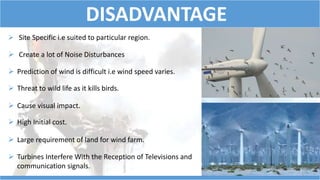
DISADVANTAGE
 Site Specific i.e suited to particular region.
 Create a lot of Noise Disturbances
 Prediction of wind is difficult i.e wind speed varies.
 Threat to wild life as it kills birds.
 Cause visual impact.
 High Initial cost.
 Large requirement of land for wind farm.
 Turbines Interfere With the Reception of Televisions and
communication signals.
Future
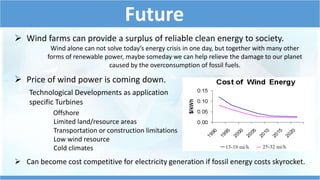
 Price of wind power is coming down.
Technological Developments as application
specific Turbines
Offshore
Limited land/resource areas
Transportation or construction limitations
Low wind resource
Cold climates
 Wind farms can provide a surplus of reliable clean energy to society.
 Can become cost competitive for electricity generation if fossil energy costs skyrocket.
Wind alone can not solve today’s energy crisis in one day, but together with many other
forms of renewable power, maybe someday we can help relieve the damage to our planet
caused by the overconsumption of fossil fuels.
windturbine-copy-141108113322-conversion-gate02.pdf

windturbine-copy-141108113322-conversion-gate02.pdf

  • 1.
    Wind Turbine Nishant RanjanKumar Bimlesh Energy Engineering Lab (BE/15163/12) (BE/15174/12)
  • 2.
    INTRODUCTION  Wind energyis created when the atmosphere is heated unevenly by the Sun, some patches of air become warmer than others. These warm patches of air rise, other air rushes in to replace them thus, wind blows.  Wind turbine is a device that converts kinetic energy from the wind into electric power.  It works opposite of fan turbine blade spin from the wind and make energy instead of using energy to make wind.  The first windmill used to produce electric energy was created in 1888 by Charles F. Brush.  The wind power programme in India was started during 1983-84 with the efforts of the Ministry of Non-Conventional Energy Sources.
  • 3.
  • 4.
    Function of Component Foundation:-Foundation give support to wind turbine. It consist of solid concrete assembly Tower :- It connect rotor and foundation and raise rotor so that it can operate at required wind. Made up of steel having tube like structure. Nacelle :- Contains the key components of the wind turbine including the gearbox , yaw system and electric generator Rotor & Rotor blades :- It is rotating part which converts wind energy to rotation. It is made up of glass-fibre, carbon-fibre, reinforced plastics. Low speed shaft:- Connects the rotor hub to the gearbox. High speed shaft :- Drives the electrical generator by rotating at high speed.
  • 5.
    Function of Component Gearbox:- The gearbox converts the rotor motion of lower rpm into the higher rpm. Coupling :- Coupling is done between the main shaft and the transmission. Generator :- Generates electricity from rotation of shaft. Controller :- It is a self operating system use in control system. It may be sensor (mechanical, electrical), decision elements( relays, microprocessor) and actuators( hydraulic, electric). Yaw mechanism :- Turns the nacelle with the rotor into the wind using motors. Anemometer and wind vane :- Measures the speed and the direction of the wind while sending signals to the controller to start or stop the turbine.
  • 6.
  • 7.
    Types of windturbine 1. Horizontal axis type A horizontal axis machine has its blades rotating on an axis parallel to the ground. Single blade Horizontal wind turbine Two blades Horizontal wind turbine Three blades Horizontal wind turbine Lower blade weight and less cost. More vibration & unconventional look. Similar to single blade HAWT. Have stability problem increases gearbox costs Balance of gyroscopic forces
  • 8.
    Types of windturbine 2. Vertical axis type Darrieus wind turbine Savonius wind turbine Vertical axis wind turbines(VAWTs) have the main rotor shaft arranged vertically. VAWTs runs in any wind direction. Good efficiency Produce large torque and cyclic stress on the tower Require some external power source to start turning drag type turbine self starting less efficient used in cases of high reliability in many things such as ventilation and anemometers.
  • 9.
    Size of windturbine Small (10 kW) • Homes • Farms • Remote Applications (e.g. water pumping, telecom sites,) Large (250 kW - 2+MW) • Central Station Wind Farms • Distributed Power Intermediate (10-250 kW) • Village Power • Hybrid Systems • Distributed Power
  • 10.
    The performance ofwind turbines depend on 5 major factors: WIND POWER AIR TEMPERATURE BLADE AERODYNAMICS OBSTRUCTIONS ALTITUDE
  • 11.
    Site Selection Consideration duringsite selection  High annual average wind speed  Altitude of proposed site  Terrain and aerodynamic  Ease of transportation  Nearness to users/centers Best sites for wind turbine  Off shore and sea coast (2400 kWh/𝑚2 per year)  Mountains (1600 kWh/𝑚2 per year)  Planes (750 kWh/𝑚2 per year)  Local ecology & Nature of ground
  • 12.
    Wind farms A windfarm or wind park is a group of wind turbines in the same location used to produce energy. Offshore wind farms Wind farm located right off the coast or in sea using floating platform. More wind power but more cost. Onshore wind farms Less wind power available than offshore. Less cost in installation. Usually near to user but create noise and visual problems. Jaisalmer wind park, Rajasthan (1064 MW) London Array, United Kingdom (630 MW)
  • 13.
    Location of windfarm Worldwide there are now over two hundred thousand wind turbines operating, with a total nameplate capacity of 318,105 MW. Top 10 countries by nameplate wind power capacity wind energy installations in states across India
  • 14.
    Safety System Emergency stop:- If a situation arises which calls for the wind turbine to be stopped immediately, it is used and wind turbine stop in few seconds by feathering the blade directly into the wind. Computer and sensors :- The wind turbine is controlled by a computer and data from sensors which monitors the most important gauging instrument and compare the result , if found error wind turbine is stopped. Lightning Rods :- The wind turbine system is protected from lighting by these rods going from the tip of the blade to the ground. Temporary Rope System :- This system provides temporary fall protection during construction, maintenance or inspection of wind turbine.
  • 15.
    ADVANTAGE  Good forenvironment as it uses renewable source of energy as wind.  Wind is freely available in nature.  Can be setup in remote areas where electricity through transmission wire cannot be reached.  Clean source of energy as it does not produce any green house gases or any other pollutants.  Once setup is completed the cost of generation electricity become less.  Can be combined with solar electricity to give reliable supply of electricity. Cost comparison of different sources Power plant type Cost ($/kW-hr) Renewable sources Natural gas 0.07-0.13 No Hydro 0.08 Yes Coal 0.08-0.14 No Wind 0.08-0.15 Yes Nuclear 0.10 No Biomass 0.10 Yes Solar PV 0.13 Yes 0 100 200 300 400 500 600 700 800 900 1000 Hydro Nuclear Wind Solar PV Natural gas fired coal fired CO2 Emissions of diff. Power Sources per Electric-generating Capacity CO2 emission(g-CO2/kWh)
  • 16.
    DISADVANTAGE  Site Specifici.e suited to particular region.  Create a lot of Noise Disturbances  Prediction of wind is difficult i.e wind speed varies.  Threat to wild life as it kills birds.  Cause visual impact.  High Initial cost.  Large requirement of land for wind farm.  Turbines Interfere With the Reception of Televisions and communication signals.
  • 17.
    Future  Price ofwind power is coming down. Technological Developments as application specific Turbines Offshore Limited land/resource areas Transportation or construction limitations Low wind resource Cold climates  Wind farms can provide a surplus of reliable clean energy to society.  Can become cost competitive for electricity generation if fossil energy costs skyrocket. Wind alone can not solve today’s energy crisis in one day, but together with many other forms of renewable power, maybe someday we can help relieve the damage to our planet caused by the overconsumption of fossil fuels.