G.H. Raisoni College of Engineering, Nagpur
Department of Mechanical Engineering
(An autonomous Institute under UGC act 1956 & affiliated to RTMNU, Nagpur)

Self-study report presented by
Abhishek Gawande
Roll No. – 04 (A)
Topic : “Wind Farms”
Under the supervision of
Dr D J Tidke
 Introduction
 Site

Selection
 Types of wind farms
 Working
 Parts of Wind Turbine
 Wind Potential
 Facts & Figures
 Pros & Cons
INTRODUCTION












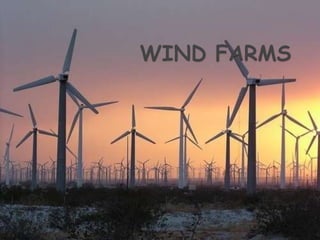
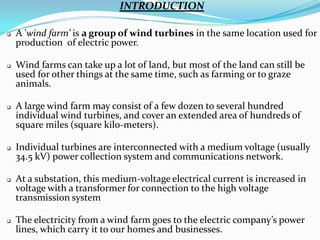
A 'wind farm’ is a group of wind turbines in the same location used for
production of electric power.
Wind farms can take up a lot of land, but most of the land can still be
used for other things at the same time, such as farming or to graze
animals.

A large wind farm may consist of a few dozen to several hundred
individual wind turbines, and cover an extended area of hundreds of
square miles (square kilo-meters).
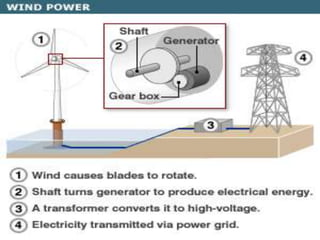
Individual turbines are interconnected with a medium voltage (usually
34.5 kV) power collection system and communications network.
At a substation, this medium-voltage electrical current is increased in
voltage with a transformer for connection to the high voltage
transmission system
The electricity from a wind farm goes to the electric company’s power
lines, which carry it to our homes and businesses.
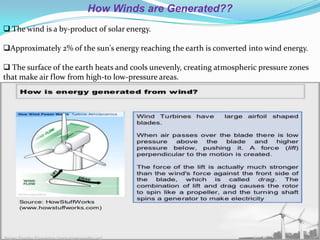
How Winds are Generated??
 The wind is a by-product of solar energy.
Approximately 2% of the sun's energy reaching the earth is converted into wind energy.
 The surface of the earth heats and cools unevenly, creating atmospheric pressure zones
that make air flow from high-to low-pressure areas.
Essential requirements for setting up a wind farm
The essential requirements for establishment of a wind farm for
optimal exploitation of the wind are
• High wind resource at particular site.
• Adequate land availability.

• Suitable terrain and good soil condition.
• Proper approach to site.
•Suitable power grid nearby.
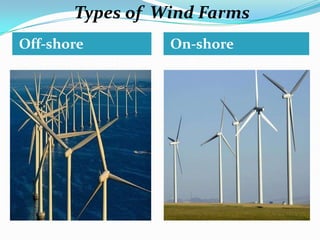
Types of Wind Farms
Off-shore

On-shore


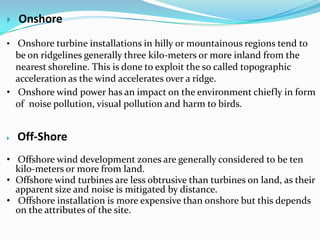
Onshore

• Onshore turbine installations in hilly or mountainous regions tend to

be on ridgelines generally three kilo-meters or more inland from the
nearest shoreline. This is done to exploit the so called topographic
acceleration as the wind accelerates over a ridge.
• Onshore wind power has an impact on the environment chiefly in form
of noise pollution, visual pollution and harm to birds.



Off-Shore

• Offshore wind development zones are generally considered to be ten
kilo-meters or more from land.
• Offshore wind turbines are less obtrusive than turbines on land, as their
apparent size and noise is mitigated by distance.
• Offshore installation is more expensive than onshore but this depends
on the attributes of the site.
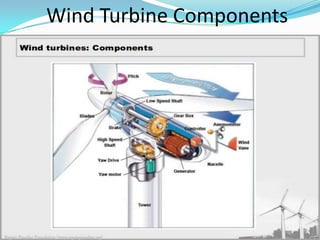
Wind Turbine Components
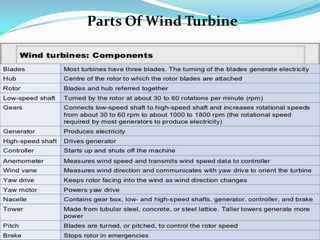
Parts Of Wind Turbine
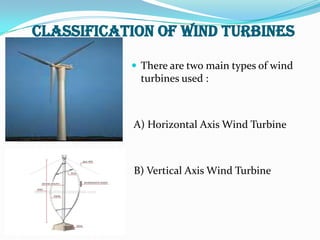
Classification of Wind Turbines
 There are two main types of wind

turbines used :

A) Horizontal Axis Wind Turbine

B) Vertical Axis Wind Turbine
Horizontal Axis Wind Turbine
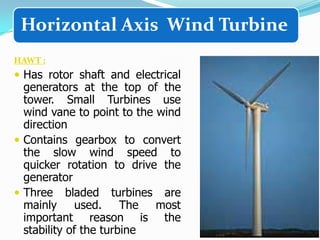
HAWT :

 Has rotor shaft and electrical

generators at the top of the
tower. Small Turbines use
wind vane to point to the wind
direction
 Contains gearbox to convert
the slow wind speed to
quicker rotation to drive the
generator
 Three bladed turbines are
mainly
used. The
most
important reason is the
stability of the turbine
Advantage and Disadvantage
(HAWT)
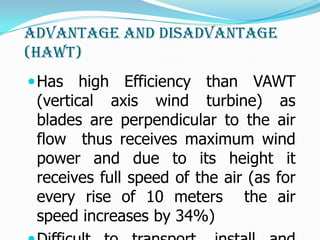
 Has

high Efficiency than VAWT
(vertical axis wind turbine) as
blades are perpendicular to the air
flow thus receives maximum wind
power and due to its height it
receives full speed of the air (as for
every rise of 10 meters the air
speed increases by 34%)
Vertical Axis Wind Turbine
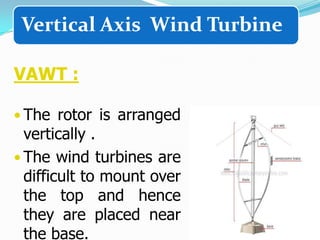
VAWT :
• The rotor is arranged

vertically .
• The wind turbines are
difficult to mount over
the top and hence
they are placed near
the base.
Advantage and Disadvantage of VAWT
 They have low start up speeds like 10 km/hr and they can easily be used

where taller structures are prohibited
Due to low height its easy to transport and cost reduces
It produces less power as they are mounted near the base so they cannot get

the full speed of wind and near the base the air gets turbulent due to presence of
various objects and hence its efficiency is less than HAWT
Parts are placed under the structures and hence maintenance is difficult
Calculation of Wind Power
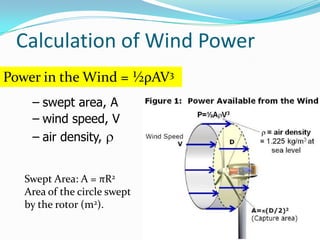
•Power in the = ½ρAV
Power in the Wind wind 3
– swept area, A
– wind speed, V
– air density,
Swept Area: A = πR2
Area of the circle swept
by the rotor (m2).

R
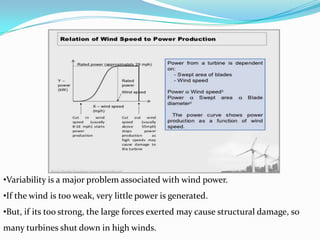
•Variability is a major problem associated with wind power.
•If the wind is too weak, very little power is generated.
•But, if its too strong, the large forces exerted may cause structural damage, so
many turbines shut down in high winds.
Facts & Figures
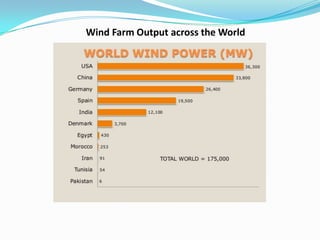
•Total worldwide installed capacity of wind turbines in 2008: 121
gigawatts .This represents about 1% of total power generation from
all sources.
•Country with highest wind energy use: US with 29 gigawatts

•States with largest wind turbine generating capacity: Texas (8.4
gigawatts), Iowa (3.0 gigawatts), and California (2.8 gigawatts)
account for almost one half of the US total wind capacity.
•World’s largest wind turbine: Enercon E-126 generates 6 MW (1
MW= 1 million watts), with a rotor diameter of over 400 ft.
•World’s largest windfarm: Horse Hollow Energy Center, spread over
47,000 acres in Nolan and Tayler counties in Texas , has 421 wind
turbines generating 735 MW of electricity.
Wind Farm Output across the World
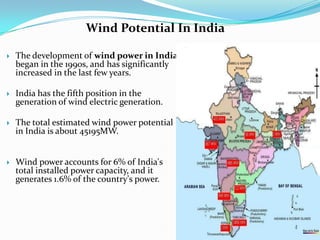
Wind Potential In India


The development of wind power in India
began in the 1990s, and has significantly
increased in the last few years.



India has the fifth position in the
generation of wind electric generation.



The total estimated wind power potential
in India is about 45195MW.



Wind power accounts for 6% of India's
total installed power capacity, and it
generates 1.6% of the country's power.
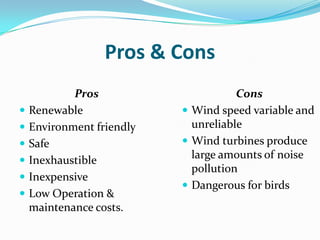
Pros & Cons









Pros
Renewable
Environment friendly
Safe
Inexhaustible
Inexpensive
Low Operation &
maintenance costs.

Cons
 Wind speed variable and
unreliable
 Wind turbines produce
large amounts of noise
pollution
 Dangerous for birds
REFERENCES
•http://en.wikipedia.org/wiki/Wind_farm
•http://science.howstuffworks.com/environment
al/green-science/wind-power7.htm
•http://www.thewindpower.net/
•http://www.suzlon.com/
•http://www.indianwindpower.com/
•http://www.inwea.org/
THANK YOU!

Wind farms

  • 1.
    G.H. Raisoni Collegeof Engineering, Nagpur Department of Mechanical Engineering (An autonomous Institute under UGC act 1956 & affiliated to RTMNU, Nagpur) Self-study report presented by Abhishek Gawande Roll No. – 04 (A) Topic : “Wind Farms” Under the supervision of Dr D J Tidke
  • 2.
     Introduction  Site Selection Types of wind farms  Working  Parts of Wind Turbine  Wind Potential  Facts & Figures  Pros & Cons
  • 4.
    INTRODUCTION       A 'wind farm’is a group of wind turbines in the same location used for production of electric power. Wind farms can take up a lot of land, but most of the land can still be used for other things at the same time, such as farming or to graze animals. A large wind farm may consist of a few dozen to several hundred individual wind turbines, and cover an extended area of hundreds of square miles (square kilo-meters). Individual turbines are interconnected with a medium voltage (usually 34.5 kV) power collection system and communications network. At a substation, this medium-voltage electrical current is increased in voltage with a transformer for connection to the high voltage transmission system The electricity from a wind farm goes to the electric company’s power lines, which carry it to our homes and businesses.
  • 5.
    How Winds areGenerated??  The wind is a by-product of solar energy. Approximately 2% of the sun's energy reaching the earth is converted into wind energy.  The surface of the earth heats and cools unevenly, creating atmospheric pressure zones that make air flow from high-to low-pressure areas.
  • 6.
    Essential requirements forsetting up a wind farm The essential requirements for establishment of a wind farm for optimal exploitation of the wind are • High wind resource at particular site. • Adequate land availability. • Suitable terrain and good soil condition. • Proper approach to site. •Suitable power grid nearby.
  • 7.
    Types of WindFarms Off-shore On-shore
  • 8.
     Onshore • Onshore turbineinstallations in hilly or mountainous regions tend to be on ridgelines generally three kilo-meters or more inland from the nearest shoreline. This is done to exploit the so called topographic acceleration as the wind accelerates over a ridge. • Onshore wind power has an impact on the environment chiefly in form of noise pollution, visual pollution and harm to birds.  Off-Shore • Offshore wind development zones are generally considered to be ten kilo-meters or more from land. • Offshore wind turbines are less obtrusive than turbines on land, as their apparent size and noise is mitigated by distance. • Offshore installation is more expensive than onshore but this depends on the attributes of the site.
  • 9.
  • 10.
  • 11.
    Classification of WindTurbines  There are two main types of wind turbines used : A) Horizontal Axis Wind Turbine B) Vertical Axis Wind Turbine
  • 12.
    Horizontal Axis WindTurbine HAWT :  Has rotor shaft and electrical generators at the top of the tower. Small Turbines use wind vane to point to the wind direction  Contains gearbox to convert the slow wind speed to quicker rotation to drive the generator  Three bladed turbines are mainly used. The most important reason is the stability of the turbine
  • 13.
    Advantage and Disadvantage (HAWT) Has high Efficiency than VAWT (vertical axis wind turbine) as blades are perpendicular to the air flow thus receives maximum wind power and due to its height it receives full speed of the air (as for every rise of 10 meters the air speed increases by 34%)
  • 14.
    Vertical Axis WindTurbine VAWT : • The rotor is arranged vertically . • The wind turbines are difficult to mount over the top and hence they are placed near the base.
  • 15.
    Advantage and Disadvantageof VAWT  They have low start up speeds like 10 km/hr and they can easily be used where taller structures are prohibited Due to low height its easy to transport and cost reduces It produces less power as they are mounted near the base so they cannot get the full speed of wind and near the base the air gets turbulent due to presence of various objects and hence its efficiency is less than HAWT Parts are placed under the structures and hence maintenance is difficult
  • 17.
    Calculation of WindPower •Power in the = ½ρAV Power in the Wind wind 3 – swept area, A – wind speed, V – air density, Swept Area: A = πR2 Area of the circle swept by the rotor (m2). R
  • 18.
    •Variability is amajor problem associated with wind power. •If the wind is too weak, very little power is generated. •But, if its too strong, the large forces exerted may cause structural damage, so many turbines shut down in high winds.
  • 19.
    Facts & Figures •Totalworldwide installed capacity of wind turbines in 2008: 121 gigawatts .This represents about 1% of total power generation from all sources. •Country with highest wind energy use: US with 29 gigawatts •States with largest wind turbine generating capacity: Texas (8.4 gigawatts), Iowa (3.0 gigawatts), and California (2.8 gigawatts) account for almost one half of the US total wind capacity. •World’s largest wind turbine: Enercon E-126 generates 6 MW (1 MW= 1 million watts), with a rotor diameter of over 400 ft. •World’s largest windfarm: Horse Hollow Energy Center, spread over 47,000 acres in Nolan and Tayler counties in Texas , has 421 wind turbines generating 735 MW of electricity.
  • 20.
    Wind Farm Outputacross the World
  • 21.
    Wind Potential InIndia  The development of wind power in India began in the 1990s, and has significantly increased in the last few years.  India has the fifth position in the generation of wind electric generation.  The total estimated wind power potential in India is about 45195MW.  Wind power accounts for 6% of India's total installed power capacity, and it generates 1.6% of the country's power.
  • 22.
    Pros & Cons       Pros Renewable Environmentfriendly Safe Inexhaustible Inexpensive Low Operation & maintenance costs. Cons  Wind speed variable and unreliable  Wind turbines produce large amounts of noise pollution  Dangerous for birds
  • 23.
  • 24.