Wind Power Forecasting - An
Application of Machine learning in
Renewable Energy
Dr. Gul Muhammad Khan
Abstract
The advancement in renewable energy sector being the focus of research these days, a
novel neuro evolutionary technique is proposed for modeling wind power forecasters.
The word uses the robust technique of
Cartesian Genetic Programming to evolve ANN
for development of forecasting models.
These Models predicts power generation of a wind based power plant from a single hour
up to a year - taking a big lead over other proposed models by reducing its MAPE to
minimum values for a single day hourly prediction.
Results when compared with other models in the literature demonstrated that the
proposed models are among the best estimators of wind based power generation plants
proposed to date.
Introduction
The environmental hazards like pollution and global warming
have compelled the power generation sectors to come up with
different green energy production techniques.
EU Wind power association Report
• 9.616GW wind based power plants installation in EUROPE in 2011
• 105.6GW capacity achieved by the end of 2012
• 7% of the total generated power in 2012 was based on wind energy
So
Considering these facts, one must adopt techniques that are feasible and
provide optimum forecasting results regarding wind power generation.
Estimation of future production of wind power is one of them.
Techniques used for forecasting wind power generation includes Stochastic,
Probabilistic and Machine learning techniques.
CGP (Cartesian Genetic Programming)
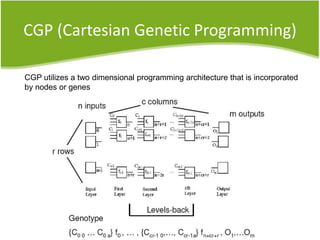
CGP utilizes a two dimensional programming architecture that is incorporated
by nodes or genes
CGP (cont.)
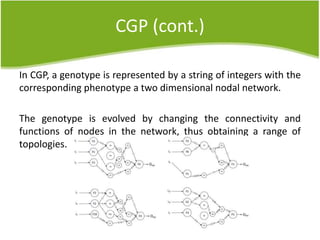
In CGP, a genotype is represented by a string of integers with the
corresponding phenotype a two dimensional nodal network.
The genotype is evolved by changing the connectivity and
functions of nodes in the network, thus obtaining a range of
topologies.
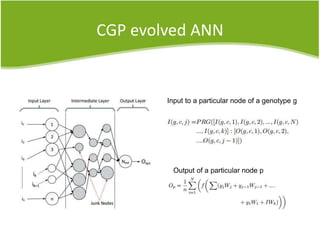
CGP evolved ANN
Input to a particular node of a genotype g
Output of a particular node p
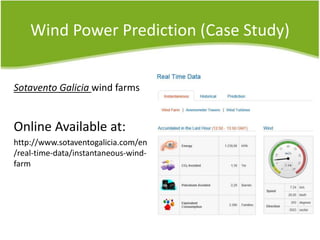
Wind Power Prediction (Case Study)
Sotavento Galicia wind farms
Online Available at:
http://www.sotaventogalicia.com/en
/real-time-data/instantaneous-wind-
farm
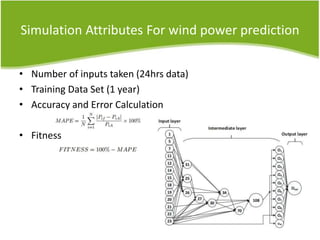
Simulation Attributes For wind power prediction
• Number of inputs taken (24hrs data)
• Training Data Set (1 year)
• Accuracy and Error Calculation
• Fitness
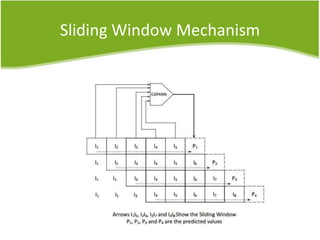
Sliding Window Mechanism
Training Accuracy
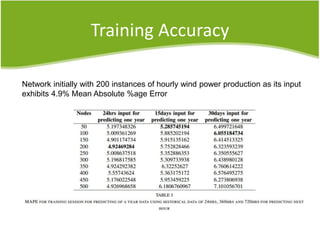
Network initially with 200 instances of hourly wind power production as its input
exhibits 4.9% Mean Absolute %age Error
Testing Results
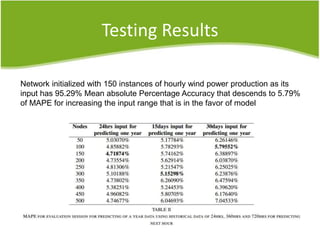
Network initialized with 150 instances of hourly wind power production as its
input has 95.29% Mean absolute Percentage Accuracy that descends to 5.79%
of MAPE for increasing the input range that is in the favor of model
Comparison with other Models for the same
Input data type and prediction horizon
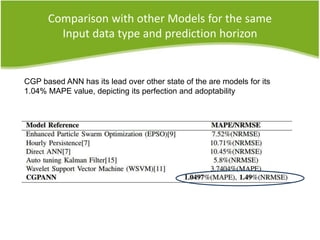
CGP based ANN has its lead over other state of the are models for its
1.04% MAPE value, depicting its perfection and adoptability
Actual Verses Forecasted terrain
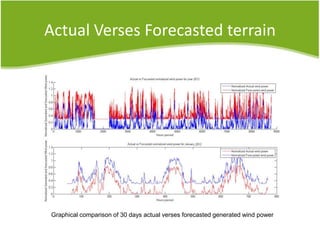
Graphical comparison of 30 days actual verses forecasted generated wind power
Conclusion
• Based on CGP evolved ANN, three different forecasting models have been
proposed in the work whereas Each model is forecasting generating wind
power for the next 1 hour.
• A MAPE value of as low as 4.71% has been achieved for a full one year.
• The Accuracy of the model goes up to 98.951% for single day prediction,
evidencing the perfection of the proposed CGPANN Models for short term
forecasting.
• The proposed solution can be further enhanced by considering
parameters such as wind-speed and its direction at the site, instantaneous
humidity, atmospheric pressure and air temperature.
Questions??

Wind power forecasting an application of machine

  • 1.
    Wind Power Forecasting- An Application of Machine learning in Renewable Energy Dr. Gul Muhammad Khan
  • 2.
    Abstract The advancement inrenewable energy sector being the focus of research these days, a novel neuro evolutionary technique is proposed for modeling wind power forecasters. The word uses the robust technique of Cartesian Genetic Programming to evolve ANN for development of forecasting models. These Models predicts power generation of a wind based power plant from a single hour up to a year - taking a big lead over other proposed models by reducing its MAPE to minimum values for a single day hourly prediction. Results when compared with other models in the literature demonstrated that the proposed models are among the best estimators of wind based power generation plants proposed to date.
  • 3.
    Introduction The environmental hazardslike pollution and global warming have compelled the power generation sectors to come up with different green energy production techniques.
  • 4.
    EU Wind powerassociation Report • 9.616GW wind based power plants installation in EUROPE in 2011 • 105.6GW capacity achieved by the end of 2012 • 7% of the total generated power in 2012 was based on wind energy
  • 5.
    So Considering these facts,one must adopt techniques that are feasible and provide optimum forecasting results regarding wind power generation. Estimation of future production of wind power is one of them. Techniques used for forecasting wind power generation includes Stochastic, Probabilistic and Machine learning techniques.
  • 6.
    CGP (Cartesian GeneticProgramming) CGP utilizes a two dimensional programming architecture that is incorporated by nodes or genes
  • 7.
    CGP (cont.) In CGP,a genotype is represented by a string of integers with the corresponding phenotype a two dimensional nodal network. The genotype is evolved by changing the connectivity and functions of nodes in the network, thus obtaining a range of topologies.
  • 8.
    CGP evolved ANN Inputto a particular node of a genotype g Output of a particular node p
  • 9.
    Wind Power Prediction(Case Study) Sotavento Galicia wind farms Online Available at: http://www.sotaventogalicia.com/en /real-time-data/instantaneous-wind- farm
  • 10.
    Simulation Attributes Forwind power prediction • Number of inputs taken (24hrs data) • Training Data Set (1 year) • Accuracy and Error Calculation • Fitness
  • 11.
  • 12.
    Training Accuracy Network initiallywith 200 instances of hourly wind power production as its input exhibits 4.9% Mean Absolute %age Error
  • 13.
    Testing Results Network initializedwith 150 instances of hourly wind power production as its input has 95.29% Mean absolute Percentage Accuracy that descends to 5.79% of MAPE for increasing the input range that is in the favor of model
  • 14.
    Comparison with otherModels for the same Input data type and prediction horizon CGP based ANN has its lead over other state of the are models for its 1.04% MAPE value, depicting its perfection and adoptability
  • 15.
    Actual Verses Forecastedterrain Graphical comparison of 30 days actual verses forecasted generated wind power
  • 16.
    Conclusion • Based onCGP evolved ANN, three different forecasting models have been proposed in the work whereas Each model is forecasting generating wind power for the next 1 hour. • A MAPE value of as low as 4.71% has been achieved for a full one year. • The Accuracy of the model goes up to 98.951% for single day prediction, evidencing the perfection of the proposed CGPANN Models for short term forecasting. • The proposed solution can be further enhanced by considering parameters such as wind-speed and its direction at the site, instantaneous humidity, atmospheric pressure and air temperature.
  • 17.