Seminar on Wind PowerSeminar on Wind Power
NAME :- CHATAR SINGH MEENA
En. Roll :- 275/12 ( 39 )
Electrical Engineering
7th
Semester
National Institute Of Technology Srinagar 190006
WIND POWERWIND POWER
 What is it?
 Windmill design
 How does it work?
 U.S. States and
Examples
 Advantages of Wind
Power
 Disadvantages Of
Wind Power
Contents :-
WIND POWERWIND POWER - What is it?- What is it?
 All renewable energy (except tidal and geothermal power), ultimately
comes from the sun
 The earth receives 1.74 x 10¹⁷
watts of power (per hour) from the sun
 About one or 2 percent of this energy is converted to wind energy
(which is about 50-100 times more than the energy converted to
biomass by all plants on earth
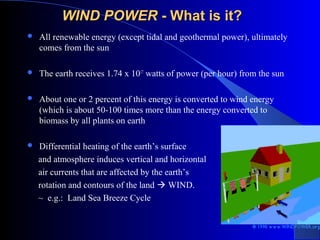
 Differential heating of the earth’s surface
and atmosphere induces vertical and horizontal
air currents that are affected by the earth’s
rotation and contours of the land  WIND.
~ e.g.: Land Sea Breeze Cycle
• Winds are influenced by the ground surface at altitudes up to
100 meters.
• Wind is slowed by the surface roughness and obstacles.
• When dealing with wind energy, we are concerned with
surface winds.
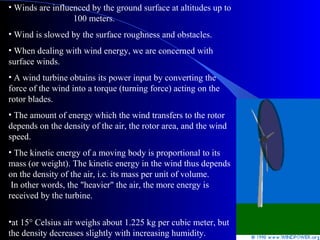
• A wind turbine obtains its power input by converting the
force of the wind into a torque (turning force) acting on the
rotor blades.
• The amount of energy which the wind transfers to the rotor
depends on the density of the air, the rotor area, and the wind
speed.
• The kinetic energy of a moving body is proportional to its
mass (or weight). The kinetic energy in the wind thus depends
on the density of the air, i.e. its mass per unit of volume.
In other words, the "heavier" the air, the more energy is
received by the turbine.
•at 15° Celsius air weighs about 1.225 kg per cubic meter, but
the density decreases slightly with increasing humidity.
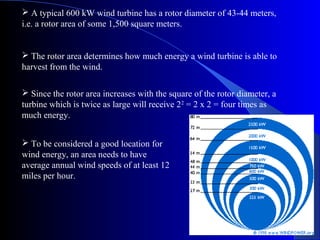
 A typical 600 kW wind turbine has a rotor diameter of 43-44 meters,
i.e. a rotor area of some 1,500 square meters.
 The rotor area determines how much energy a wind turbine is able to
harvest from the wind.
 Since the rotor area increases with the square of the rotor diameter, a
turbine which is twice as large will receive 22
= 2 x 2 = four times as
much energy.
 To be considered a good location for
wind energy, an area needs to have
average annual wind speeds of at least 12
miles per hour.
WINDMILL DESIGNWINDMILL DESIGN
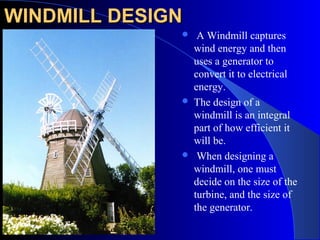
 A Windmill captures
wind energy and then
uses a generator to
convert it to electrical
energy.
 The design of a
windmill is an integral
part of how efficient it
will be.
 When designing a
windmill, one must
decide on the size of the
turbine, and the size of
the generator.
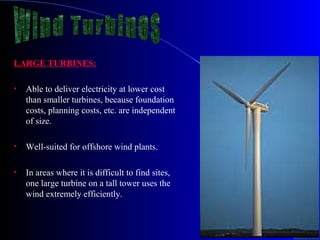
LARGE TURBINES:
• Able to deliver electricity at lower cost
than smaller turbines, because foundation
costs, planning costs, etc. are independent
of size.
• Well-suited for offshore wind plants.
• In areas where it is difficult to find sites,
one large turbine on a tall tower uses the
wind extremely efficiently.
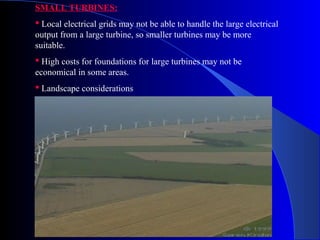
SMALL TURBINES:
 Local electrical grids may not be able to handle the large electrical
output from a large turbine, so smaller turbines may be more
suitable.
 High costs for foundations for large turbines may not be
economical in some areas.
 Landscape considerations
Wind Turbines: Number of Blades
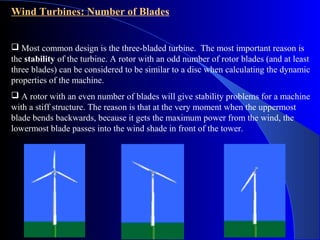
 Most common design is the three-bladed turbine. The most important reason is
the stability of the turbine. A rotor with an odd number of rotor blades (and at least
three blades) can be considered to be similar to a disc when calculating the dynamic
properties of the machine.
 A rotor with an even number of blades will give stability problems for a machine
with a stiff structure. The reason is that at the very moment when the uppermost
blade bends backwards, because it gets the maximum power from the wind, the
lowermost blade passes into the wind shade in front of the tower.
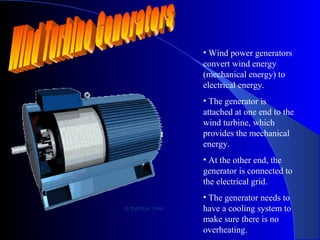
• Wind power generators
convert wind energy
(mechanical energy) to
electrical energy.
• The generator is
attached at one end to the
wind turbine, which
provides the mechanical
energy.
• At the other end, the
generator is connected to
the electrical grid.
• The generator needs to
have a cooling system to
make sure there is no
overheating.
SMALL GENERATORS:
 Require less force to turn than a larger ones, but give much lower
power output.
 Less efficient
i.e.. If you fit a large wind turbine rotor with a small generator it
will be producing electricity during many hours of the year, but it
will capture only a small part of the energy content of the wind at
high wind speeds.
LARGE GENERATORS:
 Very efficient at high wind speeds, but unable to turn at low wind
speeds.
i.e.. If the generator has larger coils, and/or a stronger internal
magnet, it will require more force (mechanical) to start in motion.
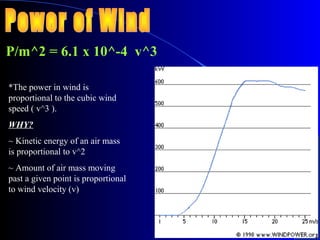
P/m^2 = 6.1 x 10^-4 v^3
*The power in wind is
proportional to the cubic wind
speed ( v^3 ).
WHY?
~ Kinetic energy of an air mass
is proportional to v^2
~ Amount of air mass moving
past a given point is proportional
to wind velocity (v)
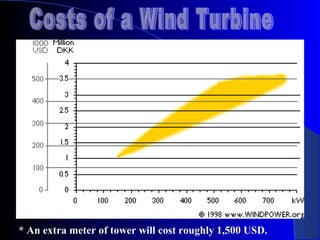
* An extra meter of tower will cost roughly 1,500 USD.
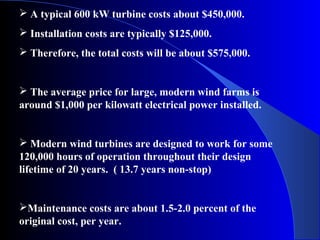
 A typical 600 kW turbine costs about $450,000.
 Installation costs are typically $125,000.
 Therefore, the total costs will be about $575,000.
 The average price for large, modern wind farms is
around $1,000 per kilowatt electrical power installed.
 Modern wind turbines are designed to work for some
120,000 hours of operation throughout their design
lifetime of 20 years. ( 13.7 years non-stop)
Maintenance costs are about 1.5-2.0 percent of the
original cost, per year.
 The U.S. currently has more than 1,600 MW of installed
capacity and produces about 3 billion KWh of electricity
each year.
 This is enough to meet the annual residential needs of 1
million people.
 More than 90 percent of this power is produced by three
wind farms in California (Altamont Pass, Tehachapi and
Palm Springs).
Advantages of Wind Power
• The wind blows day and night, which allows windmills to
produce electricity throughout the day. (Faster during the day)
• Energy output from a wind turbine will vary as the wind varies,
although the most rapid variations will to some extent be
compensated for by the inertia of the wind turbine rotor.
• Wind energy is a domestic, renewable source of energy that
generates no pollution and has little environmental impact. Up to
95 percent of land used for wind farms can also be used for other
profitable activities including ranching, farming and forestry.
• The decreasing cost of wind power and the growing interest in
renewable energy sources should ensure that wind power will
become a viable energy source in the United States and worldwide.
1. The strength of the wind is not constant it varies from zero to
Storm force.
2.Wind Turbine are noisy. Each one can generate the same level
of Noise as a family car travelling at 70kmph.
3. When Wind Turbines are being manufactured
some pollution is produced. Therefore wind power
does produce some pollution.
Conclusion :-
1. The wind has a lot of potential in it and if properly
harnessed then it can help solve the energy crises in the
world.
2. It can be used as a main source of power at those
places which are still not connected to electricty at lower
cost .
Thank You

Presentation On Wind Power

  • 1.
    Seminar on WindPowerSeminar on Wind Power NAME :- CHATAR SINGH MEENA En. Roll :- 275/12 ( 39 ) Electrical Engineering 7th Semester National Institute Of Technology Srinagar 190006
  • 2.
    WIND POWERWIND POWER What is it?  Windmill design  How does it work?  U.S. States and Examples  Advantages of Wind Power  Disadvantages Of Wind Power Contents :-
  • 3.
    WIND POWERWIND POWER- What is it?- What is it?  All renewable energy (except tidal and geothermal power), ultimately comes from the sun  The earth receives 1.74 x 10¹⁷ watts of power (per hour) from the sun  About one or 2 percent of this energy is converted to wind energy (which is about 50-100 times more than the energy converted to biomass by all plants on earth  Differential heating of the earth’s surface and atmosphere induces vertical and horizontal air currents that are affected by the earth’s rotation and contours of the land  WIND. ~ e.g.: Land Sea Breeze Cycle
  • 4.
    • Winds areinfluenced by the ground surface at altitudes up to 100 meters. • Wind is slowed by the surface roughness and obstacles. • When dealing with wind energy, we are concerned with surface winds. • A wind turbine obtains its power input by converting the force of the wind into a torque (turning force) acting on the rotor blades. • The amount of energy which the wind transfers to the rotor depends on the density of the air, the rotor area, and the wind speed. • The kinetic energy of a moving body is proportional to its mass (or weight). The kinetic energy in the wind thus depends on the density of the air, i.e. its mass per unit of volume. In other words, the "heavier" the air, the more energy is received by the turbine. •at 15° Celsius air weighs about 1.225 kg per cubic meter, but the density decreases slightly with increasing humidity.
  • 5.
     A typical600 kW wind turbine has a rotor diameter of 43-44 meters, i.e. a rotor area of some 1,500 square meters.  The rotor area determines how much energy a wind turbine is able to harvest from the wind.  Since the rotor area increases with the square of the rotor diameter, a turbine which is twice as large will receive 22 = 2 x 2 = four times as much energy.  To be considered a good location for wind energy, an area needs to have average annual wind speeds of at least 12 miles per hour.
  • 6.
    WINDMILL DESIGNWINDMILL DESIGN A Windmill captures wind energy and then uses a generator to convert it to electrical energy.  The design of a windmill is an integral part of how efficient it will be.  When designing a windmill, one must decide on the size of the turbine, and the size of the generator.
  • 7.
    LARGE TURBINES: • Ableto deliver electricity at lower cost than smaller turbines, because foundation costs, planning costs, etc. are independent of size. • Well-suited for offshore wind plants. • In areas where it is difficult to find sites, one large turbine on a tall tower uses the wind extremely efficiently.
  • 8.
    SMALL TURBINES:  Localelectrical grids may not be able to handle the large electrical output from a large turbine, so smaller turbines may be more suitable.  High costs for foundations for large turbines may not be economical in some areas.  Landscape considerations
  • 9.
    Wind Turbines: Numberof Blades  Most common design is the three-bladed turbine. The most important reason is the stability of the turbine. A rotor with an odd number of rotor blades (and at least three blades) can be considered to be similar to a disc when calculating the dynamic properties of the machine.  A rotor with an even number of blades will give stability problems for a machine with a stiff structure. The reason is that at the very moment when the uppermost blade bends backwards, because it gets the maximum power from the wind, the lowermost blade passes into the wind shade in front of the tower.
  • 10.
    • Wind powergenerators convert wind energy (mechanical energy) to electrical energy. • The generator is attached at one end to the wind turbine, which provides the mechanical energy. • At the other end, the generator is connected to the electrical grid. • The generator needs to have a cooling system to make sure there is no overheating.
  • 11.
    SMALL GENERATORS:  Requireless force to turn than a larger ones, but give much lower power output.  Less efficient i.e.. If you fit a large wind turbine rotor with a small generator it will be producing electricity during many hours of the year, but it will capture only a small part of the energy content of the wind at high wind speeds. LARGE GENERATORS:  Very efficient at high wind speeds, but unable to turn at low wind speeds. i.e.. If the generator has larger coils, and/or a stronger internal magnet, it will require more force (mechanical) to start in motion.
  • 12.
    P/m^2 = 6.1x 10^-4 v^3 *The power in wind is proportional to the cubic wind speed ( v^3 ). WHY? ~ Kinetic energy of an air mass is proportional to v^2 ~ Amount of air mass moving past a given point is proportional to wind velocity (v)
  • 13.
    * An extrameter of tower will cost roughly 1,500 USD.
  • 14.
     A typical600 kW turbine costs about $450,000.  Installation costs are typically $125,000.  Therefore, the total costs will be about $575,000.  The average price for large, modern wind farms is around $1,000 per kilowatt electrical power installed.  Modern wind turbines are designed to work for some 120,000 hours of operation throughout their design lifetime of 20 years. ( 13.7 years non-stop) Maintenance costs are about 1.5-2.0 percent of the original cost, per year.
  • 15.
     The U.S.currently has more than 1,600 MW of installed capacity and produces about 3 billion KWh of electricity each year.  This is enough to meet the annual residential needs of 1 million people.  More than 90 percent of this power is produced by three wind farms in California (Altamont Pass, Tehachapi and Palm Springs).
  • 17.
    Advantages of WindPower • The wind blows day and night, which allows windmills to produce electricity throughout the day. (Faster during the day) • Energy output from a wind turbine will vary as the wind varies, although the most rapid variations will to some extent be compensated for by the inertia of the wind turbine rotor. • Wind energy is a domestic, renewable source of energy that generates no pollution and has little environmental impact. Up to 95 percent of land used for wind farms can also be used for other profitable activities including ranching, farming and forestry. • The decreasing cost of wind power and the growing interest in renewable energy sources should ensure that wind power will become a viable energy source in the United States and worldwide.
  • 18.
    1. The strengthof the wind is not constant it varies from zero to Storm force. 2.Wind Turbine are noisy. Each one can generate the same level of Noise as a family car travelling at 70kmph. 3. When Wind Turbines are being manufactured some pollution is produced. Therefore wind power does produce some pollution.
  • 19.
    Conclusion :- 1. Thewind has a lot of potential in it and if properly harnessed then it can help solve the energy crises in the world. 2. It can be used as a main source of power at those places which are still not connected to electricty at lower cost .
  • 20.