Presented
M. HariSowjanya
14A81A0592
CSE-B
Seminar
On
WIMAX
What is WIMAX?
 WIMAX stands for Worldwide Interoperability for Microwave
Access
 WiMAX refers to broadband wireless networks that are based on
the IEEE 802.16 standard, which ensures compatibility and
interoperability between broadband wireless access equipment
 WiMAX, which will have a range of up to 31 miles, is primarily
aimed at making broadband network access widely available
without the expense of stringing wires (as in cable-access
broadband) or the distance limitations of Digital Subscriber Line.
NEW TECHNOLOGY
 Broadband access is too expensive and WiFi coverage is
very sparse.
 The new technology promises
◦ High speed of broadband service
◦ Wireless rather than wired access
◦ Broad Coverage
1) A WiMAX tower, similar in concept to a cell-phone tower
- A single WiMAX tower can provide coverage to a very
large area as big as 3,000 square miles (~8,000 square
km).
2) A WiMAX receiver - The receiver and antenna could be a
small box or Personal Computer Memory card, or they
could be built into a laptop the way WiFi access is today
A WIMAX system consists of
WIMAX TOWER WIMAX
RECEIVER
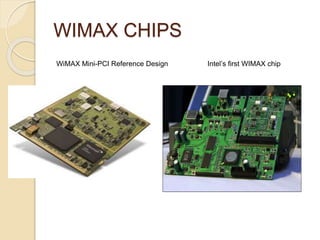
WIMAX CHIPS
WiMAX Mini-PCI Reference Design Intel’s first WIMAX chip
FEATURES OF WIMAX
 Scalability
 Quality of Service
 Range
 Coverage
RANGE
 Optimized for up to 50 Km
 Designed to handle many users spread out over
kilometres
 Designed to tolerate greater multi-path delay spread
(signal reflections) up to 10.0μ seconds.
BENEFITS OF WIMAX
 Speed
◦ Faster than broadband service
 Wireless
◦ Not having to lay cables reduces cost
◦ Easier to extend to suburban and rural areas
 Broad Coverage
◦ Much wider coverage than WiFi hotspots
Advantages of WiMax over
3G
 Using an assortment of proprietary and standards-based
technologies, such as OFDM and W-CDMA ,WIMAX
has a clear advantage over 3G.
 The advantages include
◦ Higher Throughput
◦ Low Cost
◦ Lower Latency
Disadvantages of WIMAX
 Spectral limitation
 High cost-both for installation and
operation
 Weather conditions like rain can have
a big impact on the service
 Line-of-sight is needed for longer
distances
 It has a big power consumption
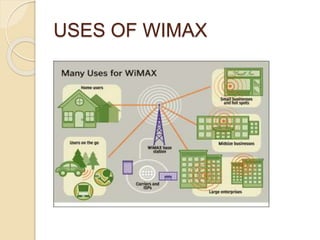
USES OF WIMAX
FUTURE
 WiMax will be deployed in three stages
◦ In the first phase WiMaX technology (based
on IEEE 802.16-2004) provides fixed
wireless connections
◦ In the second phase WiMaX will be available
as a cheap and self-installing Subscriber
Terminal (ST), linked to PC and to antenna
◦ The third phase enables portability, thus
WiMAX (based on IEEE 802.16e) will be
integrated into commercial laptops
Conclusion:
 Will WIMAX replace 3G?
◦ Along with the forthcoming standardization,
WiMAX has the potential to substitute 3G and
become a promising 4G
◦ WiMAX has its distinct identity as either a stand-
alone solution for incumbent and competitive
fixed network operators or as complementary
radio access solution for established 2G and 3G
cellular network operators.
wimax
wimax

wimax

  • 1.
  • 2.
    What is WIMAX? WIMAX stands for Worldwide Interoperability for Microwave Access  WiMAX refers to broadband wireless networks that are based on the IEEE 802.16 standard, which ensures compatibility and interoperability between broadband wireless access equipment  WiMAX, which will have a range of up to 31 miles, is primarily aimed at making broadband network access widely available without the expense of stringing wires (as in cable-access broadband) or the distance limitations of Digital Subscriber Line.
  • 3.
    NEW TECHNOLOGY  Broadbandaccess is too expensive and WiFi coverage is very sparse.  The new technology promises ◦ High speed of broadband service ◦ Wireless rather than wired access ◦ Broad Coverage
  • 4.
    1) A WiMAXtower, similar in concept to a cell-phone tower - A single WiMAX tower can provide coverage to a very large area as big as 3,000 square miles (~8,000 square km). 2) A WiMAX receiver - The receiver and antenna could be a small box or Personal Computer Memory card, or they could be built into a laptop the way WiFi access is today A WIMAX system consists of
  • 5.
  • 7.
    WIMAX CHIPS WiMAX Mini-PCIReference Design Intel’s first WIMAX chip
  • 8.
    FEATURES OF WIMAX Scalability  Quality of Service  Range  Coverage
  • 9.
    RANGE  Optimized forup to 50 Km  Designed to handle many users spread out over kilometres  Designed to tolerate greater multi-path delay spread (signal reflections) up to 10.0μ seconds.
  • 10.
    BENEFITS OF WIMAX Speed ◦ Faster than broadband service  Wireless ◦ Not having to lay cables reduces cost ◦ Easier to extend to suburban and rural areas  Broad Coverage ◦ Much wider coverage than WiFi hotspots
  • 11.
    Advantages of WiMaxover 3G  Using an assortment of proprietary and standards-based technologies, such as OFDM and W-CDMA ,WIMAX has a clear advantage over 3G.  The advantages include ◦ Higher Throughput ◦ Low Cost ◦ Lower Latency
  • 12.
    Disadvantages of WIMAX Spectral limitation  High cost-both for installation and operation  Weather conditions like rain can have a big impact on the service  Line-of-sight is needed for longer distances  It has a big power consumption
  • 13.
  • 14.
    FUTURE  WiMax willbe deployed in three stages ◦ In the first phase WiMaX technology (based on IEEE 802.16-2004) provides fixed wireless connections ◦ In the second phase WiMaX will be available as a cheap and self-installing Subscriber Terminal (ST), linked to PC and to antenna ◦ The third phase enables portability, thus WiMAX (based on IEEE 802.16e) will be integrated into commercial laptops
  • 15.
    Conclusion:  Will WIMAXreplace 3G? ◦ Along with the forthcoming standardization, WiMAX has the potential to substitute 3G and become a promising 4G ◦ WiMAX has its distinct identity as either a stand- alone solution for incumbent and competitive fixed network operators or as complementary radio access solution for established 2G and 3G cellular network operators.

Editor's Notes