Wimax technology
“A Secure Broadband Network”
Submitted by:
Anita Rani Mahato
8TH SEM, TCE
CONTENTS
 Introduction
 Working of WIMAX
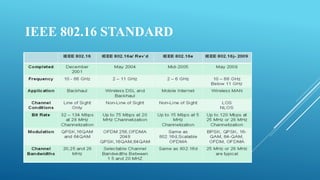
 IEEE 802.16 Standard
 IEEE 802.16 Architecture
 Features of WIMAX
 Comparison of WIMAX over WIFI
 Application of WiMAX
 WIMAX vs. 3G
 ISSUES in WIMAX vs. 3G
 FUTURE SCOPE
What is WiMAX?
• WiMAX stands for “Worldwide Interoperability for Microwave
Access”.
• WiMAX refers to broadband wireless networks that are based on
the IEEE 802.16 standard, which ensures compatibility and
interoperability between broadband wireless access equipment .
• WiMAX, which will have a range of up to 31 miles, is primarily
aimed at making broadband network access widely available
without the expense of stringing wires (as in cable-access
broadband) or the distance limitations of Digital Subscriber Line.
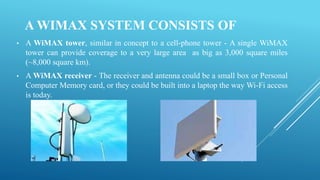
A WIMAX SYSTEM CONSISTS OF
• A WiMAX tower, similar in concept to a cell-phone tower - A single WiMAX
tower can provide coverage to a very large area as big as 3,000 square miles
(~8,000 square km).
• A WiMAX receiver - The receiver and antenna could be a small box or Personal
Computer Memory card, or they could be built into a laptop the way Wi-Fi access
is today.
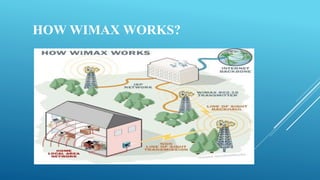
HOW WIMAX WORKS?
IEEE 802.16 STANDARD
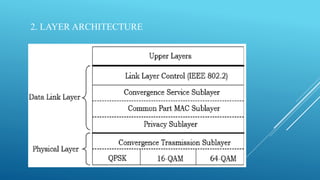
IEEE 802.16 ARCHITECTURE:
1.NETWORK ARCHITECTURE
2. LAYER ARCHITECTURE
PHYSICAL LAYER
• WiMAX uses orthogonal frequency division multiplexing
technology.
• The physical layer contains several forms of modulation
(BPSK,QPSK,QAM) and multiplexing (TDD,FDD) techniques.
• IEEE 802.16 uses uplink and downlink maps in order to ensure the
collision free access.
MAC LAYER
• IEEE 802.16 MAC layer is connection oriented.
• MAC layer consists of 3 sublayer:
o Convergence service sublayer
o Common part sublayer
o Privacy sublayer
FEATURES OF WIMAX
• Range
• Scalability
• Bit rate
• Quality of Service
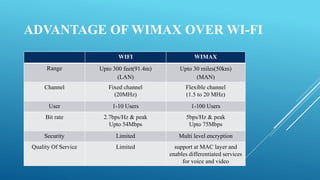
ADVANTAGE OF WIMAX OVER WI-FI
WIFI WIMAX
Range Upto 300 feet(91.4m)
(LAN)
Upto 30 miles(50km)
(MAN)
Channel Fixed channel
(20MHz)
Flexible channel
(1.5 to 20 MHz)
User 1-10 Users 1-100 Users
Bit rate 2.7bps/Hz & peak
Upto 54Mbps
5bps/Hz & peak
Upto 75Mbps
Security Limited Multi level encryption
Quality Of Service Limited support at MAC layer and
enables differentiated services
for voice and video
BENEFITS OF WIMAX
• Speed
Faster than broadband service
• Wireless
Low cost system implementation
Easier to extend to suburban and rural areas
• Broad Coverage
Much wider coverage than Wi-Fi hotspots
USES OF WiMAX
Advantages of WiMAX over 3G
• Greater flexibility
• Higher data rate
• High system capability
• Low Cost
• More reliable
ISSUES in 3G vs WiMAX
Cost Issue:
• The main reason to opt for WiMAX is its low cost.
• The price paid per Hz for WiMAX spectrum is as much as
1000 times lower than for 3G spectrum.
• The low cost of WiMAX spectrum compared to 3G is a
clear driver for service providers to enter the field of
wireless services with WiMAX.
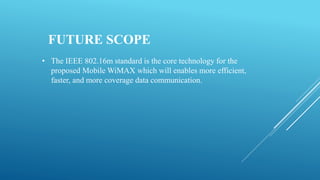
FUTURE SCOPE
• The IEEE 802.16m standard is the core technology for the
proposed Mobile WiMAX which will enables more efficient,
faster, and more coverage data communication.
THANK YOU

WiMAX Technology

  • 1.
    Wimax technology “A SecureBroadband Network” Submitted by: Anita Rani Mahato 8TH SEM, TCE
  • 2.
    CONTENTS  Introduction  Workingof WIMAX  IEEE 802.16 Standard  IEEE 802.16 Architecture  Features of WIMAX  Comparison of WIMAX over WIFI  Application of WiMAX  WIMAX vs. 3G  ISSUES in WIMAX vs. 3G  FUTURE SCOPE
  • 3.
    What is WiMAX? •WiMAX stands for “Worldwide Interoperability for Microwave Access”. • WiMAX refers to broadband wireless networks that are based on the IEEE 802.16 standard, which ensures compatibility and interoperability between broadband wireless access equipment . • WiMAX, which will have a range of up to 31 miles, is primarily aimed at making broadband network access widely available without the expense of stringing wires (as in cable-access broadband) or the distance limitations of Digital Subscriber Line.
  • 4.
    A WIMAX SYSTEMCONSISTS OF • A WiMAX tower, similar in concept to a cell-phone tower - A single WiMAX tower can provide coverage to a very large area as big as 3,000 square miles (~8,000 square km). • A WiMAX receiver - The receiver and antenna could be a small box or Personal Computer Memory card, or they could be built into a laptop the way Wi-Fi access is today.
  • 5.
  • 6.
  • 7.
  • 8.
  • 9.
    PHYSICAL LAYER • WiMAXuses orthogonal frequency division multiplexing technology. • The physical layer contains several forms of modulation (BPSK,QPSK,QAM) and multiplexing (TDD,FDD) techniques. • IEEE 802.16 uses uplink and downlink maps in order to ensure the collision free access.
  • 10.
    MAC LAYER • IEEE802.16 MAC layer is connection oriented. • MAC layer consists of 3 sublayer: o Convergence service sublayer o Common part sublayer o Privacy sublayer
  • 11.
    FEATURES OF WIMAX •Range • Scalability • Bit rate • Quality of Service
  • 12.
    ADVANTAGE OF WIMAXOVER WI-FI WIFI WIMAX Range Upto 300 feet(91.4m) (LAN) Upto 30 miles(50km) (MAN) Channel Fixed channel (20MHz) Flexible channel (1.5 to 20 MHz) User 1-10 Users 1-100 Users Bit rate 2.7bps/Hz & peak Upto 54Mbps 5bps/Hz & peak Upto 75Mbps Security Limited Multi level encryption Quality Of Service Limited support at MAC layer and enables differentiated services for voice and video
  • 13.
    BENEFITS OF WIMAX •Speed Faster than broadband service • Wireless Low cost system implementation Easier to extend to suburban and rural areas • Broad Coverage Much wider coverage than Wi-Fi hotspots
  • 14.
  • 15.
    Advantages of WiMAXover 3G • Greater flexibility • Higher data rate • High system capability • Low Cost • More reliable
  • 16.
    ISSUES in 3Gvs WiMAX Cost Issue: • The main reason to opt for WiMAX is its low cost. • The price paid per Hz for WiMAX spectrum is as much as 1000 times lower than for 3G spectrum. • The low cost of WiMAX spectrum compared to 3G is a clear driver for service providers to enter the field of wireless services with WiMAX.
  • 17.
    FUTURE SCOPE • TheIEEE 802.16m standard is the core technology for the proposed Mobile WiMAX which will enables more efficient, faster, and more coverage data communication.
  • 18.