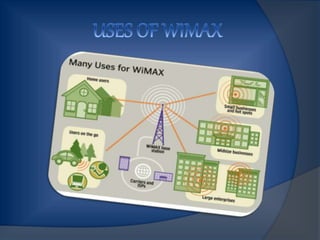
Presented by RASHMI
Gec /105109
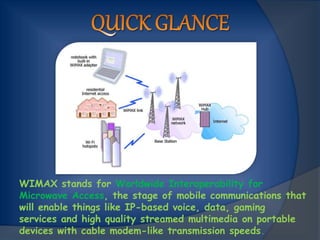
WIMAX stands for Worldwide Interoperability for
Microwave Access, the stage of mobile communications that
will enable things like IP-based voice, data, gaming
services and high quality streamed multimedia on portable
devices with cable modem-like transmission speeds.
 WIMAX is a wireless digital
communications system also known as
IEEE 802.16.
 WIMAX can provide broadband
wireless access up to 30 miles(50 km)
for fixed stations and 3-10 miles(5-
15 km) for mobile stations.
 It allows a user, to browse the
internet on a laptop without physically
connecting it to a router.
 It involves microwaves for the
transfer of data wirelessly.
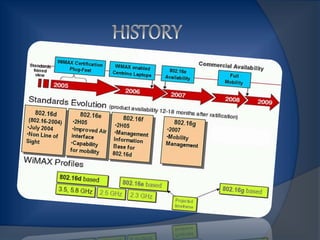
 802.16a
Uses the licensed frequencies from 2 to 11 GHz
Supports Mesh network
 802.16b
Increase spectrum to 5 and 6 GHz
Provides QoS( for real time voice and video
service)
 802.16c
Represents a 10 to 66GHz
 802.16e
Addresses on Mobile
Enable high-speed signal handoffs necessary for
communications with users moving at
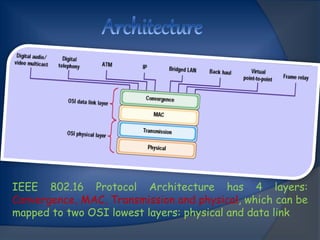
IEEE 802.16 Protocol Architecture has 4 layers:
Convergence, MAC, Transmission and physical, which can be
mapped to two OSI lowest layers: physical and data link
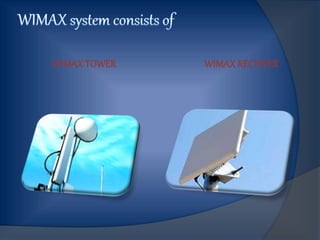
WIMAXTOWER WIMAXRECEIVER
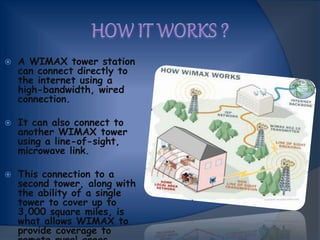
 A WIMAX tower station
can connect directly to
the internet using a
high-bandwidth, wired
connection.
 It can also connect to
another WIMAX tower
using a line-of-sight,
microwave link.
 This connection to a
second tower, along with
the ability of a single
tower to cover up to
3,000 square miles, is
what allows WIMAX to
provide coverage to
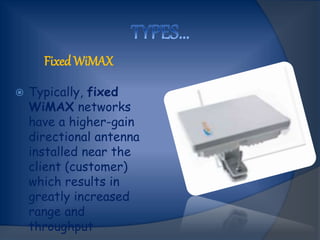
FixedWiMAX
 Typically, fixed
WiMAX networks
have a higher-gain
directional antenna
installed near the
client (customer)
which results in
greatly increased
range and
throughput
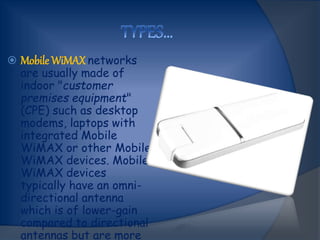
 Mobile WiMAX networks
are usually made of
indoor "customer
premises equipment"
(CPE) such as desktop
modems, laptops with
integrated Mobile
WiMAX or other Mobile
WiMAX devices. Mobile
WiMAX devices
typically have an omni-
directional antenna
which is of lower-gain
compared to directional
antennas but are more
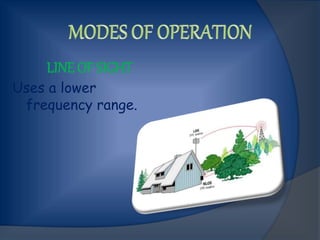
LINE OF SIGHT
Uses a lower
frequency range.
MODES OF OPERATION
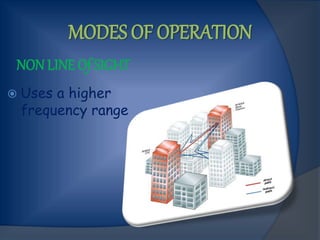
NON LINE Of SIGHT
 Uses a higher
frequency range
 Wimax Coverage
 Wimax High Speed
 Multi-functionality within Wimax
Technology
 Potential and development
 Wimax Infrastructure
 Wimax, cheap network
 Wimax Rich Features
 Smart antenna and Mesh Topology
 Ultra wide Band
 Homeland Security
 Low bit rate over Long distance
 Speed of connectivity
 Sharing of bandwidth
 Bad Weather
 Wireless equipments
 Power consuming
 Data Rate
Scalability Quality of Service
 The 802.16 standard
supports flexible radio
frequency (RF) channel
bandwidths.
 The standard supports
hundreds or even
thousands of users within
one RF channel
 As the number of
subscribers grow the
spectrum can be
reallocated with process
of sectoring.
 Primary purpose of QoS
feature is to define
transmission ordering
and scheduling on the
air interface
 These features often
need to work in
conjunction with
mechanisms beyond the
air interface in order to
provide end to end QoS
or to police the
behaviour or SS.
RANGE Coverage
 Optimized for up to 50
Km
 Designed to handle
many users spread out
over kilometres
 Designed to tolerate
greater multi-path
delay spread (signal
reflections) up to 10.0μ
seconds
 Standard supports
mesh network topology
 Optimized for outdoor
NLOS performance
 Standard supports
advanced antenna
techniques
 WiMax will be deployed in three
stages
 In the first phase WiMax technology
(based on IEEE 802.16-2004) provides
fixed wireless connections
 In the second phase WiMax will be
available as a cheap and self-installing
Subscriber Terminal (ST), linked to PC
and to antenna
 The third phase enables portability, thus
WiMAX (based on IEEE 802.16e) will be
integrated into commercial laptops
 It is highly unlikely that WiMAX will compete
with or replace every other wireless
technology; however, WiMAX will fulfill a very
valuable role in the wireless ecosystem.
 By providing and overview of the fundamental
WiMAX business models, as well as market
and technological challenges, we have
attempted to illustrate the implications of
creating and capturing value through WiMAX.
 By outlining market players and the
competitive nature of the WiMAX market, we
have attempted to provide a glimpse of what
the WiMAX landscape may resemble in the not
136040819_wimxax_introduction and coverage

136040819_wimxax_introduction and coverage

  • 1.
  • 2.
    WIMAX stands forWorldwide Interoperability for Microwave Access, the stage of mobile communications that will enable things like IP-based voice, data, gaming services and high quality streamed multimedia on portable devices with cable modem-like transmission speeds.
  • 3.
     WIMAX isa wireless digital communications system also known as IEEE 802.16.  WIMAX can provide broadband wireless access up to 30 miles(50 km) for fixed stations and 3-10 miles(5- 15 km) for mobile stations.  It allows a user, to browse the internet on a laptop without physically connecting it to a router.  It involves microwaves for the transfer of data wirelessly.
  • 5.
     802.16a Uses thelicensed frequencies from 2 to 11 GHz Supports Mesh network  802.16b Increase spectrum to 5 and 6 GHz Provides QoS( for real time voice and video service)  802.16c Represents a 10 to 66GHz  802.16e Addresses on Mobile Enable high-speed signal handoffs necessary for communications with users moving at
  • 6.
    IEEE 802.16 ProtocolArchitecture has 4 layers: Convergence, MAC, Transmission and physical, which can be mapped to two OSI lowest layers: physical and data link
  • 7.
  • 8.
     A WIMAXtower station can connect directly to the internet using a high-bandwidth, wired connection.  It can also connect to another WIMAX tower using a line-of-sight, microwave link.  This connection to a second tower, along with the ability of a single tower to cover up to 3,000 square miles, is what allows WIMAX to provide coverage to
  • 9.
    FixedWiMAX  Typically, fixed WiMAXnetworks have a higher-gain directional antenna installed near the client (customer) which results in greatly increased range and throughput
  • 10.
     Mobile WiMAXnetworks are usually made of indoor "customer premises equipment" (CPE) such as desktop modems, laptops with integrated Mobile WiMAX or other Mobile WiMAX devices. Mobile WiMAX devices typically have an omni- directional antenna which is of lower-gain compared to directional antennas but are more
  • 11.
    LINE OF SIGHT Usesa lower frequency range.
  • 12.
    MODES OF OPERATION NONLINE Of SIGHT  Uses a higher frequency range
  • 13.
     Wimax Coverage Wimax High Speed  Multi-functionality within Wimax Technology  Potential and development  Wimax Infrastructure  Wimax, cheap network  Wimax Rich Features  Smart antenna and Mesh Topology  Ultra wide Band  Homeland Security
  • 14.
     Low bitrate over Long distance  Speed of connectivity  Sharing of bandwidth  Bad Weather  Wireless equipments  Power consuming  Data Rate
  • 15.
    Scalability Quality ofService  The 802.16 standard supports flexible radio frequency (RF) channel bandwidths.  The standard supports hundreds or even thousands of users within one RF channel  As the number of subscribers grow the spectrum can be reallocated with process of sectoring.  Primary purpose of QoS feature is to define transmission ordering and scheduling on the air interface  These features often need to work in conjunction with mechanisms beyond the air interface in order to provide end to end QoS or to police the behaviour or SS.
  • 16.
    RANGE Coverage  Optimizedfor up to 50 Km  Designed to handle many users spread out over kilometres  Designed to tolerate greater multi-path delay spread (signal reflections) up to 10.0μ seconds  Standard supports mesh network topology  Optimized for outdoor NLOS performance  Standard supports advanced antenna techniques
  • 18.
     WiMax willbe deployed in three stages  In the first phase WiMax technology (based on IEEE 802.16-2004) provides fixed wireless connections  In the second phase WiMax will be available as a cheap and self-installing Subscriber Terminal (ST), linked to PC and to antenna  The third phase enables portability, thus WiMAX (based on IEEE 802.16e) will be integrated into commercial laptops
  • 19.
     It ishighly unlikely that WiMAX will compete with or replace every other wireless technology; however, WiMAX will fulfill a very valuable role in the wireless ecosystem.  By providing and overview of the fundamental WiMAX business models, as well as market and technological challenges, we have attempted to illustrate the implications of creating and capturing value through WiMAX.  By outlining market players and the competitive nature of the WiMAX market, we have attempted to provide a glimpse of what the WiMAX landscape may resemble in the not