MOOCs, Rhizomes & Networks: 


Information Literacies 
in a Time of 
Complexity  Abundance
@davecormier  @bonstewart
University of Prince Edward Island

WILU 2013
Untangling 4 Threads
•  Information abundance = context 	

•  Networks  Rhizomes = structure 	

•  MOOCs = possibilities	

•  A challenge: Where do we go from here?
The system of higher ed is
in shift


What comes next?	
  
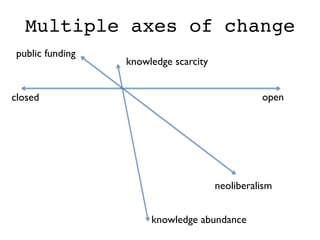
Multiple axes of change
knowledge scarcity	

knowledge abundance	

open	

public funding	

neoliberalism	

closed
h#p://www.flickr.com/photos/michaelheiss/2871996129/	
  
Part 1 – A context	

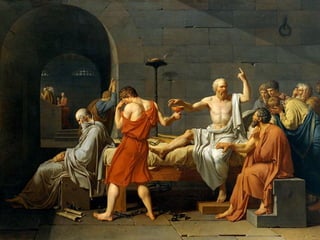
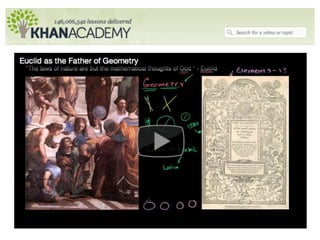
Oral to catechetical to textbook to 

         digital/market
http://www.flickr.com/photos/killfile/3344595791/
Part 2a – Identities 
The structure of networks
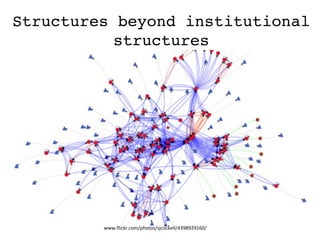
www.flickr.com/photos/sjcockell/4398929160/	
  
Structures beyond institutional 
structures
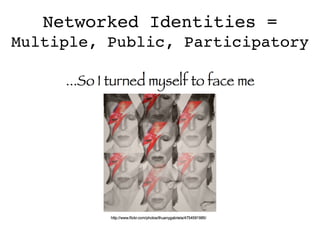
Networked Identities = 

Multiple, Public, Participatory
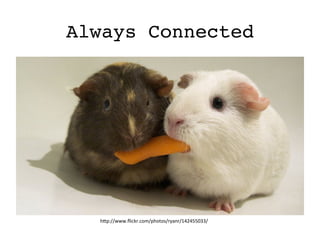
Always Connected 
h#p://www.flickr.com/photos/ryanr/142455033/	
  
Networks expand
participation
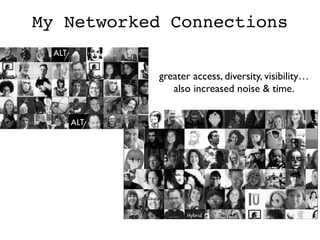
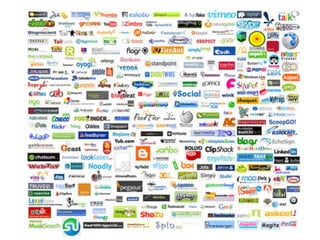
My Networked Connections
greater access, diversity, visibility…	

also increased noise  time.


Belonging is always
partial,

always multiple
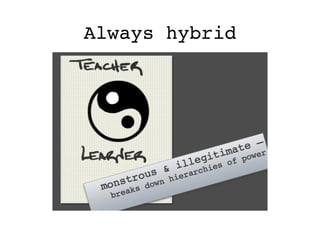
Always hybrid
h#p://www.flickr.com/photos/daveduarte/3420117809/	
  
h#p://www.flickr.com/photos/striaEc/2191408271/	
  
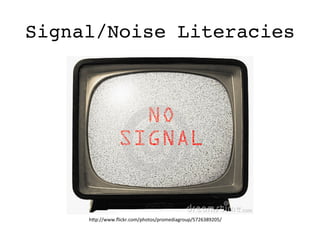
Hard to hear
Signal/Noise Literacies
h#p://www.flickr.com/photos/promediagroup/5726389205/	
  
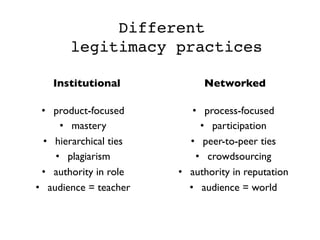
Different 

legitimacy practices 	
  
Institutional	
  
•  product-focused	

•  mastery	

•  hierarchical ties	

•  plagiarism	

•  authority in role	

•  audience = teacher	

Networked	

•  process-focused	

•  participation	

•  peer-to-peer ties	

•  crowdsourcing 	

•  authority in reputation	

•  audience = world
Part 2b – Rhizomes
Ways of navigating networks
ED 366
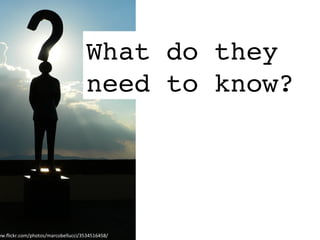
What do they
need to know?
ww.flickr.com/photos/marcobellucci/3534516458/	
  
How do I know?
ww.flickr.com/photos/marcobellucci/3534516458/	
  
I don’t know.
ww.flickr.com/photos/marcobellucci/3534516458/	
  
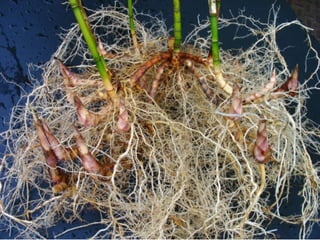
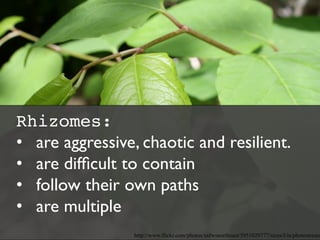
Rhizomes:
•  are aggressive, chaotic and resilient. 	

•  are difficult to contain	

•  follow their own paths	

•  are multiple	


 http://www.flickr.com/photos/usfwsnortheast/5951029777/sizes/l/in/photostream
The rhizomatic
approach is about
1.  Preparing for uncertainty	

2.  Learning when there is no answer	

3.  Dealing with complexity	

4.  Being responsible to your own learning	

5.  Drawing your own map
Part 3a – A convergence	

An example on the open web
h#p://www.flickr.com/photos/gforsythe/8028605773/	
  
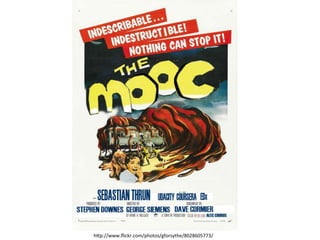
What’s a MOOC?
“MOOCs are the internet
happening to education.” 	

! ! ! ! ! !- George Siemens, 2012!
Massive
Open
h#p://www.flickr.com/photos/neosnaps/2596044654/	
  
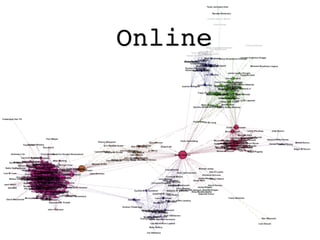
Online
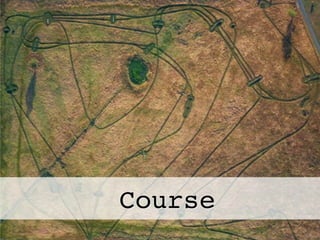
Course
Part 3b – Implications	

What this means for higher education
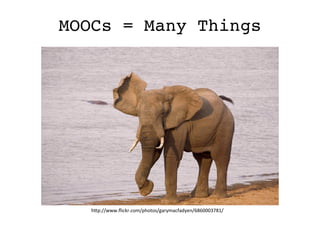
MOOCs = Many Things
h#p://www.flickr.com/photos/garymacfadyen/6860003781/	
  
h#p://www.flickr.com/photos/noiseprofessor/8270908219	
  
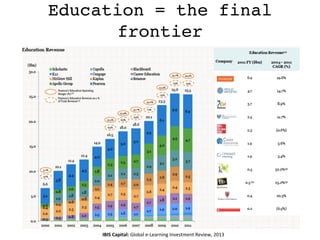
Education = the final
frontier	


IBIS	
  Capital:	
  Global	
  e-­‐Learning	
  Investment	
  Review,	
  2013	
  	
  
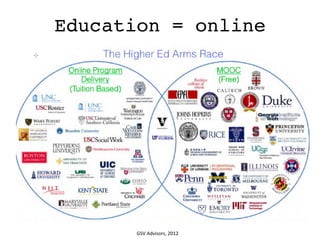
Education = online
GSV	
  Advisors,	
  2012	
  
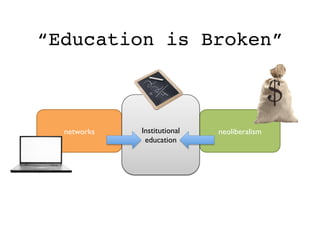
“Education is Broken”	
  
networks	

 neoliberalism	

Institutional
education
Major MOOCs merge 
networked critique of institutional education
with 
neoliberal shock doctrine: 
“here’s a disaster, here’s a solution.”	


But MOOCs don’t HAVE to be like that.	


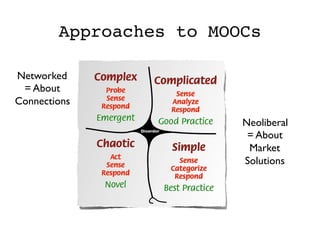
Approaches to MOOCs
Neoliberal
= About
Market 
Solutions


Networked
= About 
Connections
Some MOOCs…
	

Harness  contribute to
knowledge abundance	


Are participatory	


Are distributed	


Generate knowledge 
connections that extend
beyond course	


Share the processes of
knowledge work, not just the
products 	

h#p://www.flickr.com/photos/wiccked/133164205	
  
Part 4 – Going forward	

What should I do now?
h#p://alonetogetherbook.com/	
  
Move online together
@bonstewart	

@davecormier	

Participate 
or 
Perish.

MOOCs, Rhizomes & Networks

Editor's Notes

  • #7 I want to tell you a story. It’s a story we’re all already in. It’s a story of change. Changes in expectations, in the role higher education plays in society, in the role money plays in higher education.
  • #8 A story of change in institutions. Bricks & mortar will likely stay, many of our careers will remain tied to these organizations of human potential. But we become institutionalized. the defined boundaries, rigid structures, clear hierarchical roles: these are no longer sufficient for coping with the complexity.
  • #9 Top leftish cluster is institutional model….bottom rightish cluster is the present. Neoliberalism – idea of education as market, that nimble, efflicient, entrepreneurial approaches Not necessarily progression. These shifts are only loosely tied.
  • #10 Also a story of literacies. Academia may be institutional but its practices are built on networks. Conferences are connections, and academic publishing is making connections visible and we are already all literate in these skills. But you will notice…this is not tidy.
  • #15 Market sense and digital sense and both use of institutional structures while going beyond institutional structures
  • #18 Also fluid
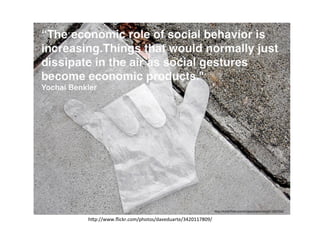
  • #24 Networked society also cannot relegate the economic to institutional structures, so it becomes more visible. In the networked collapse of personal and professional, there is also a collapse of the tidy boundaries & etiquettes around money.
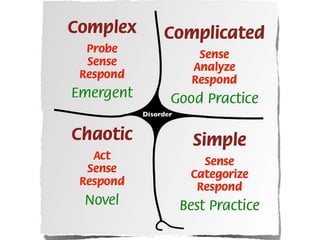
  • #28 Probe, sense respond. In complexity, and information abundance, connections are being made that haven’t been made before and we are navigating environments we haven’t before. Institutions have dealt primarily with the two right hand domains.
  • #35 We started in the summer of 2005 when there was lots of uncertaintyCommunity as curriculum
  • #36 A very messy kind of network