Beyond AltMetrics:
Identities & Influence Online
BONNIE STEWART,
University of Prince Edward Island
#et4online
@bonstewart
UPEI, April 20th, 2015
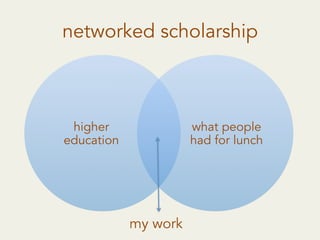
networked scholarship
higher
education
what people
had for lunch
my work
conceptual tools
h"ps://www.flickr.com/photos/zzpza/3269784239/	
  
our inheritance = scarcity
knowledge abundance
h"ps://www.flickr.com/photos/oakleyoriginals/4142641838/	
  
"For the first time in human history, two related
propositions are true. One, it no longer
is possible to store within the human brain all
of the information that a human needs.
Second, it no longer is necessary to store
within the human brain all of the information
that humans need.
Education needs to be geared toward
the handling of data rather than the
accumulation of data.”
- Berlo, 1975
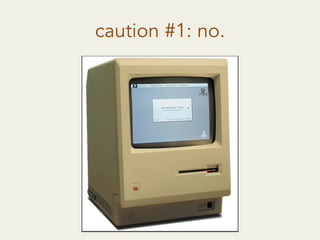
caution #1: no.
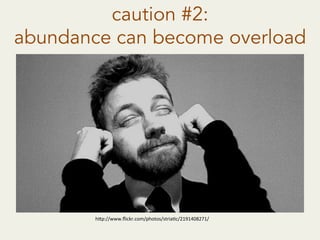
caution #2:
abundance can become overload
h"p://www.flickr.com/photos/striaAc/2191408271/	
  
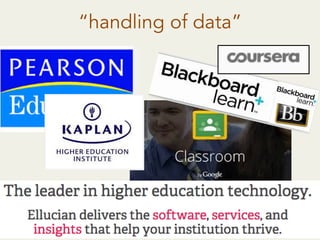
“handling of data”
WAIT
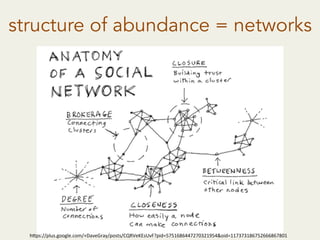
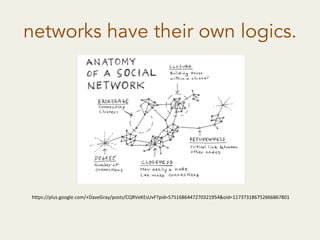
structure of abundance = networks
h"ps://plus.google.com/+DaveGray/posts/CQRVeKEsUvF?pid=5751686447270321954&oid=117373186752666867801	
  
h"ps://www.flickr.com/photos/ooohoooh/1350774613/	
  
networks are not just for consuming,
but connecting
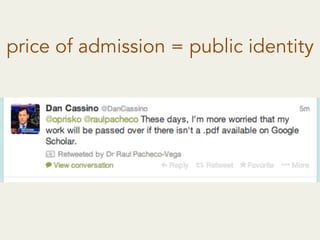
price of admission = public identity
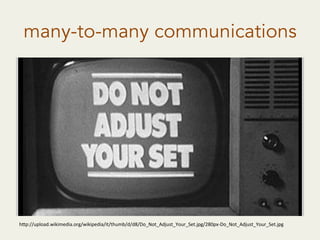
many-to-many communications
h"p://upload.wikimedia.org/wikipedia/it/thumb/d/d8/Do_Not_Adjust_Your_Set.jpg/280px-­‐Do_Not_Adjust_Your_Set.jpg	
  
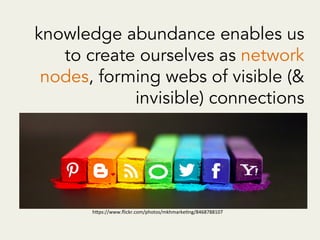
knowledge abundance enables us
to create ourselves as network
nodes, forming webs of visible (&
invisible) connections	
  
h"ps://www.flickr.com/photos/mkhmarkeAng/8468788107	
  
but.
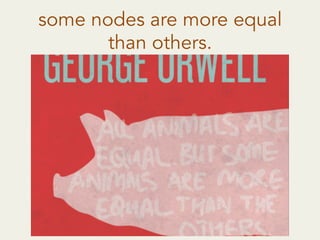
some nodes are more equal
than others.
h"ps://www.flickr.com/photos/28517410@N02/5422484194/	
  
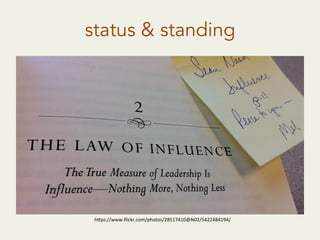
status & standing
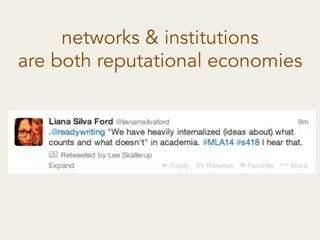
networks & institutions
are both reputational economies
Those within the academy become
very skilled at judging the stuff of
reputations. Where has the person’s work
been published, what claims of
priority in discovery have
they established, how often have they been
cited, how and where reviewed, what
prizes won, what institutional ties earned,
what organizations led?
Willinsky, 2010
h"ps://plus.google.com/+DaveGray/posts/CQRVeKEsUvF?pid=5751686447270321954&oid=117373186752666867801	
  
networks have their own logics. 	
  
institutions do not always approve. 	
  
in abundance…the gates are open
h"ps://www.flickr.com/photos/vince2012/14557320666/	
  
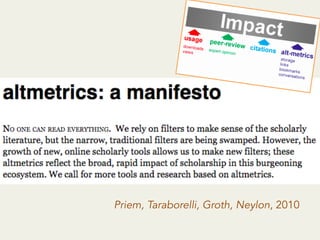
Priem, Taraborelli, Groth, Neylon, 2010
more.
h"p://hyperboleandahalf.blogspot.ca/2010/06/this-­‐is-­‐why-­‐ill-­‐never-­‐be-­‐adult.html	
  
what are the logics & literacies
of networks? what is a
scholarship of abundance? what is
learning in abundance?
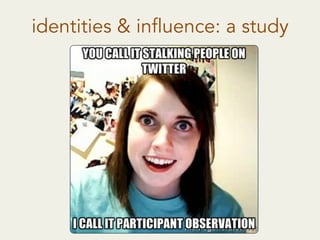
identities & influence: a study
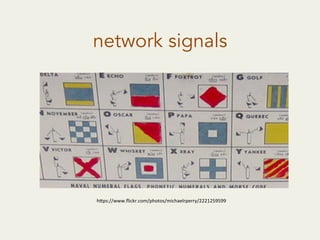
h"ps://www.flickr.com/photos/michaelrperry/2221259599	
  
network signals
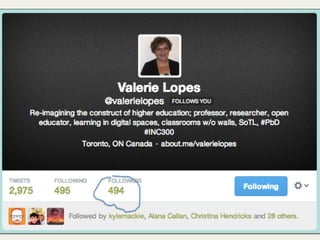
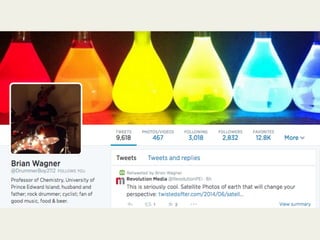
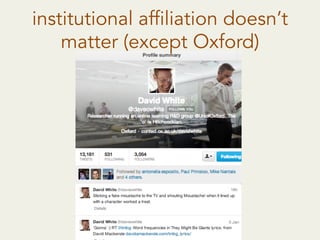
institutional affiliation doesn’t
matter (except Oxford)
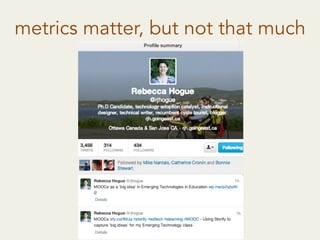
metrics matter, but not that much
individuals cultivate reputation,
visibility, & audience(s)
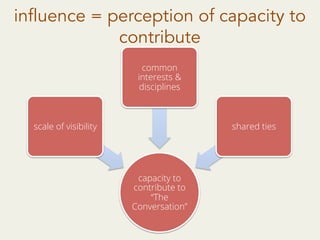
capacity to
contribute to
“The
Conversation”
scale of visibility
common
interests &
disciplines
shared ties
influence = perception of capacity to
contribute
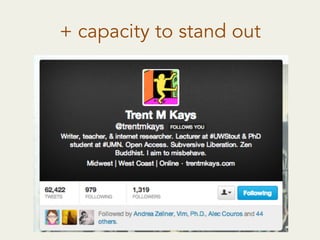
+ capacity to stand out
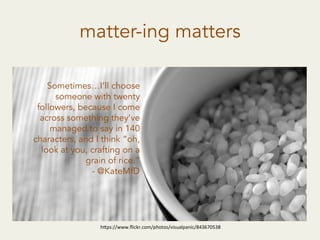
matter-ing matters
Sometimes…I’ll choose
someone with twenty
followers, because I come
across something they’ve
managed to say in 140
characters, and I think “oh,
look at you, crafting on a
grain of rice.”
- @KateMfD
h"ps://www.flickr.com/photos/visualpanic/843670538	
  
some voices get to matter more
than others
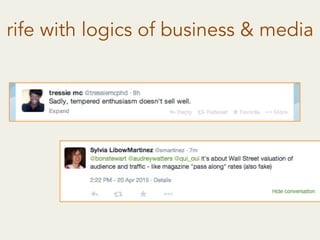
rife with logics of business & media
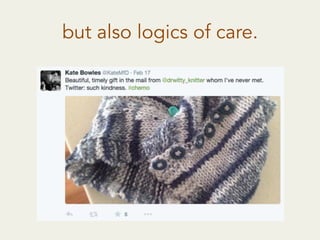
but also logics of care.
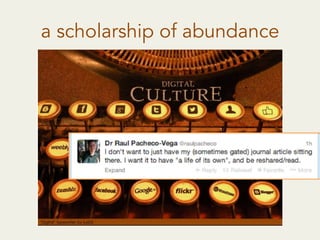
a scholarship of abundance
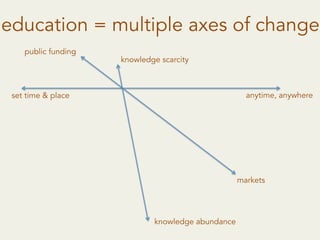
education = multiple axes of change
knowledge scarcity
knowledge abundance
anytime, anywhere
public funding
markets
set time & place
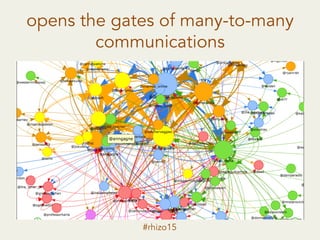
opens the gates of many-to-many
communications
#rhizo15
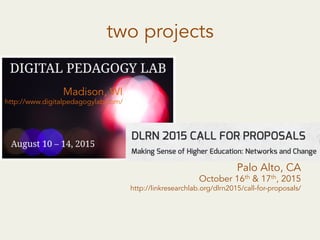
two projects
Palo Alto, CA
October 16th & 17th, 2015
http://linkresearchlab.org/dlrn2015/call-for-proposals/
Madison, WI
http://www.digitalpedagogylab.com/
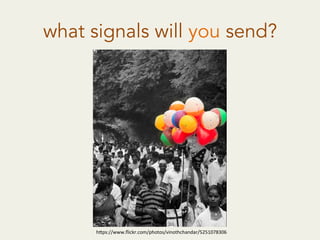
what signals will you send?
h"ps://www.flickr.com/photos/vinothchandar/5251078306	
  
thank you
@bonstewart
J

Beyond Alt-Metrics: Identities & Influence Online

Editor's Notes

  • #4 Well yes, I say. There’s scholarship. And there’s what people had for lunch. And I study the intersection of the two.
  • #15 And it’s more than just putting work online.. It’s a stretching beyond your institutional role to create identity positions within audiences and networks you may not have known were there…through ongoing networked practices.
  • #20 Influence is how we determine the reputation and credibility and essentially the status of a scholar. There are two ways we assess influence: there’s the teeny little group of people who understand what your work really means…and then there’s everybody else, from different fields, who piece together the picture from external signals: what journals you publish in, what school you went to, your citation count, your h-index, your last grant. Things people recognize and trust.
  • #21 Reputational logics
  • #22 When we talk about influence and reputation and credibility, we are always talking about tangibles and intangibles. In institutional structures and in networked structures. Each of you here has a pretty clear sense of what influence markers count in your field: how to be a credible academic within the institutional context. But influence that has its origins not in premier journals and gatekept structures, but in the free-for-all of online networks?
  • #30 New technologies gives us new ways of signaling to each other
  • #34 Credibilty