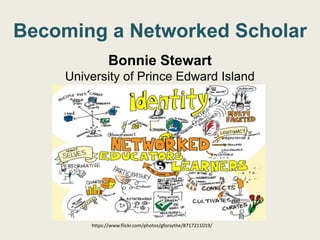
Becoming a Networked Scholar
Bonnie Stewart
University of Prince Edward Island
h"ps://www.flickr.com/photos/gforsythe/8717211019/	
  
dissemination
of knowledge
what people
had for lunch
CHANGE IN
HIGHER ED
Premise:
Online networks enable different forms of
academic identity and influence
than institutions do
• THE WHY
Why? Multiple Axes of Change
knowledge scarcity
knowledge abundance
anytime, anywhere
public funding
marketization
set time & place
Knowledge Abundance
h"p://www.flickr.com/photos/sila>x/9886617776/sizes/c	
  
Structure of abundance = Networks
Price of admission = public identity
h"ps://www.flickr.com/photos/ooohoooh/1350774613/	
  
Networks are not just for consuming,
but connecting.
Many-to-many communications
h"p://upload.wikimedia.org/wikipedia/it/thumb/d/d8/Do_Not_Adjust_Your_Set.jpg/280px-­‐Do_Not_Adjust_Your_Set.jpg	
  
Knowledge abundance enables us
to create ourselves as network
nodes, forming webs of visible (&
invisible) connections
h"ps://www.flickr.com/photos/mkhmarke>ng/8468788107	
  
Democratizing?
Some nodes are more equal than
others
Networks & institutions
are both reputational economies
To become readable in networks,
you need to learn how to read.
h"ps://www.flickr.com/photos/koonisutra/7001349018/	
  
• THE HOW
“Those within the academy become
very skilled at judging the stuff of reputations.
Where has the person’s work been published,
what claims of
priority in discovery have
they established, how often have they been cited,
how and where reviewed, what
prizes won, what institutional ties earned, what
organizations led?”
Willinsky, 2010
Reading Status Signals
•  Where you went to school
•  Who your supervisor was
•  Where you’ve published
(& their impact factor)
•  Your h-index
•  Your citation count
•  The associations you belong to
•  Your rank in the academic hierarchy
…but now…
Networks = self-dissemination
& new signals
Intersecting Prestige Economies
Institutional
Scholarship
Google
How work gets seen/known/used
Google yourself. What do your
signals say?
•  Are you visible on the first page?
•  Can I find an interactive platform through which
to engage with you or your work?
•  Do you share your own work and that of others
openly?
•  Can I see you speak/talk/teach?
•  Are there any red flags?
For building academic identity &
influence online,
you need a platform.
h"ps://www.flickr.com/photos/jiscinfonet/12947691804/in/album-­‐72157641903755433/	
  
Networked Scholarship: A Study
What do you SEE when you look at
a Twitter profile?
images!
Institutional affiliation doesn’t matter
(except Oxford)
longevity!
Shared contexts & standing out
capacity to
contribute to
“The
Conversation”
scale of visibility
common
interests &
disciplines
shared ties
Influence = perception of capacity to
contribute
Sometimes…I’ll choose
someone with twenty
followers, because I come
across something they’ve
managed to say in 140
characters, and I think
“oh, look at you,
crafting on a
grain of rice.”
- @KateMfD
h"ps://www.flickr.com/photos/visualpanic/843670538	
  
• THE WHAT IT DOES
Is the effort worth it?
Benefits as human: support & care
Benefits as thinker:
just-in-time choral conversation
Benefits as writer: crowdsourcing
Benefits as learner & scholar:
engagement & perspective
Benefits as learner & scholar:
access & profile
Benefits as teacher: opportunities
to connect students to real
audiences
How will I know if I’m succeeding?
9 years blogging, 8 years on Twitter,
3 months with a Ph.D
•  4 peer-reviewed publications (+ 3 more
pending review)
•  17 public articles on higher ed & networks
(Salon, The Guardian UK, Inside Higher Ed)
•  474 citations
•  11 keynote/plenary presentations
•  30+ conference talks
•  5 local/national CBC radio appearances
•  place at the table in leading conversations in
my field
+ uncountable flops, failures,
rejections, dead-ends, and sites of
confusion & uncertainty
h"p://www.keepcalmstudio.com/gallery/poster/X1cVAD	
  
What signals will you send?
Questions?

Becoming a Networked Scholar

Editor's Notes

  • #3 Think of a Venn diagram. Here’s traditional dissemination, here’s what people had for lunch. I study the middle. Because so long as senior scholars and administrators and tenure committees think Twitter is what people had for lunch, there’s a gap in our understanding of influence signals, especially in fields that are changing rapidly.
  • #9 And it’s more than just putting work online.. It’s a stretching beyond your institutional role to create identity positions within audiences and networks you may not have known were there…through ongoing networked practices.
  • #16 Parallel between networks & institutions -