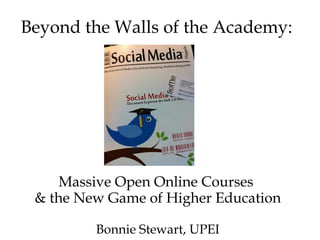

Beyond the Walls of the Academy:


     Massive Open Online Courses
 & the New Game of Higher Education

         Bonnie Stewart, UPEI
Massive Open Online Courses
           (MOOCs)
              =
Not your average online courses
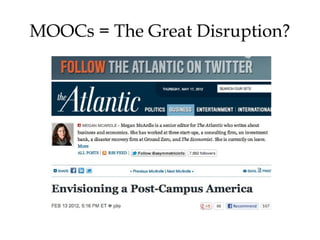
MOOCs = The Great Disruption?
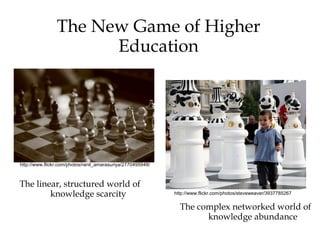
The New Game of Higher
                      Education


http://www.flickr.com/photos/ranil_amarasuriya/2770495948/


The linear, structured world of
        knowledge scarcity                                   http://www.flickr.com/photos/steveweaver/3937785267


                                                               The complex networked world of
                                                                     knowledge abundance
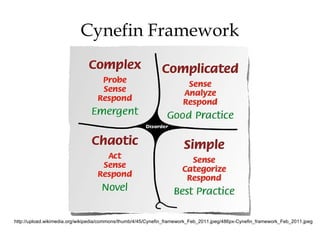
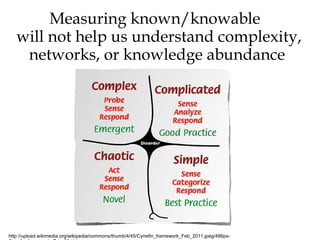
Cynefin Framework


http://upload.wikimedia.org/wikipedia/commons/thumb/4/45/Cynefin_framework_Feb_2011.jpeg/486px-Cynefin_framework_Feb_2011.jpeg
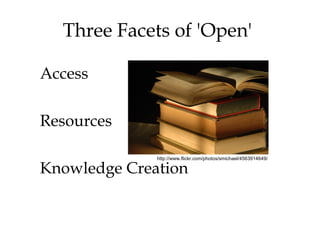
Three Facets of 'Open'

Access

Resources

              http://www.flickr.com/photos/smichael/4563914649/

Knowledge Creation
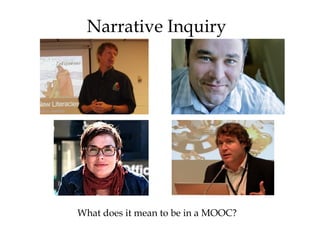
Narrative Inquiry


What does it mean to be in a MOOC?
Emergent Themes
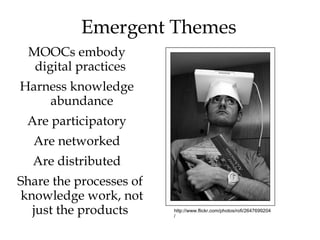
 MOOCs embody
  digital practices
Harness knowledge
    abundance
 Are participatory
  Are networked
  Are distributed
Share the processes of
knowledge work, not
  just the products      http://www.flickr.com/photos/rofi/2647699204
                         /
Emergent Themes
                                                   MOOCs reflect the
                                                    broader culture: when
                                                    change is continual &
                                                    expected, people
                                                    engage in learning
                                                    opportunities in order
                                                    to increase personal
                                                    capital and remain
http://www.flickr.com/photos/heycoach/1197947341    marketable
Knowledge in MOOCs =
Negotiated, Public, Indeterminate

 “Today, whatever can be easily duplicated cannot serve
    as the foundation for economic value. Instead of
     producing entities with known and approved
  knowledge, the digital economic model harnesses the
   capacity of its citizens to connect, innovate, and
reconfigure the known into new knowledge.”
                                          p. 43
Fast Forward: 2011-2012

        #change11

“The Mother of All
     MOOCS”
 36 weeks, 36 facilitators
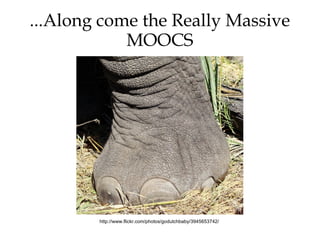
...Along come the Really Massive
            MOOCS


        http://www.flickr.com/photos/godutchbaby/3945653742/
- The X Model -


Stanford AI – Sept 2011
MITx – Dec 2011
Udacity – Jan 2012
Coursera – April 2012
EdX – May 2012
              ...?


                          http://www.flickr.com/photos/chrisinplymouth/3552059342
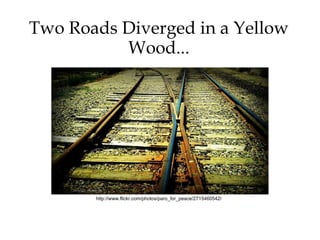
Two Roads Diverged in a Yellow
          Wood...


       http://www.flickr.com/photos/paro_for_peace/2715460542/
Connectivist MOOCs & X MOOCS
        - Commonalities -

             Open Access
            Open Resource
                Online
     Global interest & registration
       Post-registration filtering
Connectivist MOOCs & X MOOCS
           - Differences -

            Who are the registrants?
How do they connect with/learn from each other?
How do they connect with/learn from facilitators?
           What counts as learning?
          What is the business model?
            Where is the disruption?
The X Model: Triumph of the
        Traditional?


          http://www.flickr.com/photos/wiccked/133164205/


    In a global educational economy,
network power laws favour wealth & status
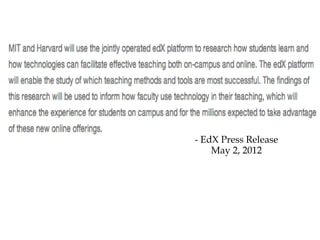
- EdX Press Release
    May 2, 2012
X MOOCs' Business Model...
       = Data?


      http://www.flickr.com/photos/kaptainkobold/5066287053
Measuring known/knowable
   will not help us understand complexity,
    networks, or knowledge abundance


http://upload.wikimedia.org/wikipedia/commons/thumb/4/45/Cynefin_framework_Feb_2011.jpeg/486px-
http://www.flickr.com/photos/cogdog/2551375149/


What Will Be Our Move?
Keeping Complexity in the Game:
 the FHE12 Open Online Course
Be part of the conversation.
            http://edfuture.net/


                THANK YOU!
                 @bonstewart
              bstewart@upei.ca


Created with the support of the Social Sciences &
          Humanities Research Council

Massive Open Online Courses and the New Game of Higher Education

  • 1.
    Beyond the Wallsof the Academy: Massive Open Online Courses & the New Game of Higher Education Bonnie Stewart, UPEI
  • 2.
    Massive Open OnlineCourses (MOOCs) = Not your average online courses
  • 3.
    MOOCs = TheGreat Disruption?
  • 4.
    The New Gameof Higher Education http://www.flickr.com/photos/ranil_amarasuriya/2770495948/ The linear, structured world of knowledge scarcity http://www.flickr.com/photos/steveweaver/3937785267 The complex networked world of knowledge abundance
  • 5.
  • 6.
    Three Facets of'Open' Access Resources http://www.flickr.com/photos/smichael/4563914649/ Knowledge Creation
  • 8.
    Narrative Inquiry What doesit mean to be in a MOOC?
  • 9.
    Emergent Themes MOOCsembody digital practices Harness knowledge abundance Are participatory Are networked Are distributed Share the processes of knowledge work, not just the products http://www.flickr.com/photos/rofi/2647699204 /
  • 10.
    Emergent Themes MOOCs reflect the broader culture: when change is continual & expected, people engage in learning opportunities in order to increase personal capital and remain http://www.flickr.com/photos/heycoach/1197947341 marketable
  • 11.
    Knowledge in MOOCs= Negotiated, Public, Indeterminate “Today, whatever can be easily duplicated cannot serve as the foundation for economic value. Instead of producing entities with known and approved knowledge, the digital economic model harnesses the capacity of its citizens to connect, innovate, and reconfigure the known into new knowledge.” p. 43
  • 12.
    Fast Forward: 2011-2012 #change11 “The Mother of All MOOCS” 36 weeks, 36 facilitators
  • 13.
    ...Along come theReally Massive MOOCS http://www.flickr.com/photos/godutchbaby/3945653742/
  • 14.
    - The XModel - Stanford AI – Sept 2011 MITx – Dec 2011 Udacity – Jan 2012 Coursera – April 2012 EdX – May 2012 ...? http://www.flickr.com/photos/chrisinplymouth/3552059342
  • 15.
    Two Roads Divergedin a Yellow Wood... http://www.flickr.com/photos/paro_for_peace/2715460542/
  • 16.
    Connectivist MOOCs &X MOOCS - Commonalities - Open Access Open Resource Online Global interest & registration Post-registration filtering
  • 17.
    Connectivist MOOCs &X MOOCS - Differences - Who are the registrants? How do they connect with/learn from each other? How do they connect with/learn from facilitators? What counts as learning? What is the business model? Where is the disruption?
  • 18.
    The X Model:Triumph of the Traditional? http://www.flickr.com/photos/wiccked/133164205/ In a global educational economy, network power laws favour wealth & status
  • 19.
    - EdX PressRelease May 2, 2012
  • 20.
    X MOOCs' BusinessModel... = Data? http://www.flickr.com/photos/kaptainkobold/5066287053
  • 21.
    Measuring known/knowable will not help us understand complexity, networks, or knowledge abundance http://upload.wikimedia.org/wikipedia/commons/thumb/4/45/Cynefin_framework_Feb_2011.jpeg/486px-
  • 22.
  • 23.
    Keeping Complexity inthe Game: the FHE12 Open Online Course
  • 24.
    Be part ofthe conversation. http://edfuture.net/ THANK YOU! @bonstewart bstewart@upei.ca Created with the support of the Social Sciences & Humanities Research Council