



Who Are We Now That We’re Online?
Connected Learners, Connected
Educators
CONNECT 2013
Bonnie Stewart
@bonstewart
University of Prince Edward Island
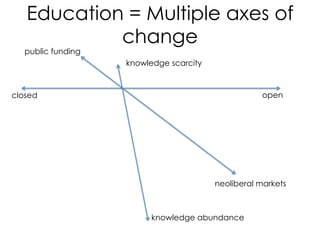
Education = Multiple axes of
change
knowledge scarcity
knowledge abundance
open
public funding
neoliberal markets
closed
Increasing pressure to go online
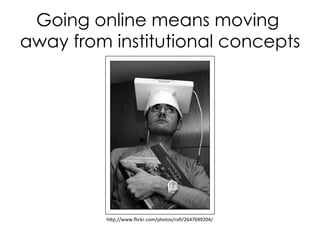
Going online means moving
away from institutional concepts
hp://www.flickr.com/photos/rofi/2647699204/ 	
  	
  
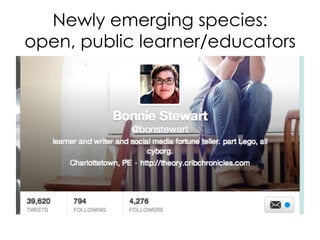
Newly emerging species:
open, public learner/educators
Online networks enable
different forms of identity,
legitimacy,
and belonging
than institutions do
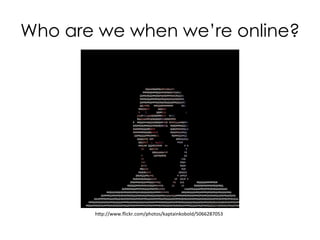
Who are we when we’re online?
hp://www.flickr.com/photos/kaptainkobold/5066287053	
  
Ourselves
Always Faceted
hp://www.flickr.com/photos/thelotuscarroll/6842167375/	
  
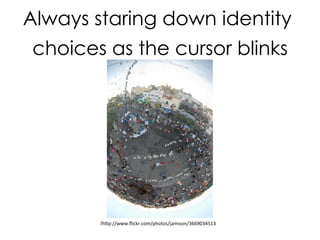
Always staring down identity
choices as the cursor blinks
/hp://www.flickr.com/photos/jamison/3669034513	
  
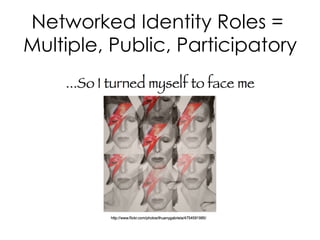
Networked Identity Roles =
Multiple, Public, Participatory
Always Connected
hp://www.flickr.com/photos/ryanr/142455033/	
  
My local cohort
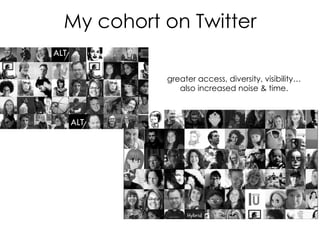
My cohort on Twitter 	
  
greater access, diversity, visibility…
also increased noise  time.
Networked Publics
•  Multiple, overlapping, global networks
•  Always accessible
•  Identities are visible, traceable  searchable
•  Different audiences all in plain sight
See Kazys Varnelis, danah boyd, Alice Marwick,
Mizuko Ito for more
Who we are is shaped by the context(s)
we’re addressing
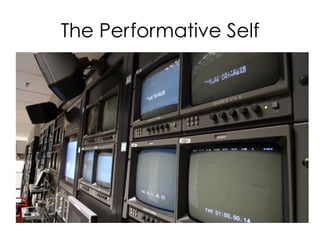
The Performative Self
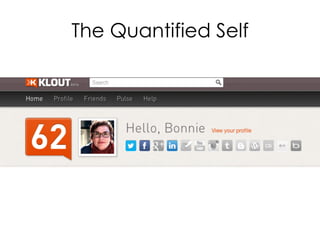
The Quantified Self
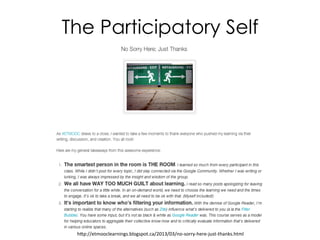
The Participatory Self
hp://etmooclearnings.blogspot.ca/2013/03/no-­‐sorry-­‐here-­‐just-­‐thanks.html	
  
The Asynchronous Self
http://www.flickr.com/photos/vylen/6158720720/
The Neoliberal Self
“Me, Inc.”
http://www.flickr.com/photos/mikebaird/4880623547
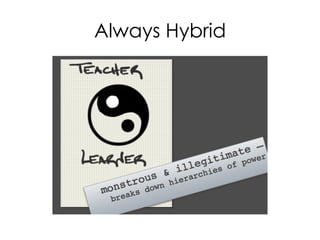
Always Hybrid
hp://www.flickr.com/photos/striaHc/2191408271/	
  
Hard to hear	
  
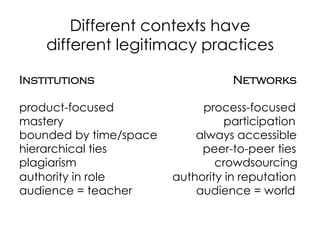
Different contexts have
different legitimacy practices
Institutions Networks
product-focused process-focused
mastery participation
bounded by time/space always accessible
hierarchical ties peer-to-peer ties
plagiarism crowdsourcing
authority in role authority in reputation
audience = teacher audience = world


The Digital = a Reputational Economy
hp://www.flickr.com/photos/8113246@N02/7932198032	
  
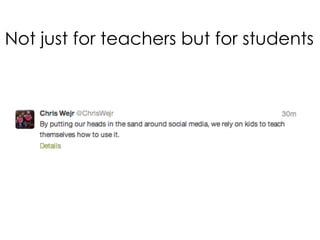
Not just for teachers but for students
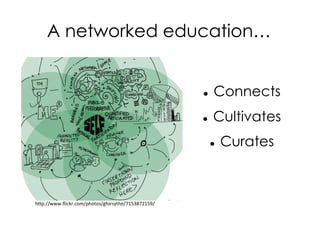
A networked education…
l  Connects
l  Cultivates
l  Curates
hp://www.flickr.com/photos/gforsythe/7153872159/	
  
…but cannot
control or count
in the same ways as
institutional models of
education
There are many currencies in
online networks
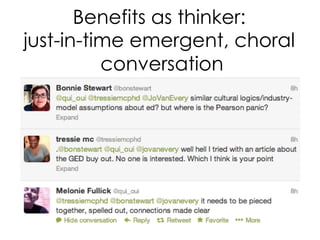
Benefits as thinker:
just-in-time emergent, choral
conversation
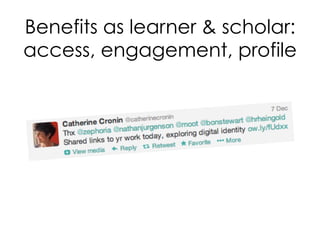
Benefits as learner  scholar:
access, engagement, profile
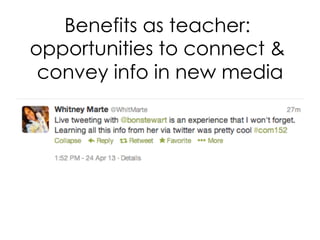
Benefits as teacher:
opportunities to connect 
convey info in new media
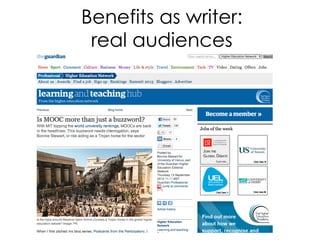
Benefits as writer:
real audiences
…that awkward moment when you
remember you friended your grandma
on Facebook.
And that your students – and your VP –
follow you on Twitter.
Context Collapse
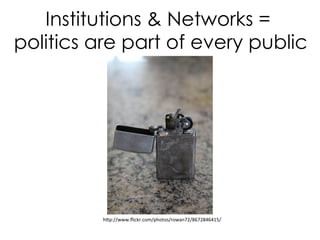
Institutions  Networks =
politics are part of every public
hp://www.flickr.com/photos/rowan72/8672846415/	
  
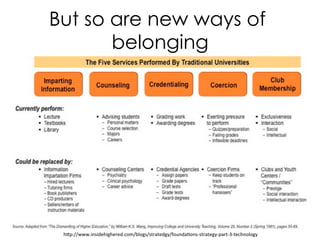
But so are new ways of
belonging
hp://www.insidehighered.com/blogs/stratedgy/foundaHons-­‐strategy-­‐part-­‐3-­‐technology	
  
Get networked. Connect.
Thank you.
@bonstewart

Who are we now that We're Online? Connected Learners, Connected Educators