The Ascending time
of
MOOC
BY SIPHELELE GODLIMPI
Contents
What is a MOOC?
The rise of Open Learning
Brief History of MOOCs
Types of MOOCs
WHY USE MOOC’S?
MOOC’S AND PEDAGOGY
What is a MOOC?
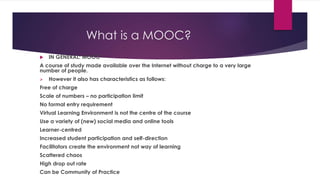
 IN GENERAL: MOOC
A course of study made available over the Internet without charge to a very large
number of people.
 However it also has characteristics as follows:
Free of charge
Scale of numbers – no participation limit
No formal entry requirement
Virtual Learning Environment is not the centre of the course
Use a variety of (new) social media and online tools
Learner-centred
Increased student participation and self-direction
Facilitators create the environment not way of learning
Scattered chaos
High drop out rate
Can be Community of Practice
Brief History of MOOCs
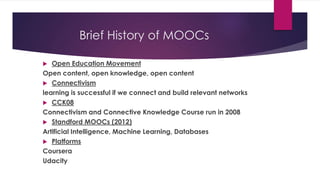
 Open Education Movement
Open content, open knowledge, open content
 Connectivism
learning is successful if we connect and build relevant networks
 CCK08
Connectivism and Connective Knowledge Course run in 2008
 Standford MOOCs (2012)
Artificial Intelligence, Machine Learning, Databases
 Platforms
Coursera
Udacity
MOOC Types
 Academics, Non profits, Individuals
 Major Universities
 Constructivist, Connectivist approach
 Behaviourist, Cognitvist approach
 Many-to-many (Dialogue, Peer2Peer interactions)
 One-to-many (Student/Content, Teacher/Student interactions)
 Informal learning
 More formal learning
 Collaborative, peer assessment
 Coordinated assessments and quizzes (often automated)
 Rich social media
 Social media used
 Drive towards openness
 Open to join, but not all content
 Network building, collaboration
 Organised group work
 Ad hoc learner space
 Fixed Platform
Why use MOOCs?
 Networked learning offers opportunities to share ideas, exchange knowledge,
and work in collaborative teams
 Learning takes place through interaction, questioning, searching for
information, and discussing what has been discovered
 Collaborative work prepares students for real-world employment
 Diverse learners bring fresh experiences from their varied backgrounds
 “Rhizomatic” learning: just as rhizomes in plant roots propagate new plants,
networked learning creates new nodes of information and higher levels of
interaction among participants (Cormier, 2012)
 Requires independent learning and encourages students to become
responsible for their own knowledge.
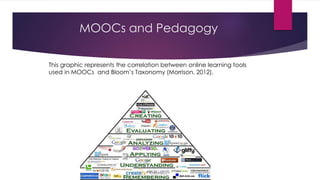
MOOCs and Pedagogy
This graphic represents the correlation between online learning tools
used in MOOCs and Bloom’s Taxonomy (Morrison, 2012).
MY MOOC
 What's it about?
 The objective of the course is to stimulate you to become a cultural
explorer in your own community by discovering music traditions outside the
normal day-to-day music heard on mass media. In the event that your
community is small with minimum diversity then you are encouraged to
explore your own cultural family heritage
 References
http://www.slideshare.net/oerafrica/the-
rise-of-moocs
http://www.slideshare.net/LynGoodnight/
multmedia-presentation-

the mooc

  • 1.
  • 2.
    Contents What is aMOOC? The rise of Open Learning Brief History of MOOCs Types of MOOCs WHY USE MOOC’S? MOOC’S AND PEDAGOGY
  • 3.
    What is aMOOC?  IN GENERAL: MOOC A course of study made available over the Internet without charge to a very large number of people.  However it also has characteristics as follows: Free of charge Scale of numbers – no participation limit No formal entry requirement Virtual Learning Environment is not the centre of the course Use a variety of (new) social media and online tools Learner-centred Increased student participation and self-direction Facilitators create the environment not way of learning Scattered chaos High drop out rate Can be Community of Practice
  • 4.
    Brief History ofMOOCs  Open Education Movement Open content, open knowledge, open content  Connectivism learning is successful if we connect and build relevant networks  CCK08 Connectivism and Connective Knowledge Course run in 2008  Standford MOOCs (2012) Artificial Intelligence, Machine Learning, Databases  Platforms Coursera Udacity
  • 5.
    MOOC Types  Academics,Non profits, Individuals  Major Universities  Constructivist, Connectivist approach  Behaviourist, Cognitvist approach  Many-to-many (Dialogue, Peer2Peer interactions)  One-to-many (Student/Content, Teacher/Student interactions)  Informal learning  More formal learning
  • 6.
     Collaborative, peerassessment  Coordinated assessments and quizzes (often automated)  Rich social media  Social media used  Drive towards openness  Open to join, but not all content  Network building, collaboration  Organised group work  Ad hoc learner space  Fixed Platform
  • 7.
    Why use MOOCs? Networked learning offers opportunities to share ideas, exchange knowledge, and work in collaborative teams  Learning takes place through interaction, questioning, searching for information, and discussing what has been discovered  Collaborative work prepares students for real-world employment  Diverse learners bring fresh experiences from their varied backgrounds  “Rhizomatic” learning: just as rhizomes in plant roots propagate new plants, networked learning creates new nodes of information and higher levels of interaction among participants (Cormier, 2012)  Requires independent learning and encourages students to become responsible for their own knowledge.
  • 8.
    MOOCs and Pedagogy Thisgraphic represents the correlation between online learning tools used in MOOCs and Bloom’s Taxonomy (Morrison, 2012).
  • 9.
    MY MOOC  What'sit about?  The objective of the course is to stimulate you to become a cultural explorer in your own community by discovering music traditions outside the normal day-to-day music heard on mass media. In the event that your community is small with minimum diversity then you are encouraged to explore your own cultural family heritage
  • 10.