MOOCs and what the entail
HAYLEY DOLLERY
M O O C
MASSIVE OPEN ONLINE COURSES
*MASSIVE
 Uses the Internet to connect with
others on a global scale
*OPEN
– No charge for students
*ONLINE
 Learning together in digital modes
*COURSE
– A MOOC Covers a single topic
 MOOC stands for Massive Open Online
Course. It’s massive because it can have an
unlimited number of learners working
together. It’s open because anyone can
participate. Traditional MOOCs are offered
free of charge, unless they are taken for
university credit. The work all takes place
online, through a combination of social
networking, wiki creation, real-time meeting
in venues like Skype, and through audio and
video podcasts. It’s a single-topic course,
lasting from a few weeks to an entire
semester.
 Networked learning offers opportunities to share ideas,
exchange knowledge, and work in collaborative teams
 Learning takes place through interaction, questioning,
searching for information, and discussing what has been
discovered
 Collaborative work prepares students for real-world
employment
 Diverse learners bring fresh experiences from their varied
backgrounds
 “Rhizomatic” learning: just as rhizomes in plant roots
propagate new plants, networked learning creates new
nodes of information and higher levels of interaction
among participants (Cormier, 2012)
 Requires independent learning and encourages students to
become responsible for their own knowledge.
 2004: George Siemens & Stephen Downes develop theory of
Connectivism, “the thesis that knowledge is distributed across a
network of connections, and therefore that learning consists of the
ability to construct and traverse those networks (Downes, 2012,
p.9).
 2008: First MOOC presented at University of Manitoba with ~ 2200
learners
 2010: Dave Cormier videos about MOOCs added to YouTube
(Cormier, 2010)
 2011: MOOC for college prep skills helps freshmen prepare for
college requirements (Cormier, 2011)
 2012:
 Harvard’s first MOOC has 370,000 registered students (Pappano,
2012)
 2012: Coursera launches from Stanford; offers first xMOOCs
(Chen, 2012)
 New York Times calls 2012 “The Year of the MOOC” Pappano,
2012)
 2013: cMOOCs and xMOOCs too numerous to count accurately
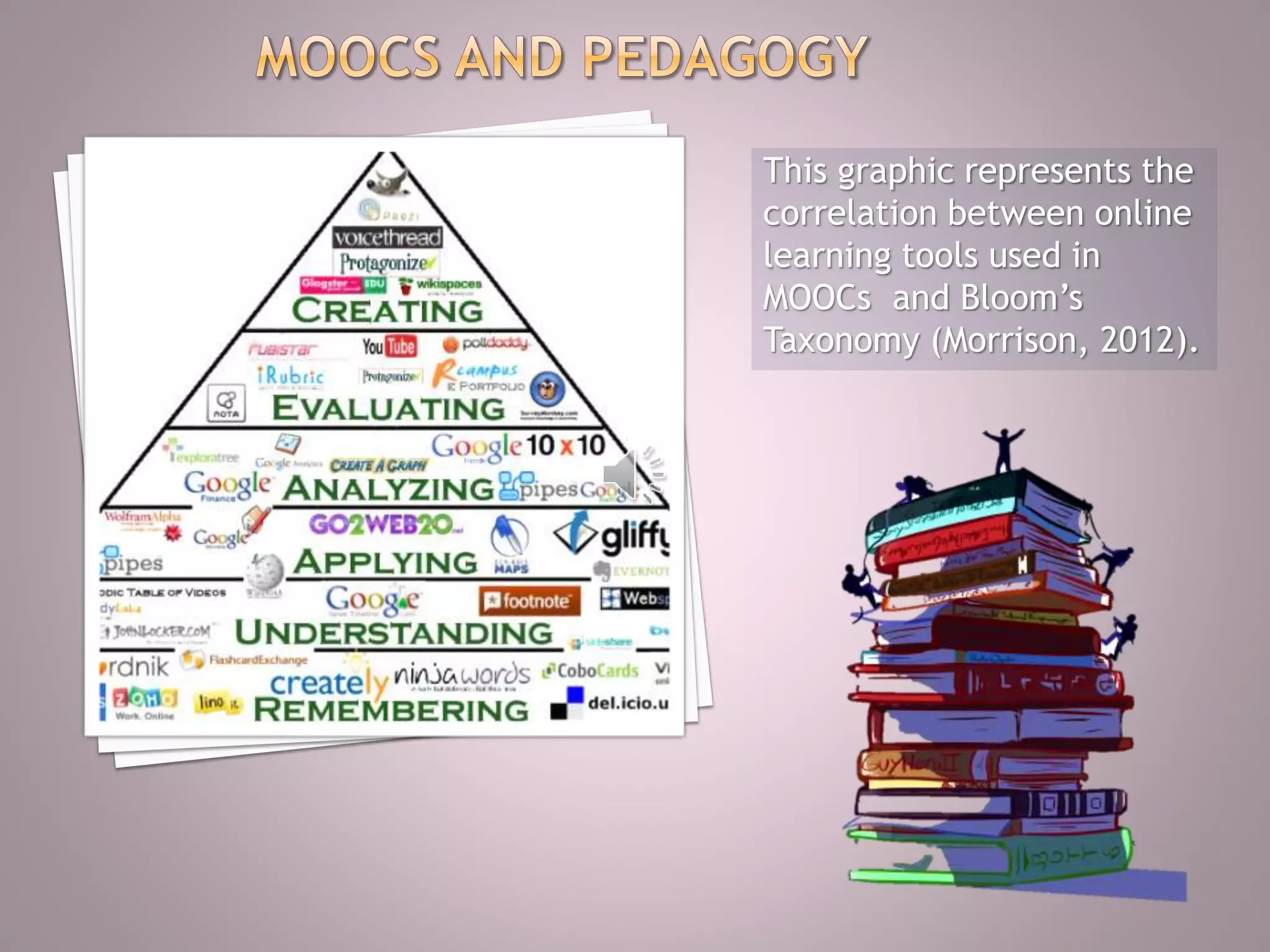
This graphic represents the
correlation between online
learning tools used in
MOOCs and Bloom’s
Taxonomy (Morrison, 2012).
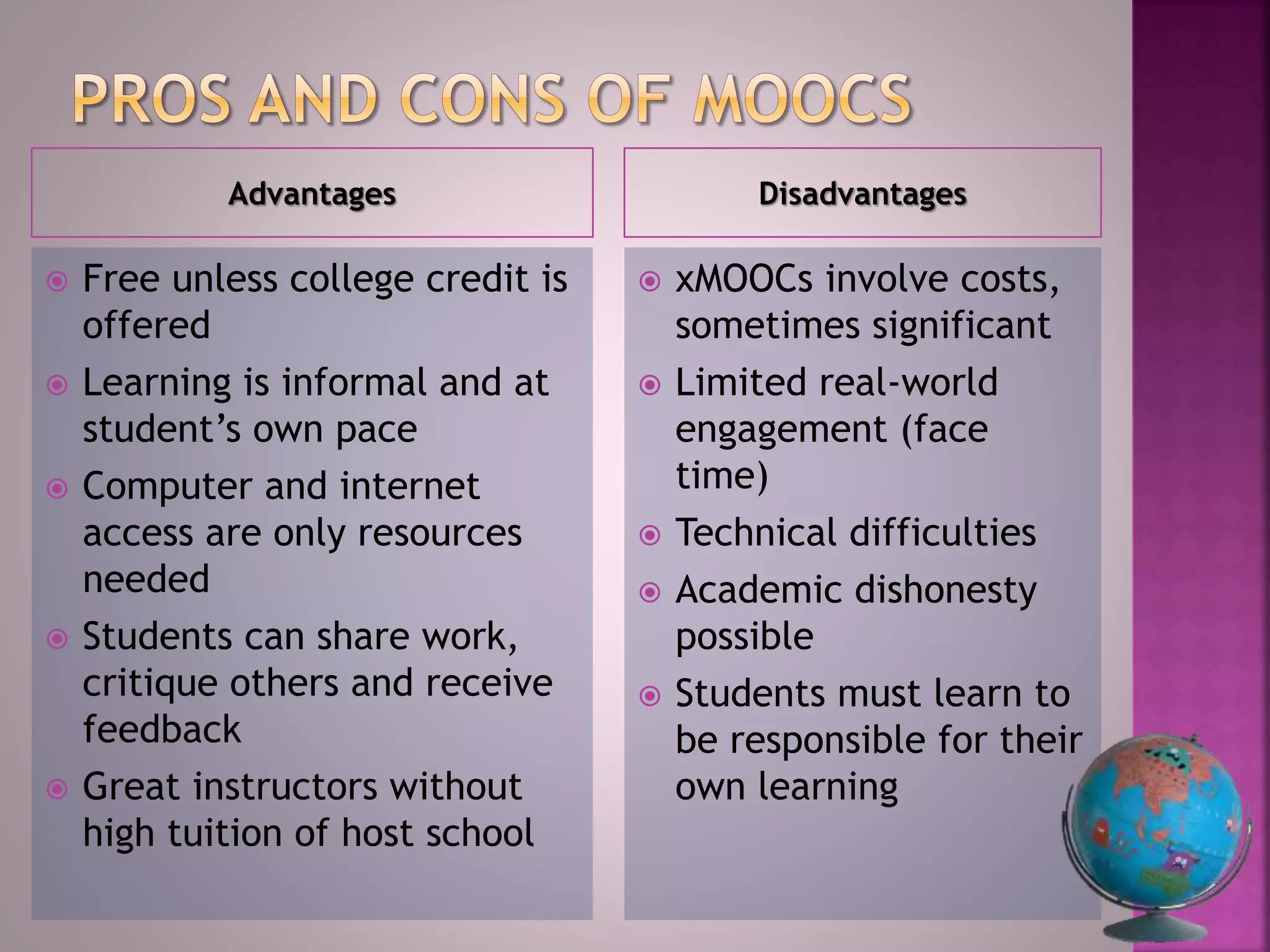
Advantages Disadvantages
 Free unless college credit is
offered
 Learning is informal and at
student’s own pace
 Computer and internet
access are only resources
needed
 Students can share work,
critique others and receive
feedback
 Great instructors without
high tuition of host school
 xMOOCs involve costs,
sometimes significant
 Limited real-world
engagement (face
time)
 Technical difficulties
 Academic dishonesty
possible
 Students must learn to
be responsible for their
own learning
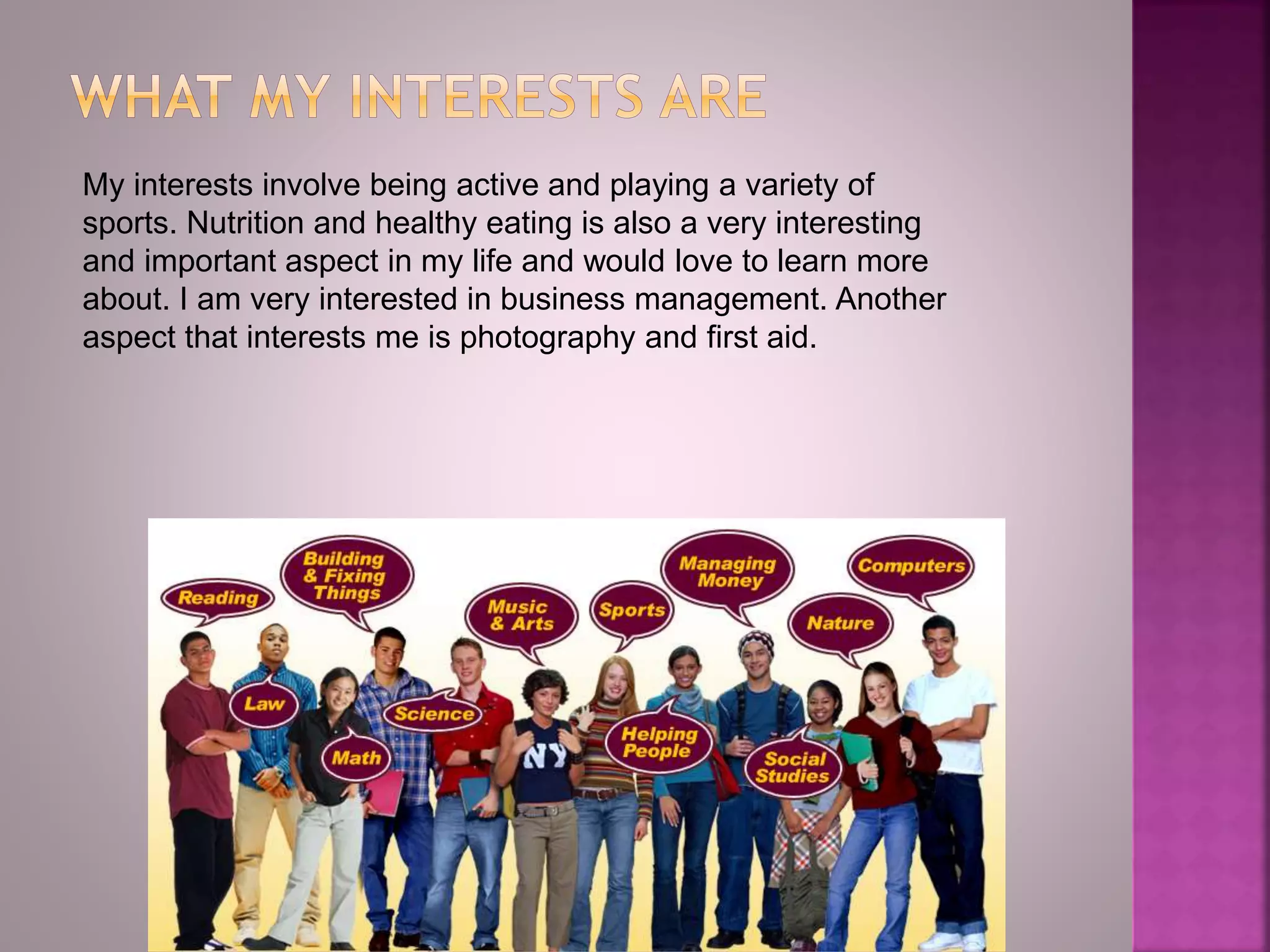
My interests involve being active and playing a variety of
sports. Nutrition and healthy eating is also a very interesting
and important aspect in my life and would love to learn more
about. I am very interested in business management. Another
aspect that interests me is photography and first aid.
The MOOCs that I’m interested in doing is
• A photography course
• A first aid course
• A fitness and nutrition course
• Business management courses
Chen, C. (2012, April 18). Coursera launches humanities courses. The Stanford
Daily. Retrieved from http://www.stanforddaily.com/2012/04/18/coursera-
launches-humanities-courses/
Cormier, D. (2011, November). Rhizomatic learning - Why we teach? Retrieved
from Dave's educational blog:
http://davecormier.com/edblog/2011/11/05/rhizomatic-learning-why-learn/
Downes, S. (2012). Connectivism and connective knowledge: Essays on meaning
and learning networks. Moncton, NB: National Research Council Canada.
Morrison, D. (2013, June 10). Need-to-know: edX reveals surprising results from
MOOC study & new online model "Skillfeed". Retrieved from Online Learning
Insights: http://onlinelearninginsights.wordpress.com/tag/web-2-0/
Pappano, L. (2012, November 2). The year of the MOOC. Retrieved from New
York Times education life:
http://www.nytimes.com/2012/11/04/education/edlife/massive-open-online-
courses-are-multiplying-at-a-rapid-pace.html?pagewanted

MOOCS

  • 1.
    MOOCs and whatthe entail HAYLEY DOLLERY M O O C MASSIVE OPEN ONLINE COURSES
  • 2.
    *MASSIVE  Uses theInternet to connect with others on a global scale *OPEN – No charge for students *ONLINE  Learning together in digital modes *COURSE – A MOOC Covers a single topic
  • 3.
     MOOC standsfor Massive Open Online Course. It’s massive because it can have an unlimited number of learners working together. It’s open because anyone can participate. Traditional MOOCs are offered free of charge, unless they are taken for university credit. The work all takes place online, through a combination of social networking, wiki creation, real-time meeting in venues like Skype, and through audio and video podcasts. It’s a single-topic course, lasting from a few weeks to an entire semester.
  • 4.
     Networked learningoffers opportunities to share ideas, exchange knowledge, and work in collaborative teams  Learning takes place through interaction, questioning, searching for information, and discussing what has been discovered  Collaborative work prepares students for real-world employment  Diverse learners bring fresh experiences from their varied backgrounds  “Rhizomatic” learning: just as rhizomes in plant roots propagate new plants, networked learning creates new nodes of information and higher levels of interaction among participants (Cormier, 2012)  Requires independent learning and encourages students to become responsible for their own knowledge.
  • 5.
     2004: GeorgeSiemens & Stephen Downes develop theory of Connectivism, “the thesis that knowledge is distributed across a network of connections, and therefore that learning consists of the ability to construct and traverse those networks (Downes, 2012, p.9).  2008: First MOOC presented at University of Manitoba with ~ 2200 learners  2010: Dave Cormier videos about MOOCs added to YouTube (Cormier, 2010)  2011: MOOC for college prep skills helps freshmen prepare for college requirements (Cormier, 2011)  2012:  Harvard’s first MOOC has 370,000 registered students (Pappano, 2012)  2012: Coursera launches from Stanford; offers first xMOOCs (Chen, 2012)  New York Times calls 2012 “The Year of the MOOC” Pappano, 2012)  2013: cMOOCs and xMOOCs too numerous to count accurately
  • 6.
    This graphic representsthe correlation between online learning tools used in MOOCs and Bloom’s Taxonomy (Morrison, 2012).
  • 7.
    Advantages Disadvantages  Freeunless college credit is offered  Learning is informal and at student’s own pace  Computer and internet access are only resources needed  Students can share work, critique others and receive feedback  Great instructors without high tuition of host school  xMOOCs involve costs, sometimes significant  Limited real-world engagement (face time)  Technical difficulties  Academic dishonesty possible  Students must learn to be responsible for their own learning
  • 8.
    My interests involvebeing active and playing a variety of sports. Nutrition and healthy eating is also a very interesting and important aspect in my life and would love to learn more about. I am very interested in business management. Another aspect that interests me is photography and first aid.
  • 9.
    The MOOCs thatI’m interested in doing is • A photography course • A first aid course • A fitness and nutrition course • Business management courses
  • 10.
    Chen, C. (2012,April 18). Coursera launches humanities courses. The Stanford Daily. Retrieved from http://www.stanforddaily.com/2012/04/18/coursera- launches-humanities-courses/ Cormier, D. (2011, November). Rhizomatic learning - Why we teach? Retrieved from Dave's educational blog: http://davecormier.com/edblog/2011/11/05/rhizomatic-learning-why-learn/ Downes, S. (2012). Connectivism and connective knowledge: Essays on meaning and learning networks. Moncton, NB: National Research Council Canada. Morrison, D. (2013, June 10). Need-to-know: edX reveals surprising results from MOOC study & new online model "Skillfeed". Retrieved from Online Learning Insights: http://onlinelearninginsights.wordpress.com/tag/web-2-0/ Pappano, L. (2012, November 2). The year of the MOOC. Retrieved from New York Times education life: http://www.nytimes.com/2012/11/04/education/edlife/massive-open-online- courses-are-multiplying-at-a-rapid-pace.html?pagewanted

Editor's Notes

  • #2 Today’s presentation will introduce you to a teaching-learning method known as MOOCs. I believe MOOCs will offer our teachers a unique way to integrate technology with teaching in a way that will engage students and expose them to a wider world of ideas and knowledge.
  • #5 MOOCs can be valuable to high school students, who can benefit from the larger exchange of ideas and knowledge available when networking expands beyond the school walls. Students learn through interactions, discussions, questioning what is found, and discovering new information. Collaborative teams are becoming more prevalent in the business world, so the MOOC level of interaction helps prepare students for real-world employment situations. Since MOOCs bring together learners from a wide variety of backgrounds and experiences, learning diversifies and provides fresh insight into the subject matter. The concept of “rhizomatic learning” illustrates the nature of MOOCs; just as plants often propagate through rhizomes in their root systems, networked learning provides fresh nodes of connection and encourages further exploration beyond the classroom. MOOCs require a higher level of independent learning than traditional lecture-test instruction. Students learn that the knowledge they acquire is their own responsibility: if they want to understand a concept, they need to seek out answers and experience the learning for themselves.
  • #6 MOOCs have a brief history, but the concept has become so popular that its use has spread throughout the world, both within academic circles and among independent learner groups. The MOOC model is based on the Connectivist learning theory, which demonstrates how learning occurs through connections with others. MOOCs throughout the Internet world have grown from the first in 2008 to a place five years later where there are MOOCs or facsimiles of MOOCs available on nearly every topic imaginable, with participants from around the globe. Last year the New York Times pronounced 2012 as the “Year of the MOOC” in education.
  • #7 MOOCs offer opportunities to take course content to new levels of cognitive experience. Rather than simply memorizing and testing on information, MOOC models encourage a personal journey of exploration on the topic being discussed. As students become more familiar with the ways of using MOOC networking and collaboration, they will spend more time finding personal applications for the information, evaluating content for appropriate contributions to the knowledge base, and eventually creating their own content to share forward.
  • #8 The nature of MOOCs produces a number of pros and cons. cMOOCs are usually free, while xMOOCs are usually provided at cost; where these are offered for college credit, sometimes the cost will be prohibitive for the average person. Some colleges have opened their MOOCs to non-credit participants, which holds closely to the original MOOC model. Learning in a MOOC is much less formal than the traditional lecture-test method of teaching. Students work at their own paces and in collaboration with others in whatever time is agreeable to all. A drawback to the online-only venue can be the lack of in-person engagement, but MOOCs often develop local cohorts of participants, particularly when those learners live close to each other geographically. No expensive materials are needed, beyond computer and internet access. While this could be a hindrance for those who have not bridged the “digital divide” yet, such facilities are available in nearly every library, and most cell phones will offer internet access. Computer procedures can always offer technical difficulties, so it is up to facilitators to make sure their efforts are well prepared and undergo test runs. In MOOCs, students are encouraged to share work and to collaborate with others to enhance learning. Some educators believe this sets up MOOCs for academic dishonesty issues, but where knowledge is free and open, dishonesty is not a great problem. The point of MOOC interaction is not to own knowledge but to share it with others. Some MOOCs are facilitated by leading scholars in their fields. This offers MOOC participants the opportunity to learn from some of our greatest minds, without the expense of the major university’s tuition. One factor that can be both a pro and a con is the responsibility students have for their own learning. Students who are accustomed to having their knowledge handed to them in bits may find the independent nature of the MOOC difficult to manage at first. With practice, however, most students will realize that they get more benefit when they put in more effort, and they will spend more time in MOOC participation.