MOOC
MASSIVE OPEN ONLINE COURSE
BY FAAIZAH MAHOMED
201304037
03 AUGUST 2015
TEACHING STUDIES 3B
WHAT DOES A ENTAIL
OF?
 Uses the Internet to connect with others all over the world
 No charge for students in some courses
 Learning together
 A MOOC Covers a single topic of study
WHAT IS A MOOC
In essence A MOOC is a free internet-
based, distance learning program, designed for
students from all around the world to participate
in.
A MOOC may be used for a particular university
course or may be less structured at times.
Although MOOCs don't always offer academic
credits, they provide education that may enable
certification, employment or further studies.
The brief history of
MOOCs
 The first MOOCs emerged from the open educational resources (OER) movement.
 In 2008, First MOOC presented at University of Manitoba with ~ 2200 learners, the term
MOOCs was devised by Dave Cormier and Bryan Alexander in response to a course
called Connectivism and Connective knowledge (also known as CCK08)
 The CCK08 led by George Siemens (Athabasca University) and Stephen Downes
(National Research Council) in 2004 develop theory of Connectivism, “the thesis that
knowledge is distributed across a network of connections, and therefore that learning
consists of the ability to construct and traverse those networks (Downes, 2012, p.9). It
consisted of 25 tuition-paying students in Extended education at the University of
Manitoba, as well as over 2200 online students from the general public who paid
nothing.
 2010: Dave Cormier videos about MOOCs added to YouTube (Cormier, 2010)
The brief history of MOOCs cont…
 MOOCs records 1.2 million unique visitors per month with 250,000
graduates of its 500+ courses as of January 2013. In February 2014,
ALISON registered its 3 millionth user
 2012:
 Harvard’s first MOOC has 370,000 registered students (Pappano,
2012)
 2012: Coursera launches from Stanford; offers first xMOOCs
(Chen, 2012)
 New York Times calls 2012 “The Year of the MOOC” Pappano,
2012)
Why use MOOCs?
 Networked learning offers opportunities to
share ideas, exchange knowledge, and work in
collaborative teams
 Learning takes place through interaction,
questioning, searching for information, and
discussing what has been discovered
 Collaborative work prepares students for real-
world employment
WHY USE MOOC’S CONT…
 Diverse learners bring fresh experiences from their
varied backgrounds
 “Rhizomatic” learning: just as rhizomes in plant roots
propagate new plants, networked learning creates
new nodes of information and higher levels of
interaction among participants (Cormier, 2012)
 Requires independent learning and encourages
students to become responsible for their own
knowledge.
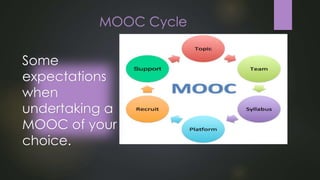
MOOC Cycle
Some
expectations
when
undertaking a
MOOC of your
choice.
Types of MOOCs
However the aforementioned types can
be in the following forms:
 Network based.
 Content-based.
 Task based.
 cMOOC
 xMOOC
 connectivistMOOCS
 adaptiveMOOCS
 groupMOOCS
 transferMOOCS
 SocialMOOC
Benefits of MOOCs
 You can organize a MOOC in any setting that has connectivity.
 You can organize it in any language you like.
 You can use any online tools that are relevant to your target region or that
are already being used by the participants.
 You can move beyond time zones and physical boundaries.
 It can be organized as quickly as you can inform the participants.
 Contextualized content can be shared by all.
PROS & CONS
ADVANTAGES
 Free unless college credit is offered
 Learning is informal and at student’s own
pace
 Computer and internet access are only
resources needed
 Students can share work, critique others
and receive feedback
 Great instructors without high tuition of
host school
DISADVANTAGES
 xMOOCs involve costs, sometimes
significant
 Limited real-world engagement (face
time)
 Technical difficulties
 Academic dishonesty possible
 Students must learn to be responsible for
their own learning
WHAT AM I INTERESTED IN?
I am interested in various courses as I have mentioned before, as a “Jill
of all trades” I am definitely spoiled for choice. There are various
courses I could pursue in order to be prepared for any common
experiences in the classroom or school environment. However I would
love to venture outside of the educational faculty. Working in the
design business I am tempted to do an interior design course, but the
sites that I have visited are not available to commence. Therefore the
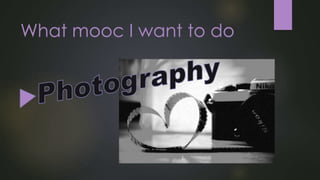
other option I am leading towards is a photography course.
What mooc I want to do
Ref cont……….
 Cormier, D. (2011, November). Rhizomatic learning - Why we teach? Retrieved from
Dave's educational blog: http://davecormier.com/edblog/2011/11/05/rhizomatic-
learning-why-learn
 Downes, S. (2012). Connectivism and connective knowledge: Essays on meaning and
learning networks. Moncton, NB: National Research Council Canada.
► Cormier D, Siemens G (2010) Through the open door: open courses as research,
► learning, and engagement.Chen, C. (2012, April 18). Coursera launches humanities
courses. The Stanford Daily. Retrieved from
http://www.stanforddaily.com/2012/04/18/coursera-launches-humanities-courses/
► Levy & Schrire. (2011). Kibbutzim College of Education, Technology, and the Arts

All About MOOCs

  • 1.
    MOOC MASSIVE OPEN ONLINECOURSE BY FAAIZAH MAHOMED 201304037 03 AUGUST 2015 TEACHING STUDIES 3B
  • 2.
    WHAT DOES AENTAIL OF?  Uses the Internet to connect with others all over the world  No charge for students in some courses  Learning together  A MOOC Covers a single topic of study
  • 3.
    WHAT IS AMOOC In essence A MOOC is a free internet- based, distance learning program, designed for students from all around the world to participate in. A MOOC may be used for a particular university course or may be less structured at times. Although MOOCs don't always offer academic credits, they provide education that may enable certification, employment or further studies.
  • 4.
    The brief historyof MOOCs  The first MOOCs emerged from the open educational resources (OER) movement.  In 2008, First MOOC presented at University of Manitoba with ~ 2200 learners, the term MOOCs was devised by Dave Cormier and Bryan Alexander in response to a course called Connectivism and Connective knowledge (also known as CCK08)  The CCK08 led by George Siemens (Athabasca University) and Stephen Downes (National Research Council) in 2004 develop theory of Connectivism, “the thesis that knowledge is distributed across a network of connections, and therefore that learning consists of the ability to construct and traverse those networks (Downes, 2012, p.9). It consisted of 25 tuition-paying students in Extended education at the University of Manitoba, as well as over 2200 online students from the general public who paid nothing.  2010: Dave Cormier videos about MOOCs added to YouTube (Cormier, 2010)
  • 5.
    The brief historyof MOOCs cont…  MOOCs records 1.2 million unique visitors per month with 250,000 graduates of its 500+ courses as of January 2013. In February 2014, ALISON registered its 3 millionth user  2012:  Harvard’s first MOOC has 370,000 registered students (Pappano, 2012)  2012: Coursera launches from Stanford; offers first xMOOCs (Chen, 2012)  New York Times calls 2012 “The Year of the MOOC” Pappano, 2012)
  • 6.
    Why use MOOCs? Networked learning offers opportunities to share ideas, exchange knowledge, and work in collaborative teams  Learning takes place through interaction, questioning, searching for information, and discussing what has been discovered  Collaborative work prepares students for real- world employment
  • 7.
    WHY USE MOOC’SCONT…  Diverse learners bring fresh experiences from their varied backgrounds  “Rhizomatic” learning: just as rhizomes in plant roots propagate new plants, networked learning creates new nodes of information and higher levels of interaction among participants (Cormier, 2012)  Requires independent learning and encourages students to become responsible for their own knowledge.
  • 8.
  • 9.
    Types of MOOCs Howeverthe aforementioned types can be in the following forms:  Network based.  Content-based.  Task based.  cMOOC  xMOOC  connectivistMOOCS  adaptiveMOOCS  groupMOOCS  transferMOOCS  SocialMOOC
  • 10.
    Benefits of MOOCs You can organize a MOOC in any setting that has connectivity.  You can organize it in any language you like.  You can use any online tools that are relevant to your target region or that are already being used by the participants.  You can move beyond time zones and physical boundaries.  It can be organized as quickly as you can inform the participants.  Contextualized content can be shared by all.
  • 11.
    PROS & CONS ADVANTAGES Free unless college credit is offered  Learning is informal and at student’s own pace  Computer and internet access are only resources needed  Students can share work, critique others and receive feedback  Great instructors without high tuition of host school DISADVANTAGES  xMOOCs involve costs, sometimes significant  Limited real-world engagement (face time)  Technical difficulties  Academic dishonesty possible  Students must learn to be responsible for their own learning
  • 12.
    WHAT AM IINTERESTED IN? I am interested in various courses as I have mentioned before, as a “Jill of all trades” I am definitely spoiled for choice. There are various courses I could pursue in order to be prepared for any common experiences in the classroom or school environment. However I would love to venture outside of the educational faculty. Working in the design business I am tempted to do an interior design course, but the sites that I have visited are not available to commence. Therefore the other option I am leading towards is a photography course.
  • 13.
    What mooc Iwant to do
  • 14.
    Ref cont……….  Cormier,D. (2011, November). Rhizomatic learning - Why we teach? Retrieved from Dave's educational blog: http://davecormier.com/edblog/2011/11/05/rhizomatic- learning-why-learn  Downes, S. (2012). Connectivism and connective knowledge: Essays on meaning and learning networks. Moncton, NB: National Research Council Canada. ► Cormier D, Siemens G (2010) Through the open door: open courses as research, ► learning, and engagement.Chen, C. (2012, April 18). Coursera launches humanities courses. The Stanford Daily. Retrieved from http://www.stanforddaily.com/2012/04/18/coursera-launches-humanities-courses/ ► Levy & Schrire. (2011). Kibbutzim College of Education, Technology, and the Arts

Editor's Notes

  • #3 MOOC stands for Massive Open Online Course. It’s huge because it can have many learners working together. It’s open because anyone can participate and do it. Usually MOOCs are offered free of charge, but some of them are not. The work all takes place on the net, through a combination of social networking, wiki creation, real-time meeting in venues like Skype, and through audio and video podcasts. It’s a single-topic course and the duration varies across courses.
  • #5 MOOCs have a brief history, but the concept has become very popular that its use has spread throughout the world, both within academic circles and among independent learner groups. The MOOC model is based on connections, in sense that learning takes place through connecting with others. MOOCs throughout the Internet world have grown from the first in 2008 to a place seven years later where there are MOOCs available on nearly every topic, with participants from around the world.