EXPERIENTIAL Approaches
to Digital Teaching & Learning
Dr. BONNIE STEWART
University of Windsor
TEACHxperts, Northwestern University
November 30, 2018
Me.
● Assistant Professor of Online
Pedagogy & Workplace
Learning
● Program Lead, Experiential
Education
● Research Lead, Provincial
Cultural Strategy
● Coordinator, Adult
Education
● Digital Strategist
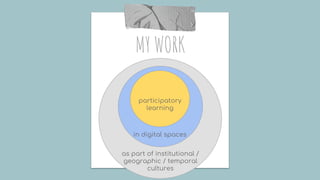
MY WORK
participatory
learning
in digital spaces
as part of institutional /
geographic / temporal
cultures
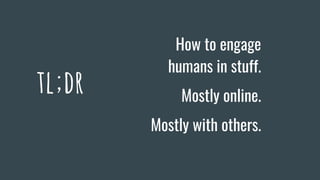
tl;dr
How to engage
humans in stuff.
Mostly online.
Mostly with others.
How many of you
work / teach / learn in digital spaces?
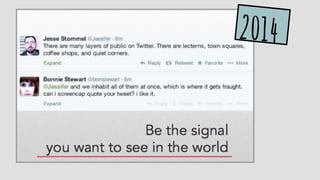
2014
misinformation
fake news surveillance
data manipulation image via Amy Collier
enclosure2018
How do you
teach / learn in the
middle of a Dumpster
fire ?
OUCH.
Digital learning in 2018 has to
go beyond content delivery...
...or maybe we should
rethink it.
https://www.flickr.com/photos/tom-margie/4050083521
We need models & literacies for engaged,
conscious, individual & community
LEARNING
How to Find our way?
EXPERIENTIAL MODELS
have a lot to
offer to digital teaching & learning
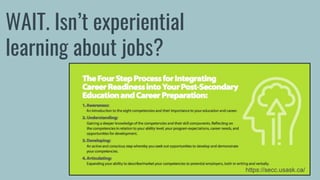
WAIT. Isn’t experiential
learning about jobs?
https://secc.usask.ca/
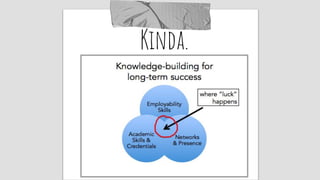
Kinda.
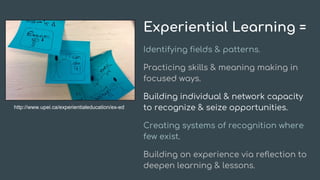
Experiential Learning =
Identifying fields & patterns.
Practicing skills & meaning making in
focused ways.
Building individual & network capacity
to recognize & seize opportunities.
Creating systems of recognition where
few exist.
Building on experience via reflection to
deepen learning & lessons.
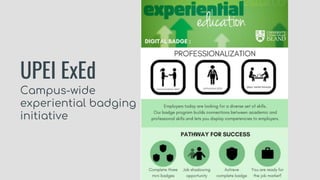
http://www.upei.ca/experientialeducation/ex-ed
Experiential learning is
PARTICIPATORY
(Conscious of the individual in Society & of power differences. Action-focused.)
...just like digital learning.
Have you ever...
● Used team problem-solving for learning?
● Asked students to build something to learn a concept?
● Engaged in role plays or improv games?
● Assigned the creation of class texts (even short ones) by
students?
● Had students do a community consultation related to a
concept they were learning?
● Gone on a field trip or placement?
Participatory
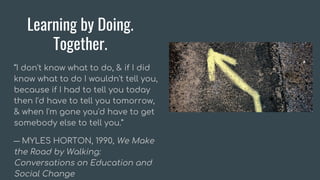
Learning by Doing.
Together.
“I don't know what to do, & if I did
know what to do I wouldn't tell you,
because if I had to tell you today
then I'd have to tell you tomorrow,
& when I'm gone you'd have to get
somebody else to tell you.”
― MYLES HORTON, 1990, We Make
the Road by Walking:
Conversations on Education and
Social Change
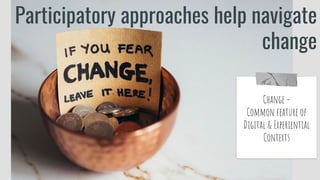
Participatory approaches help navigate
change
Change =
Common feature of
Digital & Experiential
Contexts
hype. fear. uncertainty. SAME!
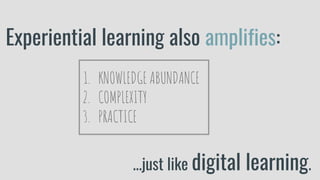
Experiential learning also amplifies:
1. KNOWLEDGE ABUNDANCE
2. COMPLEXITY
3. PRACTICE
...just like digital learning.
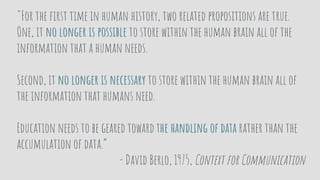
"For the first time in human history, two related propositions are true.
One, it no longer is possible to store within the human brain all of the
information that a human needs.
Second, it no longer is necessary to store within the human brain all of
the information that humans need.
Education needs to be geared toward the handling of data rather than the
accumulation of data.”
- David Berlo, 1975, Context for Communication
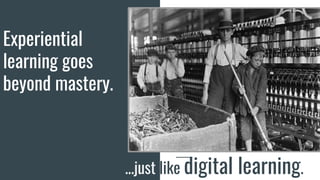
Experiential
learning goes
beyond mastery.
...just like digital learning.
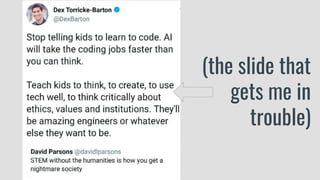
(the slide that
gets me in
trouble)
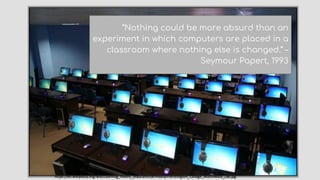
“Nothing could be more absurd than an
experiment in which computers are placed in a
classroom where nothing else is changed.” –
Seymour Papert, 1993
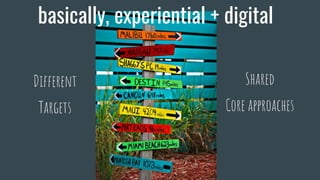
Different
Targets
Shared
Core approaches
basically, experiential + digital
SO.
How can experiential approaches
help me teach & Learn in the
Dumpster fire digital?
In this afternoon’s Workshop we’ll talk about:
Thinking Tools for
1. complexity &
2. Participatory Practice
...But First, a Few hands-on experiential pathsto learner-centered,
community-oriented knowledge creation & media navigation
3pm
Ver Steeg
Lounge
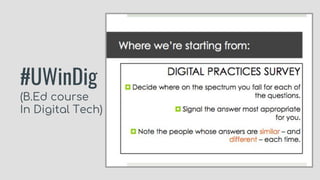
Can learners identify
practices, skills, & literacies?
#UWinDig
(B.Ed course
In Digital Tech)
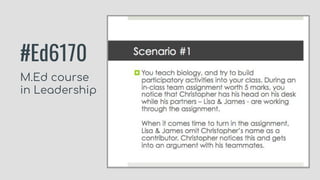
#Ed6170
M.Ed course
in Leadership
Can learners identify equity &
power issues & navigate
conflicts & difference?
#UWinDig
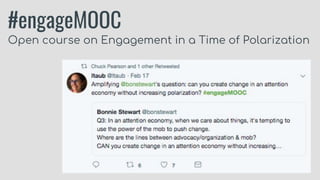
#engageMOOC
Open course on Engagement in a Time of Polarization
Can learners deal with
misinformation & data privacy
issues in an informed way?
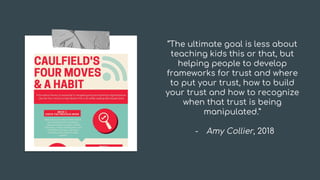
“The ultimate goal is less about
teaching kids this or that, but
helping people to develop
frameworks for trust and where
to put your trust, how to build
your trust and how to recognize
when that trust is being
manipulated.”
- Amy Collier, 2018
Tip
#UWinDig
Can learners process &
present information in succinct
& varied ways?
#Ed363
Certificate course in Adult Education
Can learners’ efforts &
engagement be captured &
recognized?
UPEI ExEd
Campus-wide
experiential badging
initiative
#TeachComUAL
open online seminar series
Can students reflect on
their learning, potentially
without the teacher as sole
audience?
#UWinDig
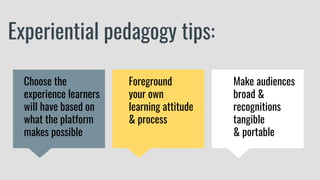
Experiential pedagogy tips:
Make audiences
broad &
recognitions
tangible
& portable
Choose the
experience learners
will have based on
what the platform
makes possible
Foreground
your own
learning attitude
& process
THANK YOU.
@bonstewart
bstewart@uwindsor.ca

Experiential Approaches to Digital Teaching & Learning