WILMS’ TUMOUR
PEDIATRIC SURGERY
AN OVRVIEWDr.B.Selvaraj MS;Mch;FICS;
“Surgical Educator”
Malaysia
WILMS’ TUMOUR
Objectives
 Overview
 Epidemiology & Etiology
 Pathology
 Clinical features
 Investigations
 Staging
 Differential Diagnosis
 Treatment
WILMS’ TUMOUR- Overview
 Wilms’ tumour (WT) or Nephroblastoma
is the most common renal tumour
affecting children of 2 to 4 yrs old
 Presents as an asymptomatic abdominal
mass in children.
 Most Wilms’ tumours are unilateral,
being bilateral in < 5 % of cases.
 Overall survival rate is 85% because of
multidisciplinary treatment.
 Advancements in the diagnosis and
treatment of Wilms' tumour have
greatly improved the prognosis for
children with this disease.
 Two study groups are instrumental in
establishing the basis for current
therapy:
- The Children Oncology Group(COG)
previously National Wilms’ Tumour
Study Group (NWTSG) in North America
-The International Society of
Paediatric Oncology (SIOP) in Europe
 Immediate nephrectomy is the
preferred approach of the COG,
whereas in SIOP, nephrectomy follows
a short course of chemotherapy.
WILMS’ TUMOUR- Etiology
 Incidence seven in a million children in the
USA. 6% 0f all renal tumour in children
 Black children more affected than others.
 Girls are more prone to develop than boys.
 Risk factors are African-American race and
family H/O Wilms’ tumour.
 75 % of Wilms tumour occurs in healthy
children; but in 25 % cases, is associated with
other genetic abnormalities
 Beckwith–Wiedemann syndrome consists of
Omphalocele, Macroglossia and
Visceromegaly
 Denys–Drash syndrome consists of Wilms
tumor,Kidney disease and Male
pseudohermaphroditism.
 WAGR syndrome consists of Wilms tumor,
Aniridia, Genital abnormalities and Mental
retardation
 WT1 is the Wilms’ tumor suppressor gene
located at chromosome 11pl3. The gene is
deleted in WAGR syndrome and has point
mutations in Denys-Drash syndrome.
 Beckwith–Wiedemann syndrome is associated
with loss of heterozygosity (LOH) at
chromosome 11p15, and the WT2 gene may be
situated at this locus.
WILMS’ TUMOUR- Pathology
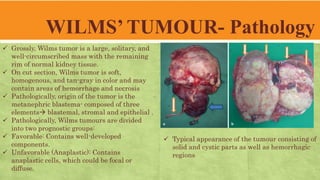
 Grossly, Wilms tumor is a large, solitary, and
well-circumscribed mass with the remaining
rim of normal kidney tissue.
 On cut section, Wilms tumor is soft,
homogenous, and tan-gray in color and may
contain areas of hemorrhage and necrosis
 Pathologically, origin of the tumor is the
metanephric blastema- composed of three
elements blastemal, stromal and epithelial .
 Pathologically, Wilms tumours are divided
into two prognostic groups:
 Favorable: Contains well-developed
components.
 Unfavorable (Anaplastic): Contains
anaplastic cells, which could be focal or
diffuse.
 Typical appearance of the tumour consisting of
solid and cystic parts as well as hemorrhagic
regions
WILMS’ TUMOUR- Clinical Features
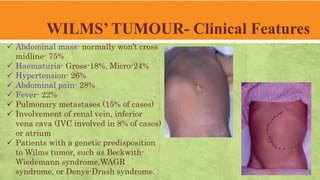
 Abdominal mass- normally won’t cross
midline- 75%
 Haematuria- Gross-18%, Micro-24%
 Hypertension- 26%
 Abdominal pain- 28%
 Fever- 22%
 Pulmonary metastases (15% of cases)
 Involvement of renal vein, inferior
vena cava (IVC involved in 8% of cases)
or atrium
 Patients with a genetic predisposition
to Wilms tumor, such as Beckwith-
Wiedemann syndrome,WAGR
syndrome, or Denys-Drash syndrome.
WILMS’ TUMOUR-Investigations
 The aim is to evaluate the site, size, and extent
of the tumour, the presence or absence of
secondaries and kidney functioning status
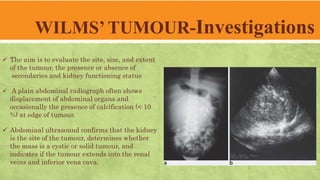
 A plain abdominal radiograph often shows
displacement of abdominal organs and
occasionally the presence of calcification (< 10
%) at edge of tumour.
 Abdominal ultrasound confirms that the kidney
is the site of the tumour, determines whether
the mass is a cystic or solid tumour, and
indicates if the tumour extends into the renal
veins and inferior vena cava.
WILMS’ TUMOUR-Investigations
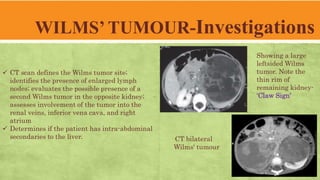
 CT scan defines the Wilms tumor site;
identifies the presence of enlarged lymph
nodes; evaluates the possible presence of a
second Wilms tumor in the opposite kidney;
assesses involvement of the tumor into the
renal veins, inferior vena cava, and right
atrium
 Determines if the patient has intra-abdominal
secondaries to the liver.
Showing a large
leftsided Wilms
tumor. Note the
thin rim of
remaining kidney-
‘Claw Sign’
CT bilateral
Wilms' tumour
WILMS’ TUMOUR-Investigations
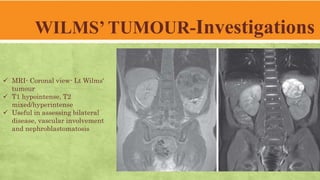
 MRI- Coronal view- Lt Wilms'
tumour
 T1 hypointense, T2
mixed/hyperintense
 Useful in assessing bilateral
disease, vascular involvement
and nephroblastomatosis
WILMS’ TUMOUR-Investigations
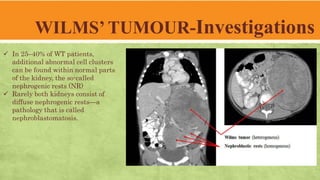
 In 25–40% of WT patients,
additional abnormal cell clusters
can be found within normal parts
of the kidney, the so-called
nephrogenic rests (NR)
 Rarely both kidneys consist of
diffuse nephrogenic rests—a
pathology that is called
nephroblastomatosis.
WILMS’ TUMOUR- Staging
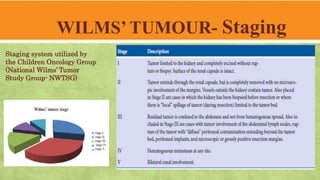
Staging system utilized by
the Children Oncology Group
(National Wilms’ Tumor
Study Group- NWTSG)
WILMS’ TUMOUR- Staging
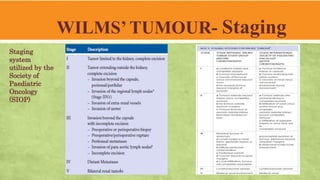
Staging
system
utilized by the
Society of
Paediatric
Oncology
(SIOP)
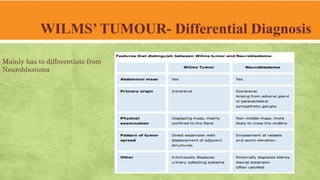
WILMS’ TUMOUR- Differential Diagnosis
Mainly has to differentiate from
Neuroblastoma
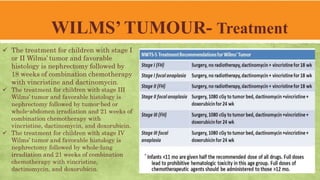
WILMS’ TUMOUR- Treatment
 The treatment for children with stage I
or II Wilms’ tumor and favorable
histology is nephrectomy followed by
18 weeks of combination chemotherapy
with vincristine and dactinomycin.
 The treatment for children with stage III
Wilms’ tumor and favorable histology is
nephrectomy followed by tumor-bed or
whole-abdomen irradiation and 21 weeks of
combination chemotherapy with
vincristine, dactinomycin, and doxorubicin.
 The treatment for children with stage IV
Wilms’ tumor and favorable histology is
nephrectomy followed by whole-lung
irradiation and 21 weeks of combination
chemotherapy with vincristine,
dactinomycin, and doxorubicin.
WILMS’ TUMOUR
Peripheral Arterial Diseases(PAD)

Wilms' tumour-- Pediatric Surgery

  • 1.
    WILMS’ TUMOUR PEDIATRIC SURGERY ANOVRVIEWDr.B.Selvaraj MS;Mch;FICS; “Surgical Educator” Malaysia
  • 2.
    WILMS’ TUMOUR Objectives  Overview Epidemiology & Etiology  Pathology  Clinical features  Investigations  Staging  Differential Diagnosis  Treatment
  • 3.
    WILMS’ TUMOUR- Overview Wilms’ tumour (WT) or Nephroblastoma is the most common renal tumour affecting children of 2 to 4 yrs old  Presents as an asymptomatic abdominal mass in children.  Most Wilms’ tumours are unilateral, being bilateral in < 5 % of cases.  Overall survival rate is 85% because of multidisciplinary treatment.  Advancements in the diagnosis and treatment of Wilms' tumour have greatly improved the prognosis for children with this disease.  Two study groups are instrumental in establishing the basis for current therapy: - The Children Oncology Group(COG) previously National Wilms’ Tumour Study Group (NWTSG) in North America -The International Society of Paediatric Oncology (SIOP) in Europe  Immediate nephrectomy is the preferred approach of the COG, whereas in SIOP, nephrectomy follows a short course of chemotherapy.
  • 4.
    WILMS’ TUMOUR- Etiology Incidence seven in a million children in the USA. 6% 0f all renal tumour in children  Black children more affected than others.  Girls are more prone to develop than boys.  Risk factors are African-American race and family H/O Wilms’ tumour.  75 % of Wilms tumour occurs in healthy children; but in 25 % cases, is associated with other genetic abnormalities  Beckwith–Wiedemann syndrome consists of Omphalocele, Macroglossia and Visceromegaly  Denys–Drash syndrome consists of Wilms tumor,Kidney disease and Male pseudohermaphroditism.  WAGR syndrome consists of Wilms tumor, Aniridia, Genital abnormalities and Mental retardation  WT1 is the Wilms’ tumor suppressor gene located at chromosome 11pl3. The gene is deleted in WAGR syndrome and has point mutations in Denys-Drash syndrome.  Beckwith–Wiedemann syndrome is associated with loss of heterozygosity (LOH) at chromosome 11p15, and the WT2 gene may be situated at this locus.
  • 5.
    WILMS’ TUMOUR- Pathology Grossly, Wilms tumor is a large, solitary, and well-circumscribed mass with the remaining rim of normal kidney tissue.  On cut section, Wilms tumor is soft, homogenous, and tan-gray in color and may contain areas of hemorrhage and necrosis  Pathologically, origin of the tumor is the metanephric blastema- composed of three elements blastemal, stromal and epithelial .  Pathologically, Wilms tumours are divided into two prognostic groups:  Favorable: Contains well-developed components.  Unfavorable (Anaplastic): Contains anaplastic cells, which could be focal or diffuse.  Typical appearance of the tumour consisting of solid and cystic parts as well as hemorrhagic regions
  • 6.
    WILMS’ TUMOUR- ClinicalFeatures  Abdominal mass- normally won’t cross midline- 75%  Haematuria- Gross-18%, Micro-24%  Hypertension- 26%  Abdominal pain- 28%  Fever- 22%  Pulmonary metastases (15% of cases)  Involvement of renal vein, inferior vena cava (IVC involved in 8% of cases) or atrium  Patients with a genetic predisposition to Wilms tumor, such as Beckwith- Wiedemann syndrome,WAGR syndrome, or Denys-Drash syndrome.
  • 7.
    WILMS’ TUMOUR-Investigations  Theaim is to evaluate the site, size, and extent of the tumour, the presence or absence of secondaries and kidney functioning status  A plain abdominal radiograph often shows displacement of abdominal organs and occasionally the presence of calcification (< 10 %) at edge of tumour.  Abdominal ultrasound confirms that the kidney is the site of the tumour, determines whether the mass is a cystic or solid tumour, and indicates if the tumour extends into the renal veins and inferior vena cava.
  • 8.
    WILMS’ TUMOUR-Investigations  CTscan defines the Wilms tumor site; identifies the presence of enlarged lymph nodes; evaluates the possible presence of a second Wilms tumor in the opposite kidney; assesses involvement of the tumor into the renal veins, inferior vena cava, and right atrium  Determines if the patient has intra-abdominal secondaries to the liver. Showing a large leftsided Wilms tumor. Note the thin rim of remaining kidney- ‘Claw Sign’ CT bilateral Wilms' tumour
  • 9.
    WILMS’ TUMOUR-Investigations  MRI-Coronal view- Lt Wilms' tumour  T1 hypointense, T2 mixed/hyperintense  Useful in assessing bilateral disease, vascular involvement and nephroblastomatosis
  • 10.
    WILMS’ TUMOUR-Investigations  In25–40% of WT patients, additional abnormal cell clusters can be found within normal parts of the kidney, the so-called nephrogenic rests (NR)  Rarely both kidneys consist of diffuse nephrogenic rests—a pathology that is called nephroblastomatosis.
  • 11.
    WILMS’ TUMOUR- Staging Stagingsystem utilized by the Children Oncology Group (National Wilms’ Tumor Study Group- NWTSG)
  • 12.
    WILMS’ TUMOUR- Staging Staging system utilizedby the Society of Paediatric Oncology (SIOP)
  • 13.
    WILMS’ TUMOUR- DifferentialDiagnosis Mainly has to differentiate from Neuroblastoma
  • 14.
    WILMS’ TUMOUR- Treatment The treatment for children with stage I or II Wilms’ tumor and favorable histology is nephrectomy followed by 18 weeks of combination chemotherapy with vincristine and dactinomycin.  The treatment for children with stage III Wilms’ tumor and favorable histology is nephrectomy followed by tumor-bed or whole-abdomen irradiation and 21 weeks of combination chemotherapy with vincristine, dactinomycin, and doxorubicin.  The treatment for children with stage IV Wilms’ tumor and favorable histology is nephrectomy followed by whole-lung irradiation and 21 weeks of combination chemotherapy with vincristine, dactinomycin, and doxorubicin.
  • 15.
  • 16.