Arthoplasty of knee
a. Pre operative evaluation
b. complications
BY: Dr Sabir khadka
Junior resident
Department of orthopaedics
Preparation for aTKRjourney
STARTS BY MEETING
Starts by a meeting
ENDS AT THE DOOR OF
OPERATION ROOM Ends
at the door of Operation Room
Indication of TKR
• Primary indication
– Pain and loss of function of knee
• Secondary indication
– Osteoarthritis
– Rheumatoid Arthritis
– Osteochondromatosis
– Villonodular synovitis
– Metabolic arthritis
– Post traumatic arthritis
Contraindication
Absolute
• septic arthritis
• Chronic infection
• Extensor mechanism
dysfunction
• Severe vascular disease
• Recurvatum deformity sec.
to muscular weakness
• Presence of well functioning
arthrodesis
Relative
• Medical condition
• Inadequate soft tissue
coverage
• Morbid Obesity
• Neuropathic Arthropathy
• History of osteomyelitis
around knee joint
I-Patient’s meeting:
Crepitations with walking and going up and down
stairs.
Repeated knee swellings.
Mechanical symptoms ( locking)
Age, sex, level of activity , Habits: smoking,
alcohol.
Complaining of PAIN.
Deformities.
Limitation of the knee motion.
Crepitations with walking and going up and
down stairs
Repeated knee swellings.
Mechanical symptoms ( locking)
I-Patient’s meeting:
History of previous medications
Previous physiotherapy courses+ knee
injections.
Generalized joint disease.
Other comorbidities: D/M, renal ,
cerebrovascular.
History of UTI.
History of DVT
Mental status (dementia)
Social conditions : divorced, lives-alone
(postoperative care and rehabilitation)
II-Analysis of Complaints:
Age: above 50 y (55 y). Younger patients if
juvenile arthritis , post traumatic, markedly
deformed.
Gender of the patient: women have poorer
preoperative
knee flexion but better post-operative
functional scoring than men.
Level of activity: more active and high impact
sport ( jogging) ---less longevity of TKR
II-Analysis of Complaints:
1-Claudication pain of ischemia or spinal canalstenosis
(character and how it is relieved
2-Radiating pain form back , hip or sacroiliac joint.
1- Pain: (onset, course , duration , site , character,
severity, radiation , what increase ,
what decrease, night pain and associated
symptoms)
To be indication for TKA: DISABLING PAIN with
daily walking or stairs climbing, not relieving by
medications and rest.
NIGHT PAIN
+ Failure all previous trials of conservative
treatment.
Exclude:
1-Claudication pain of ischemia or spinal canal
stenosis
2-Radiating pain form back , hip or sacroiliac joint.
II-Analysis of Complaints
That’s it.
Knee deformity:( traumatic or inflammatory
can
be a younger age than 50 y.)
Expectations of the patient: should be
restored to reality
Operation will reduce your pain ,
improve function of your knee and
improve quality of life (activity and
sleeping).
Examination of the Joint
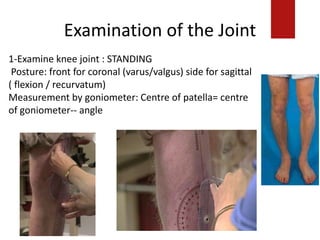
1-Examine knee joint : STANDING
Posture: front for coronal (varus/valgus) side for sagittal
( flexion / recurvatum)
Measurement by goniometer: Centre of patella= centre
of goniometer-- angle
III-Examination of the joints
aricositie.
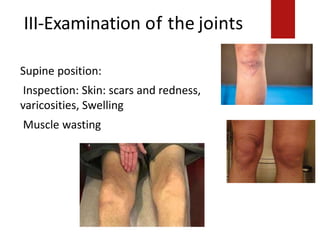
Supine position:
Supine position:
Inspection: Skin: scars and redness,
varicosities, Swelling
Muscle wastingection: Skin: scars and
redness, v
Swelling:
Muscle wasting:
VMO
III-Examination of the joints
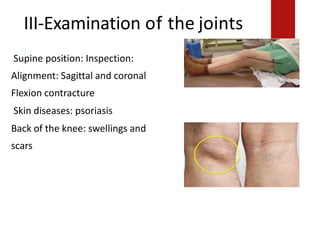
Supine position: Inspection:
iSupine position: Inspection:
Alignment: Sagittal and coronal
Flexion contracture
Skin diseases: psoriasis
Back of the knee: swellings and
scarsnment: Sagittal and coronal
Flexion contracture
Skin diseases: psoriasis.
Back of the knee: swellings and scars
III-Examination of the joint
2-Palpation:
Skin hotness.
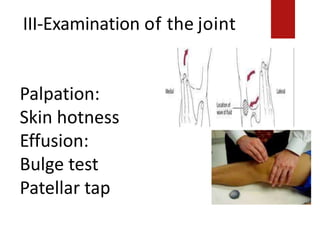
Palpation:
Skin hotness
Effusion:
Bulge test
Patellar tap
Effusion: Bulge test
Patellar tap
III-Examination
of the joint:
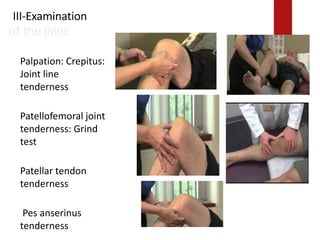
Palpation: Crepitus:
Joint line
tenderness
Patellofemoral joint
tenderness: Grind
test
Patellar tendon
tenderness
Pes anserinus
tenderness
III-Examination of the joint:
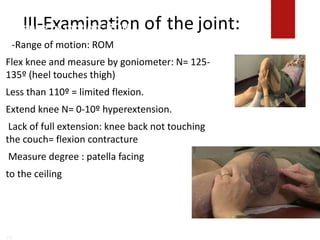
3-Range of motion: ROM
F-Range of motion: ROM
Flex knee and measure by goniometer: N= 125-
135º (heel touches thigh)
Less than 110º = limited flexion.
Extend knee N= 0-10º hyperextension.
Lack of full extension: knee back not touching
the couch= flexion contracture
Measure degree : patella facing
to the ceiling lex knee and measure by
goniometer:
N= 125-135º (heel touches thigh)
Lessthan 110º = limited flexion.
III-Examination of the joint:
Pulses
popliteal
dorsal pedis
posterior tibial
If impaired B.V.:
No
Tourniquet.
( or inflate during
cementing)
)
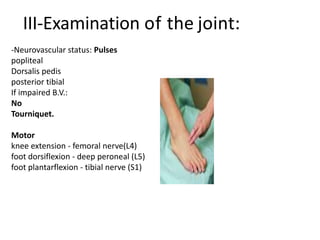
-Neurovascular status: Pulses
popliteal
Dorsalis pedis
posterior tibial
If impaired B.V.:
No
Tourniquet.
Motor
knee extension - femoral nerve(L4)
foot dorsiflexion - deep peroneal (L5)
foot plantarflexion - tibial nerve (S1)
IV-Radiographic Evaluation
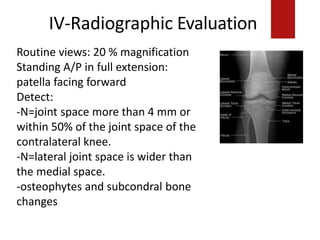
Routine views: 20 % magnification
Standing A/P in full extension:
patella facing forward
Detect:
-N=joint space more than 4 mm or
within 50% of the joint space of the
contralateral knee.
-N=lateral joint space is wider than
the medial space.
-osteophytes and subcondral bone
changes
AP Radiograph of the knee
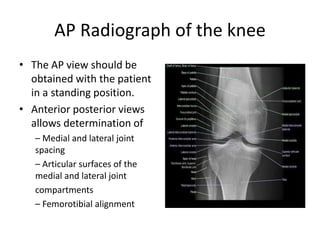
• The AP view should be
obtained with the patient
in a standing position.
• Anterior posterior views
allows determination of
– Medial and lateral joint
spacing
– Articular surfaces of the
medial and lateral joint
compartments
– Femorotibial alignment
Lateral View
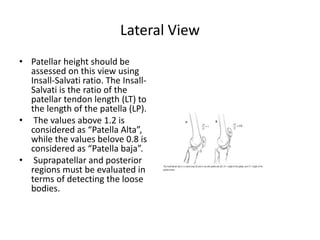
• Patellar height should be
assessed on this view using
Insall-Salvati ratio. The Insall-
Salvati is the ratio of the
patellar tendon length (LT) to
the length of the patella (LP).
• The values above 1.2 is
considered as “Patella Alta”,
while the values belove 0.8 is
considered as “Patella baja”.
• Suprapatellar and posterior
regions must be evaluated in
terms of detecting the loose
bodies.
Standing Orthorontgenogram
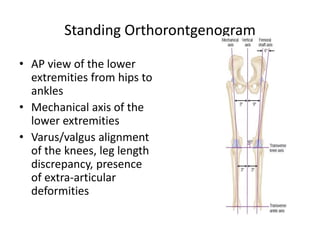
• AP view of the lower
extremities from hips to
ankles
• Mechanical axis of the
lower extremities
• Varus/valgus alignment
of the knees, leg length
discrepancy, presence
of extra-articular
deformities
Merchant View
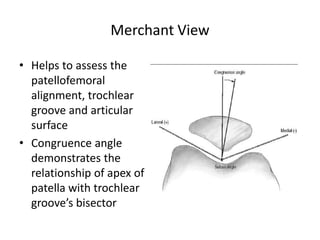
• Helps to assess the
patellofemoral
alignment, trochlear
groove and articular
surface
• Congruence angle
demonstrates the
relationship of apex of
patella with trochlear
groove’s bisector
MRI
• MRI is used to asses the Meniscal and Ligament integrity.
• The recommended sequences are
– T1 weighted Fat suppressed spoiled gradient-echo technique
– T2 weighted fast spin-echo technique
• MRI helps in defining the avascular lesions of the knee,
determining the extent of lesion and integrity of the
overlying cartilage.
Radiographic Classification
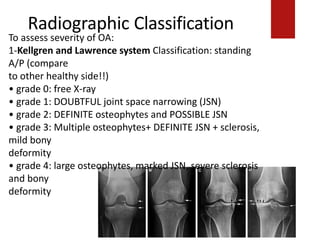
To assess severity of OA:
1-Kellgren and Lawrence system Classification: standing
A/P (compare
to other healthy side!!)
• grade 0: free X-ray
• grade 1: DOUBTFUL joint space narrowing (JSN)
• grade 2: DEFINITE osteophytes and POSSIBLE JSN
• grade 3: Multiple osteophytes+ DEFINITE JSN + sclerosis,
mild bony
deformity
• grade 4: large osteophytes, marked JSN, severe sclerosis
and bony
deformity
Radiographic classification
II - > 4 mm joint space, but small osteophytes, slightsclerosis, or
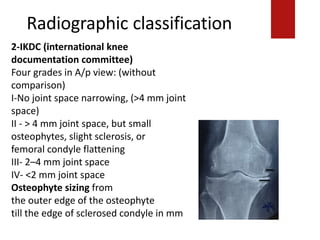
2-IKDC (international knee
documentation committee)
Four grades in A/p view: (without
comparison)
I-No joint space narrowing, (>4 mm joint
space)
II - > 4 mm joint space, but small
osteophytes, slight sclerosis, or
femoral condyle flattening
III- 2–4 mm joint space
IV- <2 mm joint space
Osteophyte sizing from
the outer edge of the osteophyte
till the edge of sclerosed condyle in mm
Templating
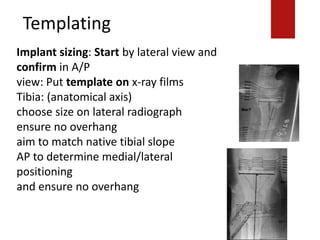
Implant sizing: Start by lateral view and
confirm in A/P
view: Put template on x-ray films
Tibia: (anatomical axis)
choose size on lateral radiograph
ensure no overhang
aim to match native tibial slope
AP to determine medial/lateral
positioning
and ensure no overhang
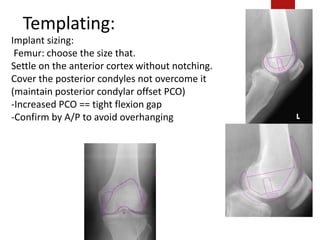
Templating:
Implant sizing:
Femur: choose the size that.
Settle on the anterior cortex without notching.
Cover the posterior condyles not overcome it
(maintain posterior condylar offset PCO)
-Increased PCO == tight flexion gap
-Confirm by A/P to avoid overhanging
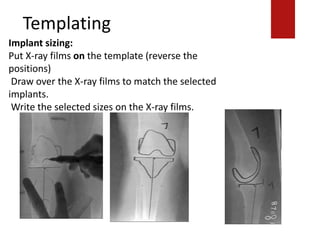
Templating
Implant sizing:
Put X-ray films on the template (reverse the
positions)
Draw over the X-ray films to match the selected
implants.
Write the selected sizes on the X-ray films.
V-Laboratory investigations:
========================================
====
ECG& Echo (above 45 y)
Chest X-ray.
BMI.
CBC, ESR, CRP.
Liver ( albumin) and kidney functions.
Random blood sugar , HbA1c(if D/M)
PT, INR
Urine analysis (with culture if pus)
MRSA screening.
ECG & Echo (above 45 y)
Chest X-ray.
BMI.
Laboratory investigations:
Additional:
25 (OH) vit D.
HIV screening.
Nicotine level. (if smoker)
Pre-requisites: (against infection and wound
problems)
Hg > 12g/dl
• HbA1C < 7
• Albumin >3.5mg/dl
• Transferrin >200mg/dl
• Total Lymphocyte count 1200-1500 cells/ mm3
• BMI <40
• 25-Hydroxy vitamin D >30 ng/ml
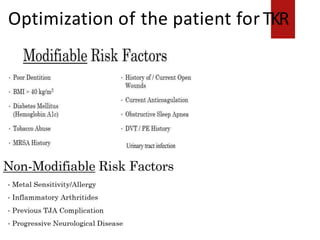
Optimization of the patient forTKR
you can deal with them.
Optimization of the patient
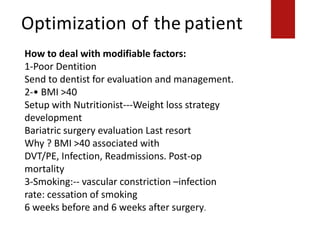
How to deal with modifiable factors:
1-Poor Dentition
Send to dentist for evaluation and management.
2-• BMI >40
Setup with Nutritionist---Weight loss strategy
development
Bariatric surgery evaluation Last resort
Why ? BMI >40 associated with
DVT/PE, Infection, Readmissions. Post-op
mortality
3-Smoking:-- vascular constriction –infection
rate: cessation of smoking
6 weeks before and 6 weeks after surgery.
Optimization of the patient .
Decreases lymphocyte count <1200 cells/ mm3
4 HbA1c >7.0
increased risk
Stroke, PE
Infection
Mortality
5- Malnutrition: Albumin <3.5 g/dL & lymphocytes < 1200
cells/mm3
Nutritionist consult ,
malnutrition---- Impairs wound healing
Hinders fibroblast proliferation
Decreases collagen synthesis
Prolongs inflammation
Decreases lymphocyte count <1200 cells/ mm3
Impairs body’s ability to fight infection
Increased risk of pneumonia
Optimization of the patient
Spread between people is by skin contact (shaking hands, etc.), on
2. No chronic intravenous device is present ( PICCline, etc.), and urinary
6-MRSA: STAPH AUREUS
Decolonization procedure MRSA:
1. All active skin infection sites must be resolved
before decolonization . Boils
must be drained. Antibiotics may be needed.
2. No chronic intravenous device and urinary
catheters should be avoided.
3. Colonization eradication should be attempted at
home, not in the hospital.
4. Chlorhexidine or hexachlorophene antiseptic
soap:
Optimization of the patient
5. Mupirocin 2% ointment
• Apply inside each nostril twice daily for 7 days, using a
cotton tipped
swab• Duration: 7 days
6. Oral antibiotics:
• Are not required for decolonization
• May be used to decrease gastrointestinal colonization,
and may
include clindamycin, doxycycline.
7. Encourage treatment of all household members
Optimization of the patient
obstruction (prostate)
Treat UTI prior to surgery if:
Obstructive symptoms ( retention)OR
Dysuria and bacterial count >1000 CFU/mL
Urinary tract infection (UTI)
Consider urine analysis and urine culture if:
Symptoms suggestive of urinary tract infection
OR
No symptoms, but risk factors for infection
(prostate , DM )
Proceed with surgery if:
Urine analysis not suggestive of UTI OR
Urinary tract infection, but bacterial count <1000
CFU/mL without
obstruction (prostate)
Treat UTI prior to surgery if:
Obstructive symptoms ( retention)OR
Dysuria and bacterial count >1000 CFU/mL
Optimization of the patient
Supraventricular arrhythmias (including atrial fibrillation) with heart rate of
>100 beats/min at rest
Symptomatic bradycardia
Severe valvular disease
Cardiac problems: cardiac consultation (ECG for ALL)
Delay surgery after coronary stenting for 1 year
Renal problems: (nephrology consultation)
If creatinine > 1.5 mg/dl or creatinine clearance < 100 ml/min.
Anaemia:
Increased risk of infection in patients with preoperative Hb < 10
g/dl
Vit D deficiency: !!
Normal > 30 ng/ ml
Less than 20 nm/ml= increased risk of aseptic loosening and
infection
Optimization of the patient
Drugs:
methotrexate therapy
5-Other disease-modifying antirheumatic drugs
Hydroxychloroquine considered safe to continue in perioperative period
Leflunomide, sulfasalazine, and azathioprine generally held until normal bowel/renal
function postoperatively
Drugs:
1- Dual antiplatelet therapy ( Aspirin and clopidogrel :
Stop 7 days before surgery ( after cardiologist).
2-NSAIDs: 7 days before surgery Stop taking all NSAIDs such as
naproxen , ibuprofen.
3-Stress-dose steroids (SDS) for patients on steroids
If <7.5 mg/day or any dose for <3 wks, only use typical daily dose
perioperatively
If > 7.5 mg/day individualized by the physician.
4-Methotrexate
Considered safe to continue in the perioperative period
Reasonable to hold for 2-4 weeks preoperatively if patient can
tolerate withdrawal of
methotrexate therapy
5-Other disease-modifying antirheumatic drugs
Hydroxychloroquine considered safe to continue in perioperative
period
Leflunomide, sulfasalazine, and azathioprine generally held until
normal bowel/renal
function postoperatively
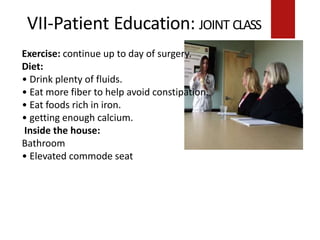
VII-Patient Education: JOINT CLASS
Exercise: continue up to day of surgery.
Diet:
• Drink plenty of fluids.
• Eat more fiber to help avoid constipation.
• Eat foods rich in iron.
• getting enough calcium.
Inside the house:
Bathroom
• Elevated commode seat
Patient Education:
chips, gum, or mints are
NOT allowed.
• Do NOT use lotions or powders.
• Do NOT shave before surgery.
• Do NOT shower the morning of your surgery.
The Day before Surgery:
Do
• Remove nail polish.
• Shower and wash your hair the night before. Use the
antibacterial soap
• Sleep in clean pajamas or clothes on freshly laundered
linens.
• Get a good night’s sleep.
Do Not
• Do NOT eat or drink anything after the time you were
instructed;
chips, gum, or mints are
NOT allowed.
• Do NOT use lotions or powders.
• Do NOT shave before surgery.
• Do NOT shower the morning of your surgery
Complication
• Thromboembolism
– The overall prevalence of DVT after TKR without any form
of mechanical or pharmaceutical prophylaxis is 40-84%
– Correlated with other co-morbidities
– Mechanical compression boots and foot pumps helps in
prevention
– Warfarin prophylaxis usually begin on the evening before
or after surgery, adjusted according to PT ( INR 2.0-3.0)
– LMWH
– Chemical prophylaxis for at least 14days in patient without
previous DVT and upto 6 weeks in patient with history of
DVT
Infection
• Dreadful complication, 2-3%
• Pre-operative factors: Rheumatoid arthritis(Sero
+,Male), Skin ulceration, previous knee surgery,
use of hinged knee prosthesis, obesity ,
consistent UTI, Steroid use, DM, poor
nutrition,malignancy, psoriasis
• Organism : Staph aureus, Staph epidermidis,
Strep Species
• Usually treated with 1st Generation
Cephalosporin if resistant Vancomycin
Polyethyelene Wear
• Most prevalent cause of eventual prosthesis
failure
• Wear of liner creates debris and stimulates
foreign body reaction
• Leads to synovitis and osteolysis
• With progressive wear asymmetric joint space
narrowing
• Eventual metal on metal contact
Patellofemoral complication
• Patellofemoral instability
• Patellar fracture
• Patellar component failure
• Patellar component loosening
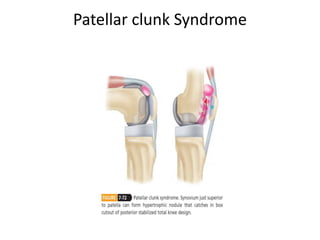
• Patellar clunk syndrome
• Extensor mechanism rupture
• Patellofemoral instability
– Extensor mechanism imbalance
– Mispositioned patellar, femoral or tibial components
– Patellar subluxation
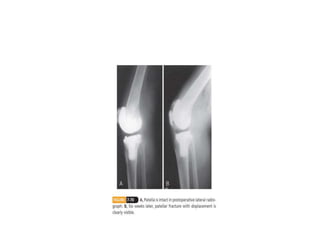
• Patellar fracture
– Uncommon, 1%
– Excessive patellar resection
– Vascular compromise secondary to lateral release
– Patellar maltracking secondary to component malposition
– Excessive joint line elevation
– Knee flexion more than 115degrees
– Trauma, thermal necrosis
– Revision TKR
• Patellar component failure
– Fatigue fracture pf the metal baseplate from the
fixation lugs
– Delamination of the polyethyelene from the base
plate
• Patellar component loosening
– 0.6-2.4%
– Predisposing factors: deficient bone stock, component
malposition and subluxation, patellar fractures,
osteonecrosis of the patella, loosening of other
components
Patellar clunk Syndrome
• Extensor mechanism rupture
– Rupture of Quadriceps or patellar tendon- 0.1-
0.55%
– Quadriceps rupture may be related to lateral
release in part
– Patellar tendon release is associated with previous
knee surgery,knee manipulation,distal
realignment procedure of the extensor
mechanism
Neurovascular complication
• Aterial compromise after TKA is a rare but
devastating complication that occurs in 0.03-
0.02% of patients, with 25% resulting in
amputation
• Peroneal nerve palsy- 1-2%
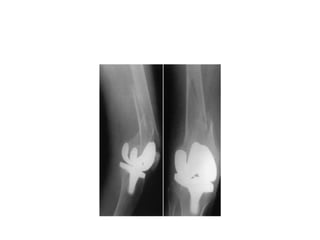
Periprosthetic fractures
• Supracondylar fracture of the femur occur
infrequently after TKA ( 0.3 to 2%)
• Related risk fracture include anterior femoral
notching, osteoporosis, rheumatoid arthritis,
steroid use, female gender, revision
arthroplasty and neurological disorders
• Tibial fractures are uncommon
Aseptic failure of primary TKA
• Component loosening
• Polyethylene wear with osteolysis
• Ligamentous laxity
• Periprosthetic fracture
• Arthrofibrosis
• Patellofemoral complications
REFERENCES
• CAMPBELL’S OPERATIVE ORTHOPAEDICS, 13TH
EDITION
• APLEY & SOLOMON’S SYSTEM OF
ORTHOPAEDICS AND TRAUMA, 10TH EDITION
Final preop evalun

Final preop evalun

  • 1.
    Arthoplasty of knee a.Pre operative evaluation b. complications BY: Dr Sabir khadka Junior resident Department of orthopaedics
  • 2.
    Preparation for aTKRjourney STARTSBY MEETING Starts by a meeting ENDS AT THE DOOR OF OPERATION ROOM Ends at the door of Operation Room
  • 3.
    Indication of TKR •Primary indication – Pain and loss of function of knee • Secondary indication – Osteoarthritis – Rheumatoid Arthritis – Osteochondromatosis – Villonodular synovitis – Metabolic arthritis – Post traumatic arthritis
  • 4.
    Contraindication Absolute • septic arthritis •Chronic infection • Extensor mechanism dysfunction • Severe vascular disease • Recurvatum deformity sec. to muscular weakness • Presence of well functioning arthrodesis Relative • Medical condition • Inadequate soft tissue coverage • Morbid Obesity • Neuropathic Arthropathy • History of osteomyelitis around knee joint
  • 5.
    I-Patient’s meeting: Crepitations withwalking and going up and down stairs. Repeated knee swellings. Mechanical symptoms ( locking) Age, sex, level of activity , Habits: smoking, alcohol. Complaining of PAIN. Deformities. Limitation of the knee motion. Crepitations with walking and going up and down stairs Repeated knee swellings. Mechanical symptoms ( locking)
  • 6.
    I-Patient’s meeting: History ofprevious medications Previous physiotherapy courses+ knee injections. Generalized joint disease. Other comorbidities: D/M, renal , cerebrovascular. History of UTI. History of DVT Mental status (dementia) Social conditions : divorced, lives-alone (postoperative care and rehabilitation)
  • 7.
    II-Analysis of Complaints: Age:above 50 y (55 y). Younger patients if juvenile arthritis , post traumatic, markedly deformed. Gender of the patient: women have poorer preoperative knee flexion but better post-operative functional scoring than men. Level of activity: more active and high impact sport ( jogging) ---less longevity of TKR
  • 8.
    II-Analysis of Complaints: 1-Claudicationpain of ischemia or spinal canalstenosis (character and how it is relieved 2-Radiating pain form back , hip or sacroiliac joint. 1- Pain: (onset, course , duration , site , character, severity, radiation , what increase , what decrease, night pain and associated symptoms) To be indication for TKA: DISABLING PAIN with daily walking or stairs climbing, not relieving by medications and rest. NIGHT PAIN + Failure all previous trials of conservative treatment. Exclude: 1-Claudication pain of ischemia or spinal canal stenosis 2-Radiating pain form back , hip or sacroiliac joint.
  • 9.
    II-Analysis of Complaints That’sit. Knee deformity:( traumatic or inflammatory can be a younger age than 50 y.) Expectations of the patient: should be restored to reality Operation will reduce your pain , improve function of your knee and improve quality of life (activity and sleeping).
  • 10.
    Examination of theJoint 1-Examine knee joint : STANDING Posture: front for coronal (varus/valgus) side for sagittal ( flexion / recurvatum) Measurement by goniometer: Centre of patella= centre of goniometer-- angle
  • 11.
    III-Examination of thejoints aricositie. Supine position: Supine position: Inspection: Skin: scars and redness, varicosities, Swelling Muscle wastingection: Skin: scars and redness, v Swelling: Muscle wasting: VMO
  • 12.
    III-Examination of thejoints Supine position: Inspection: iSupine position: Inspection: Alignment: Sagittal and coronal Flexion contracture Skin diseases: psoriasis Back of the knee: swellings and scarsnment: Sagittal and coronal Flexion contracture Skin diseases: psoriasis. Back of the knee: swellings and scars
  • 13.
    III-Examination of thejoint 2-Palpation: Skin hotness. Palpation: Skin hotness Effusion: Bulge test Patellar tap Effusion: Bulge test Patellar tap
  • 14.
    III-Examination of the joint: Palpation:Crepitus: Joint line tenderness Patellofemoral joint tenderness: Grind test Patellar tendon tenderness Pes anserinus tenderness
  • 15.
    III-Examination of thejoint: 3-Range of motion: ROM F-Range of motion: ROM Flex knee and measure by goniometer: N= 125- 135º (heel touches thigh) Less than 110º = limited flexion. Extend knee N= 0-10º hyperextension. Lack of full extension: knee back not touching the couch= flexion contracture Measure degree : patella facing to the ceiling lex knee and measure by goniometer: N= 125-135º (heel touches thigh) Lessthan 110º = limited flexion.
  • 16.
    III-Examination of thejoint: Pulses popliteal dorsal pedis posterior tibial If impaired B.V.: No Tourniquet. ( or inflate during cementing) ) -Neurovascular status: Pulses popliteal Dorsalis pedis posterior tibial If impaired B.V.: No Tourniquet. Motor knee extension - femoral nerve(L4) foot dorsiflexion - deep peroneal (L5) foot plantarflexion - tibial nerve (S1)
  • 17.
    IV-Radiographic Evaluation Routine views:20 % magnification Standing A/P in full extension: patella facing forward Detect: -N=joint space more than 4 mm or within 50% of the joint space of the contralateral knee. -N=lateral joint space is wider than the medial space. -osteophytes and subcondral bone changes
  • 18.
    AP Radiograph ofthe knee • The AP view should be obtained with the patient in a standing position. • Anterior posterior views allows determination of – Medial and lateral joint spacing – Articular surfaces of the medial and lateral joint compartments – Femorotibial alignment
  • 19.
    Lateral View • Patellarheight should be assessed on this view using Insall-Salvati ratio. The Insall- Salvati is the ratio of the patellar tendon length (LT) to the length of the patella (LP). • The values above 1.2 is considered as “Patella Alta”, while the values belove 0.8 is considered as “Patella baja”. • Suprapatellar and posterior regions must be evaluated in terms of detecting the loose bodies.
  • 20.
    Standing Orthorontgenogram • APview of the lower extremities from hips to ankles • Mechanical axis of the lower extremities • Varus/valgus alignment of the knees, leg length discrepancy, presence of extra-articular deformities
  • 21.
    Merchant View • Helpsto assess the patellofemoral alignment, trochlear groove and articular surface • Congruence angle demonstrates the relationship of apex of patella with trochlear groove’s bisector
  • 22.
    MRI • MRI isused to asses the Meniscal and Ligament integrity. • The recommended sequences are – T1 weighted Fat suppressed spoiled gradient-echo technique – T2 weighted fast spin-echo technique • MRI helps in defining the avascular lesions of the knee, determining the extent of lesion and integrity of the overlying cartilage.
  • 23.
    Radiographic Classification To assessseverity of OA: 1-Kellgren and Lawrence system Classification: standing A/P (compare to other healthy side!!) • grade 0: free X-ray • grade 1: DOUBTFUL joint space narrowing (JSN) • grade 2: DEFINITE osteophytes and POSSIBLE JSN • grade 3: Multiple osteophytes+ DEFINITE JSN + sclerosis, mild bony deformity • grade 4: large osteophytes, marked JSN, severe sclerosis and bony deformity
  • 24.
    Radiographic classification II -> 4 mm joint space, but small osteophytes, slightsclerosis, or 2-IKDC (international knee documentation committee) Four grades in A/p view: (without comparison) I-No joint space narrowing, (>4 mm joint space) II - > 4 mm joint space, but small osteophytes, slight sclerosis, or femoral condyle flattening III- 2–4 mm joint space IV- <2 mm joint space Osteophyte sizing from the outer edge of the osteophyte till the edge of sclerosed condyle in mm
  • 25.
    Templating Implant sizing: Startby lateral view and confirm in A/P view: Put template on x-ray films Tibia: (anatomical axis) choose size on lateral radiograph ensure no overhang aim to match native tibial slope AP to determine medial/lateral positioning and ensure no overhang
  • 26.
    Templating: Implant sizing: Femur: choosethe size that. Settle on the anterior cortex without notching. Cover the posterior condyles not overcome it (maintain posterior condylar offset PCO) -Increased PCO == tight flexion gap -Confirm by A/P to avoid overhanging
  • 27.
    Templating Implant sizing: Put X-rayfilms on the template (reverse the positions) Draw over the X-ray films to match the selected implants. Write the selected sizes on the X-ray films.
  • 28.
    V-Laboratory investigations: ======================================== ==== ECG& Echo(above 45 y) Chest X-ray. BMI. CBC, ESR, CRP. Liver ( albumin) and kidney functions. Random blood sugar , HbA1c(if D/M) PT, INR Urine analysis (with culture if pus) MRSA screening. ECG & Echo (above 45 y) Chest X-ray. BMI.
  • 29.
    Laboratory investigations: Additional: 25 (OH)vit D. HIV screening. Nicotine level. (if smoker) Pre-requisites: (against infection and wound problems) Hg > 12g/dl • HbA1C < 7 • Albumin >3.5mg/dl • Transferrin >200mg/dl • Total Lymphocyte count 1200-1500 cells/ mm3 • BMI <40 • 25-Hydroxy vitamin D >30 ng/ml
  • 30.
    Optimization of thepatient forTKR you can deal with them.
  • 31.
    Optimization of thepatient How to deal with modifiable factors: 1-Poor Dentition Send to dentist for evaluation and management. 2-• BMI >40 Setup with Nutritionist---Weight loss strategy development Bariatric surgery evaluation Last resort Why ? BMI >40 associated with DVT/PE, Infection, Readmissions. Post-op mortality 3-Smoking:-- vascular constriction –infection rate: cessation of smoking 6 weeks before and 6 weeks after surgery.
  • 32.
    Optimization of thepatient . Decreases lymphocyte count <1200 cells/ mm3 4 HbA1c >7.0 increased risk Stroke, PE Infection Mortality 5- Malnutrition: Albumin <3.5 g/dL & lymphocytes < 1200 cells/mm3 Nutritionist consult , malnutrition---- Impairs wound healing Hinders fibroblast proliferation Decreases collagen synthesis Prolongs inflammation Decreases lymphocyte count <1200 cells/ mm3 Impairs body’s ability to fight infection Increased risk of pneumonia
  • 33.
    Optimization of thepatient Spread between people is by skin contact (shaking hands, etc.), on 2. No chronic intravenous device is present ( PICCline, etc.), and urinary 6-MRSA: STAPH AUREUS Decolonization procedure MRSA: 1. All active skin infection sites must be resolved before decolonization . Boils must be drained. Antibiotics may be needed. 2. No chronic intravenous device and urinary catheters should be avoided. 3. Colonization eradication should be attempted at home, not in the hospital. 4. Chlorhexidine or hexachlorophene antiseptic soap:
  • 34.
    Optimization of thepatient 5. Mupirocin 2% ointment • Apply inside each nostril twice daily for 7 days, using a cotton tipped swab• Duration: 7 days 6. Oral antibiotics: • Are not required for decolonization • May be used to decrease gastrointestinal colonization, and may include clindamycin, doxycycline. 7. Encourage treatment of all household members
  • 35.
    Optimization of thepatient obstruction (prostate) Treat UTI prior to surgery if: Obstructive symptoms ( retention)OR Dysuria and bacterial count >1000 CFU/mL Urinary tract infection (UTI) Consider urine analysis and urine culture if: Symptoms suggestive of urinary tract infection OR No symptoms, but risk factors for infection (prostate , DM ) Proceed with surgery if: Urine analysis not suggestive of UTI OR Urinary tract infection, but bacterial count <1000 CFU/mL without obstruction (prostate) Treat UTI prior to surgery if: Obstructive symptoms ( retention)OR Dysuria and bacterial count >1000 CFU/mL
  • 36.
    Optimization of thepatient Supraventricular arrhythmias (including atrial fibrillation) with heart rate of >100 beats/min at rest Symptomatic bradycardia Severe valvular disease Cardiac problems: cardiac consultation (ECG for ALL) Delay surgery after coronary stenting for 1 year Renal problems: (nephrology consultation) If creatinine > 1.5 mg/dl or creatinine clearance < 100 ml/min. Anaemia: Increased risk of infection in patients with preoperative Hb < 10 g/dl Vit D deficiency: !! Normal > 30 ng/ ml Less than 20 nm/ml= increased risk of aseptic loosening and infection
  • 37.
    Optimization of thepatient Drugs: methotrexate therapy 5-Other disease-modifying antirheumatic drugs Hydroxychloroquine considered safe to continue in perioperative period Leflunomide, sulfasalazine, and azathioprine generally held until normal bowel/renal function postoperatively Drugs: 1- Dual antiplatelet therapy ( Aspirin and clopidogrel : Stop 7 days before surgery ( after cardiologist). 2-NSAIDs: 7 days before surgery Stop taking all NSAIDs such as naproxen , ibuprofen. 3-Stress-dose steroids (SDS) for patients on steroids If <7.5 mg/day or any dose for <3 wks, only use typical daily dose perioperatively If > 7.5 mg/day individualized by the physician. 4-Methotrexate Considered safe to continue in the perioperative period Reasonable to hold for 2-4 weeks preoperatively if patient can tolerate withdrawal of methotrexate therapy 5-Other disease-modifying antirheumatic drugs Hydroxychloroquine considered safe to continue in perioperative period Leflunomide, sulfasalazine, and azathioprine generally held until normal bowel/renal function postoperatively
  • 38.
    VII-Patient Education: JOINTCLASS Exercise: continue up to day of surgery. Diet: • Drink plenty of fluids. • Eat more fiber to help avoid constipation. • Eat foods rich in iron. • getting enough calcium. Inside the house: Bathroom • Elevated commode seat
  • 39.
    Patient Education: chips, gum,or mints are NOT allowed. • Do NOT use lotions or powders. • Do NOT shave before surgery. • Do NOT shower the morning of your surgery. The Day before Surgery: Do • Remove nail polish. • Shower and wash your hair the night before. Use the antibacterial soap • Sleep in clean pajamas or clothes on freshly laundered linens. • Get a good night’s sleep. Do Not • Do NOT eat or drink anything after the time you were instructed; chips, gum, or mints are NOT allowed. • Do NOT use lotions or powders. • Do NOT shave before surgery. • Do NOT shower the morning of your surgery
  • 40.
    Complication • Thromboembolism – Theoverall prevalence of DVT after TKR without any form of mechanical or pharmaceutical prophylaxis is 40-84% – Correlated with other co-morbidities – Mechanical compression boots and foot pumps helps in prevention – Warfarin prophylaxis usually begin on the evening before or after surgery, adjusted according to PT ( INR 2.0-3.0) – LMWH – Chemical prophylaxis for at least 14days in patient without previous DVT and upto 6 weeks in patient with history of DVT
  • 41.
    Infection • Dreadful complication,2-3% • Pre-operative factors: Rheumatoid arthritis(Sero +,Male), Skin ulceration, previous knee surgery, use of hinged knee prosthesis, obesity , consistent UTI, Steroid use, DM, poor nutrition,malignancy, psoriasis • Organism : Staph aureus, Staph epidermidis, Strep Species • Usually treated with 1st Generation Cephalosporin if resistant Vancomycin
  • 42.
    Polyethyelene Wear • Mostprevalent cause of eventual prosthesis failure • Wear of liner creates debris and stimulates foreign body reaction • Leads to synovitis and osteolysis • With progressive wear asymmetric joint space narrowing • Eventual metal on metal contact
  • 43.
    Patellofemoral complication • Patellofemoralinstability • Patellar fracture • Patellar component failure • Patellar component loosening • Patellar clunk syndrome • Extensor mechanism rupture
  • 44.
    • Patellofemoral instability –Extensor mechanism imbalance – Mispositioned patellar, femoral or tibial components – Patellar subluxation • Patellar fracture – Uncommon, 1% – Excessive patellar resection – Vascular compromise secondary to lateral release – Patellar maltracking secondary to component malposition – Excessive joint line elevation – Knee flexion more than 115degrees – Trauma, thermal necrosis – Revision TKR
  • 46.
    • Patellar componentfailure – Fatigue fracture pf the metal baseplate from the fixation lugs – Delamination of the polyethyelene from the base plate • Patellar component loosening – 0.6-2.4% – Predisposing factors: deficient bone stock, component malposition and subluxation, patellar fractures, osteonecrosis of the patella, loosening of other components
  • 47.
  • 48.
    • Extensor mechanismrupture – Rupture of Quadriceps or patellar tendon- 0.1- 0.55% – Quadriceps rupture may be related to lateral release in part – Patellar tendon release is associated with previous knee surgery,knee manipulation,distal realignment procedure of the extensor mechanism
  • 49.
    Neurovascular complication • Aterialcompromise after TKA is a rare but devastating complication that occurs in 0.03- 0.02% of patients, with 25% resulting in amputation • Peroneal nerve palsy- 1-2%
  • 50.
    Periprosthetic fractures • Supracondylarfracture of the femur occur infrequently after TKA ( 0.3 to 2%) • Related risk fracture include anterior femoral notching, osteoporosis, rheumatoid arthritis, steroid use, female gender, revision arthroplasty and neurological disorders • Tibial fractures are uncommon
  • 52.
    Aseptic failure ofprimary TKA • Component loosening • Polyethylene wear with osteolysis • Ligamentous laxity • Periprosthetic fracture • Arthrofibrosis • Patellofemoral complications
  • 53.
    REFERENCES • CAMPBELL’S OPERATIVEORTHOPAEDICS, 13TH EDITION • APLEY & SOLOMON’S SYSTEM OF ORTHOPAEDICS AND TRAUMA, 10TH EDITION

Editor's Notes

  • #4 Intrarticular #, Malaligned ankylosis, Failed high tibial osteotomies
  • #19  The joint space on the weight bearing AP film should be more than 3 mm or within 50% of the joint space of the contralateral knee presence of associated osteophytes and subcondral bone changes
  • #20 Knee leaned against the x-ray film cassette and flexed 30 degree Patellar height(Insall-Salvati Ratio) Allow the size selection of femoral component
  • #21 Mechanical axis of lower limb extends from center of femoral head to center of ankle joint and passes near or through center of knee. It is in 3 degrees of valgus from vertical axis of body. Anatomical axis of femur is in 6 degrees of valgus from mechanical axis of lower limb and 9 degrees of valgus from true vertical axis of body. Anatomical axis of tibia lies in 2 to 3 degrees of varus from vertical axis of body
  • #22 Preoperatively patellar subluxation seen on this view alert the surgeon for lateral release of patella
  • #48 A fibrous nodule forms on the posterior surface of Quadriceps tendon just above the superior pole of the patella This nodule can become entrapped in the intercondylar notch of the femoral prosthesis and cause the knee to pop or “clunk” at 30-45 degrees of knee flexion Causes- proximal placement of patellar button, femoral component design