Where Do I Start? Culture
and Behavioral Change
February 23, 2014
Craig Swanson
Insignia Health
Conflict of Interest Disclosure
Crag Swanson is a stakeholder in Insignia Health. Insignia licenses the
Patient Activation MeasureĀ®.

Ā© 2014 HIMSS
Learning Objectives
• Describe key elements of patient and consumer engagement and
health activation from a variety of stakeholder perspectives.
• Discuss patient activation and the role of measurement
• Learn what successful providers and practices do to begin and sustain
a program for patient activation, including culture and behavior
change.
• Design your organization and systems to engage patients and families
more effectively and practice in a truly patient-centered way.
• Understand some of the innovative approaches taken to activate
patients and how to scale those innovations.

.

3
STEPSā„¢ & Patient Activation
Relationship to Patient Activation
Satisfaction and experience with
clinicians improves with higher
patient activation
Patients lower in activation account
for the vast majority of readmissions
Patients higher in activation are
significantly more likely to seek and
use information
Self-management (screenings,
adherence, nutrition, etc.) improves
significantly as activation increases
Utilization and costs decline with
increasing activation

4
Remind you of your members / patients?

5
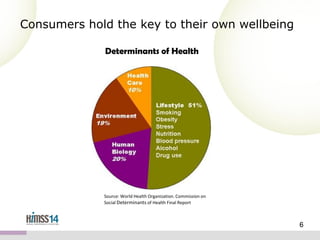
Consumers hold the key to their own wellbeing
Determinants of Health

Source: World Health Organization. Commission on
Social Determinants of Health Final Report

6

6
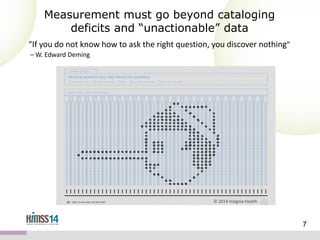
Measurement must go beyond cataloging
deficits and ā€œunactionableā€ data
ā€œIf you do not know how to ask the right question, you discover nothingā€
– W. Edward Deming

Ā© 2014 Insignia Health

7
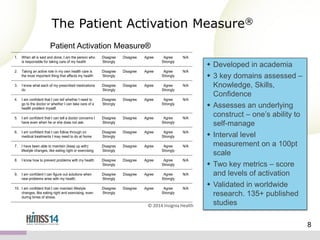
The Patient Activation MeasureĀ®
Patient Activation MeasureĀ®

Ā© 2014 Insignia Health

 Developed in academia
 3 key domains assessed –
Knowledge, Skills,
Confidence
 Assesses an underlying
construct – one’s ability to
self-manage
 Interval level
measurement on a 100pt
scale
 Two key metrics – score
and levels of activation
 Validated in worldwide
research. 135+ published
studies
8
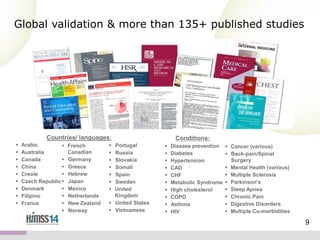
Global validation & more than 135+ published studies

Countries/ languages:
ļ‚§
ļ‚§
ļ‚§
ļ‚§
ļ‚§
ļ‚§
ļ‚§
ļ‚§
ļ‚§

Arabic
ļ‚§
Australia
ļ‚§
Canada
ļ‚§
China
ļ‚§
Creole
Czech Republic ļ‚§
ļ‚§
Denmark
ļ‚§
Filipino
ļ‚§
France
ļ‚§

French
Canadian
Germany
Greece
Hebrew
Japan
Mexico
Netherlands
New Zealand
Norway

ļ‚§
ļ‚§
ļ‚§
ļ‚§
ļ‚§
ļ‚§
ļ‚§

Portugal
Russia
Slovakia
Somali
Spain
Sweden
United
Kingdom
ļ‚§ United States
ļ‚§ Vietnamese

Conditions:
ļ‚§
ļ‚§
ļ‚§
ļ‚§
ļ‚§
ļ‚§
ļ‚§
ļ‚§
ļ‚§
ļ‚§

Disease prevention
Diabetes
Hypertension
CAD
CHF
Metabolic Syndrome
High cholesterol
COPD
Asthma
HIV

ļ‚§ Cancer (various)
ļ‚§ Back-pain/Spinal
Surgery
ļ‚§ Mental Health (various)
ļ‚§ Multiple Sclerosis
ļ‚§ Parkinson's
ļ‚§ Sleep Apnea
ļ‚§ Chronic Pain
ļ‚§ Digestive Disorders
ļ‚§ Multiple Co-morbidities

9
Activation is developmental

Ā© 2014 Insignia Health

Four levels of activation along a 100-point continuum

1215%

2025%

2530%

2025%

10
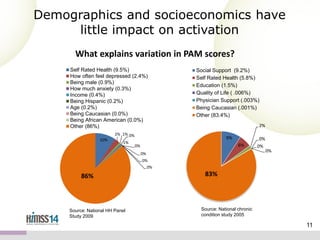
Demographics and socioeconomics have
little impact on activation
What explains variation in PAM scores?
Self Rated Health (9.5%)
How often feel depressed (2.4%)
Being male (0.9%)
How much anxiety (0.3%)
Income (0.4%)
Being Hispanic (0.2%)
Age (0.2%)
Being Caucasian (0.0%)
Being African American (0.0%)
Other (86%)
10%

Social Support (9.2%)
Self Rated Health (5.8%)
Education (1.5%)
Quality of Life ( .006%)
Physician Support (.003%)
Being Caucasian (.001%)
Other (83.4%)
2%

2% 1% 0%
1%

9%
6%

0%
0%

0%
0%

0%

0%
0%

86%

Source: National HH Panel
Study 2009

83%

Source: National chronic
condition study 2005

11
Adoption of PAM is broad
• Hospitals and health systems in 40 states
ACOs

Readmission prevention

Medical Homes

• National and regional health plans
Commercial

Medicare Advantage

Medicaid

• State Medicaid
Care Coordination Organizations

Health Homes

• Pharmaceutical firms

• Employers

12

12
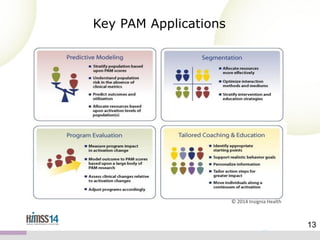
Key PAM Applications

Ā© 2014 Insignia Health

13

13
PAM Predictive Power – Medical Cost
Patients in the lower two PAM levels are at significantly
greater risk for high cost utilization
Medical Cost (billed) by Activation
Level
Level 1
$10,864

Level 2

Level 3

Level 4

$9,476
$7,758
$5,969

Hibbard, J. Greene, J., Overton, V. Patients With Lower Activation Associated With Higher
Costs; Delivery Systems Should Know Their Patients’ ā€˜Scores’. Health Affairs, February
2014

14
PAM levels guide the journey to best practice
self-management

Source: Hibbard National Study, Patients managing a chronic condition, N=1,544

15
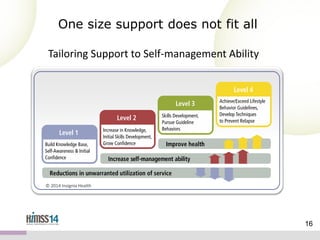
One size support does not fit all
Tailoring Support to Self-management Ability

Ā© 2014 Insignia Health

16
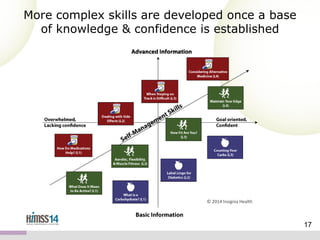
More complex skills are developed once a base
of knowledge & confidence is established

Ā© 2014 Insignia Health

17
PAM Applied in Telephonic Coaching
Coaching tailored to levels outperforms support that
emphasizes compliance with guidelines
ROI:
 ER visits declined 22%
 Readmissions declined 33%

 Increased adherence to
immunization and drug regimens
 Significantly greater drop in
diastolic BP

 Significantly greater drop in LDL

Hibbard, J, Green J, Tusler, M. Improving the Outcomes of Disease Management by Tailoring Care to
the Patient’s Level of Activation. The American Journal of Managed Care, V.15, 6. June 2009.

18
PAM Applied in a Medical Home
Allocating resource and tailoring support to activation levels
cuts ER use by nearly 50%
 ER/urgent care visits down
42% in 18 months
 Statistically significant
improvement in 8/10 clinical
measures
 Improved adherence
 Increase in controlled blood
pressure from 56% to 76%
 Improvement in A1c & LDL
 47% of patients improved
PAM scores
 24% increase in office
appointments
Source: PeaceHealth’s Team Filingame Uses Patient Activation Measure to
Customize the Medical Home, Center for the Health Professions Research Brief, May
2011

 Increased patient satisfaction
19
Using activation levels to allocate resources

Source: PeaceHealth’s Team Filingame Uses Patient Activation Measure to Customize the Medical Home,
Center for the Health Professions Research Brief, May 2011

20
Achieving STEPSā„¢ Objectives through
Activation
More activated patients = better health and lower utilization
ā–ŗ Know a patient’s level of activation to
improve interactions and outcomes
ā–ŗ Allocate resources to where the
return on activation is greatest
ā–ŗ Help the low activated access and
use information
ā–ŗ Tailor support and education to a
patient’s level of activation

ā–ŗ When activation increases Triple Aim
goals are realized

21
Questions?
Thank You.
Craig Swanson
cswanson@insigniahealth.com