



“Exercise is Medicine”Sponsored by:
Coming up?Dr. John Searle OBE         Prof. Alfonso Jimenez         Ben JonesSponsored by:
Panel DiscussionExercise is Medicine - Can it be done?
Case studiesWhat lessons do we take back to our business?Sponsored by:
What can exercise do in chronic disease?John SearleChief Medical Officer, FIAand Personal TrainerSponsored by:
Exercise in disease preventionCoronary artery disease / strokeObesity and type 2 diabetesDementiaDepressionSome cancersOsteoporosisSponsored by:
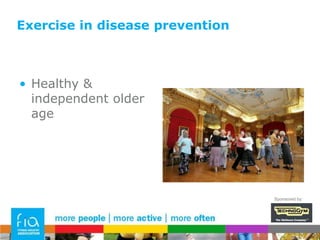
Exercise in disease preventionHealthy & independent older ageSponsored by:
Physical activity and seniors’ health care needsCanadian study 2010:24,281 65+ over  1 yearMean number of health visits:	Active = 8 Inactive = 11Active have shorter hospital stays and faster illness recovery timesSponsored by:
Physical activity levels for healthEvidence based guidance:ACSM 2011BASES 2010Start Active, Stay Active 2011Sponsored by:
Exercise in chronic diseaseRecommendations:Nice Guidelines: non-specificACSM’s Exercise Management for Persons with Chronic Disease (2009)Swedish National Institute of Health, Physical Activity in the Prevention and Treatment of Disease (2010)Sponsored by:
Which diseases are we talking about?Osteoarthritis (OA)Rheumatoid arthritis (RA)Ankylosing spondylitisFibromyalgiaCoronary artery diseaseHypertensionStrokeObesity & type 2 DMAsthmaCOPDParkinson’s diseaseMultiple sclerosisBreast and bowel cancerDepressionSponsored by:
Review articleKujala UM, Evidence of the effects of exercise therapy  in the treatment of chronic disease. Br J Sports Med 2009; 43: 550-555.Sponsored by:
But it was not always like this!Sponsored by:
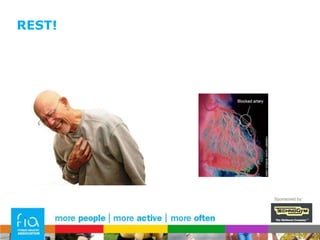
REST!Sponsored by:
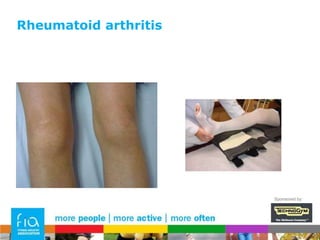
Rheumatoid arthritisSponsored by:
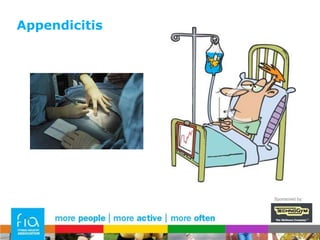
AppendicitisSponsored by:
ObjectivesTo achieve:An active life style & a sustainable increase in physical activityImprovement in symptomsReduction in the rate of disease progressionSponsored by:
But is it risky?Greater risk not to exerciseGraded progressionSupervision and monitoringProper precautionsSponsored by:
Does it work?Cardiovascular diseaseRheumatoid arthritisDepressionSponsored by:
Coronary artery diseaseNational Exercise Referral Scheme in Wales (2010)Increased levels of physical activity at 12 monthsPositive effects on depression and anxietyCost effectiveSponsored by:
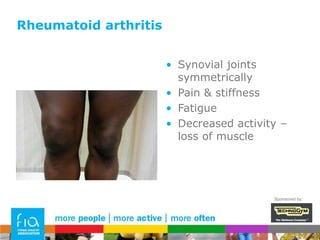
Rheumatoid arthritisSynovial joints symmetricallyPain & stiffnessFatigueDecreased activity –loss of muscleSponsored by:
What does exercise achieve in RA?Literature summary:Increases aerobic capacityIncrease in muscle strength and lean body massIncrease in exercise enduranceWeight controlImproved quality of lifeSponsored by:
And it really does work!Sponsored by:
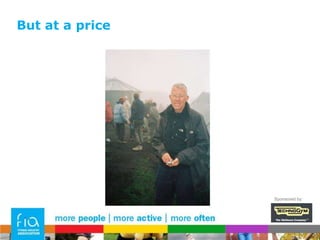
But at a priceSponsored by:
Depression: exercise and mental healthMental Health Foundation:less tension, stress and mental fatiguea natural energy boostimproved sleepa sense of achievementfocus in life and motivationless anger or frustrationa healthy appetitebetter social lifehaving fun.Sponsored by:
Cancer: case study82 year old manPreviously well, played golf twice a weekDecember 2010 cancer in the mouth6 months aggressive chemotherapySerious weight loss, lethargy, loss of appetiteSponsored by:
Cancer: case studyExercise programme at home, June 2011Gradual increase in daily walkingResistance bands – progressionStretching and motor skillsHealthy eatingLass week: 18 holes of golfSponsored by:
So what?Exercise plays a vital in role as part of the management of chronic diseaseBut how do you do it?Sponsored by:
The Importance of Measurement in Exercise ReferralBen Jones, Blue skies FitnessSponsored by:
OverviewThe business of exercise referralVARTEC – a reminderDeciding what to measureSponsored by:
Not so NICENICE recommendation 2006:…insufficient evidence to recommend the use of exercise referral schemes other than as part of research studies where effectiveness can be evaluated…Sponsored by:
The business of exercise referralPublic money typically PCT/LA fundedEstablishing what represents ROIDesired outcomesKey Performance IndicatorsThe need to measure & monitorSponsored by:
VARTECValidityAccuracyReliabilityTime efficientEquipment considerationsCost comparisonSponsored by:
ValidityDoes the measurement pass the Ronseal test?Who’s responsibility is it to measure the effectiveness of an ER scheme?Financial impactClinical effectivenessAnthropological risk factorsLifestyle risk factorsPsychological/QOLSponsored by:
Accuracy/ReliabilityDetermined by a number of factors that need to be controlled adequately in an exercise referral schemeEquipment qualityEquipment consistencyEquipment maintenanceSuitability of environmentStandardised testing protocol usedConsistency of person testingRecord keeping & confidentialitySponsored by:
Time/Equipment/CostAll come down to the same issueTests must be efficient and cost-effective to deliver without sacrificing validity or accuracy of measurementsDoes this answer the ‘who’ question?Clinical tests must be conducted by GP/SpecialistAnthropological tests/questionnaires can be administered by appropriately trained fitness professionalsSponsored by:
What to measureDecision starts with the Validity question – why are we measuring?Requires us to first answer the question – Who are we measuring for?PatientFitness ProfessionalDoctorCommissionerGreater medical/scientific community? The future? All of us?Sponsored by:
What to measure for the patientPatient wants to know…Is exercise worth the time & effort?!How can we influence them to conclude ‘yes’Demonstrate reduced pain/signs/symptoms?Demonstrate reduction in disease markers? – clinicalDemonstrate improvement in general health? – bothDemonstrate personal achievement/improved functional fitnessSponsored by:
What to measure - fitness professionalIs the exercise programme effective?How can we determine yes/no?How well have they adhered to it?Has the patient progressed toward their individual goals?Does the patient have a measurable improvement in function?Does the patient have a measurable improvement in health?Is the programme sustainable for the patient?Do they have a robust action plan to continue to be active?Sponsored by:
What to measure for the DoctorHas the patient’s chronic condition improved or shown slowed progress?Have signs/symptoms or risk factors of other conditions reduced?Are patients more active than baseline at 6, 12, 24+ months?Sponsored by:
What to measure for the DoctorHow can we determine yes/no?Improved clinical markersImproved signs or symptoms of comorbiditiesImproved predictors of risk for comorbiditiesIncrease in long term moderate-vigorous PA behaviourSponsored by:
What to measure for commissionersThe easier it is to demonstrate ROI the better…Challenge – we don’t have direct access to the data that shows this:Decrease in frequency of visits to GP and other NHS servicesReduced dosages of medicationsReduced need for surgical interventionsCo-morbid conditions preventedSponsored by:
What to measure for commissionersAttendance/adherenceAnthropological predictors of chronic conditionsPsychological/QOL questionnairesLong-term follow-up of patient’s activity levels (questionnaires)Sponsored by:
What to measure - future developmentAs much as possible, in a standardised format that can be compared in a meaningful way across schemes to evaluate effectivenessWhy?To allow controlled adaptation and comparison of scheme variables and development of increasingly effective & targeted exercise referral servicesSponsored by:

Exercise is Medicine

  • 1.
  • 2.
    Coming up?Dr. JohnSearle OBE Prof. Alfonso Jimenez Ben JonesSponsored by:
  • 3.
    Panel DiscussionExercise isMedicine - Can it be done?
  • 4.
    Case studiesWhat lessonsdo we take back to our business?Sponsored by:
  • 5.
    What can exercisedo in chronic disease?John SearleChief Medical Officer, FIAand Personal TrainerSponsored by:
  • 6.
    Exercise in diseasepreventionCoronary artery disease / strokeObesity and type 2 diabetesDementiaDepressionSome cancersOsteoporosisSponsored by:
  • 7.
    Exercise in diseasepreventionHealthy & independent older ageSponsored by:
  • 8.
    Physical activity andseniors’ health care needsCanadian study 2010:24,281 65+ over 1 yearMean number of health visits: Active = 8 Inactive = 11Active have shorter hospital stays and faster illness recovery timesSponsored by:
  • 9.
    Physical activity levelsfor healthEvidence based guidance:ACSM 2011BASES 2010Start Active, Stay Active 2011Sponsored by:
  • 10.
    Exercise in chronicdiseaseRecommendations:Nice Guidelines: non-specificACSM’s Exercise Management for Persons with Chronic Disease (2009)Swedish National Institute of Health, Physical Activity in the Prevention and Treatment of Disease (2010)Sponsored by:
  • 11.
    Which diseases arewe talking about?Osteoarthritis (OA)Rheumatoid arthritis (RA)Ankylosing spondylitisFibromyalgiaCoronary artery diseaseHypertensionStrokeObesity & type 2 DMAsthmaCOPDParkinson’s diseaseMultiple sclerosisBreast and bowel cancerDepressionSponsored by:
  • 12.
    Review articleKujala UM,Evidence of the effects of exercise therapy in the treatment of chronic disease. Br J Sports Med 2009; 43: 550-555.Sponsored by:
  • 13.
    But it wasnot always like this!Sponsored by:
  • 14.
  • 15.
  • 16.
  • 17.
    ObjectivesTo achieve:An activelife style & a sustainable increase in physical activityImprovement in symptomsReduction in the rate of disease progressionSponsored by:
  • 18.
    But is itrisky?Greater risk not to exerciseGraded progressionSupervision and monitoringProper precautionsSponsored by:
  • 19.
    Does it work?CardiovasculardiseaseRheumatoid arthritisDepressionSponsored by:
  • 20.
    Coronary artery diseaseNationalExercise Referral Scheme in Wales (2010)Increased levels of physical activity at 12 monthsPositive effects on depression and anxietyCost effectiveSponsored by:
  • 21.
    Rheumatoid arthritisSynovial jointssymmetricallyPain & stiffnessFatigueDecreased activity –loss of muscleSponsored by:
  • 22.
    What does exerciseachieve in RA?Literature summary:Increases aerobic capacityIncrease in muscle strength and lean body massIncrease in exercise enduranceWeight controlImproved quality of lifeSponsored by:
  • 23.
    And it reallydoes work!Sponsored by:
  • 24.
    But at apriceSponsored by:
  • 25.
    Depression: exercise andmental healthMental Health Foundation:less tension, stress and mental fatiguea natural energy boostimproved sleepa sense of achievementfocus in life and motivationless anger or frustrationa healthy appetitebetter social lifehaving fun.Sponsored by:
  • 26.
    Cancer: case study82year old manPreviously well, played golf twice a weekDecember 2010 cancer in the mouth6 months aggressive chemotherapySerious weight loss, lethargy, loss of appetiteSponsored by:
  • 27.
    Cancer: case studyExerciseprogramme at home, June 2011Gradual increase in daily walkingResistance bands – progressionStretching and motor skillsHealthy eatingLass week: 18 holes of golfSponsored by:
  • 28.
    So what?Exercise playsa vital in role as part of the management of chronic diseaseBut how do you do it?Sponsored by:
  • 29.
    The Importance ofMeasurement in Exercise ReferralBen Jones, Blue skies FitnessSponsored by:
  • 30.
    OverviewThe business ofexercise referralVARTEC – a reminderDeciding what to measureSponsored by:
  • 31.
    Not so NICENICErecommendation 2006:…insufficient evidence to recommend the use of exercise referral schemes other than as part of research studies where effectiveness can be evaluated…Sponsored by:
  • 32.
    The business ofexercise referralPublic money typically PCT/LA fundedEstablishing what represents ROIDesired outcomesKey Performance IndicatorsThe need to measure & monitorSponsored by:
  • 33.
  • 34.
    ValidityDoes the measurementpass the Ronseal test?Who’s responsibility is it to measure the effectiveness of an ER scheme?Financial impactClinical effectivenessAnthropological risk factorsLifestyle risk factorsPsychological/QOLSponsored by:
  • 35.
    Accuracy/ReliabilityDetermined by anumber of factors that need to be controlled adequately in an exercise referral schemeEquipment qualityEquipment consistencyEquipment maintenanceSuitability of environmentStandardised testing protocol usedConsistency of person testingRecord keeping & confidentialitySponsored by:
  • 36.
    Time/Equipment/CostAll come downto the same issueTests must be efficient and cost-effective to deliver without sacrificing validity or accuracy of measurementsDoes this answer the ‘who’ question?Clinical tests must be conducted by GP/SpecialistAnthropological tests/questionnaires can be administered by appropriately trained fitness professionalsSponsored by:
  • 37.
    What to measureDecisionstarts with the Validity question – why are we measuring?Requires us to first answer the question – Who are we measuring for?PatientFitness ProfessionalDoctorCommissionerGreater medical/scientific community? The future? All of us?Sponsored by:
  • 38.
    What to measurefor the patientPatient wants to know…Is exercise worth the time & effort?!How can we influence them to conclude ‘yes’Demonstrate reduced pain/signs/symptoms?Demonstrate reduction in disease markers? – clinicalDemonstrate improvement in general health? – bothDemonstrate personal achievement/improved functional fitnessSponsored by:
  • 39.
    What to measure- fitness professionalIs the exercise programme effective?How can we determine yes/no?How well have they adhered to it?Has the patient progressed toward their individual goals?Does the patient have a measurable improvement in function?Does the patient have a measurable improvement in health?Is the programme sustainable for the patient?Do they have a robust action plan to continue to be active?Sponsored by:
  • 40.
    What to measurefor the DoctorHas the patient’s chronic condition improved or shown slowed progress?Have signs/symptoms or risk factors of other conditions reduced?Are patients more active than baseline at 6, 12, 24+ months?Sponsored by:
  • 41.
    What to measurefor the DoctorHow can we determine yes/no?Improved clinical markersImproved signs or symptoms of comorbiditiesImproved predictors of risk for comorbiditiesIncrease in long term moderate-vigorous PA behaviourSponsored by:
  • 42.
    What to measurefor commissionersThe easier it is to demonstrate ROI the better…Challenge – we don’t have direct access to the data that shows this:Decrease in frequency of visits to GP and other NHS servicesReduced dosages of medicationsReduced need for surgical interventionsCo-morbid conditions preventedSponsored by:
  • 43.
    What to measurefor commissionersAttendance/adherenceAnthropological predictors of chronic conditionsPsychological/QOL questionnairesLong-term follow-up of patient’s activity levels (questionnaires)Sponsored by:
  • 44.
    What to measure- future developmentAs much as possible, in a standardised format that can be compared in a meaningful way across schemes to evaluate effectivenessWhy?To allow controlled adaptation and comparison of scheme variables and development of increasingly effective & targeted exercise referral servicesSponsored by: