Creating value through patient
support programs
Adopting a patient-centric approach to strategy &
operations in pharma
Ashley Ocvirk
Senior Analyst
SKIM Group
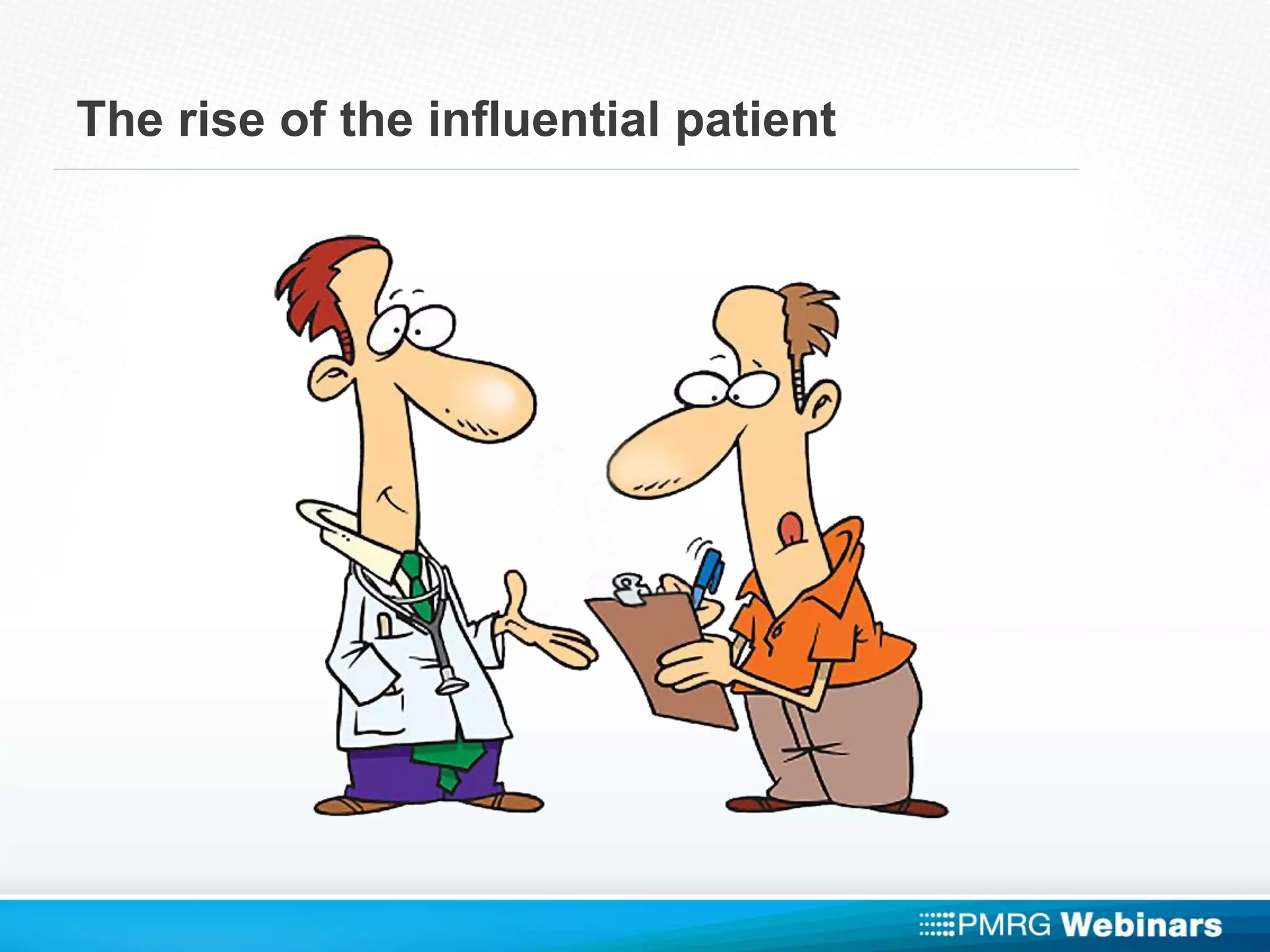
The rise of the influential patient
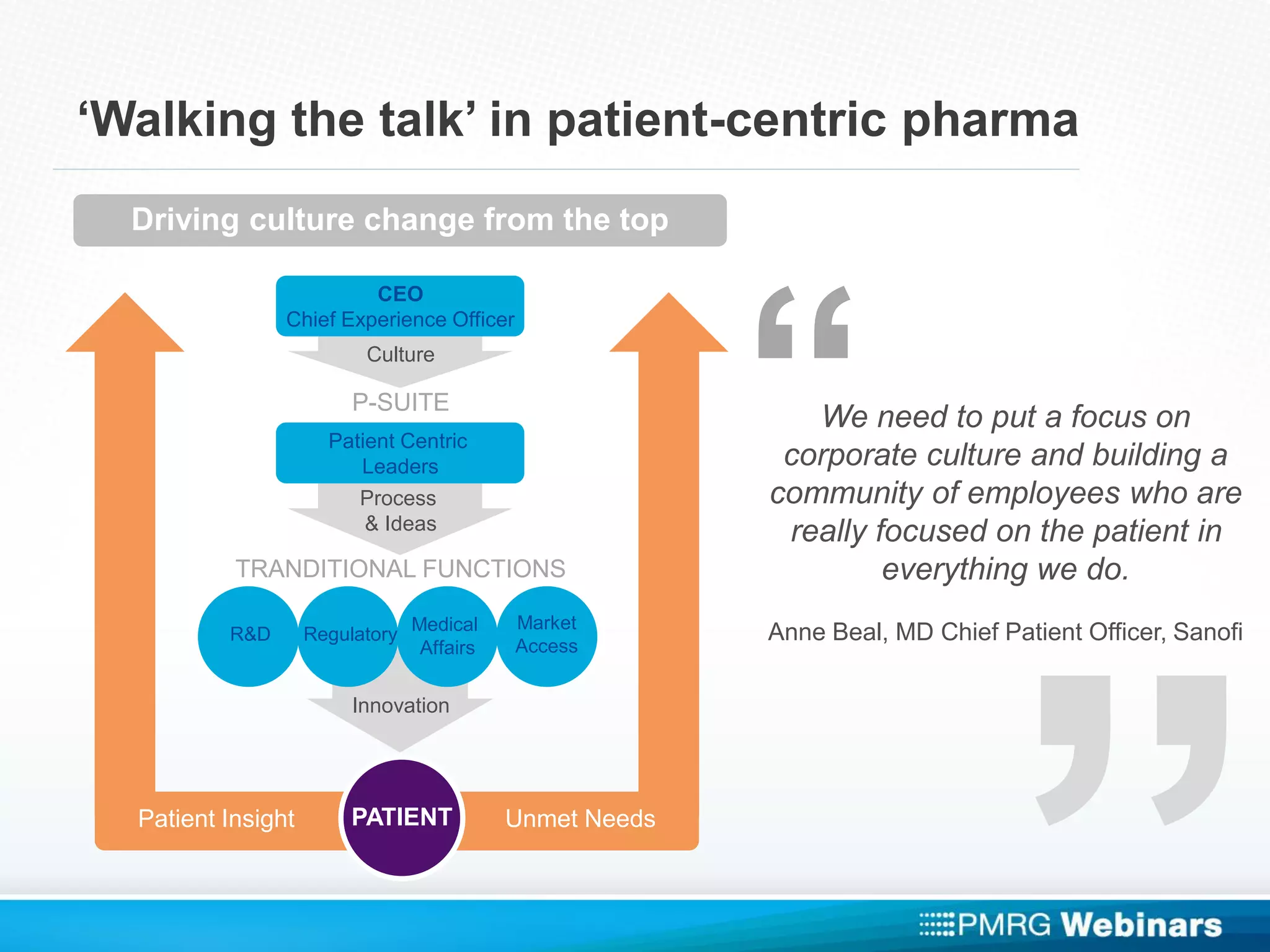
‘Walking the talk’ in patient-centric pharma
We need to put a focus on
corporate culture and building a
community of employees who are
really focused on the patient in
everything we do.
Anne Beal, MD Chief Patient Officer, Sanofi
Driving culture change from the top
CEO
Chief Experience Officer
Patient Centric
Leaders
Culture
Process
& Ideas
P-SUITE
TRANDITIONAL FUNCTIONS
R&D Regulatory
Medical
Affairs
Market
Access
PATIENTPatient Insight Unmet Needs
“
Innovation
Outline
Patient Support
Programs Background
Market Research
Framework
Case studies
Background
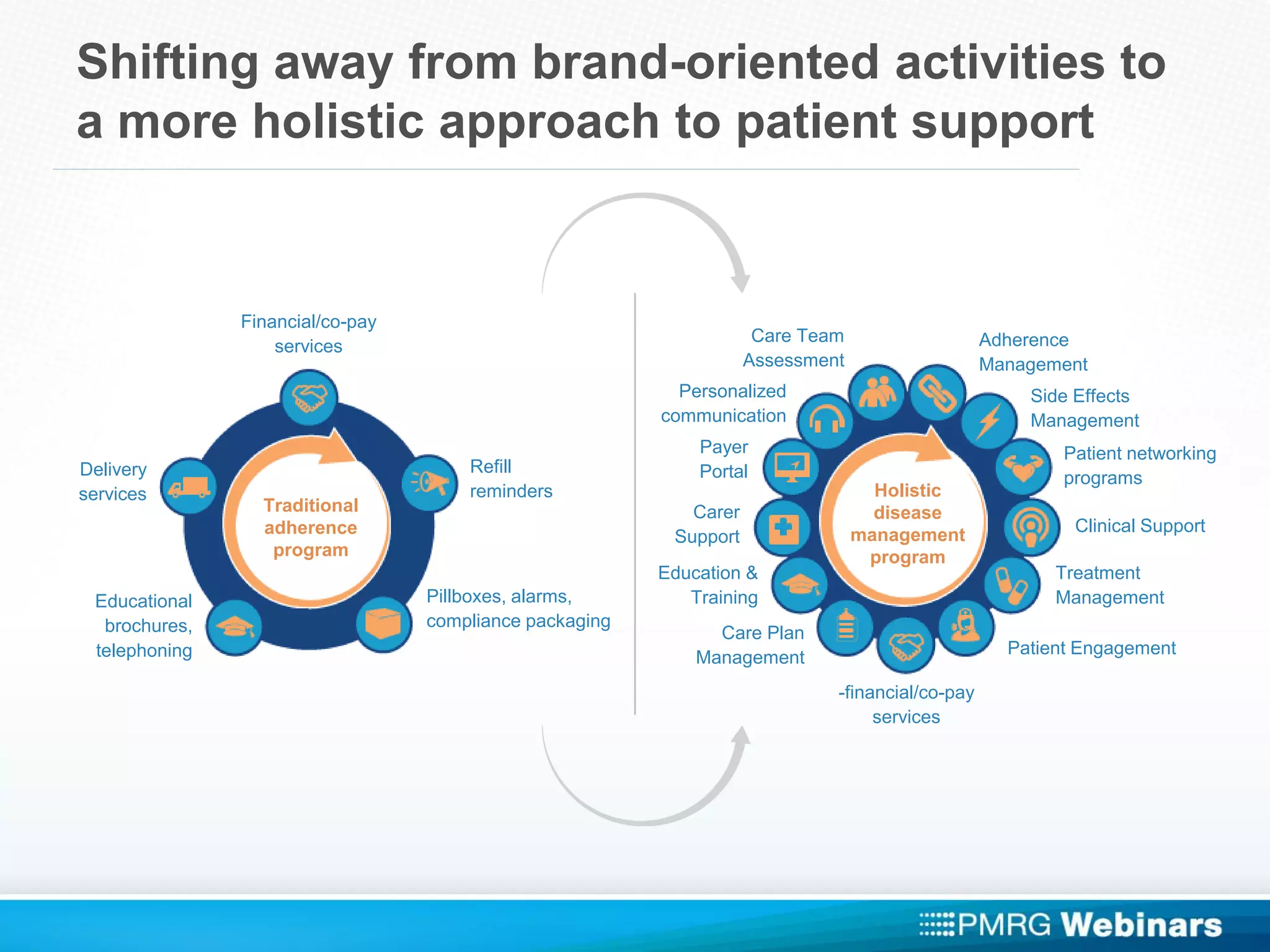
Shifting away from brand-oriented activities to
a more holistic approach to patient support
Traditional
adherence
program
Refill
reminders
Pillboxes, alarms,
compliance packaging
Educational
brochures,
telephoning
Delivery
services
Financial/co-pay
services
Holistic
disease
management
program
Care Team
Assessment
Payer
Portal
Carer
Support
Care Plan
Management
Education &
Training
Patient Engagement
-financial/co-pay
services
Adherence
Management
Side Effects
Management
Clinical Support
Personalized
communication
Treatment
Management
Patient networking
programs
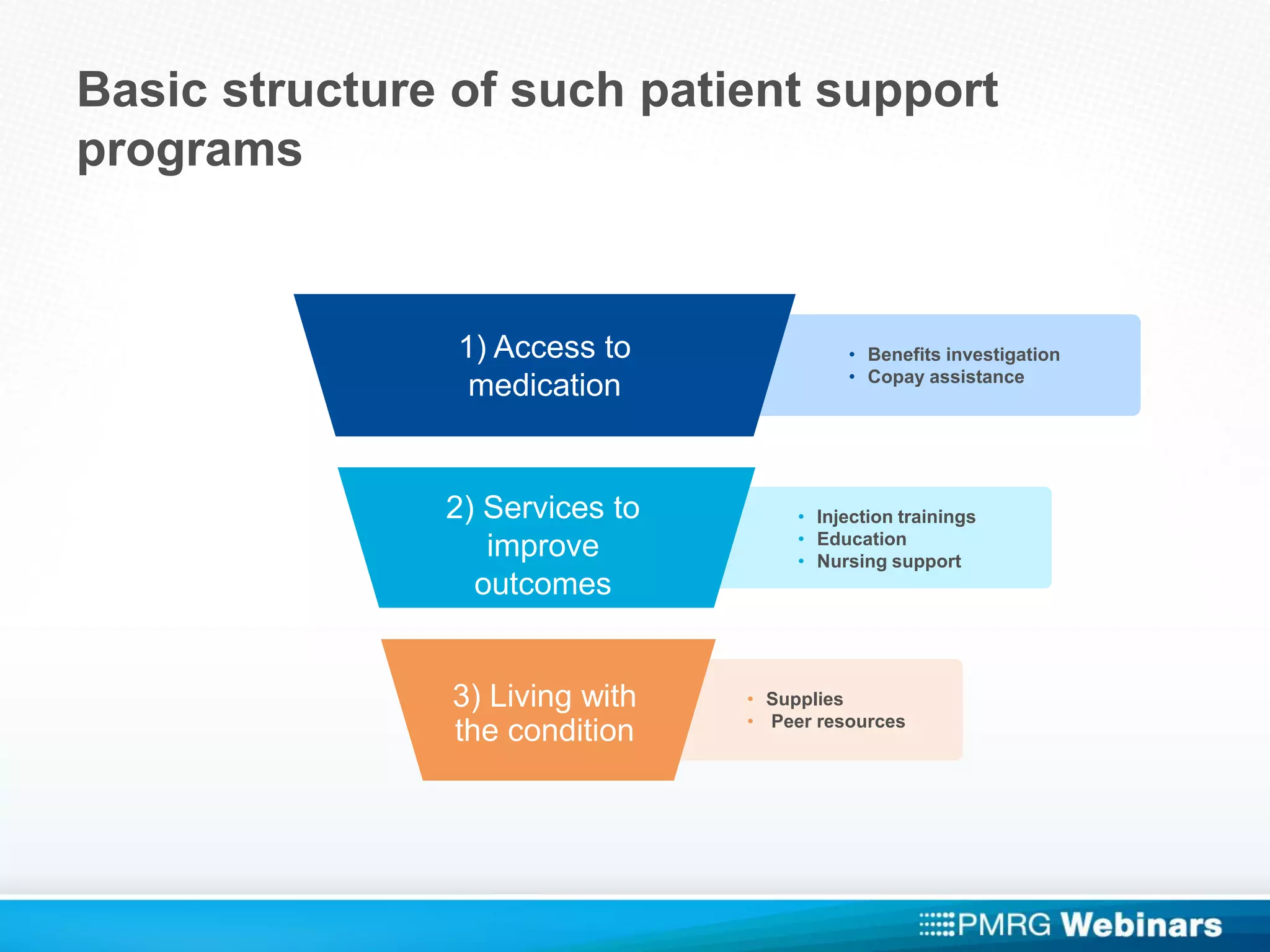
Basic structure of such patient support
programs
• Benefits investigation
• Copay assistance
• Injection trainings
• Education
• Nursing support
• Supplies
• Peer resources
1) Access to
medication
2) Services to
improve
outcomes
3) Living with
the condition
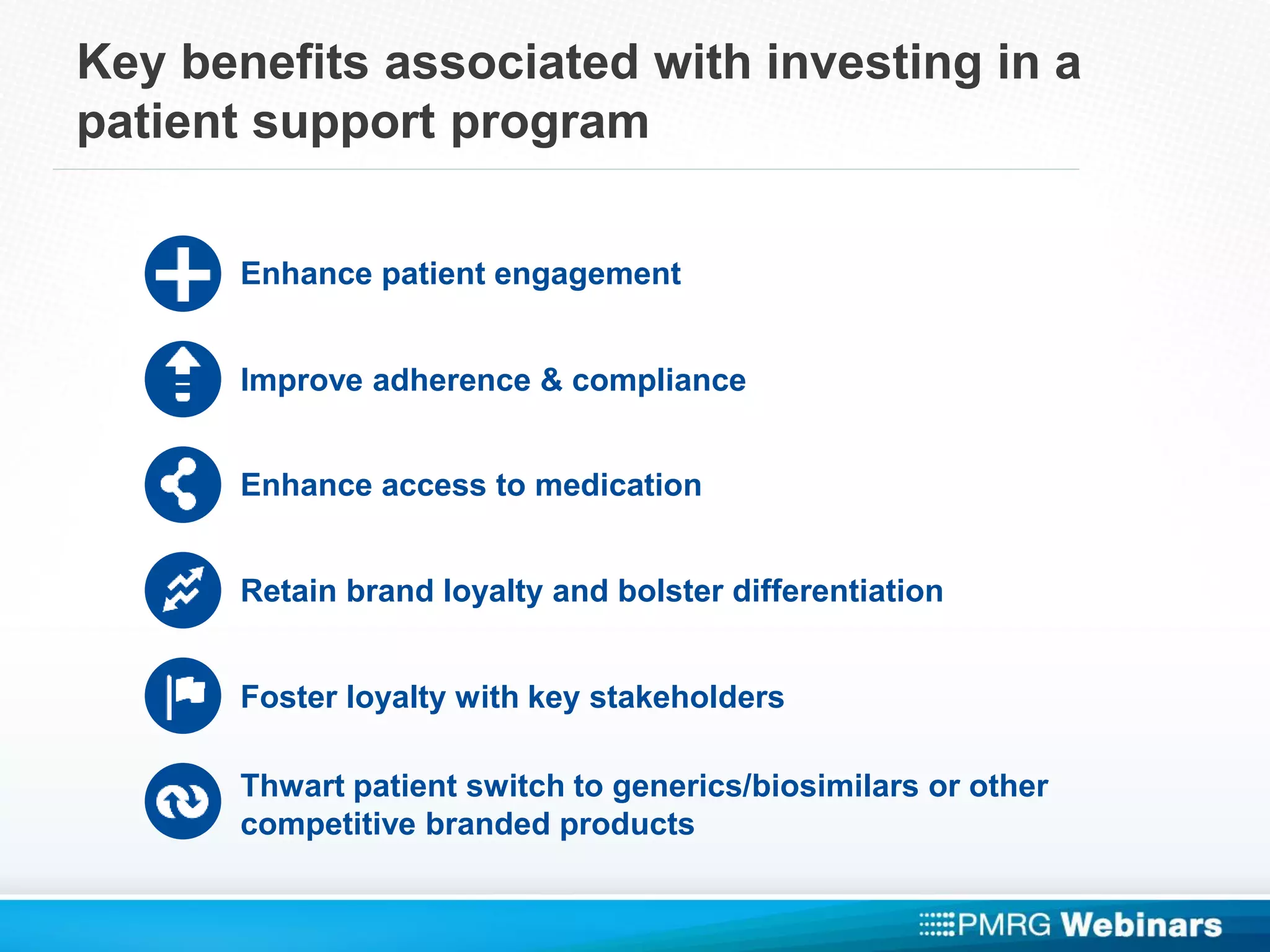
Key benefits associated with investing in a
patient support program
Enhance patient engagement
Improve adherence & compliance
Enhance access to medication
Retain brand loyalty and bolster differentiation
Foster loyalty with key stakeholders
Thwart patient switch to generics/biosimilars or other
competitive branded products
An opportunity for patient support initiatives to
step in and help
Nobody ever went to school to be a patient,
but suddenly, upon diagnosis you have
multiple instructions to manage your disease
including appointments, tests, monitoring,
diaries, and dealing with all of the emotions.
“
”-Andrew Schorr from the cancer advocacy
group, Patient Power
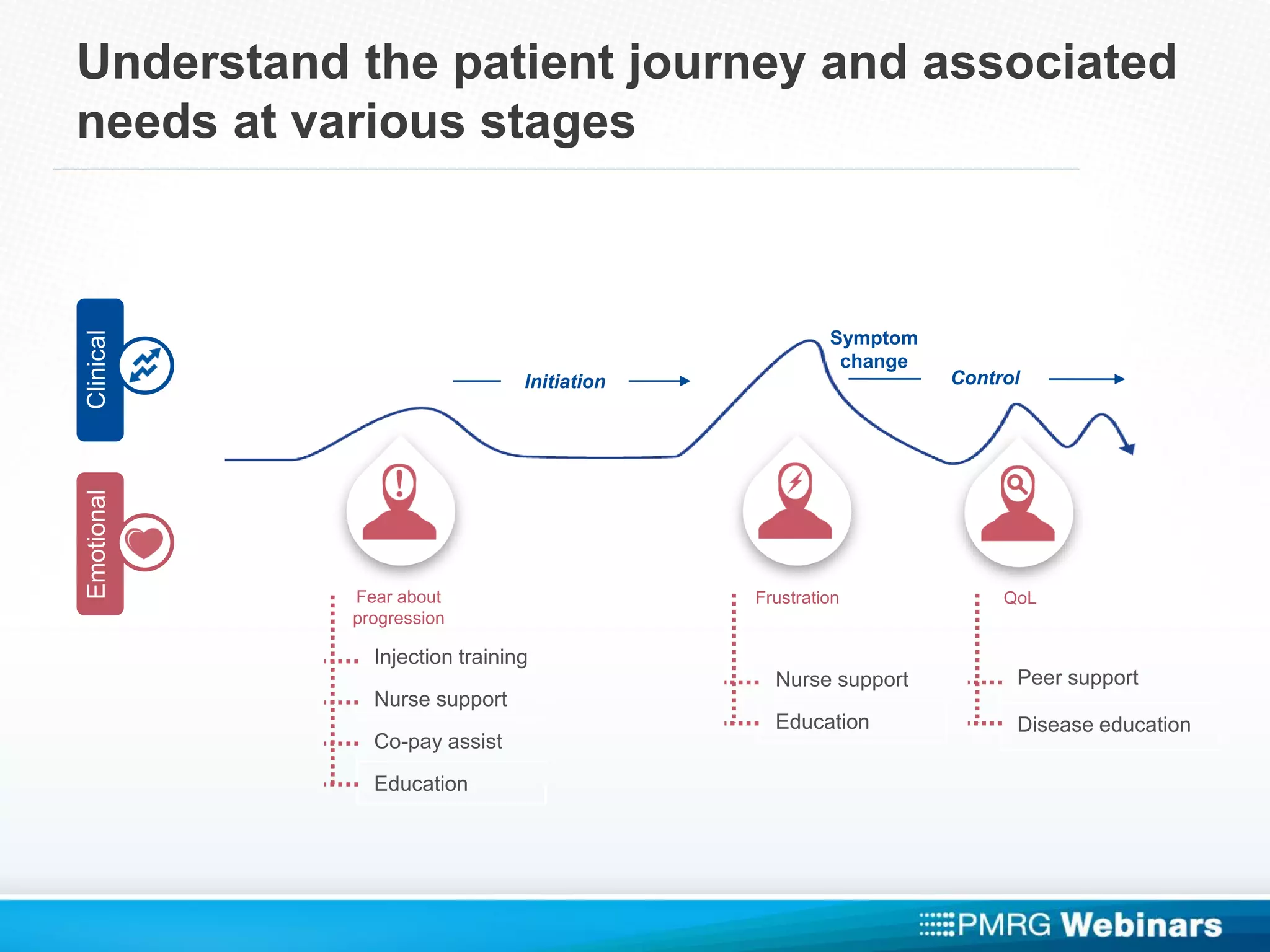
Understand the patient journey and associated
needs at various stages
Initiation Control
QoLFrustration
Symptom
change
Fear about
progression
Injection training
Nurse support
Co-pay assist
Education
Nurse support
Education
Peer support
Disease education
EmotionalClinical
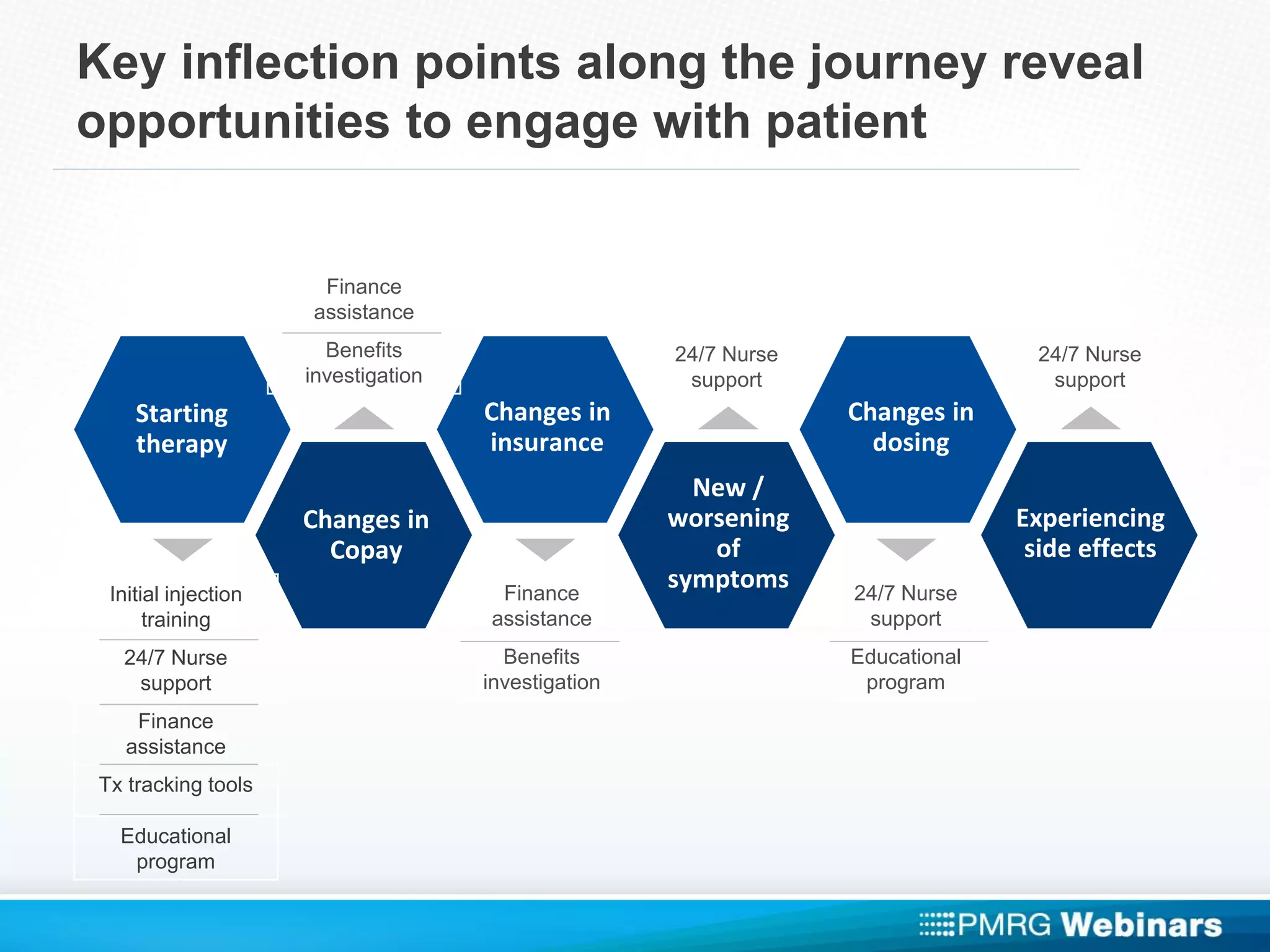
Key inflection points along the journey reveal
opportunities to engage with patient
Starting
therapy
Changes in
Copay
Experiencing
side effects
Changes in
dosing
Changes in
insurance
New /
worsening
of
symptomsInitial injection
training
24/7 Nurse
support
Finance
assistance
Tx tracking tools
Educational
program
Finance
assistance
Benefits
investigation
24/7 Nurse
support
24/7 Nurse
support
Educational
program
24/7 Nurse
support
Finance
assistance
Benefits
investigation
Market Research
Framework
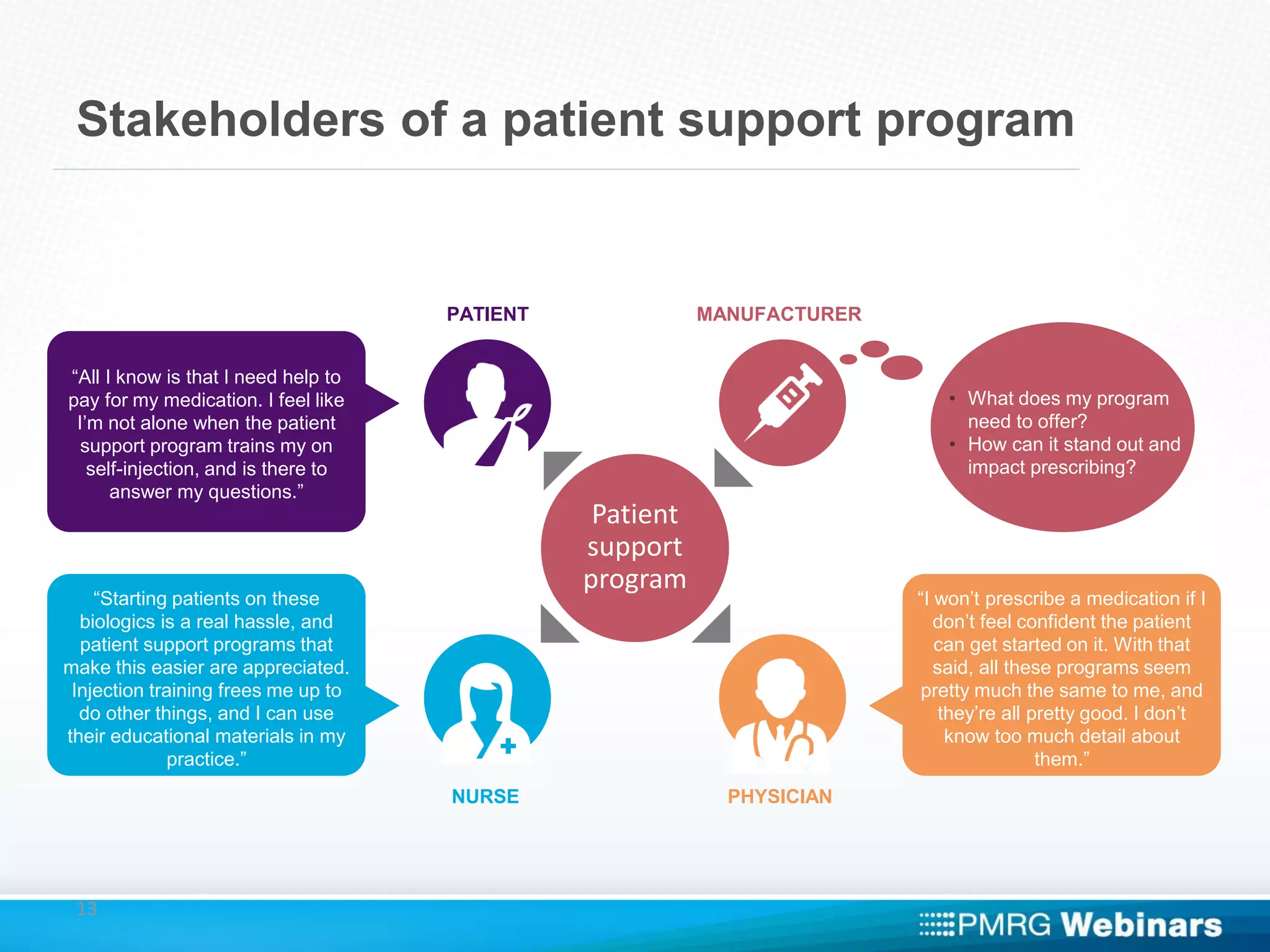
Stakeholders of a patient support program
13
Patient
support
program
“All I know is that I need help to
pay for my medication. I feel like
I’m not alone when the patient
support program trains my on
self-injection, and is there to
answer my questions.”
“Starting patients on these
biologics is a real hassle, and
patient support programs that
make this easier are appreciated.
Injection training frees me up to
do other things, and I can use
their educational materials in my
practice.”
• What does my program
need to offer?
• How can it stand out and
impact prescribing?
“I won’t prescribe a medication if I
don’t feel confident the patient
can get started on it. With that
said, all these programs seem
pretty much the same to me, and
they’re all pretty good. I don’t
know too much detail about
them.”
PATIENT MANUFACTURER
NURSE PHYSICIAN
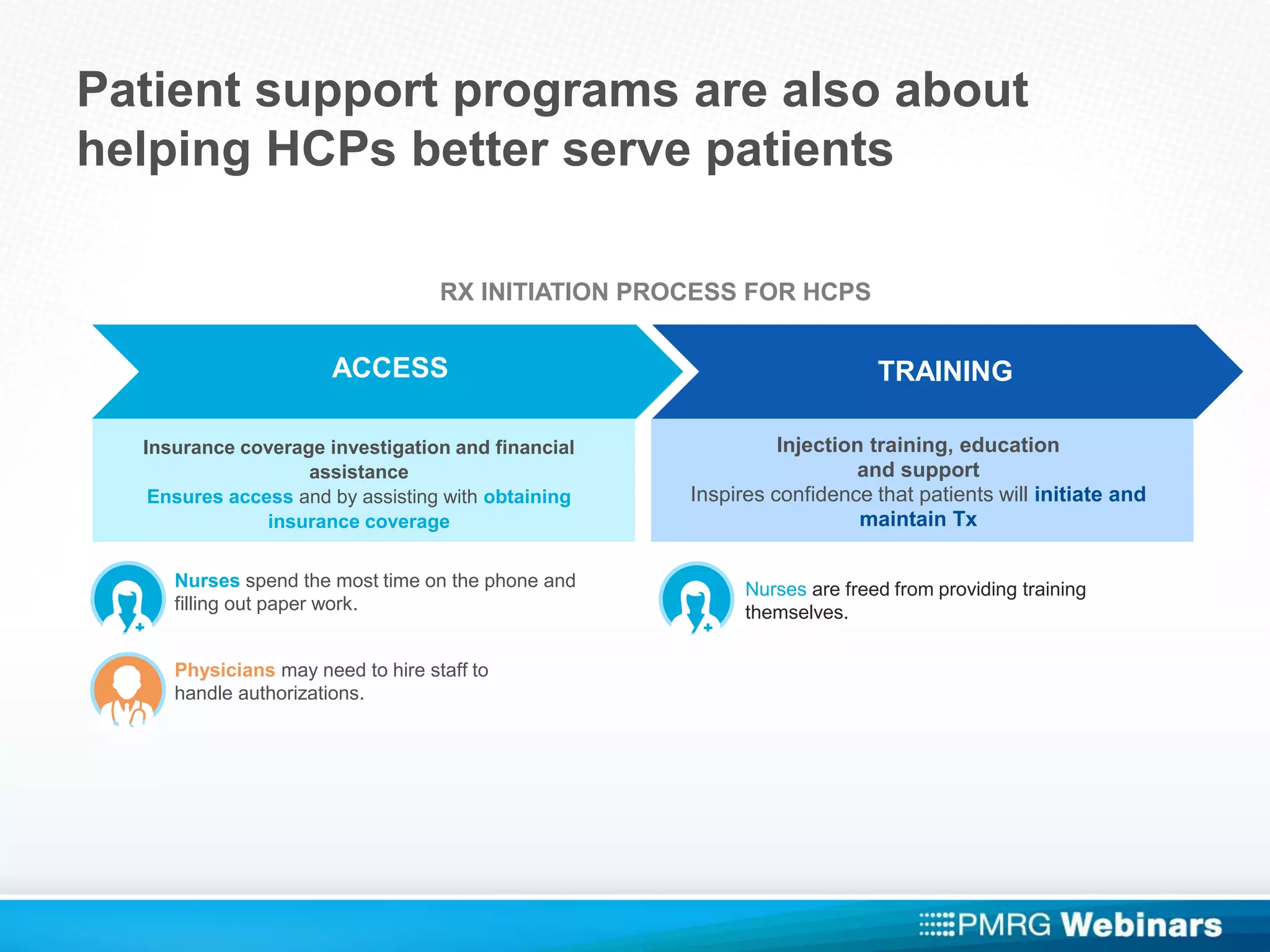
Patient support programs are also about
helping HCPs better serve patients
RX INITIATION PROCESS FOR HCPS
ACCESS TRAINING
Insurance coverage investigation and financial
assistance
Ensures access and by assisting with obtaining
insurance coverage
Injection training, education
and support
Inspires confidence that patients will initiate and
maintain Tx
Nurses spend the most time on the phone and
filling out paper work.
Physicians may need to hire staff to
handle authorizations.
Nurses are freed from providing training
themselves.
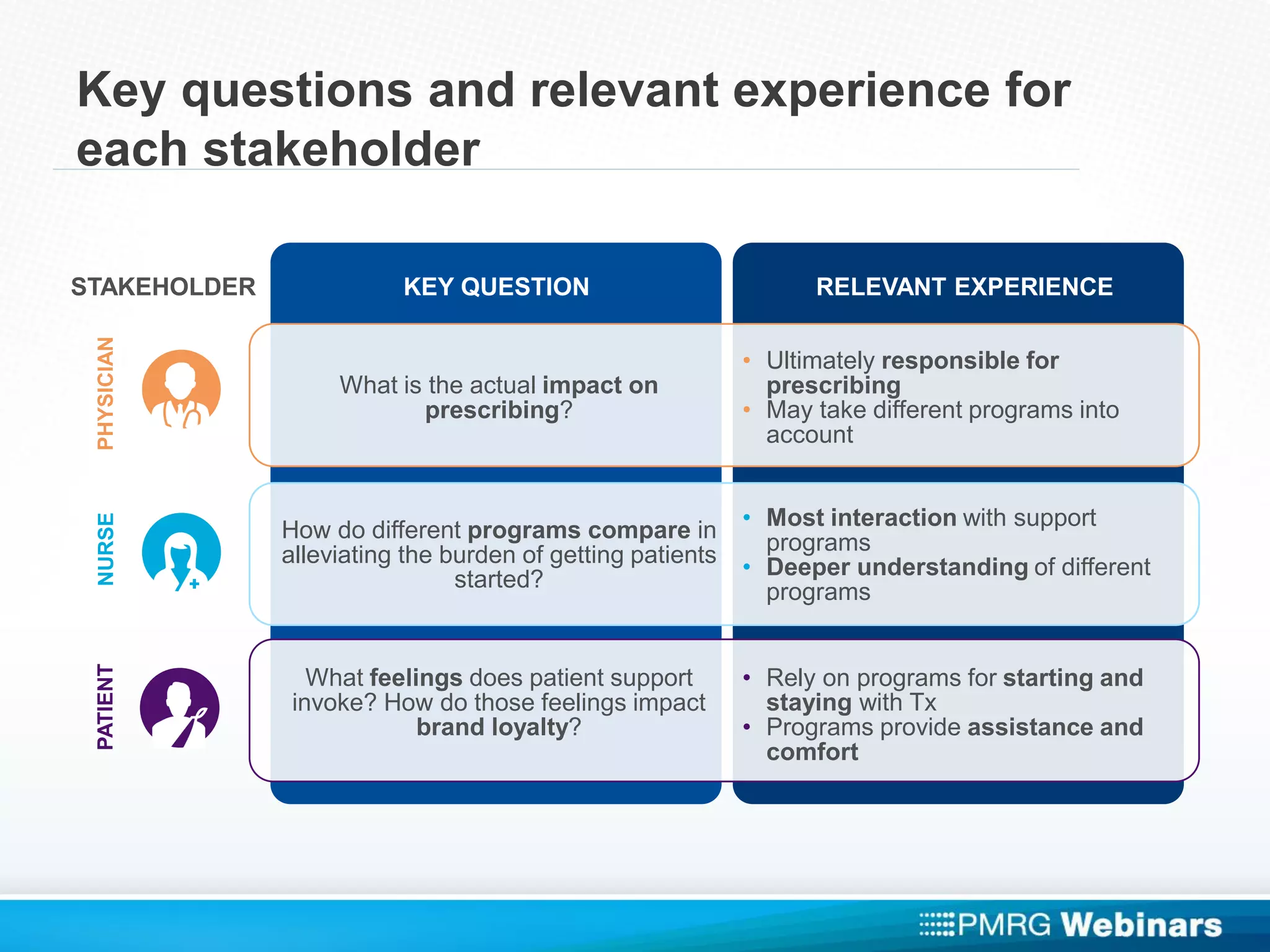
Key questions and relevant experience for
each stakeholder
KEY QUESTION RELEVANT EXPERIENCE
PHYSICIAN
STAKEHOLDER
PATIENTNURSE
What is the actual impact on
prescribing?
• Ultimately responsible for
prescribing
• May take different programs into
account
How do different programs compare in
alleviating the burden of getting patients
started?
• Most interaction with support
programs
• Deeper understanding of different
programs
What feelings does patient support
invoke? How do those feelings impact
brand loyalty?
• Rely on programs for starting and
staying with Tx
• Programs provide assistance and
comfort
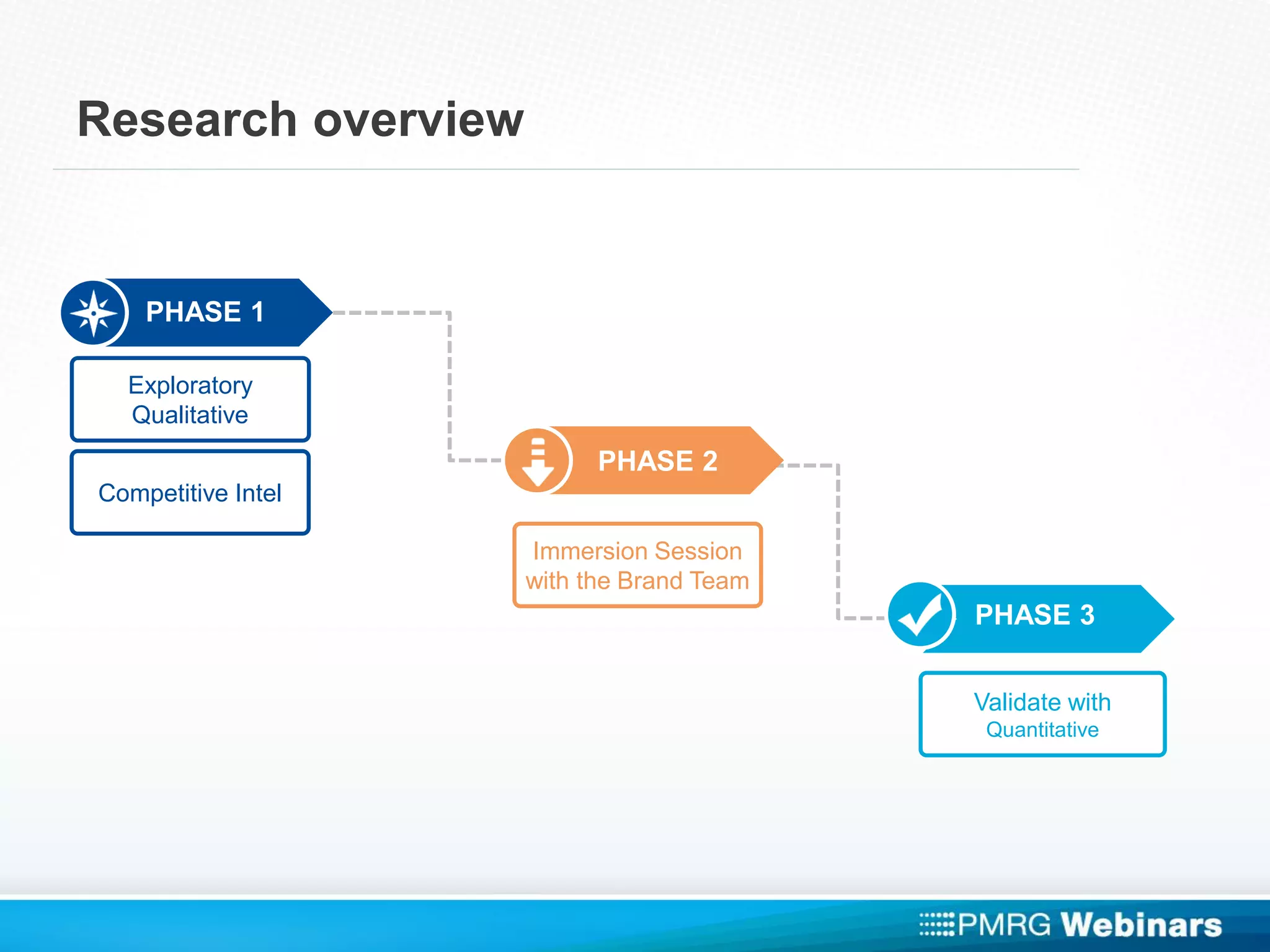
Research overview
PHASE 1
PHASE 2
PHASE 3
Exploratory
Qualitative
Immersion Session
with the Brand Team
Validate with
Quantitative
Competitive Intel
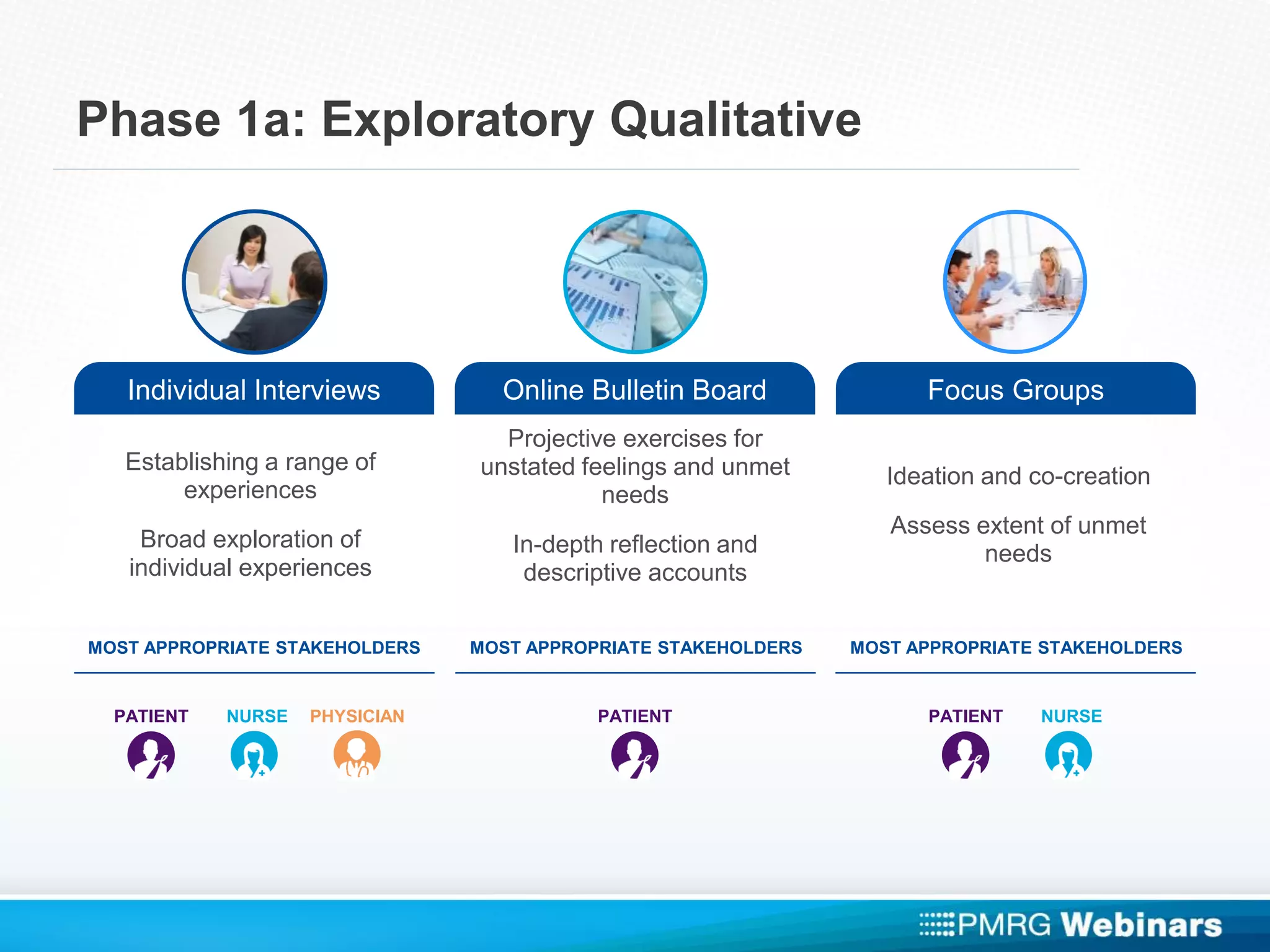
Phase 1a: Exploratory Qualitative
Individual Interviews Online Bulletin Board Focus Groups
Establishing a range of
experiences
Broad exploration of
individual experiences
Projective exercises for
unstated feelings and unmet
needs
In-depth reflection and
descriptive accounts
Ideation and co-creation
Assess extent of unmet
needs
MOST APPROPRIATE STAKEHOLDERS MOST APPROPRIATE STAKEHOLDERS MOST APPROPRIATE STAKEHOLDERS
PATIENT NURSE PHYSICIAN PATIENT NURSEPATIENT
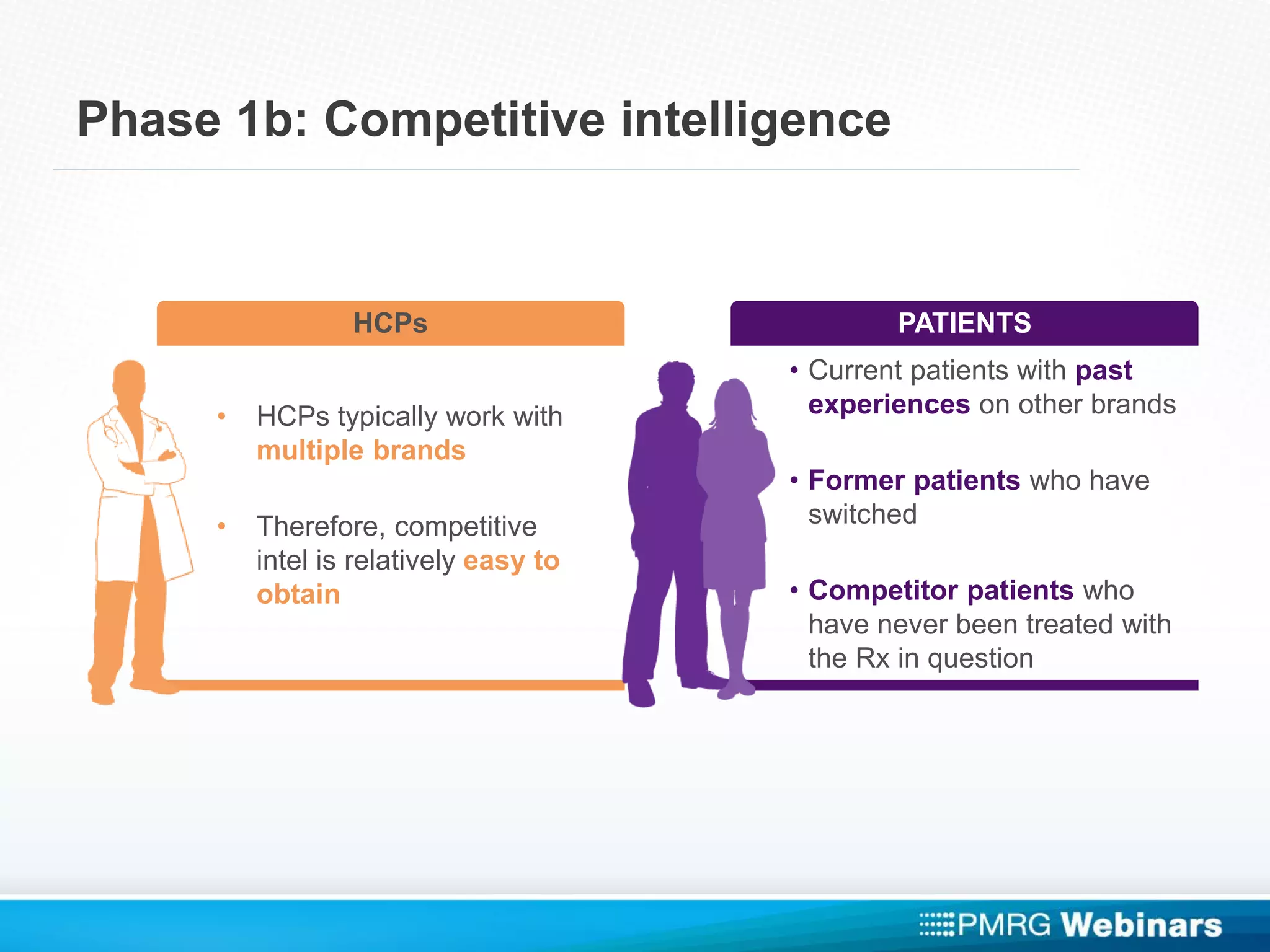
Phase 1b: Competitive intelligence
• HCPs typically work with
multiple brands
• Therefore, competitive
intel is relatively easy to
obtain
• Current patients with past
experiences on other brands
• Former patients who have
switched
• Competitor patients who
have never been treated with
the Rx in question
HCPs PATIENTS
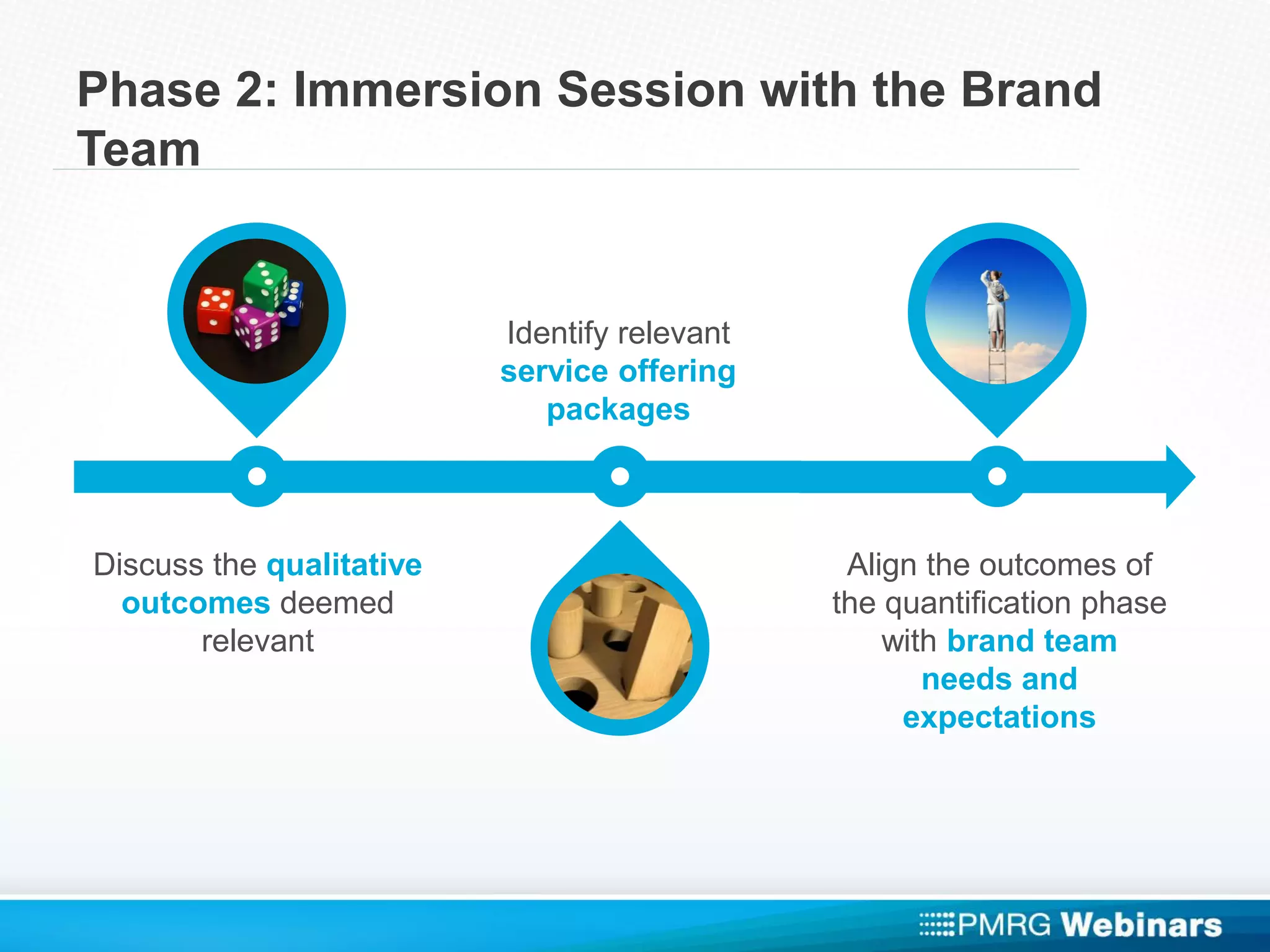
Phase 2: Immersion Session with the Brand
Team
Discuss the qualitative
outcomes deemed
relevant
Identify relevant
service offering
packages
Align the outcomes of
the quantification phase
with brand team
needs and
expectations
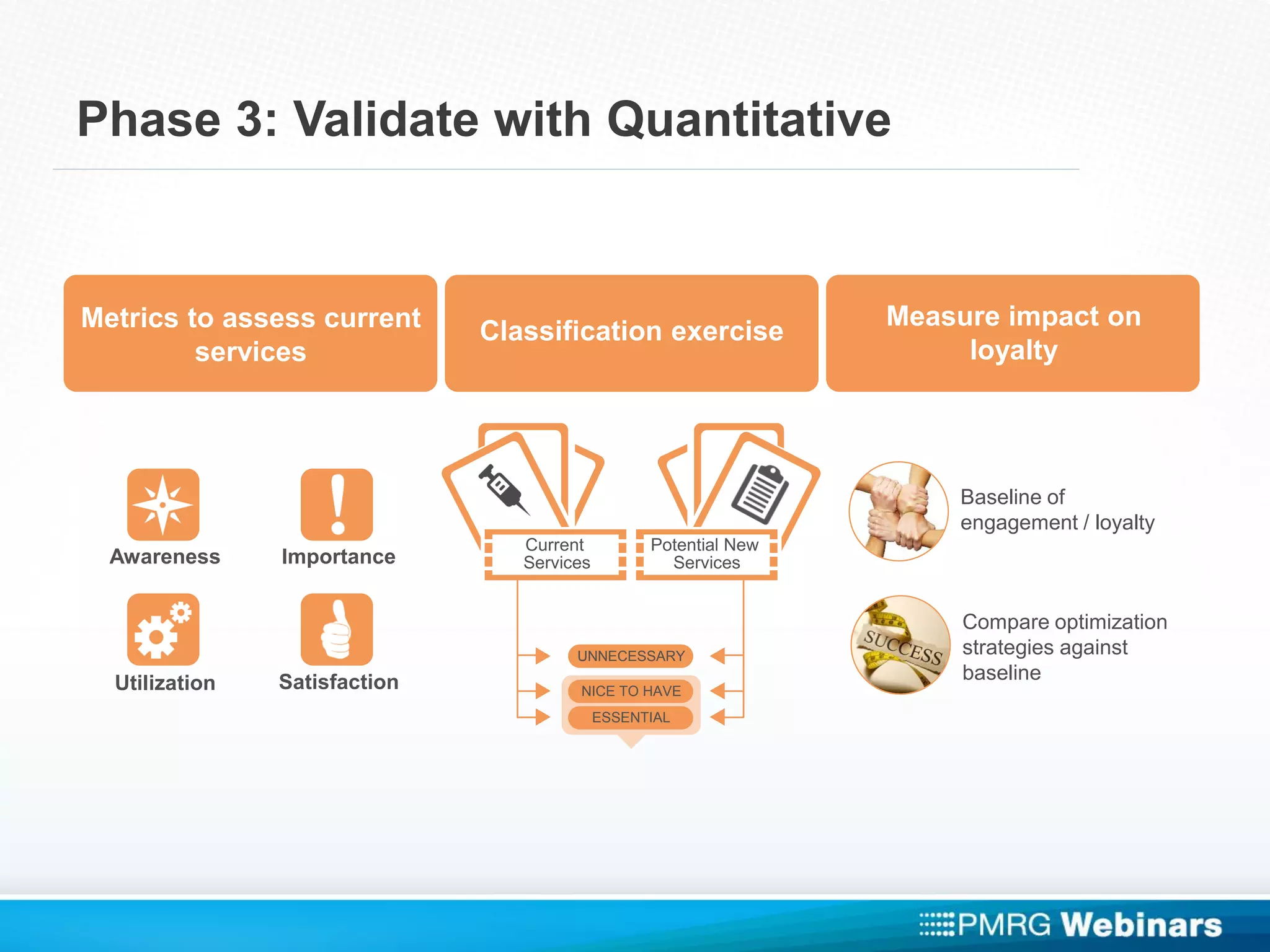
Phase 3: Validate with Quantitative
Metrics to assess current
services
Classification exercise
Measure impact on
loyalty
Current
Services
Potential New
Services
UNNECESSARY
NICE TO HAVE
ESSENTIAL
Awareness Importance
SatisfactionUtilization
Baseline of
engagement / loyalty
Compare optimization
strategies against
baseline
Case Studies
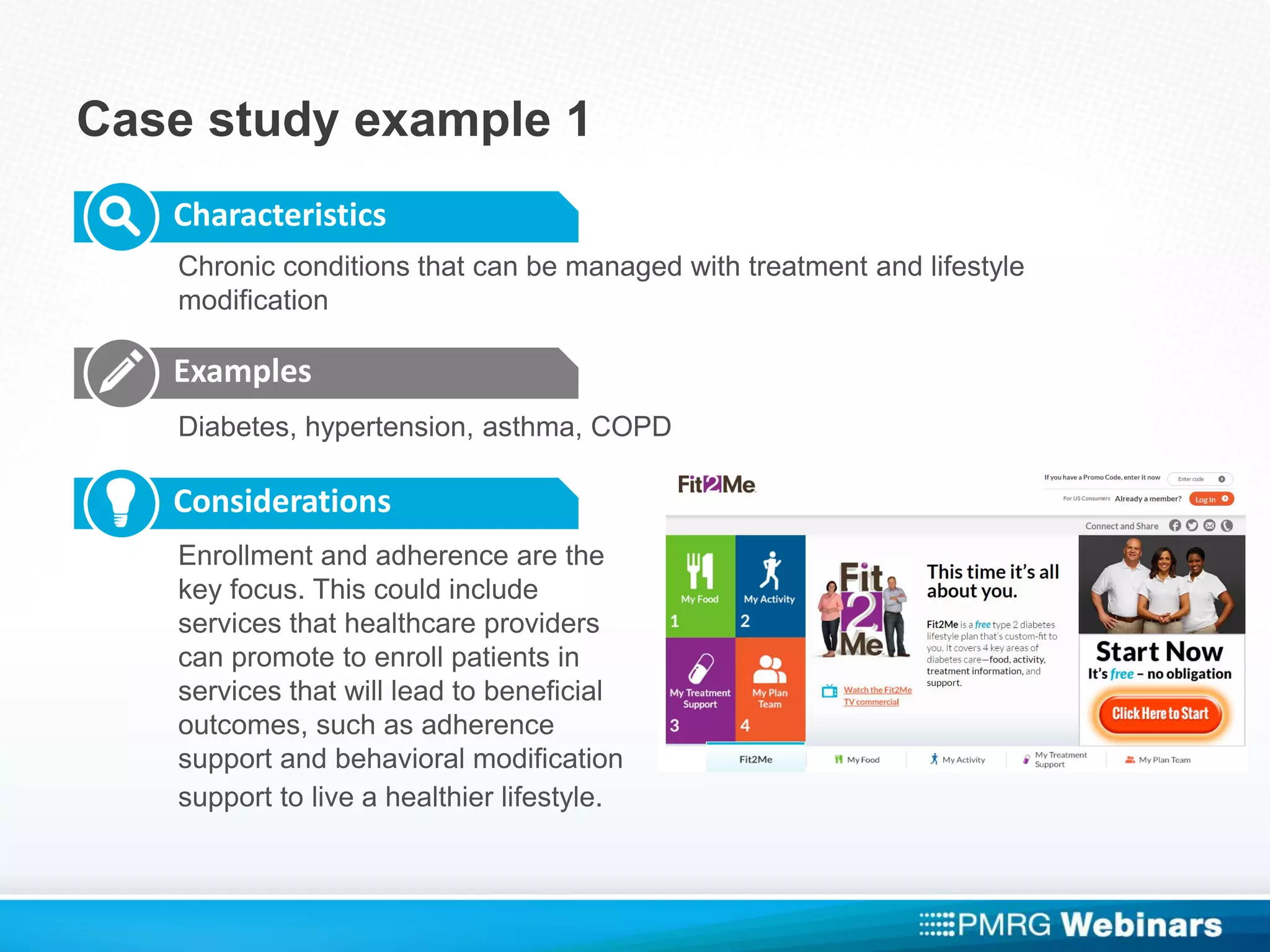
Case study example 1
Characteristics
Examples
Considerations
Chronic conditions that can be managed with treatment and lifestyle
modification
Diabetes, hypertension, asthma, COPD
Enrollment and adherence are the
key focus. This could include
services that healthcare providers
can promote to enroll patients in
services that will lead to beneficial
outcomes, such as adherence
support and behavioral modification
support to live a healthier lifestyle.
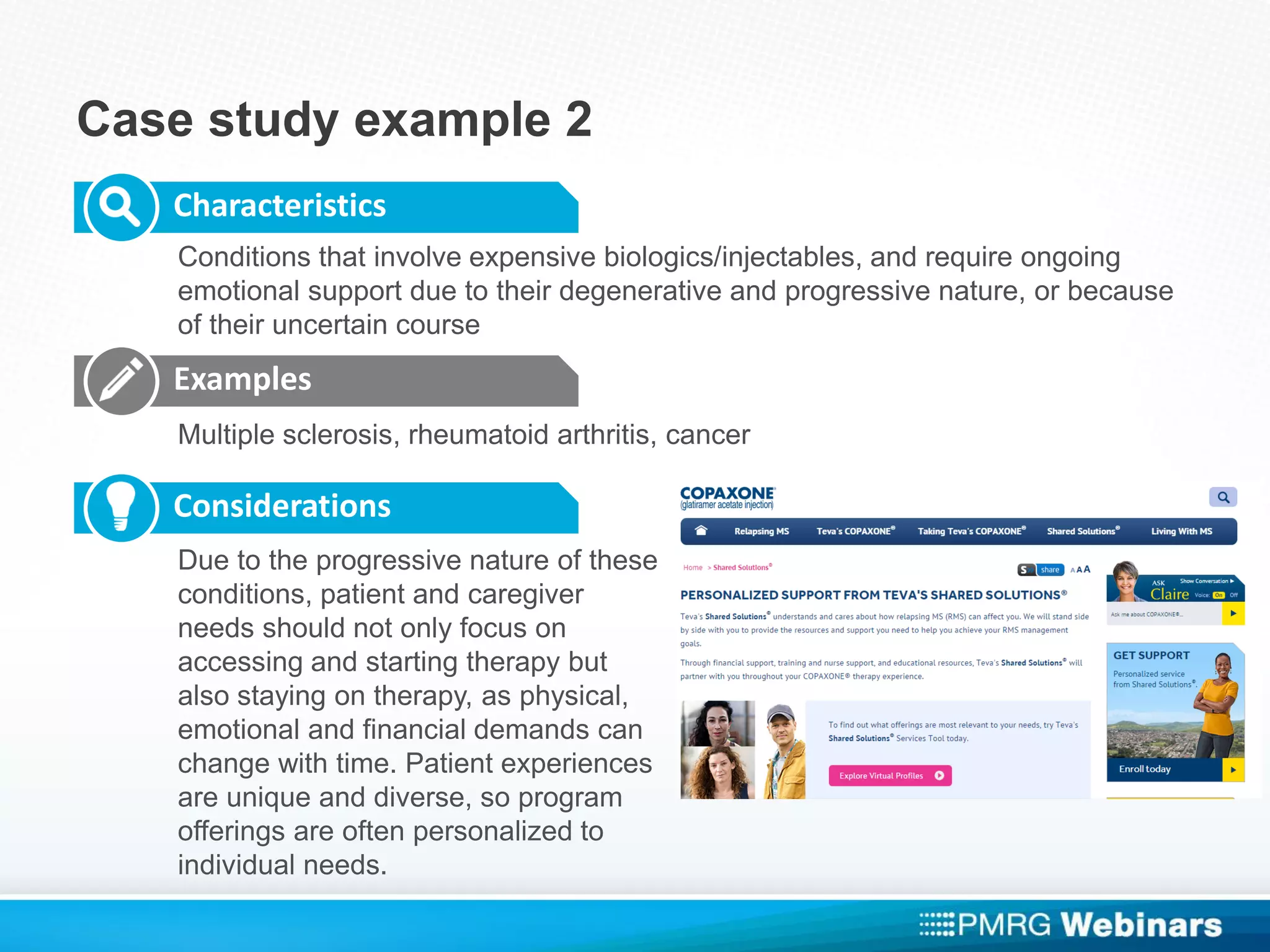
Case study example 2
Characteristics
Examples
Considerations
Conditions that involve expensive biologics/injectables, and require ongoing
emotional support due to their degenerative and progressive nature, or because
of their uncertain course
Multiple sclerosis, rheumatoid arthritis, cancer
Due to the progressive nature of these
conditions, patient and caregiver
needs should not only focus on
accessing and starting therapy but
also staying on therapy, as physical,
emotional and financial demands can
change with time. Patient experiences
are unique and diverse, so program
offerings are often personalized to
individual needs.
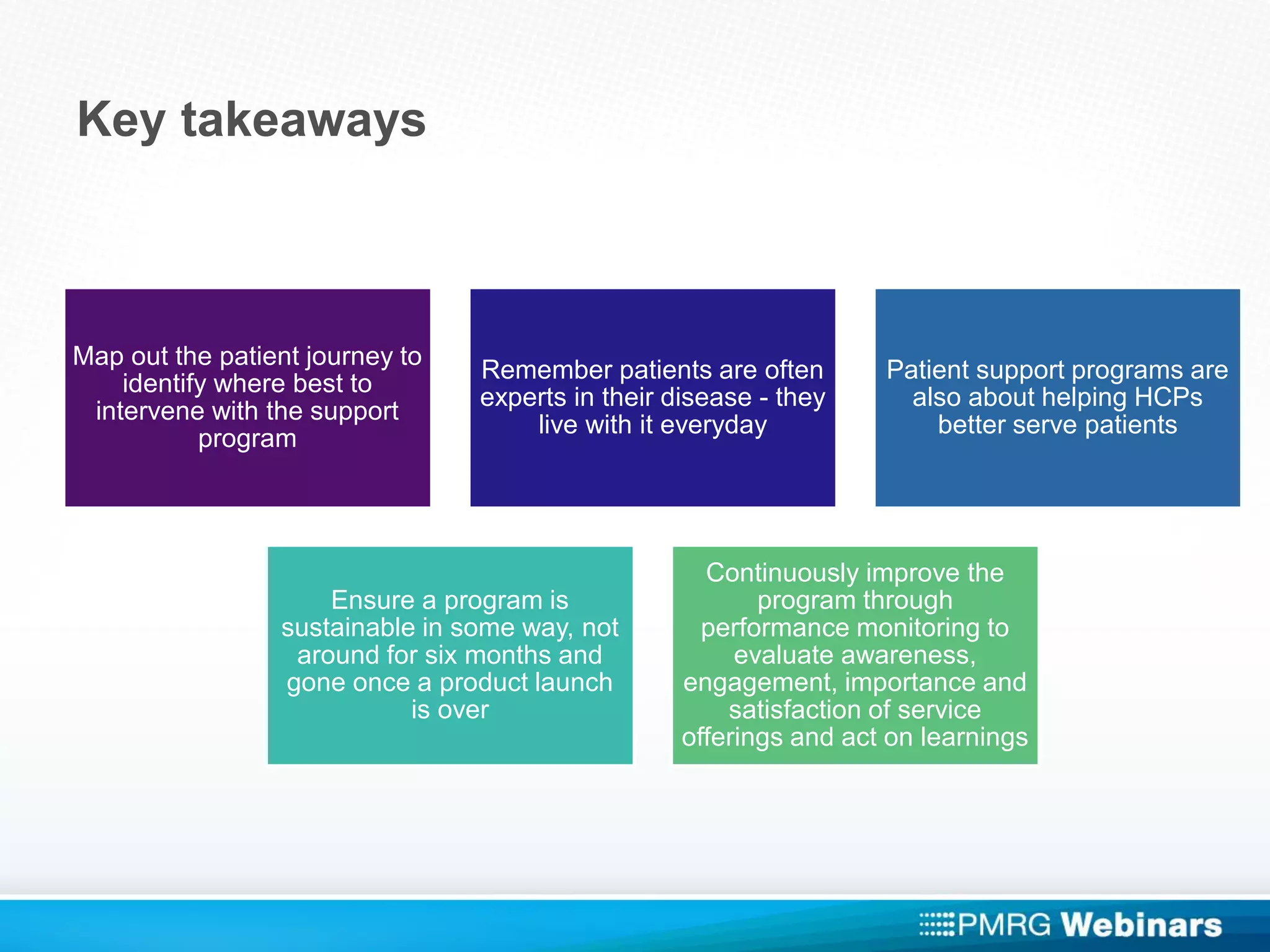
Key takeaways
Map out the patient journey to
identify where best to
intervene with the support
program
Remember patients are often
experts in their disease - they
live with it everyday
Patient support programs are
also about helping HCPs
better serve patients
Ensure a program is
sustainable in some way, not
around for six months and
gone once a product launch
is over
Continuously improve the
program through
performance monitoring to
evaluate awareness,
engagement, importance and
satisfaction of service
offerings and act on learnings
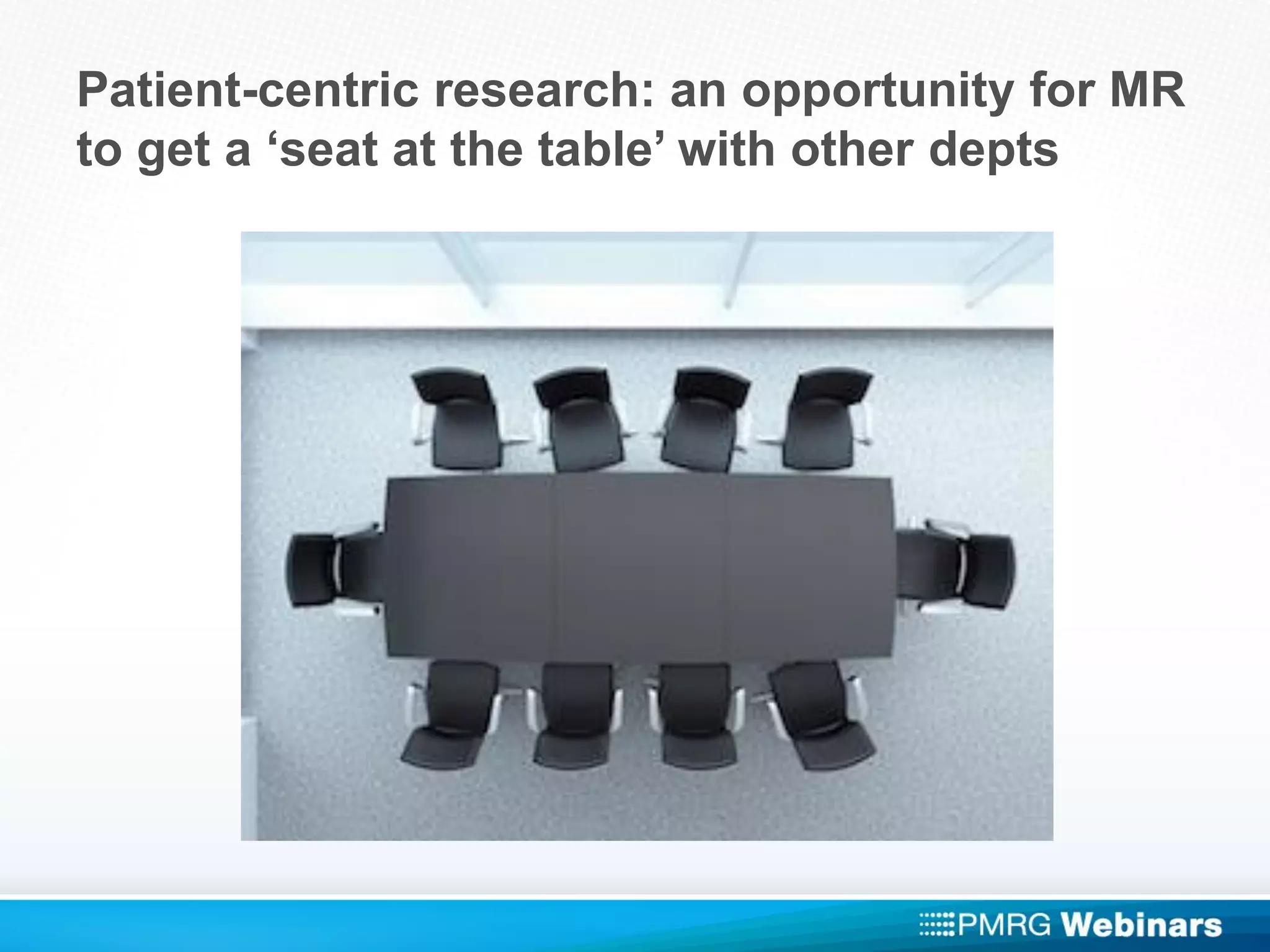
Patient-centric research: an opportunity for MR
to get a ‘seat at the table’ with other depts
Contact
26
skimgroup.com
SKIM: Decision Behavior Specialists
Ashley Ocvirk
a.ocvirk@skimgroup.com
Senior Analyst
Based in New York

Creating value through patient support programs

  • 1.
    Creating value throughpatient support programs Adopting a patient-centric approach to strategy & operations in pharma Ashley Ocvirk Senior Analyst SKIM Group
  • 2.
    The rise ofthe influential patient
  • 3.
    ‘Walking the talk’in patient-centric pharma We need to put a focus on corporate culture and building a community of employees who are really focused on the patient in everything we do. Anne Beal, MD Chief Patient Officer, Sanofi Driving culture change from the top CEO Chief Experience Officer Patient Centric Leaders Culture Process & Ideas P-SUITE TRANDITIONAL FUNCTIONS R&D Regulatory Medical Affairs Market Access PATIENTPatient Insight Unmet Needs “ Innovation
  • 4.
  • 5.
  • 6.
    Shifting away frombrand-oriented activities to a more holistic approach to patient support Traditional adherence program Refill reminders Pillboxes, alarms, compliance packaging Educational brochures, telephoning Delivery services Financial/co-pay services Holistic disease management program Care Team Assessment Payer Portal Carer Support Care Plan Management Education & Training Patient Engagement -financial/co-pay services Adherence Management Side Effects Management Clinical Support Personalized communication Treatment Management Patient networking programs
  • 7.
    Basic structure ofsuch patient support programs • Benefits investigation • Copay assistance • Injection trainings • Education • Nursing support • Supplies • Peer resources 1) Access to medication 2) Services to improve outcomes 3) Living with the condition
  • 8.
    Key benefits associatedwith investing in a patient support program Enhance patient engagement Improve adherence & compliance Enhance access to medication Retain brand loyalty and bolster differentiation Foster loyalty with key stakeholders Thwart patient switch to generics/biosimilars or other competitive branded products
  • 9.
    An opportunity forpatient support initiatives to step in and help Nobody ever went to school to be a patient, but suddenly, upon diagnosis you have multiple instructions to manage your disease including appointments, tests, monitoring, diaries, and dealing with all of the emotions. “ ”-Andrew Schorr from the cancer advocacy group, Patient Power
  • 10.
    Understand the patientjourney and associated needs at various stages Initiation Control QoLFrustration Symptom change Fear about progression Injection training Nurse support Co-pay assist Education Nurse support Education Peer support Disease education EmotionalClinical
  • 11.
    Key inflection pointsalong the journey reveal opportunities to engage with patient Starting therapy Changes in Copay Experiencing side effects Changes in dosing Changes in insurance New / worsening of symptomsInitial injection training 24/7 Nurse support Finance assistance Tx tracking tools Educational program Finance assistance Benefits investigation 24/7 Nurse support 24/7 Nurse support Educational program 24/7 Nurse support Finance assistance Benefits investigation
  • 12.
  • 13.
    Stakeholders of apatient support program 13 Patient support program “All I know is that I need help to pay for my medication. I feel like I’m not alone when the patient support program trains my on self-injection, and is there to answer my questions.” “Starting patients on these biologics is a real hassle, and patient support programs that make this easier are appreciated. Injection training frees me up to do other things, and I can use their educational materials in my practice.” • What does my program need to offer? • How can it stand out and impact prescribing? “I won’t prescribe a medication if I don’t feel confident the patient can get started on it. With that said, all these programs seem pretty much the same to me, and they’re all pretty good. I don’t know too much detail about them.” PATIENT MANUFACTURER NURSE PHYSICIAN
  • 14.
    Patient support programsare also about helping HCPs better serve patients RX INITIATION PROCESS FOR HCPS ACCESS TRAINING Insurance coverage investigation and financial assistance Ensures access and by assisting with obtaining insurance coverage Injection training, education and support Inspires confidence that patients will initiate and maintain Tx Nurses spend the most time on the phone and filling out paper work. Physicians may need to hire staff to handle authorizations. Nurses are freed from providing training themselves.
  • 15.
    Key questions andrelevant experience for each stakeholder KEY QUESTION RELEVANT EXPERIENCE PHYSICIAN STAKEHOLDER PATIENTNURSE What is the actual impact on prescribing? • Ultimately responsible for prescribing • May take different programs into account How do different programs compare in alleviating the burden of getting patients started? • Most interaction with support programs • Deeper understanding of different programs What feelings does patient support invoke? How do those feelings impact brand loyalty? • Rely on programs for starting and staying with Tx • Programs provide assistance and comfort
  • 16.
    Research overview PHASE 1 PHASE2 PHASE 3 Exploratory Qualitative Immersion Session with the Brand Team Validate with Quantitative Competitive Intel
  • 17.
    Phase 1a: ExploratoryQualitative Individual Interviews Online Bulletin Board Focus Groups Establishing a range of experiences Broad exploration of individual experiences Projective exercises for unstated feelings and unmet needs In-depth reflection and descriptive accounts Ideation and co-creation Assess extent of unmet needs MOST APPROPRIATE STAKEHOLDERS MOST APPROPRIATE STAKEHOLDERS MOST APPROPRIATE STAKEHOLDERS PATIENT NURSE PHYSICIAN PATIENT NURSEPATIENT
  • 18.
    Phase 1b: Competitiveintelligence • HCPs typically work with multiple brands • Therefore, competitive intel is relatively easy to obtain • Current patients with past experiences on other brands • Former patients who have switched • Competitor patients who have never been treated with the Rx in question HCPs PATIENTS
  • 19.
    Phase 2: ImmersionSession with the Brand Team Discuss the qualitative outcomes deemed relevant Identify relevant service offering packages Align the outcomes of the quantification phase with brand team needs and expectations
  • 20.
    Phase 3: Validatewith Quantitative Metrics to assess current services Classification exercise Measure impact on loyalty Current Services Potential New Services UNNECESSARY NICE TO HAVE ESSENTIAL Awareness Importance SatisfactionUtilization Baseline of engagement / loyalty Compare optimization strategies against baseline
  • 21.
  • 22.
    Case study example1 Characteristics Examples Considerations Chronic conditions that can be managed with treatment and lifestyle modification Diabetes, hypertension, asthma, COPD Enrollment and adherence are the key focus. This could include services that healthcare providers can promote to enroll patients in services that will lead to beneficial outcomes, such as adherence support and behavioral modification support to live a healthier lifestyle.
  • 23.
    Case study example2 Characteristics Examples Considerations Conditions that involve expensive biologics/injectables, and require ongoing emotional support due to their degenerative and progressive nature, or because of their uncertain course Multiple sclerosis, rheumatoid arthritis, cancer Due to the progressive nature of these conditions, patient and caregiver needs should not only focus on accessing and starting therapy but also staying on therapy, as physical, emotional and financial demands can change with time. Patient experiences are unique and diverse, so program offerings are often personalized to individual needs.
  • 24.
    Key takeaways Map outthe patient journey to identify where best to intervene with the support program Remember patients are often experts in their disease - they live with it everyday Patient support programs are also about helping HCPs better serve patients Ensure a program is sustainable in some way, not around for six months and gone once a product launch is over Continuously improve the program through performance monitoring to evaluate awareness, engagement, importance and satisfaction of service offerings and act on learnings
  • 25.
    Patient-centric research: anopportunity for MR to get a ‘seat at the table’ with other depts
  • 26.
    Contact 26 skimgroup.com SKIM: Decision BehaviorSpecialists Ashley Ocvirk a.ocvirk@skimgroup.com Senior Analyst Based in New York