
Challenges for Developing  Global Online Courses  in Low Resource Settings   by  Inge de Waard
In this session you will see: Technical, human and motivational challenges How to reach learners in low resource settings How to motivate learners from a variety of cultures Strategic issues to take into account while planning global eLearning The importance of well trained tutors
Why should you take cultural differences into account? Let the learner feel s/he matters Localized content feels closer to the learner Knowledge is at its best with a variety of viewpoints Different cultures have different educational histories and preferences  Every region has its specific way of communicating Logic is not universal Knowing how to address a target group is important if you go for a new market And all of your ideas!
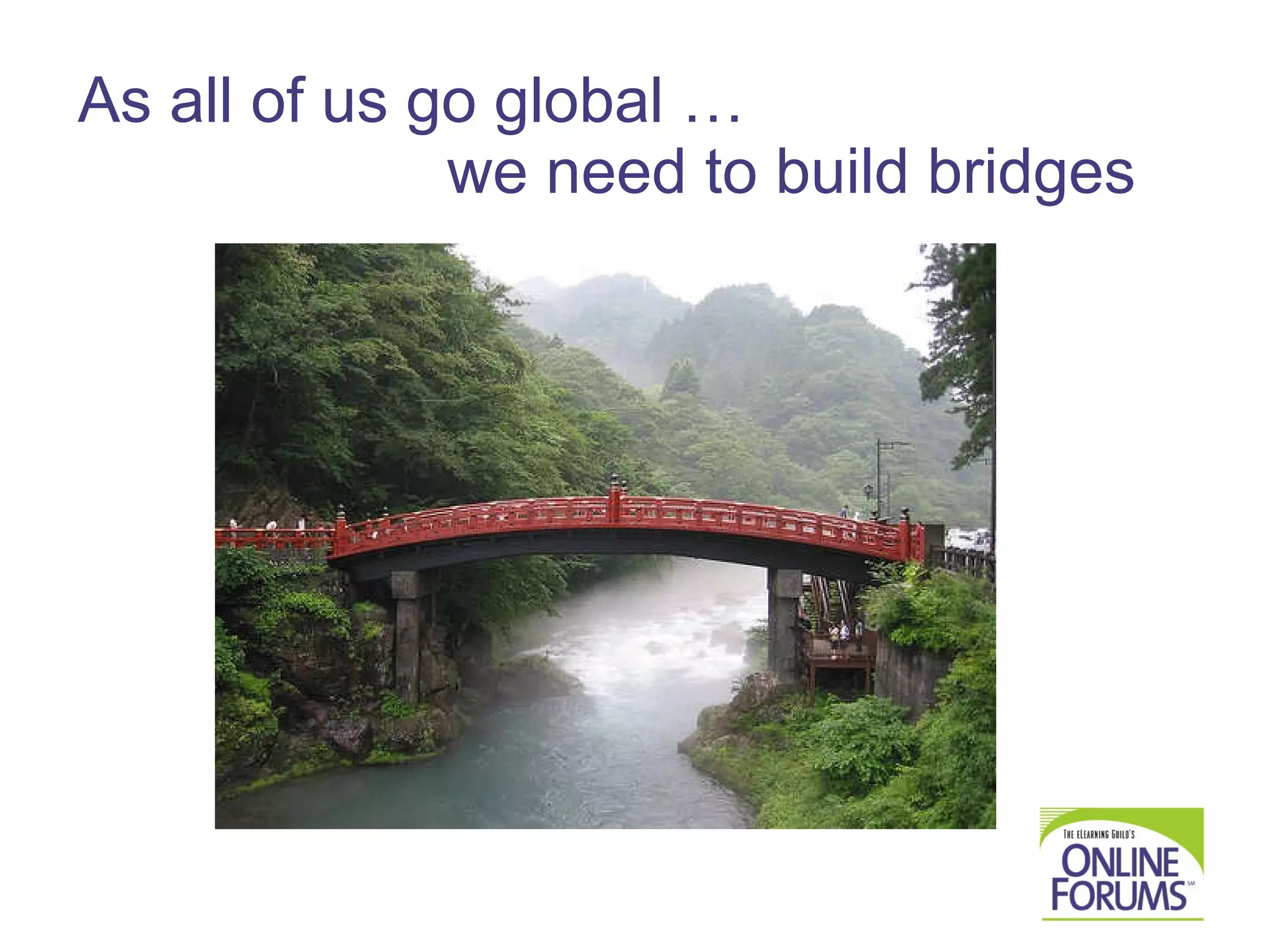
As all of us go global …    we need to build bridges
Balance Bridges are build at both shores, so reach out from your end, all of the learners will come across as well. Look for communicative consensus whenever possible. Creative, pro-active and strategic thinking helps
1  eSCART specifics  eSCART = electronic Short Course of AntiRetroviral Therapy Target group:  physicians and health care workers  in low resource areas (developing countries) working on HIV/AIDS We put in  meta objectives  for the course developers to attain Started as a face-2-face course 6 years ago. With very positive evaluation feedback => we were confident about the content. Start from what you have and learn what works
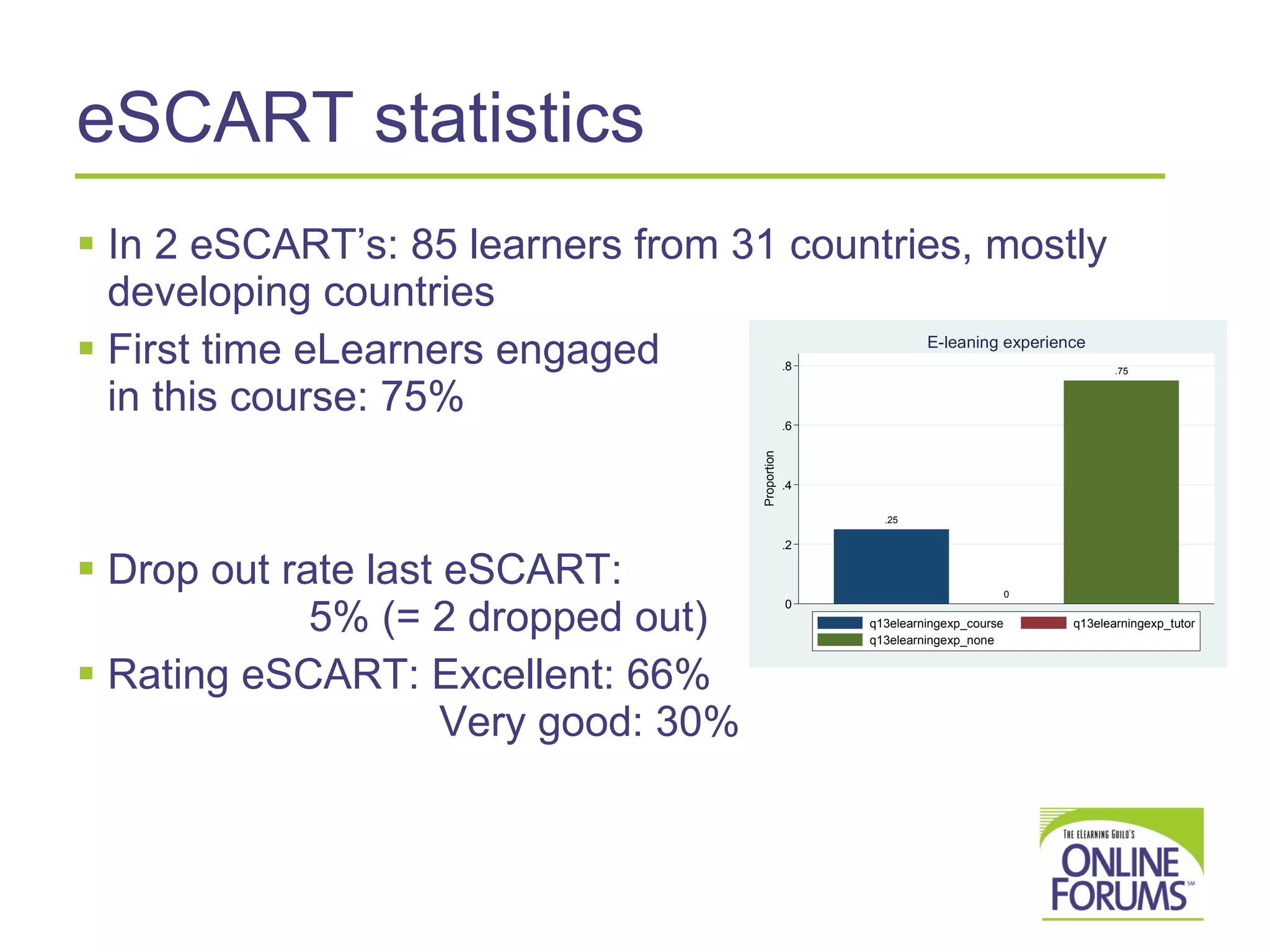
eSCART statistics In 2 eSCART’s: 85 learners from 31 countries, mostly developing countries First time eLearners engaged  in this course: 75% Drop out rate last eSCART:    5% (= 2 dropped out) Rating eSCART: Excellent: 66%    Very good: 30%
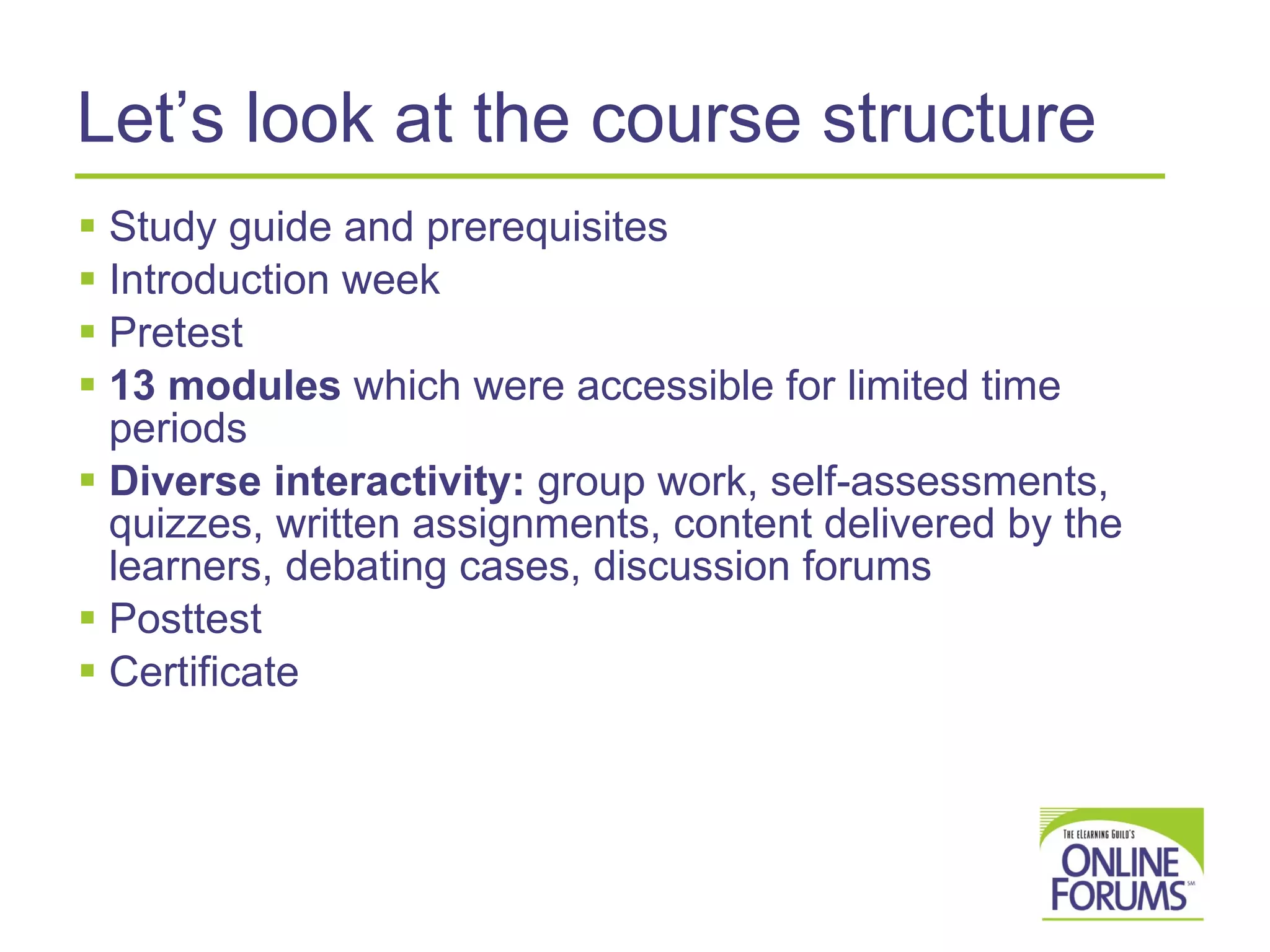
Let’s look at the course structure Study guide and prerequisites Introduction week Pretest  13 modules  which were accessible for limited time periods Diverse interactivity:  group work, self-assessments, quizzes, written assignments, content delivered by the learners, debating cases, discussion forums Posttest  Certificate
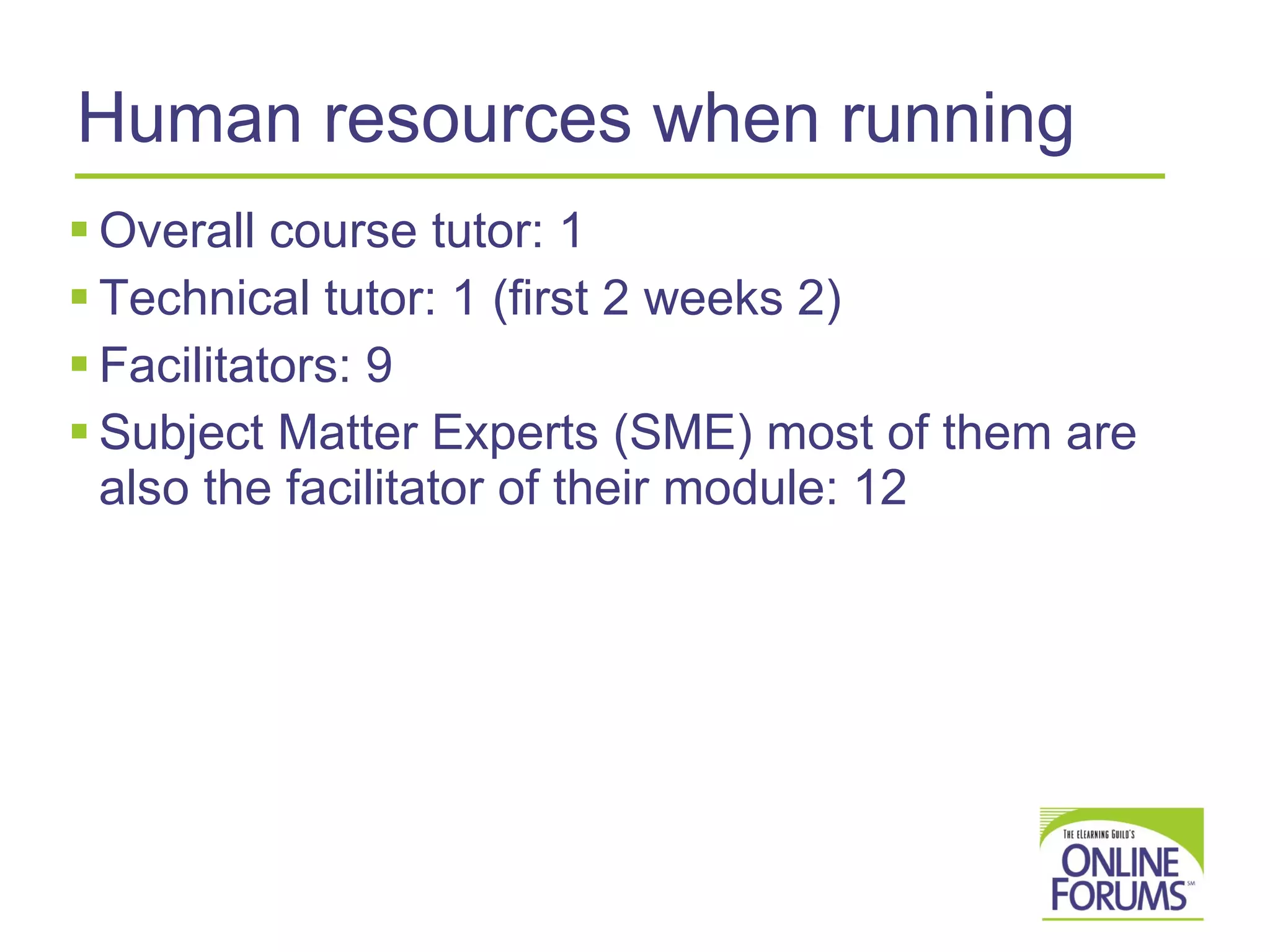
Human resources when running Overall course tutor: 1 Technical tutor: 1 (first 2 weeks 2) Facilitators: 9 Subject Matter Experts (SME) most of them are also the facilitator of their module: 12
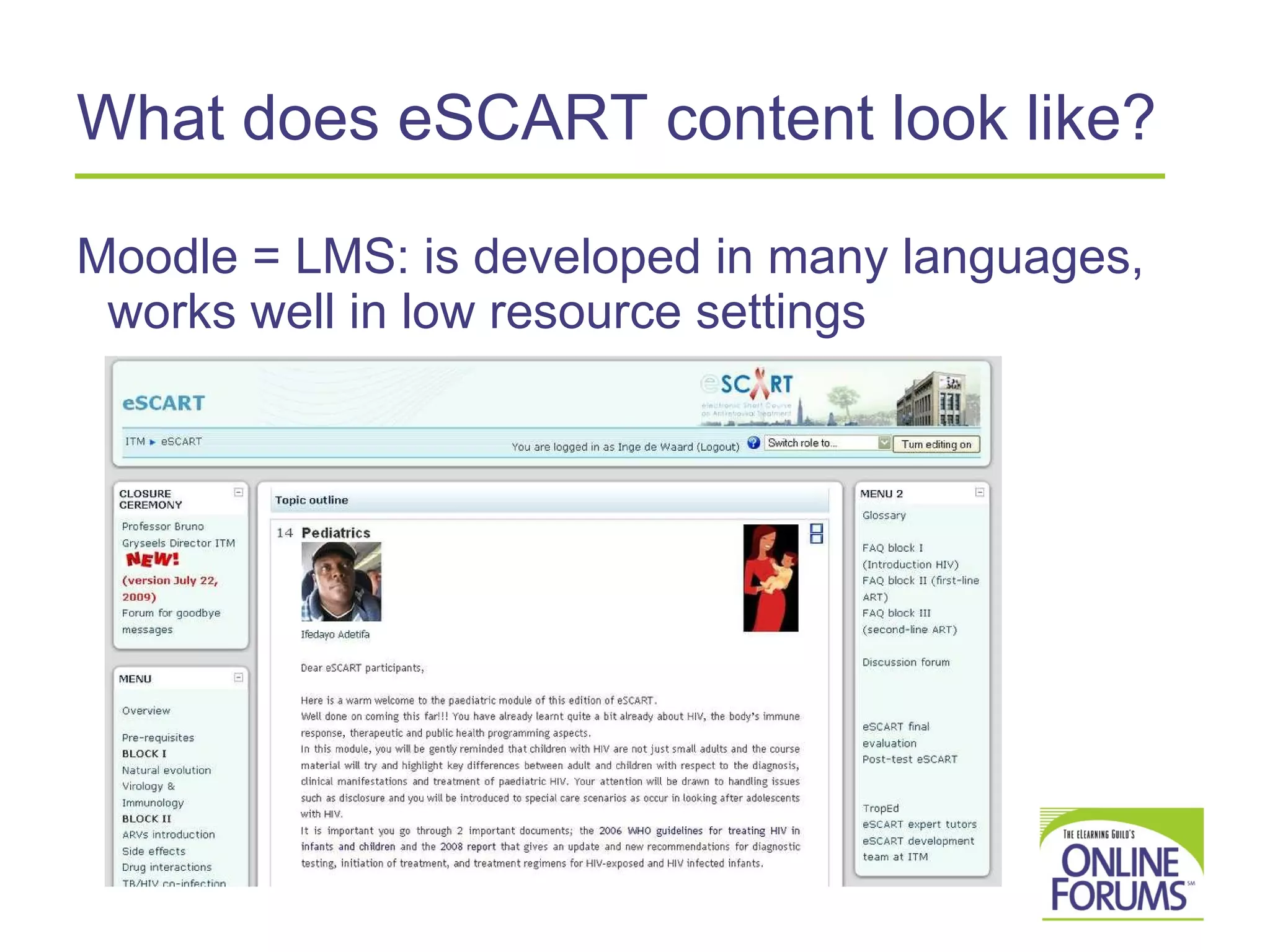
What does eSCART content look like? Moodle = LMS: is developed in many languages, works well in low resource settings
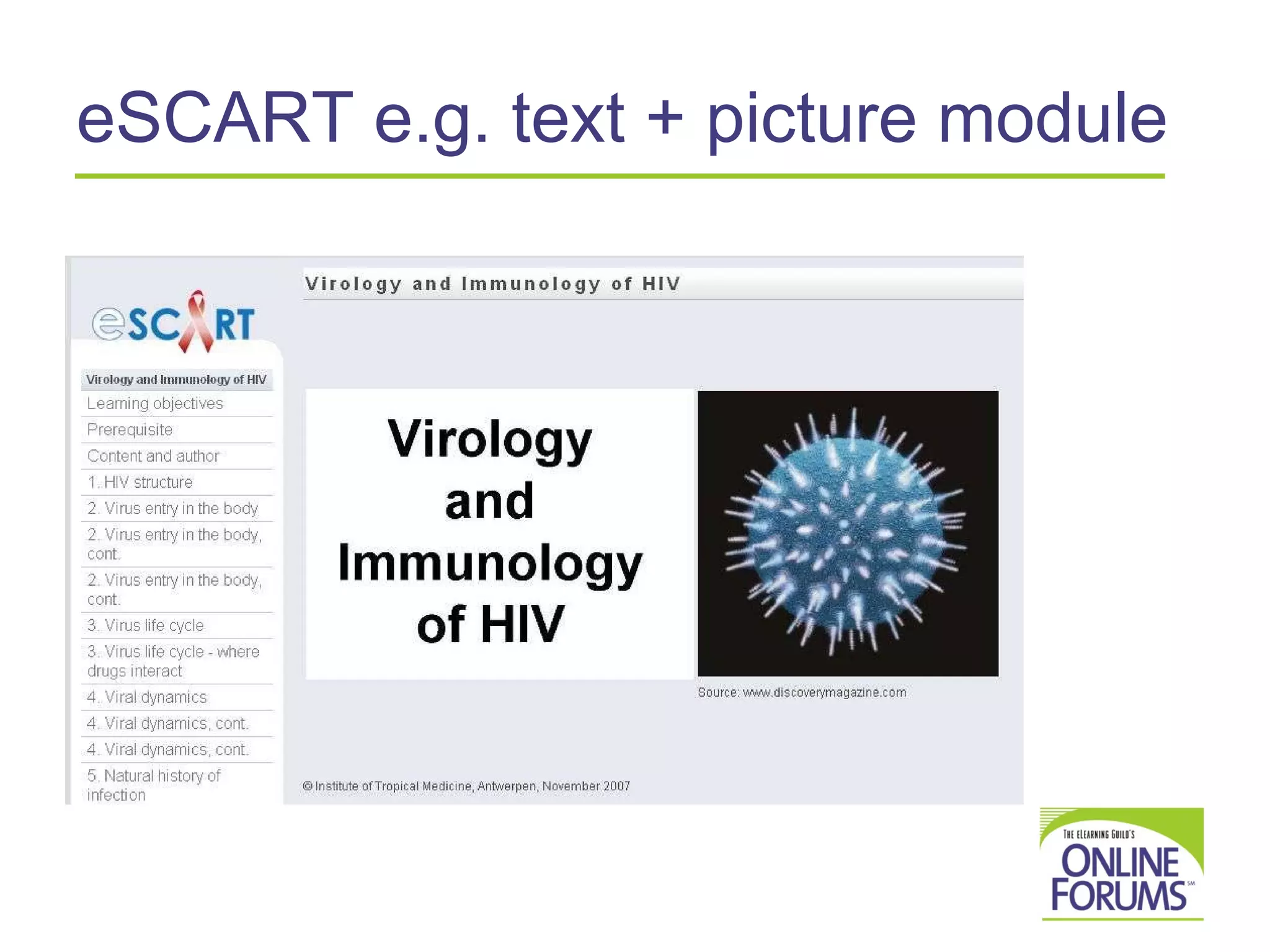
eSCART e.g. text + picture module
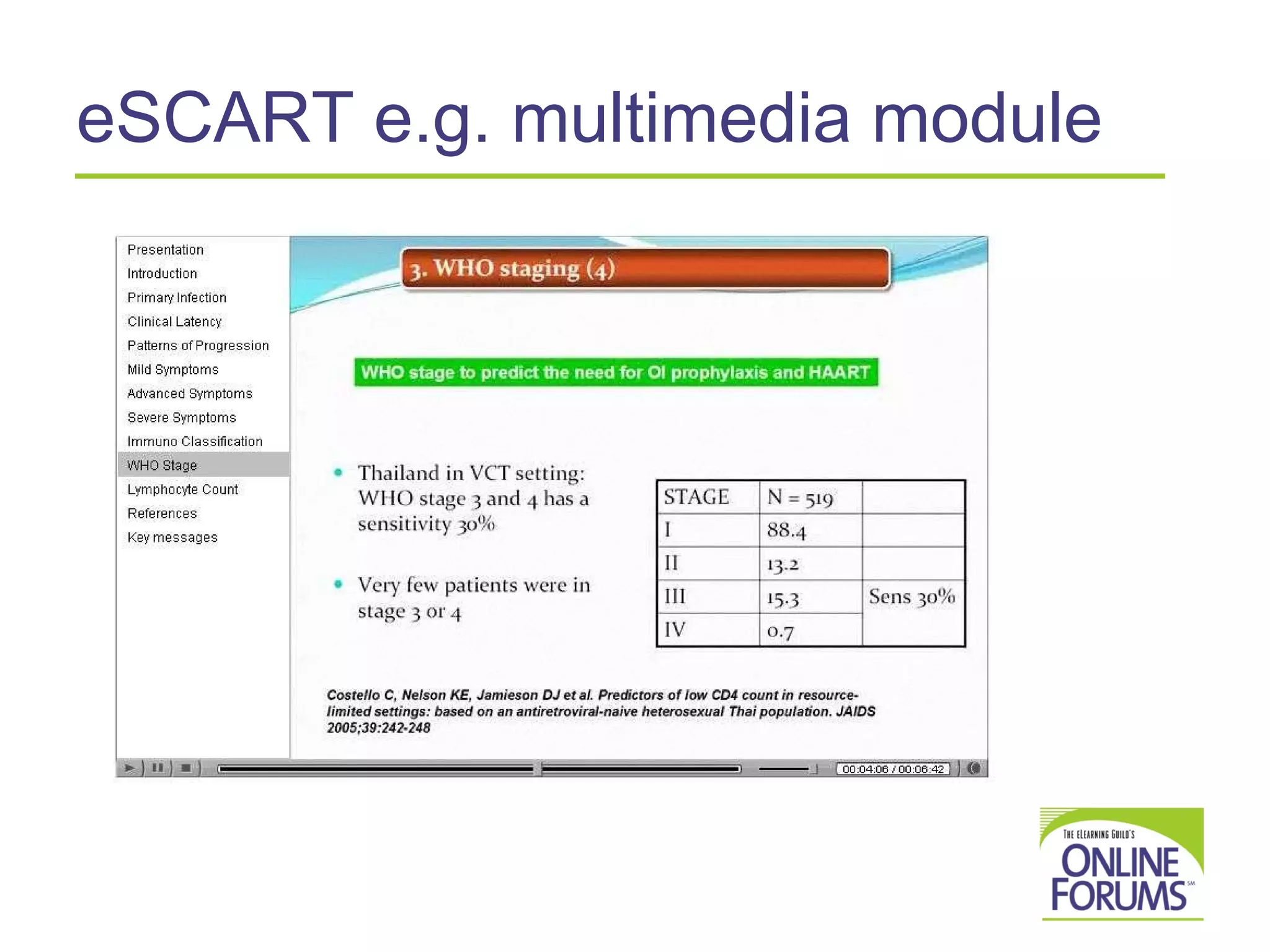
eSCART e.g. multimedia module
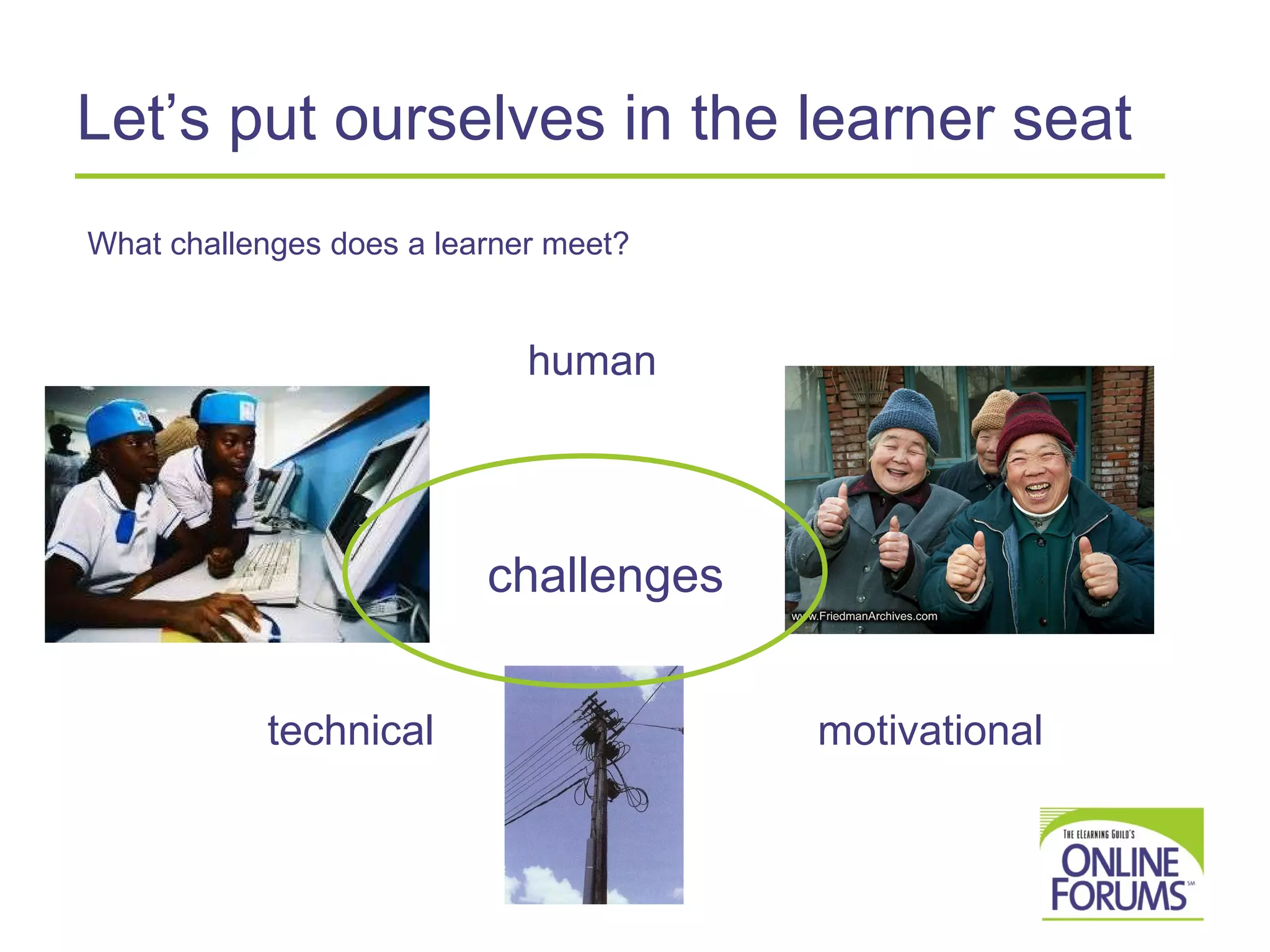
Let’s put ourselves in the learner seat challenges human motivational technical What challenges does a learner meet?
2 Technical challenges These need to be tackled before the rest can be handled.  To allow the best possible environment: Make the minimum technical requirements known    to the possible applicants (before they apply:    audio, cdrom…) Pre-course entry-questionnaire with technical    issues Technical tutor on stand-by 24/7 (at the beginning) due to different time zones   so what technical issues do we address?
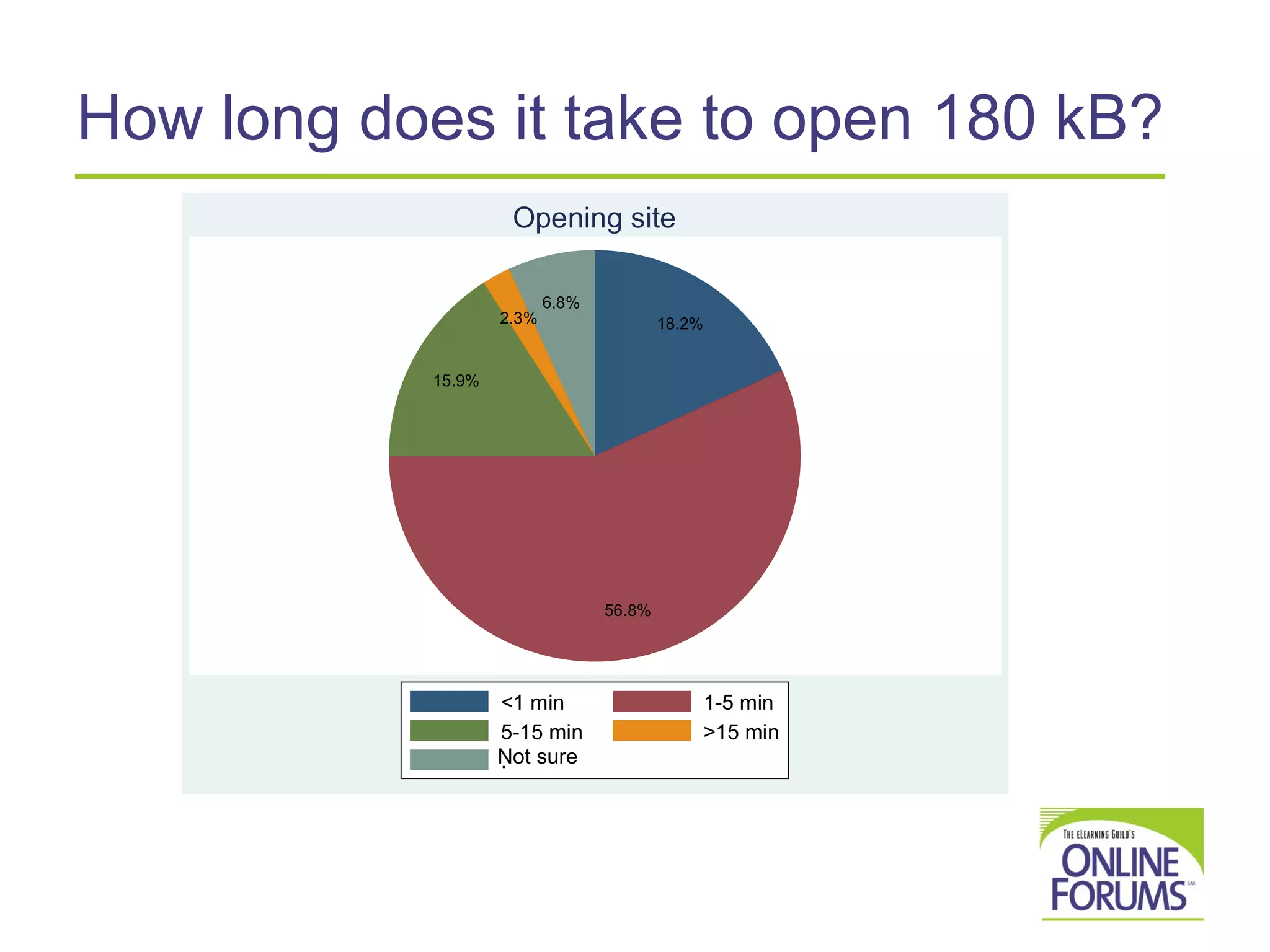
How long does it take to open 180 kB? Not sure
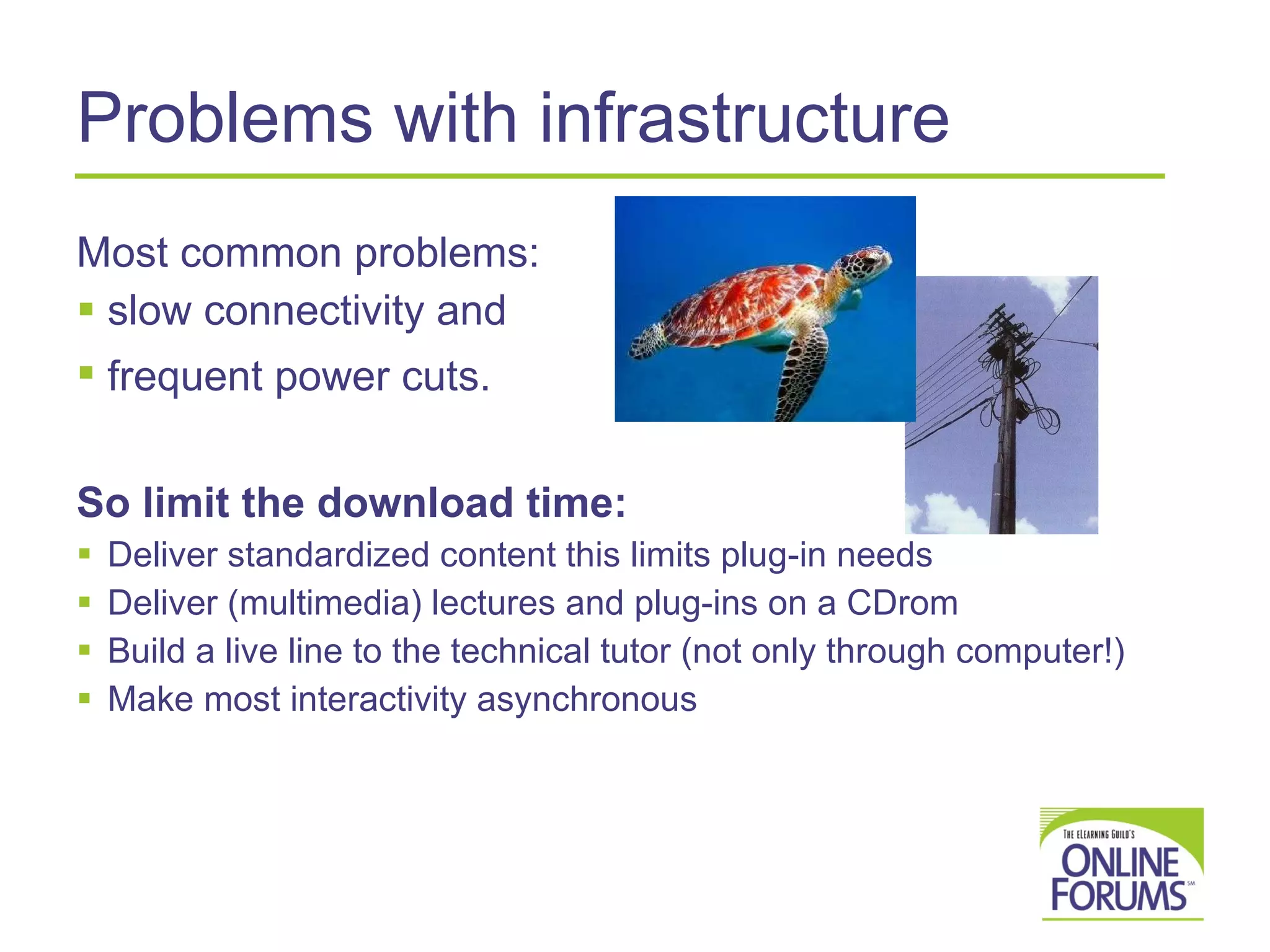
Problems with infrastructure Most common problems:  slow connectivity and  frequent power cuts.   So limit the download time: Deliver standardized content this limits plug-in needs  Deliver (multimedia) lectures and plug-ins on a CDrom  Build a live line to the technical tutor (not only through computer!) Make most interactivity asynchronous
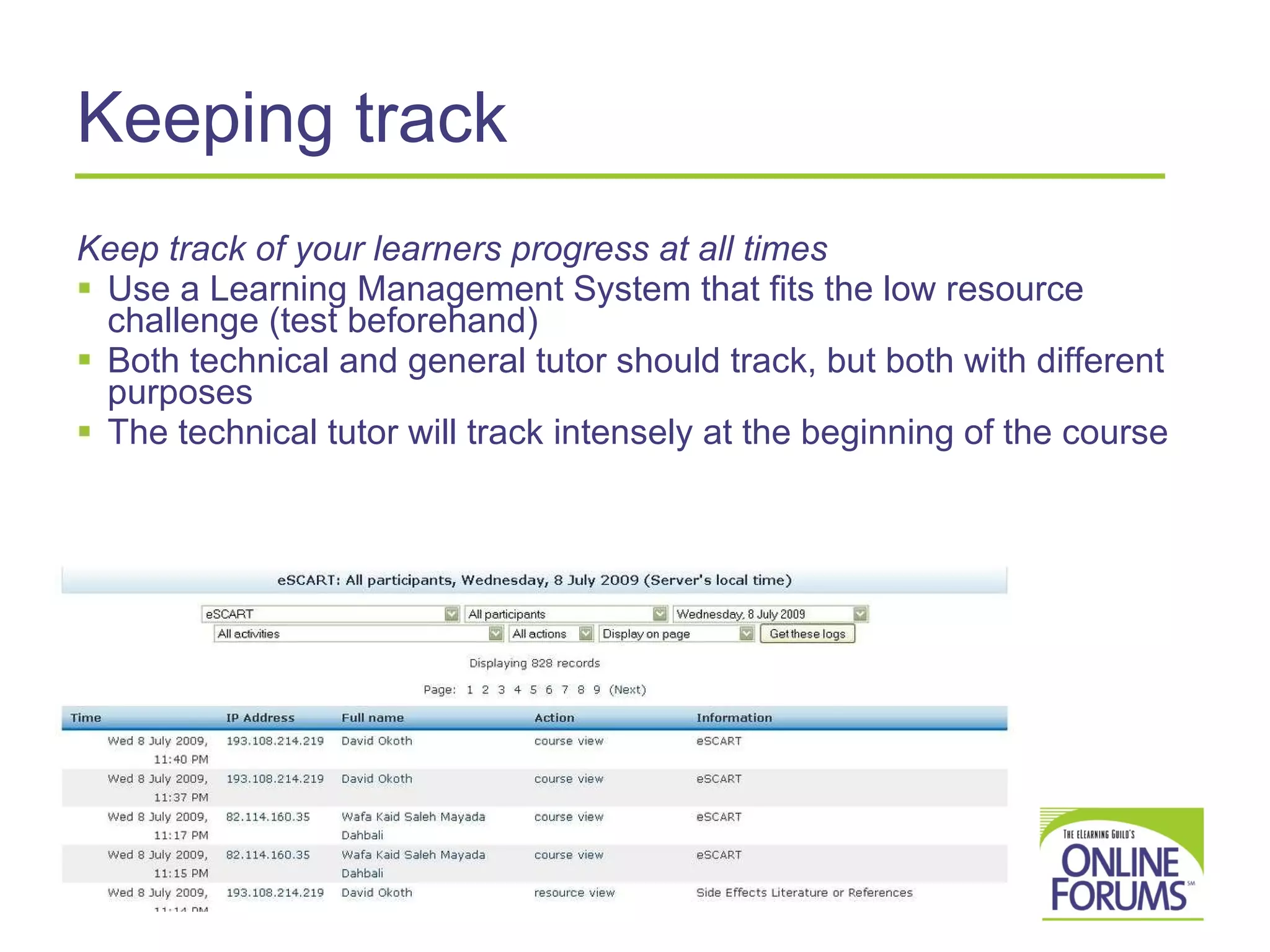
Keeping track Keep track of your learners progress at all times Use a Learning Management System that fits the low resource challenge (test beforehand) Both technical and general tutor should track, but both with different purposes The technical tutor will track intensely at the beginning of the course
Keep online data small in size Lectures and plug-ins on CDrom, but quizzes, discussion forums, assessments can only be done online => security reasons To keep the learner motivated, all the online material should be easy to open and to use => select appropriate software: ( SCORM -compatible for easy grading and easy on the connection)  But keep this Ethiopean proverb in mind:  “I want the wheat flour, I don’t care about the mill”,    The learning is what matters, not the technology.
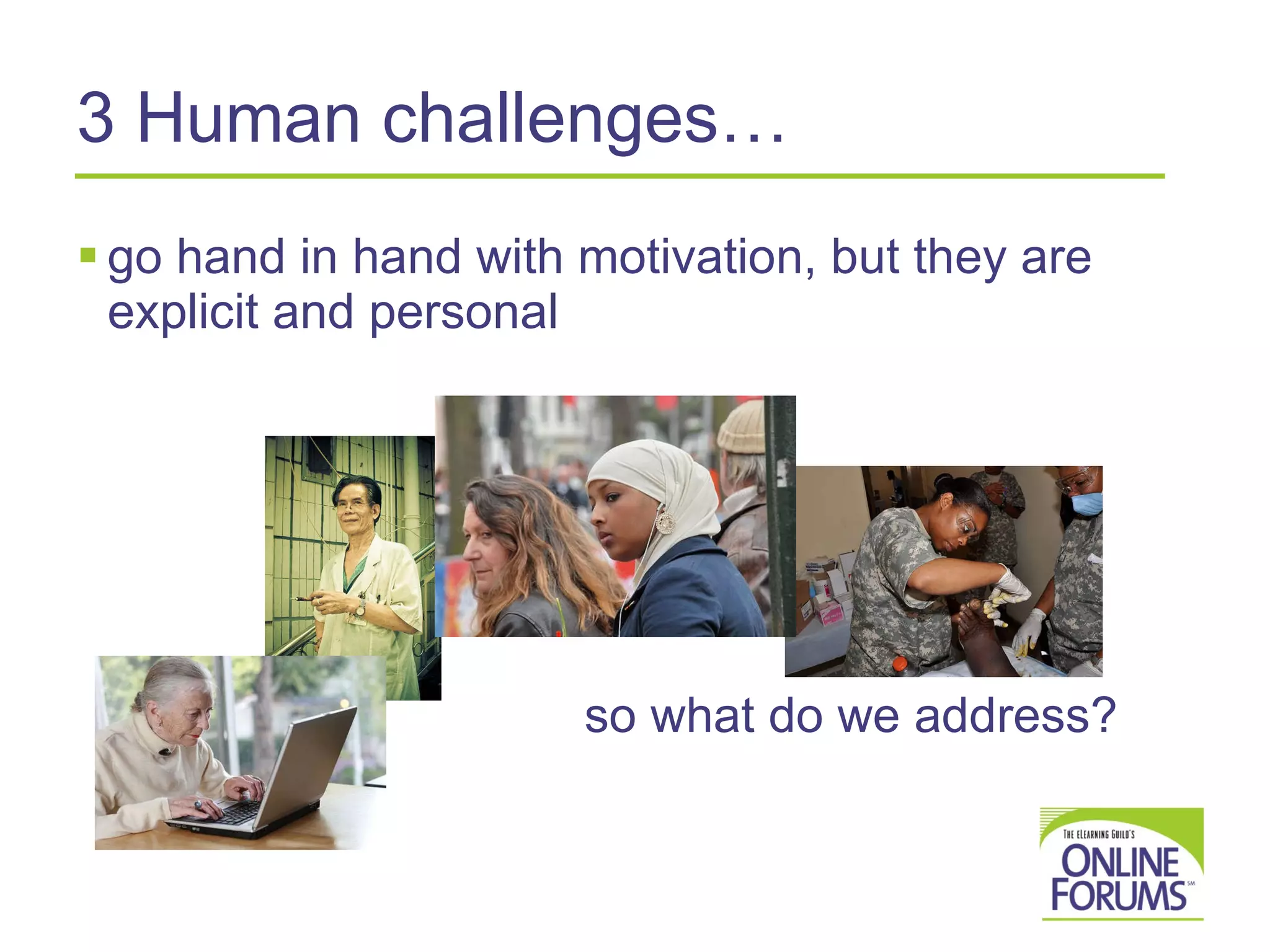
3 Human challenges… go hand in hand with motivation, but they are explicit and personal so what do we address?
Finding yourself reflected in the course Make the content diverse: and make those differences visible We built a database to extrapolate what type of visuals, audio, video depictions we were using From the database quantitative data can be extracted
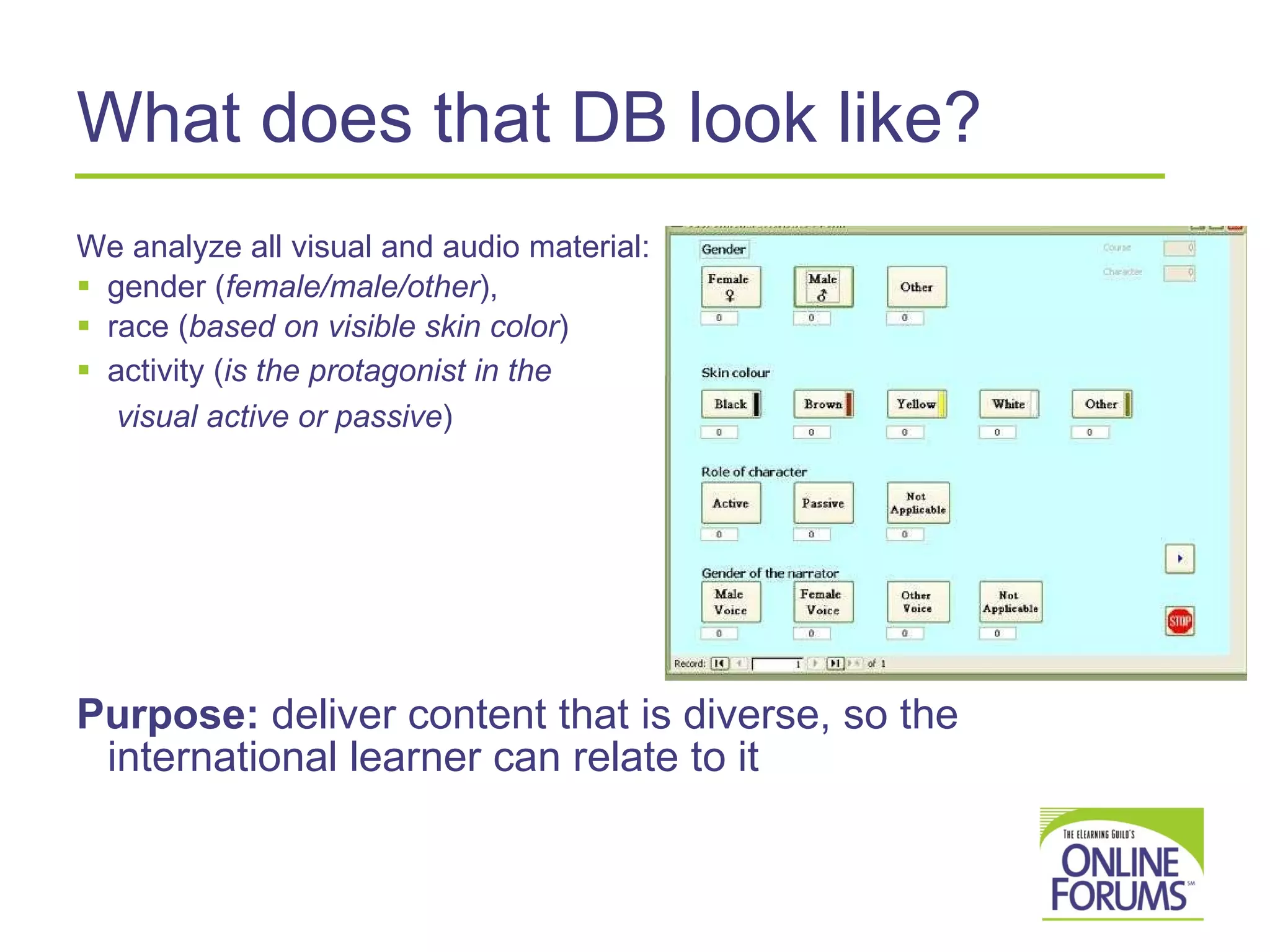
What does that DB look like? We analyze all visual and audio material:  gender ( female/male/other ),  race ( based on visible skin color )  activity ( is the protagonist in the  visual active or passive )  Purpose:  deliver content that is diverse, so the international learner can relate to it
Respect local human constraints Professional demand : synchronous activities? Think about time zones, be flexible for 1-1 Important religious days : no assignment deadline or key moments on these days Leave room for  family matters : death, weddings and the local associated rituals  (more than one day sometimes) Be respectful in your communication, even if the learner response seems aggressive at first ( possible language barrier )
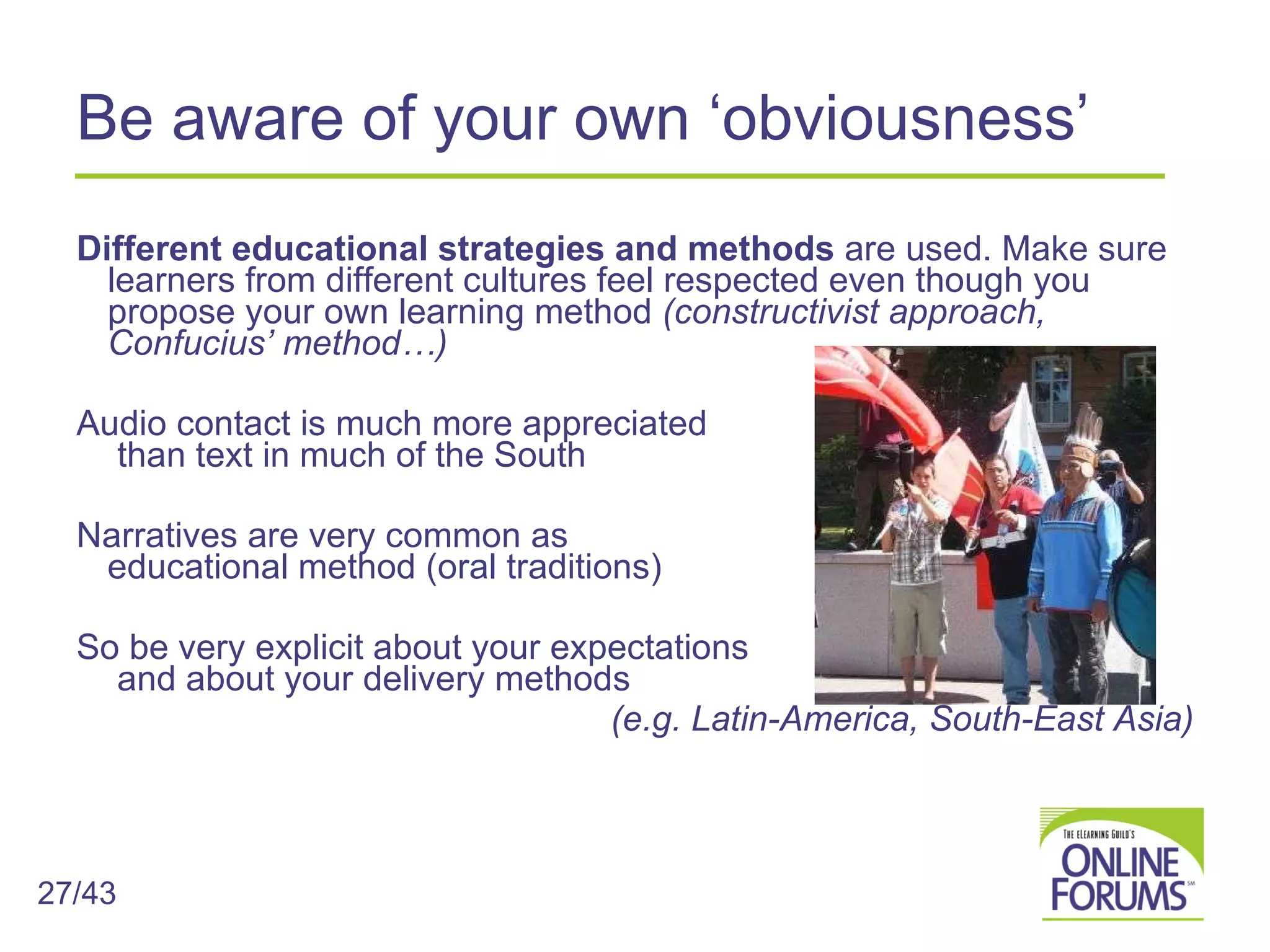
Be aware of your own ‘obviousness’ Different educational strategies and methods  are used. Make sure learners from different cultures feel respected even though you propose your own learning method  (constructivist approach, Confucius’ method…)  Audio contact is much more appreciated  than text in much of the South Narratives are very common as  educational method (oral traditions) So be very explicit about your expectations  and about your delivery methods (e.g. Latin-America, South-East Asia) 27/43
4 Motivational challenges Let’s look at how can you keep learners from all corners of the world motivated to continue learning
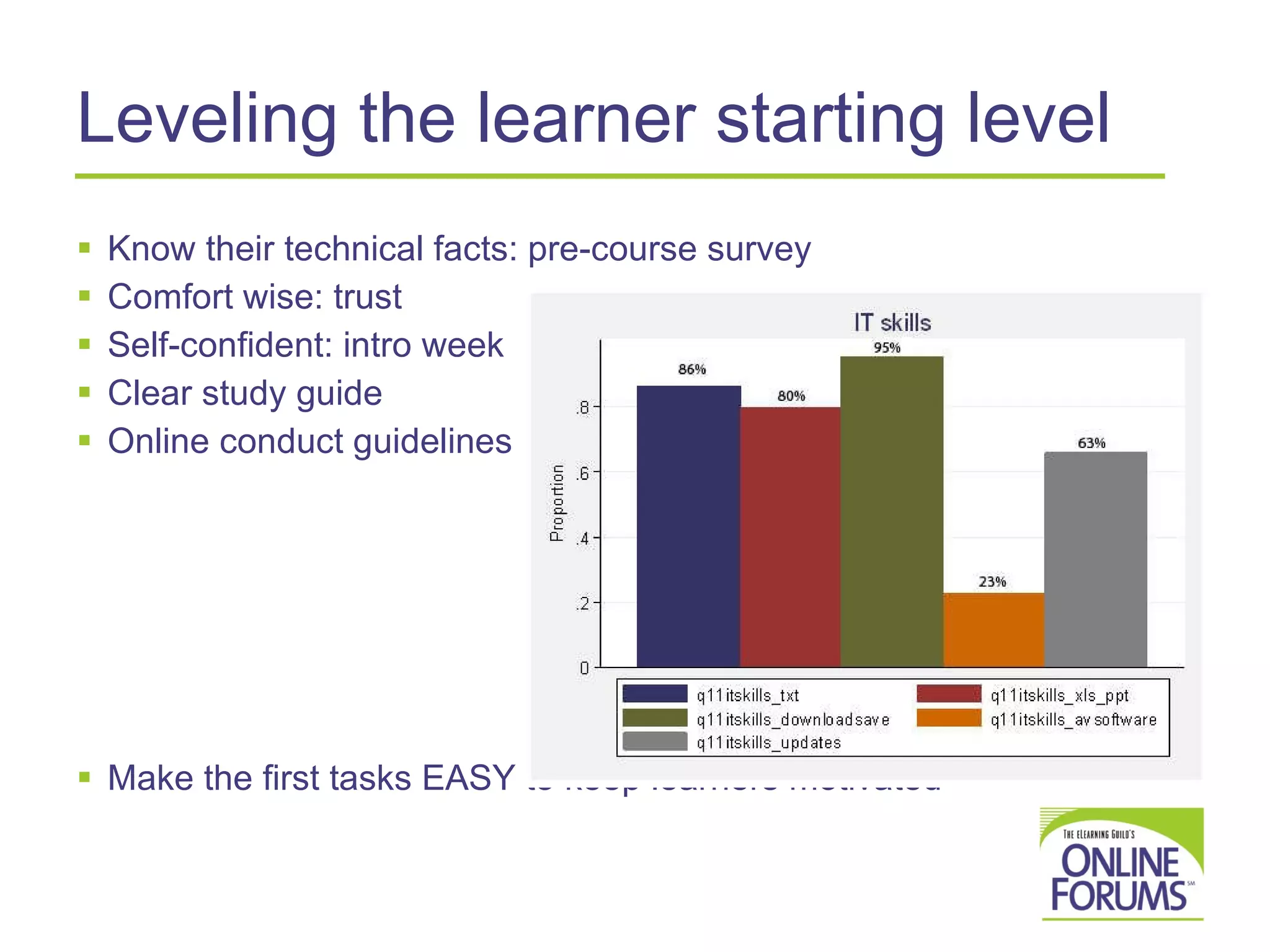
Leveling the learner starting level Know their technical facts: pre-course survey Comfort wise: trust Self-confident: intro week Clear study guide Online conduct guidelines Make the first tasks EASY to keep learners motivated
Importance of the tutor / facilitator Use facilitators (mostly SME) from different cultures (= recognizable identity) Attract an overall course tutor that has worked and lived in international settings Contact with the tutor is expected and very important in most South countries   …
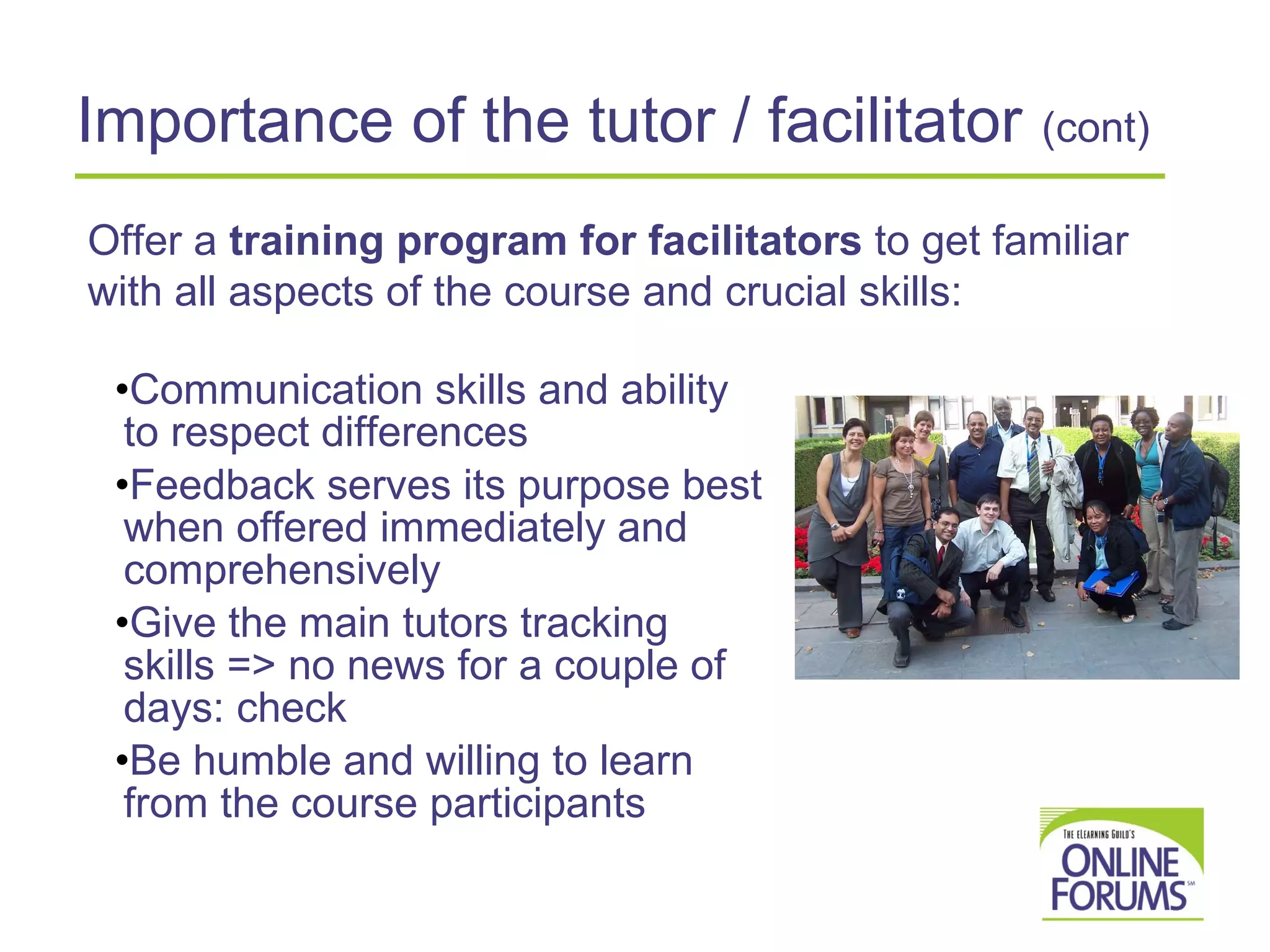
Importance of the tutor / facilitator   (cont) Communication skills and ability to respect differences  Feedback serves its purpose best when offered immediately and comprehensively Give the main tutors tracking skills => no news for a couple of days: check  Be humble and willing to learn from the course participants Offer a  training program for facilitators  to get familiar with all aspects of the course and crucial skills:
Scrutinize your content Add meta learning objectives for yourself & attain them Let your content be screened by specialists from other continents (and cultures) Use real-life international situations for your content Learner-centered learning: actively put learner content in the course: their cases, their expertise, their needs Use parts from different educational methods: collaborative learning, learner-centered content, fully prepared knowledge…
Intrinsic motivation What do they get out of it? Certificate or bi-monthly award for ‘best learner’ Knowing that they are on top of their profession Get continued (medical) education afterwards Long-term network possibilities (Community of Practice) Career / growing opportunities: becoming a facilitator for their region/clinic (we pick-up best learners as possible facilitators) Increased IT-confidence and skills Give the learners a place to share THEIR references and content, show their expertise
Priority: communication & interactivity Communicate very clearly what your communication will be like  Be open and clear throughout  Give them communication guidelines Never feel offended as a tutor, give them a chance to explain what they really mean Pick-up learners that trot behind Give confidence to your learners
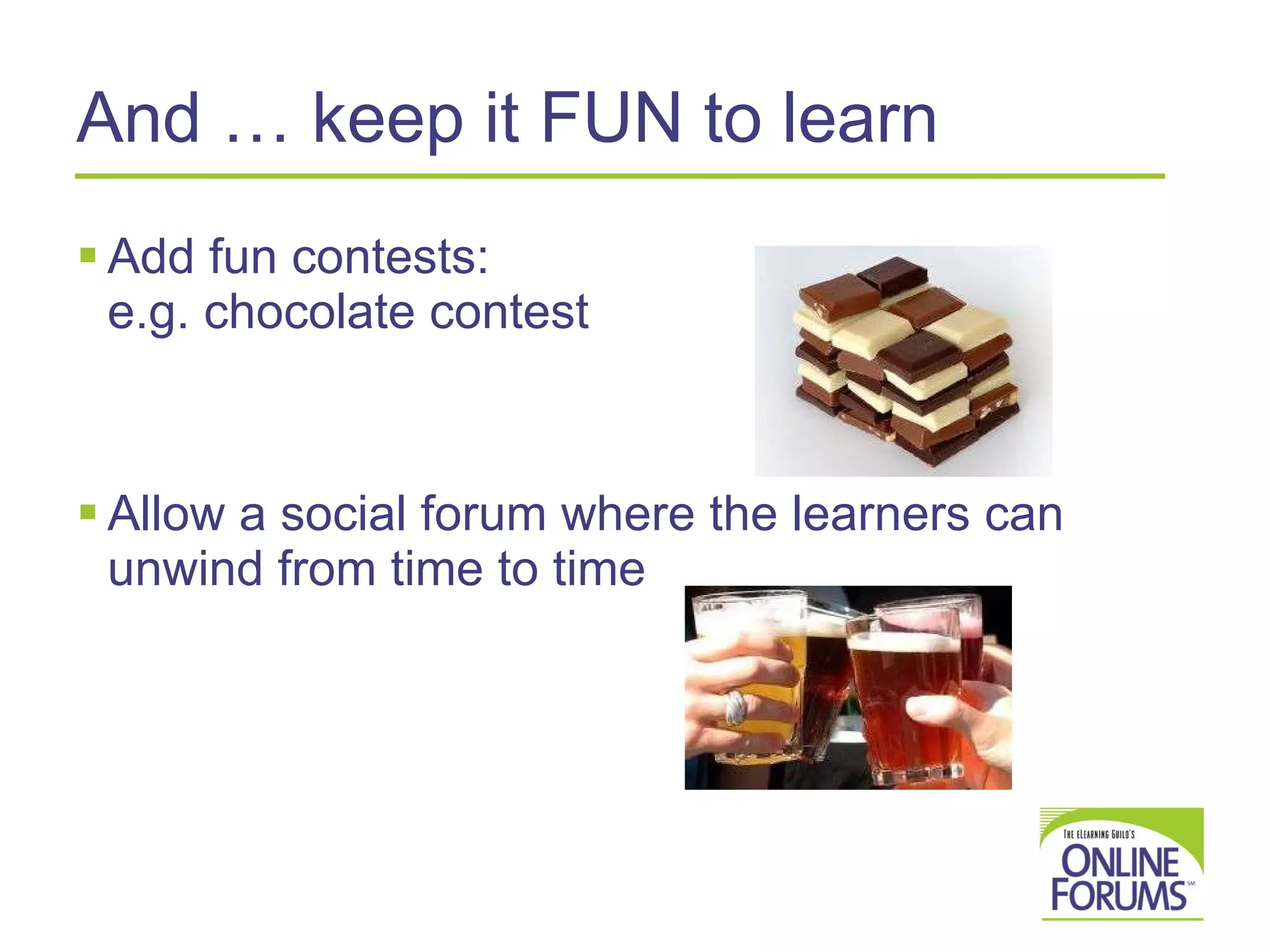
And … keep it FUN to learn Add fun contests:  e.g. chocolate contest Allow a social forum where the learners can unwind from time to time
Remember general best practices: Organize evaluations on both content and support  Address different learner skills Add interactivity whenever possible Add self-assessments so the learner knows what s/he has learned Organize social learning moments  Check-out eLearning Guild resources …
We are almost there     rounding up
A quick overview to address challenges  Screen your visual and AV material for diversity Deliver heavy content via an external tool (cdrom, usb..) Use a pre-course technical survey Know when important religious days are planned Content screened by international specialists Tutor and facilitators trained Keep track of learner progress and access Communicate respectfully at all levels Allow users to give their expertise  Give certification or accreditation
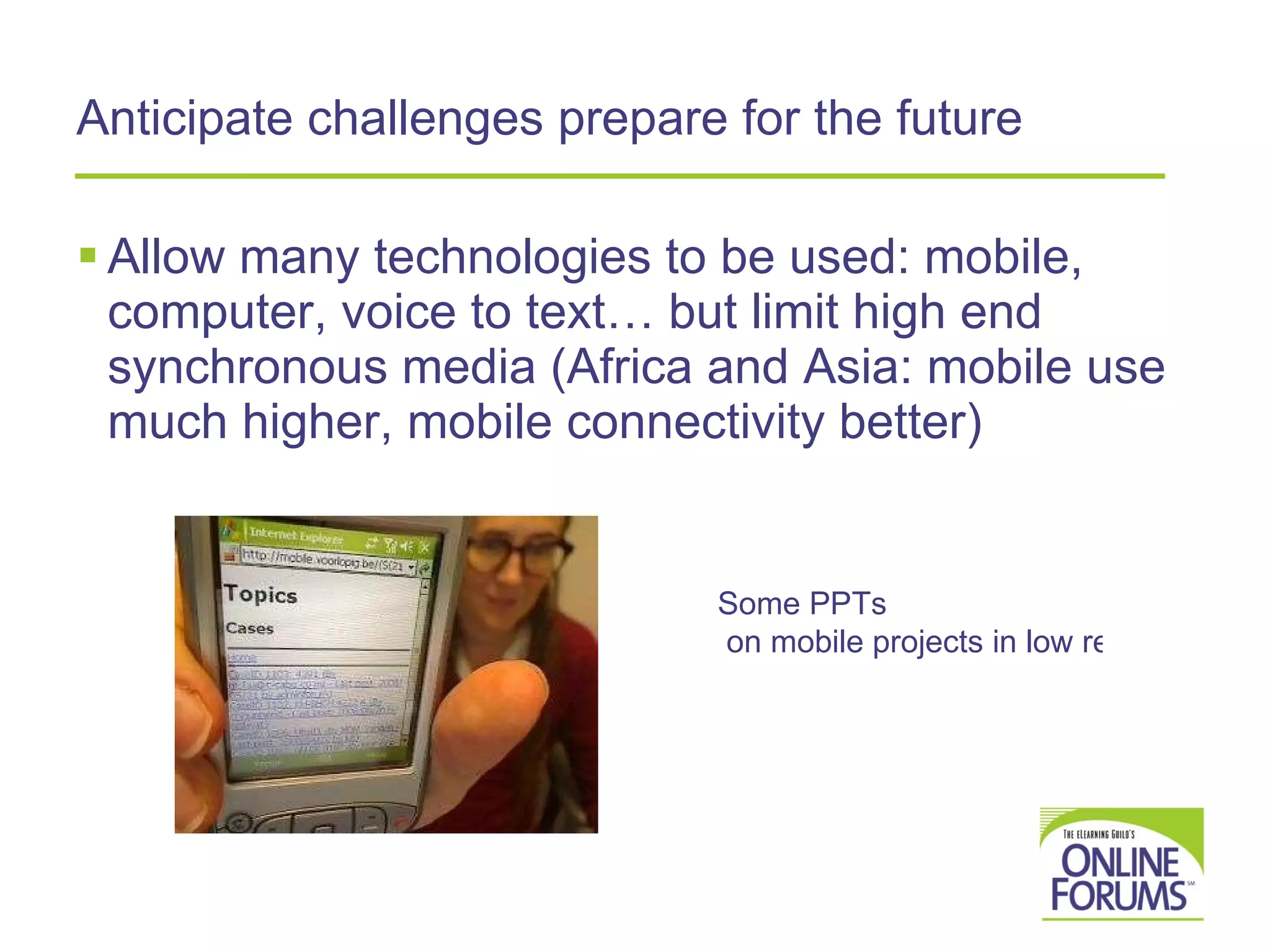
Anticipate challenges prepare for the future Allow many technologies to be used: mobile, computer, voice to text… but limit high end synchronous media (Africa and Asia: mobile use much higher, mobile connectivity better)  Some  PPTs  on mobile projects in low resource areas
More information - links Pre-course technical survey Paper on database for quantifying types of visuals List with conduct guidelines Long-term network and Continued Medical Education site
Contact me Email:   idewaard@ itg.be   Blog:   ignatiawebs.blogspot.com Delicious :  http:// del.icio.us/ignatia LinkedIn:   http:// www.linkedin.com /in/ ingedewaard Twitter:   http://twitter.com/Ignatia PPT:   http:// www.slideshare.net/ignatia

What to take into account when developing courses for low resource areas or developing countries

  • 1.
    Challenges for Developing Global Online Courses in Low Resource Settings by Inge de Waard
  • 2.
    In this sessionyou will see: Technical, human and motivational challenges How to reach learners in low resource settings How to motivate learners from a variety of cultures Strategic issues to take into account while planning global eLearning The importance of well trained tutors
  • 3.
    Why should youtake cultural differences into account? Let the learner feel s/he matters Localized content feels closer to the learner Knowledge is at its best with a variety of viewpoints Different cultures have different educational histories and preferences Every region has its specific way of communicating Logic is not universal Knowing how to address a target group is important if you go for a new market And all of your ideas!
  • 4.
    As all ofus go global … we need to build bridges
  • 5.
    Balance Bridges arebuild at both shores, so reach out from your end, all of the learners will come across as well. Look for communicative consensus whenever possible. Creative, pro-active and strategic thinking helps
  • 6.
    1 eSCARTspecifics eSCART = electronic Short Course of AntiRetroviral Therapy Target group: physicians and health care workers in low resource areas (developing countries) working on HIV/AIDS We put in meta objectives for the course developers to attain Started as a face-2-face course 6 years ago. With very positive evaluation feedback => we were confident about the content. Start from what you have and learn what works
  • 7.
    eSCART statistics In2 eSCART’s: 85 learners from 31 countries, mostly developing countries First time eLearners engaged in this course: 75% Drop out rate last eSCART: 5% (= 2 dropped out) Rating eSCART: Excellent: 66% Very good: 30%
  • 8.
    Let’s look atthe course structure Study guide and prerequisites Introduction week Pretest 13 modules which were accessible for limited time periods Diverse interactivity: group work, self-assessments, quizzes, written assignments, content delivered by the learners, debating cases, discussion forums Posttest Certificate
  • 9.
    Human resources whenrunning Overall course tutor: 1 Technical tutor: 1 (first 2 weeks 2) Facilitators: 9 Subject Matter Experts (SME) most of them are also the facilitator of their module: 12
  • 10.
    What does eSCARTcontent look like? Moodle = LMS: is developed in many languages, works well in low resource settings
  • 11.
    eSCART e.g. text+ picture module
  • 12.
  • 13.
    Let’s put ourselvesin the learner seat challenges human motivational technical What challenges does a learner meet?
  • 14.
    2 Technical challengesThese need to be tackled before the rest can be handled. To allow the best possible environment: Make the minimum technical requirements known to the possible applicants (before they apply: audio, cdrom…) Pre-course entry-questionnaire with technical issues Technical tutor on stand-by 24/7 (at the beginning) due to different time zones so what technical issues do we address?
  • 15.
    How long doesit take to open 180 kB? Not sure
  • 16.
    Problems with infrastructureMost common problems: slow connectivity and frequent power cuts. So limit the download time: Deliver standardized content this limits plug-in needs Deliver (multimedia) lectures and plug-ins on a CDrom Build a live line to the technical tutor (not only through computer!) Make most interactivity asynchronous
  • 17.
    Keeping track Keeptrack of your learners progress at all times Use a Learning Management System that fits the low resource challenge (test beforehand) Both technical and general tutor should track, but both with different purposes The technical tutor will track intensely at the beginning of the course
  • 18.
    Keep online datasmall in size Lectures and plug-ins on CDrom, but quizzes, discussion forums, assessments can only be done online => security reasons To keep the learner motivated, all the online material should be easy to open and to use => select appropriate software: ( SCORM -compatible for easy grading and easy on the connection) But keep this Ethiopean proverb in mind: “I want the wheat flour, I don’t care about the mill”, The learning is what matters, not the technology.
  • 19.
    3 Human challenges…go hand in hand with motivation, but they are explicit and personal so what do we address?
  • 20.
    Finding yourself reflectedin the course Make the content diverse: and make those differences visible We built a database to extrapolate what type of visuals, audio, video depictions we were using From the database quantitative data can be extracted
  • 21.
    What does thatDB look like? We analyze all visual and audio material: gender ( female/male/other ), race ( based on visible skin color ) activity ( is the protagonist in the visual active or passive ) Purpose: deliver content that is diverse, so the international learner can relate to it
  • 22.
    Respect local humanconstraints Professional demand : synchronous activities? Think about time zones, be flexible for 1-1 Important religious days : no assignment deadline or key moments on these days Leave room for family matters : death, weddings and the local associated rituals (more than one day sometimes) Be respectful in your communication, even if the learner response seems aggressive at first ( possible language barrier )
  • 23.
    Be aware ofyour own ‘obviousness’ Different educational strategies and methods are used. Make sure learners from different cultures feel respected even though you propose your own learning method (constructivist approach, Confucius’ method…) Audio contact is much more appreciated than text in much of the South Narratives are very common as educational method (oral traditions) So be very explicit about your expectations and about your delivery methods (e.g. Latin-America, South-East Asia) 27/43
  • 24.
    4 Motivational challengesLet’s look at how can you keep learners from all corners of the world motivated to continue learning
  • 25.
    Leveling the learnerstarting level Know their technical facts: pre-course survey Comfort wise: trust Self-confident: intro week Clear study guide Online conduct guidelines Make the first tasks EASY to keep learners motivated
  • 26.
    Importance of thetutor / facilitator Use facilitators (mostly SME) from different cultures (= recognizable identity) Attract an overall course tutor that has worked and lived in international settings Contact with the tutor is expected and very important in most South countries …
  • 27.
    Importance of thetutor / facilitator (cont) Communication skills and ability to respect differences Feedback serves its purpose best when offered immediately and comprehensively Give the main tutors tracking skills => no news for a couple of days: check Be humble and willing to learn from the course participants Offer a training program for facilitators to get familiar with all aspects of the course and crucial skills:
  • 28.
    Scrutinize your contentAdd meta learning objectives for yourself & attain them Let your content be screened by specialists from other continents (and cultures) Use real-life international situations for your content Learner-centered learning: actively put learner content in the course: their cases, their expertise, their needs Use parts from different educational methods: collaborative learning, learner-centered content, fully prepared knowledge…
  • 29.
    Intrinsic motivation Whatdo they get out of it? Certificate or bi-monthly award for ‘best learner’ Knowing that they are on top of their profession Get continued (medical) education afterwards Long-term network possibilities (Community of Practice) Career / growing opportunities: becoming a facilitator for their region/clinic (we pick-up best learners as possible facilitators) Increased IT-confidence and skills Give the learners a place to share THEIR references and content, show their expertise
  • 30.
    Priority: communication &interactivity Communicate very clearly what your communication will be like Be open and clear throughout Give them communication guidelines Never feel offended as a tutor, give them a chance to explain what they really mean Pick-up learners that trot behind Give confidence to your learners
  • 31.
    And … keepit FUN to learn Add fun contests: e.g. chocolate contest Allow a social forum where the learners can unwind from time to time
  • 32.
    Remember general bestpractices: Organize evaluations on both content and support Address different learner skills Add interactivity whenever possible Add self-assessments so the learner knows what s/he has learned Organize social learning moments Check-out eLearning Guild resources …
  • 33.
    We are almostthere  rounding up
  • 34.
    A quick overviewto address challenges Screen your visual and AV material for diversity Deliver heavy content via an external tool (cdrom, usb..) Use a pre-course technical survey Know when important religious days are planned Content screened by international specialists Tutor and facilitators trained Keep track of learner progress and access Communicate respectfully at all levels Allow users to give their expertise Give certification or accreditation
  • 35.
    Anticipate challenges preparefor the future Allow many technologies to be used: mobile, computer, voice to text… but limit high end synchronous media (Africa and Asia: mobile use much higher, mobile connectivity better) Some PPTs on mobile projects in low resource areas
  • 36.
    More information -links Pre-course technical survey Paper on database for quantifying types of visuals List with conduct guidelines Long-term network and Continued Medical Education site
  • 37.
    Contact me Email: idewaard@ itg.be Blog: ignatiawebs.blogspot.com Delicious : http:// del.icio.us/ignatia LinkedIn: http:// www.linkedin.com /in/ ingedewaard Twitter: http://twitter.com/Ignatia PPT: http:// www.slideshare.net/ignatia