Recommended Practices for Creating  Online Courses and Instruction E-Learning Workshop 2006 University of Sonora Hermosillo, Mexico
Why an Online Course? For students, the number one reason is convenience.
For instructors, it can be a way to extend the classroom and make learning more authentic and meaningful.
For preservice teachers, it is important to have experience using technology for education, because they will be expected to use technology effectively throughout their careers.
Why Moodle? It's open source and free!
It's one of the best learning management systems (LMS) available.
It's a natural gateway into doing more stuff online. Students are already engaged and the web is only a click away.
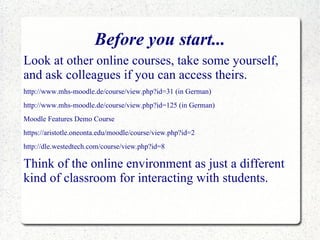
Before you start... Look at other online courses, take some yourself, and ask colleagues if you can access theirs. http://www.mhs-moodle.de/course/view.php?id=31  (in German)
http://www.mhs-moodle.de/course/view.php?id=125  (in German)
Moodle Features Demo Course
https://aristotle.oneonta.edu/moodle/course/view.php?id=2
http://dle.westedtech.com/course/view.php?id=8 Think of the online environment as just a different kind of classroom for interacting with students.
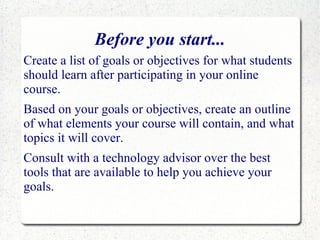
Before you start... Create a list of goals or objectives for what students should learn after participating in your online course.
Based on your goals or objectives, create an outline of what elements your course will contain, and what topics it will cover.
Consult with a technology advisor over the best tools that are available to help you achieve your goals.
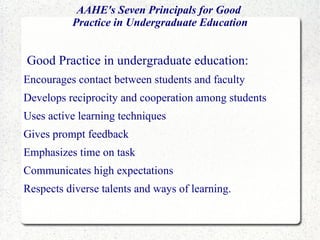
AAHE's Seven Principals for Good  Practice in Undergraduate Education Good Practice in undergraduate education: Encourages contact between students and faculty
Develops reciprocity and cooperation among students
Uses active learning techniques
Gives prompt feedback
Emphasizes time on task
Communicates high expectations
Respects diverse talents and ways of learning.
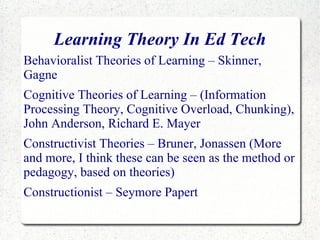
Learning Theory In Ed Tech Behavioralist Theories of Learning – Skinner, Gagne
Cognitive Theories of Learning – (Information Processing Theory, Cognitive Overload, Chunking), John Anderson, Richard E. Mayer
Constructivist Theories – Bruner, Jonassen (More and more, I think these can be seen as the method or pedagogy, based on theories)
Constructionist – Seymore Papert
Shades of Constructivism Early educational technology methods were heavily behavioralist, but constructivist approaches dominate in educational technology today.
Cognitive constructivism might be viewed as falling more into the realm of educational psychology and is focused on how the learner constructs knowledge internally
Social (radical) constructivism focuses on how knowledge is constructed through social interaction

UniSon Workshop 2006