ELearningImprove Your Facilitation SkillsPrepare Your Students for ElearningTasks To Do Before Your Class Starts
  “Chat, discussion questions, and voice over IP are useful to connect students and are seen as student-centered technologies” Bill Hopkinson
For example, one participant stated, ‘I currently have a group of students, and during a recent feedback request, the responses were heavily centered on: "I need an instructor to tell me what to do/think/know".
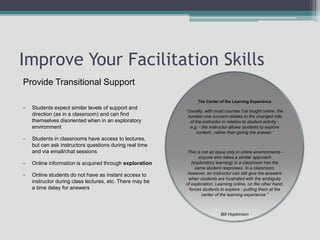
Improve Your Facilitation SkillsThe Center of the Learning Experience“Usually, with most courses I've taught online, the number one concern relates to the changed role of the instructor in relation to student activity - e.g. - the instructor allows students to explore content...rather than giving the answer.’ This is not an issue only in online environments - anyone who takes a similar approach (exploratory learning) in a classroom has the same student responses. In a classroom, however, an instructor can still give the answers when students are frustrated with the ambiguity of exploration. Learning online, on the other hand, forces students to explore - putting them at the center of the learning experience.”Bill HopkinsonProvide Transitional SupportStudents expect similar levels of support and direction (as in a classroom) and can find themselves disoriented when in an exploratory environmentStudents in classrooms have access to lectures, but can ask instructors questions during real time and via email/chat sessionsOnline information is acquired through explorationOnline students do not have as instant access to instructor during class lectures, etc. There may be a time delay for answers
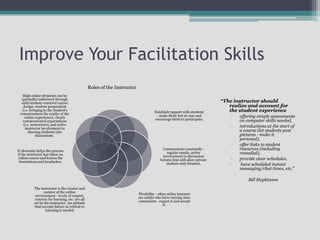
Improve Your Facilitation Skills“The instructor should realize and account for the student experienceoffering simple assessments on computer skills needed,introductions at the start of a course (let students post pictures - make it personal), offer links to student resources (including remedial),provide clear schedules, have scheduled instant messaging/chat times, etc.”Bill Hopkinson
Prepare Your Students for ELearning“The type of learning, formal or informal, impacts student preparation. Often, formal elearning (online course) tend to create preparation resources that help students to "take a course" (versus learning). This may perpetuate continued dependence on the instructor or course as the "source" of knowledge. Informal learning is learning that occurs independently and often without direction. Few resources are available to prepare for this type of learning.”Bill HopkinsonRegardless of the formality of online learning, basic computer and Internet skill, decent connection are a must. These are, however, foundational skills that must be developed in students before learning can occur. They may not be included in every course, but remedial resources should always be listed to direct students to additional help.These may be accurate requirements (and important information) for learning online, but the emphasis is not explicitly on learning - it is how to function effectively according to the manner in which the course is designed. Informal learning (like listservs, Internet searches, or even this "noncourse") have few restrictions and allow learners to perform at their own level of need.
Prepare Your Students for ELearningRole of the StudentOnline students can contribute to successful learning and preparation through the following: Awareness - evaluate expectations, assess time needed to complete work, understand motivations/value of the learning, assess personal skills -technical and study skillsOrientation - online, a student goes through several stages before engaging the content - the computer, internet, the virtual classroom, software, instructor and students, and finally the content. Different students will enter a course at different levels of preparedness...but in online courses, and instructor should be able to accommodate a student at any levelDisciplined - follow course schedule and complete assignmentsOrganized - schedule study time and online time to ensure all course obligations are metSelf-directed - able to motivate her/himself...ask for help when needed, etc.Internal or externally motivated (ie, some requirement or just because it's something that really interests them). “Student preparation is not exclusively the responsibility of the instructor. One of the defining traits of online learning is the increased independence of learners.”Bill Hopkinson
Tasks to Complete Before Your Course StartsIf this is the first course you've taught online (in this environment), this is what you should do:Identify tech support availableTake an online course as a student Familiarize yourself with the tools and support available If this is the first time you've taught this course online, Pilot the course - with colleagues and potential students,Prepare a "back up plan" for technology/server failureIf you are assembling (some of) the elements of an online course that you or others are going to teach:Pilot the course - with colleagues and potential studentsBack up the course contentPrepare or determine support mechanisms for students and instructorsEnsure workload and assignments are reasonable, but challengingVerify that copyright/IP concerns have been addressed Things you have to do for every course even if none of the above applyPrepare learners - send out welcome emailsTest linksTest assumptions about student readiness and technology access (i.e. are some students on 56k? if so, how will video work? or even complex activities?)Plan a course initiation activity - phone conference, chat, in person...this activity should focus on connecting students with each other...and create a degree of comfort
Learning StylesStudent's learning styles will obviously impact their success online. Students may benefit from understanding their own learning style by completing and online questionnaire. Students have different learning styles--characteristic strengths and preferences in the ways they take in and process information. Some students tend to focus on facts, data, and algorithms; others are more comfortable with theories and mathematical models. Some respond strongly to visual forms of information, like pictures, diagrams, and schematics; others get more from verbal forms--written and spoken explanations. Some prefer to learn actively and interactively; others function more introspectively and individually...A learning style model is useful if balancing instruction on each of the model dimensions meets the learning needs of essentially all students in a class."
Successful preparation for online learning is not significantly different from classroom preparation. As with any new concept, however, it is important for an instructor to communicate how existing practices integrate with a new concept (in this case, learning online).ConclusionHigh dropout rates are not a function of the online learning environment.  They are a function of :poor course design

E learning2

  • 1.
    ELearningImprove Your FacilitationSkillsPrepare Your Students for ElearningTasks To Do Before Your Class Starts
  • 2.
      “Chat, discussion questions,and voice over IP are useful to connect students and are seen as student-centered technologies” Bill Hopkinson
  • 3.
    For example, oneparticipant stated, ‘I currently have a group of students, and during a recent feedback request, the responses were heavily centered on: "I need an instructor to tell me what to do/think/know".
  • 4.
    Improve Your FacilitationSkillsThe Center of the Learning Experience“Usually, with most courses I've taught online, the number one concern relates to the changed role of the instructor in relation to student activity - e.g. - the instructor allows students to explore content...rather than giving the answer.’ This is not an issue only in online environments - anyone who takes a similar approach (exploratory learning) in a classroom has the same student responses. In a classroom, however, an instructor can still give the answers when students are frustrated with the ambiguity of exploration. Learning online, on the other hand, forces students to explore - putting them at the center of the learning experience.”Bill HopkinsonProvide Transitional SupportStudents expect similar levels of support and direction (as in a classroom) and can find themselves disoriented when in an exploratory environmentStudents in classrooms have access to lectures, but can ask instructors questions during real time and via email/chat sessionsOnline information is acquired through explorationOnline students do not have as instant access to instructor during class lectures, etc. There may be a time delay for answers
  • 5.
    Improve Your FacilitationSkills“The instructor should realize and account for the student experienceoffering simple assessments on computer skills needed,introductions at the start of a course (let students post pictures - make it personal), offer links to student resources (including remedial),provide clear schedules, have scheduled instant messaging/chat times, etc.”Bill Hopkinson
  • 6.
    Prepare Your Studentsfor ELearning“The type of learning, formal or informal, impacts student preparation. Often, formal elearning (online course) tend to create preparation resources that help students to "take a course" (versus learning). This may perpetuate continued dependence on the instructor or course as the "source" of knowledge. Informal learning is learning that occurs independently and often without direction. Few resources are available to prepare for this type of learning.”Bill HopkinsonRegardless of the formality of online learning, basic computer and Internet skill, decent connection are a must. These are, however, foundational skills that must be developed in students before learning can occur. They may not be included in every course, but remedial resources should always be listed to direct students to additional help.These may be accurate requirements (and important information) for learning online, but the emphasis is not explicitly on learning - it is how to function effectively according to the manner in which the course is designed. Informal learning (like listservs, Internet searches, or even this "noncourse") have few restrictions and allow learners to perform at their own level of need.
  • 7.
    Prepare Your Studentsfor ELearningRole of the StudentOnline students can contribute to successful learning and preparation through the following: Awareness - evaluate expectations, assess time needed to complete work, understand motivations/value of the learning, assess personal skills -technical and study skillsOrientation - online, a student goes through several stages before engaging the content - the computer, internet, the virtual classroom, software, instructor and students, and finally the content. Different students will enter a course at different levels of preparedness...but in online courses, and instructor should be able to accommodate a student at any levelDisciplined - follow course schedule and complete assignmentsOrganized - schedule study time and online time to ensure all course obligations are metSelf-directed - able to motivate her/himself...ask for help when needed, etc.Internal or externally motivated (ie, some requirement or just because it's something that really interests them). “Student preparation is not exclusively the responsibility of the instructor. One of the defining traits of online learning is the increased independence of learners.”Bill Hopkinson
  • 8.
    Tasks to CompleteBefore Your Course StartsIf this is the first course you've taught online (in this environment), this is what you should do:Identify tech support availableTake an online course as a student Familiarize yourself with the tools and support available If this is the first time you've taught this course online, Pilot the course - with colleagues and potential students,Prepare a "back up plan" for technology/server failureIf you are assembling (some of) the elements of an online course that you or others are going to teach:Pilot the course - with colleagues and potential studentsBack up the course contentPrepare or determine support mechanisms for students and instructorsEnsure workload and assignments are reasonable, but challengingVerify that copyright/IP concerns have been addressed Things you have to do for every course even if none of the above applyPrepare learners - send out welcome emailsTest linksTest assumptions about student readiness and technology access (i.e. are some students on 56k? if so, how will video work? or even complex activities?)Plan a course initiation activity - phone conference, chat, in person...this activity should focus on connecting students with each other...and create a degree of comfort
  • 9.
    Learning StylesStudent's learningstyles will obviously impact their success online. Students may benefit from understanding their own learning style by completing and online questionnaire. Students have different learning styles--characteristic strengths and preferences in the ways they take in and process information. Some students tend to focus on facts, data, and algorithms; others are more comfortable with theories and mathematical models. Some respond strongly to visual forms of information, like pictures, diagrams, and schematics; others get more from verbal forms--written and spoken explanations. Some prefer to learn actively and interactively; others function more introspectively and individually...A learning style model is useful if balancing instruction on each of the model dimensions meets the learning needs of essentially all students in a class."
  • 10.
    Successful preparation foronline learning is not significantly different from classroom preparation. As with any new concept, however, it is important for an instructor to communicate how existing practices integrate with a new concept (in this case, learning online).ConclusionHigh dropout rates are not a function of the online learning environment. They are a function of :poor course design