Assignment Writing
at University
Gino Fransman
Academic Development Professional
Nelson Mandela University
2017
https://twitter.com/housekeepingldn
The Line-Up
Remembering University Requirements
Types of Questions
• Short Questions
• - Definitions
• -Multiple Choice Questions
Basic Structure of Short Writing Responses
Longer Writing Responses: Introductions
Essays in Assignments and Exams
Feel free to go online and visit resources referred
to during the session.
The aim is not to suggest that after this 1,5 hour
session,
you will be a better writer.
But: I bet you’ll think about it more constructively.
This is an introduction.
You should explore related materials located by
clicking on the links to pages provided.
They take you much further.
Please note down questions you may have during any
screened video clips for afterward.
Types of Questions
Short Questions
Definitions/ Terminology
Multiple Choice Questions
Essays, or longer pieces of writing.
These often test the language of your discipline...
Can you speak it?
What is ‘different’ with writing at university?
What are your writing challenges at university?
Let’s write as many of each down as possible.
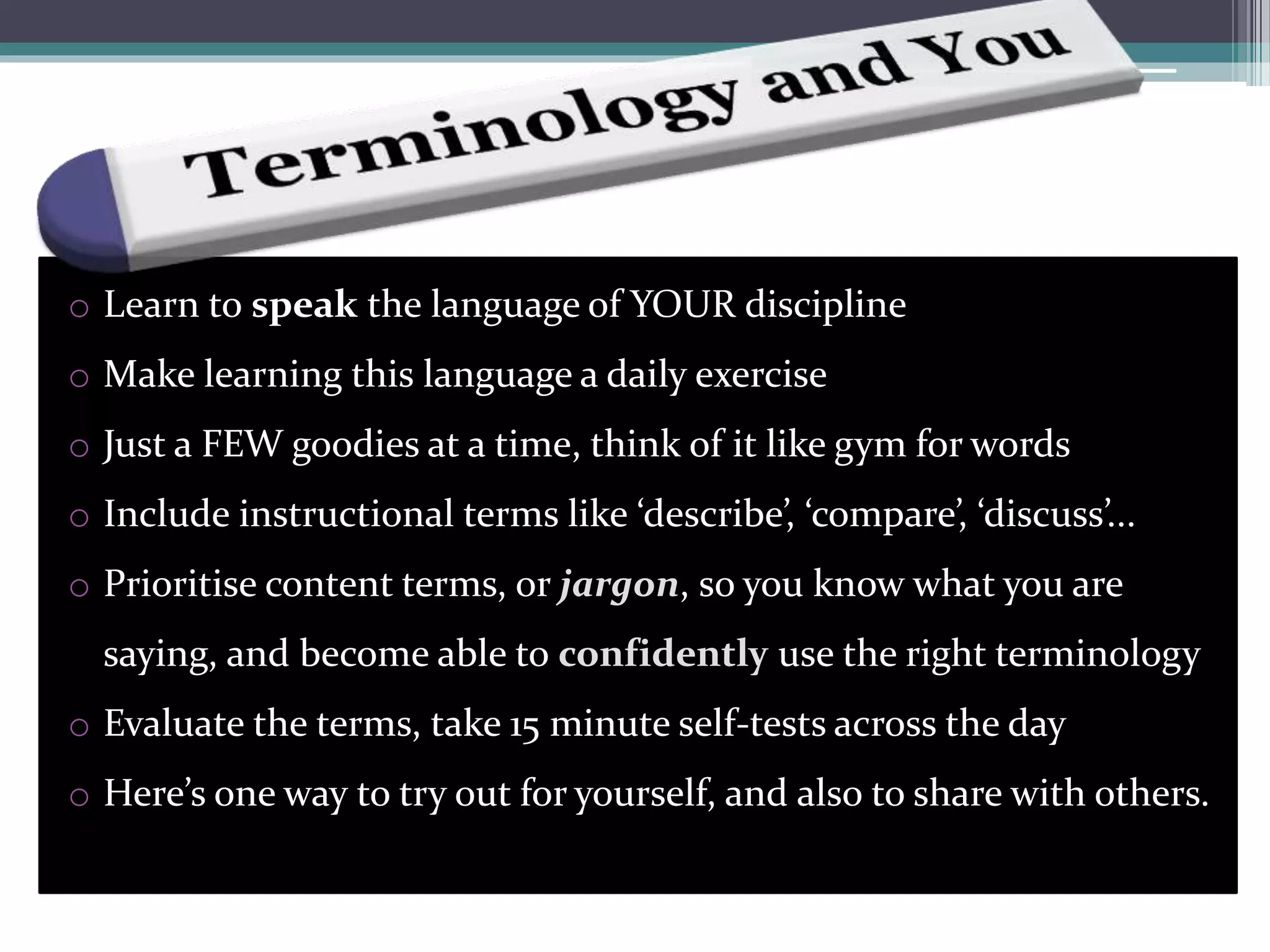
o Learn to speak the language of YOUR discipline
o Make learning this language a daily exercise
o Just a FEW goodies at a time, think of it like gym for words
o Include instructional terms like ‘describe’, ‘compare’, ‘discuss’...
o Prioritise content terms, or jargon, so you know what you are
saying, and become able to confidently use the right terminology
o Evaluate the terms, take 15 minute self-tests across the day
o Here’s one way to try out for yourself, and also to share with others.
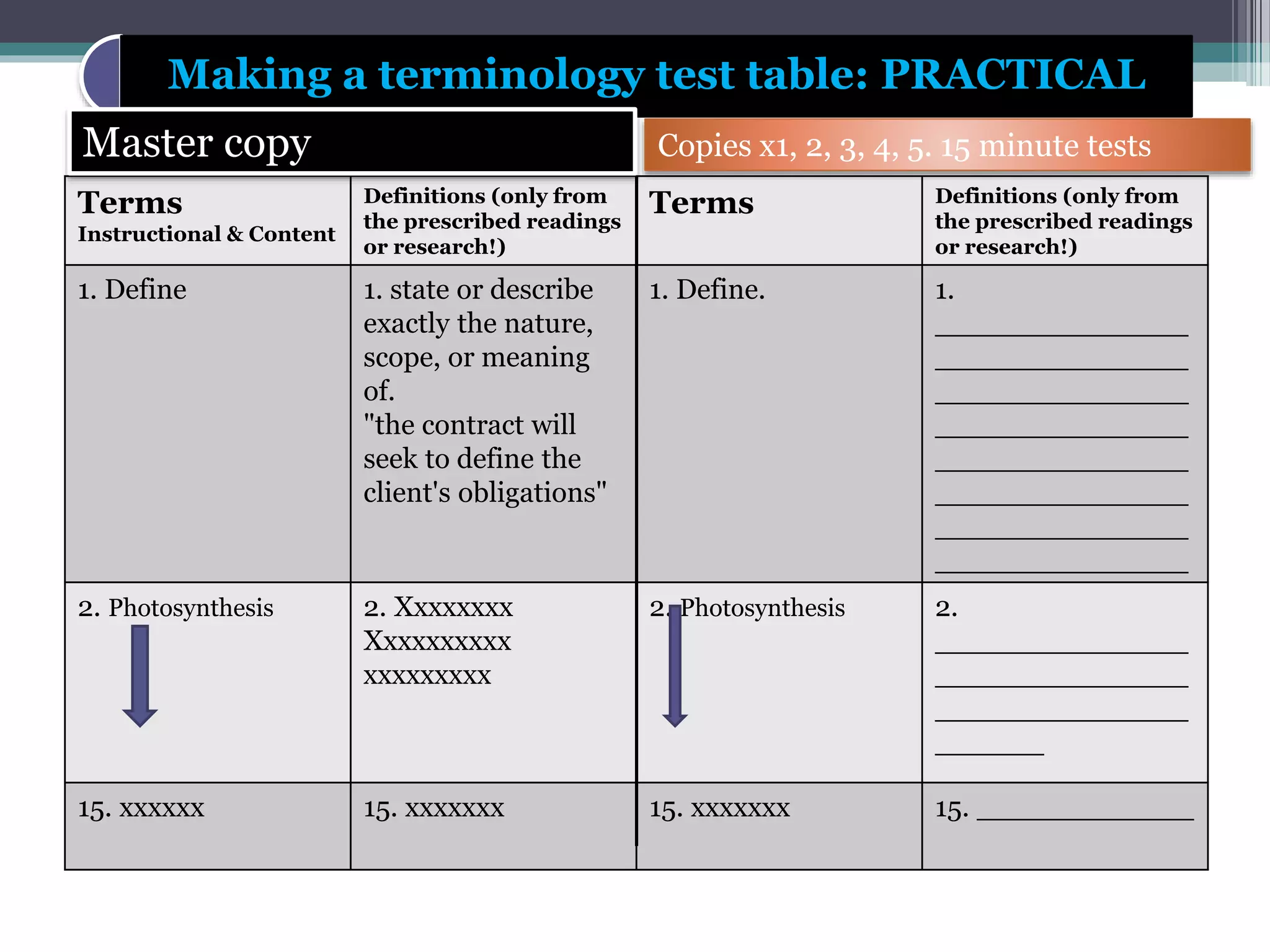
Terms
Instructional & Content
Definitions (only from
the prescribed readings
or research!)
Terms Definitions (only from
the prescribed readings
or research!)
1. Define 1. state or describe
exactly the nature,
scope, or meaning
of.
"the contract will
seek to define the
client's obligations"
1. Define. 1.
______________
______________
______________
______________
______________
______________
______________
______________
2. Photosynthesis 2. Xxxxxxxx
Xxxxxxxxxx
xxxxxxxxx
2. Photosynthesis 2.
______________
______________
______________
______
15. xxxxxx 15. xxxxxxx 15. xxxxxxx 15. ____________
Making a terminology test table: PRACTICAL
Master copy Copies x1, 2, 3, 4, 5. 15 minute tests
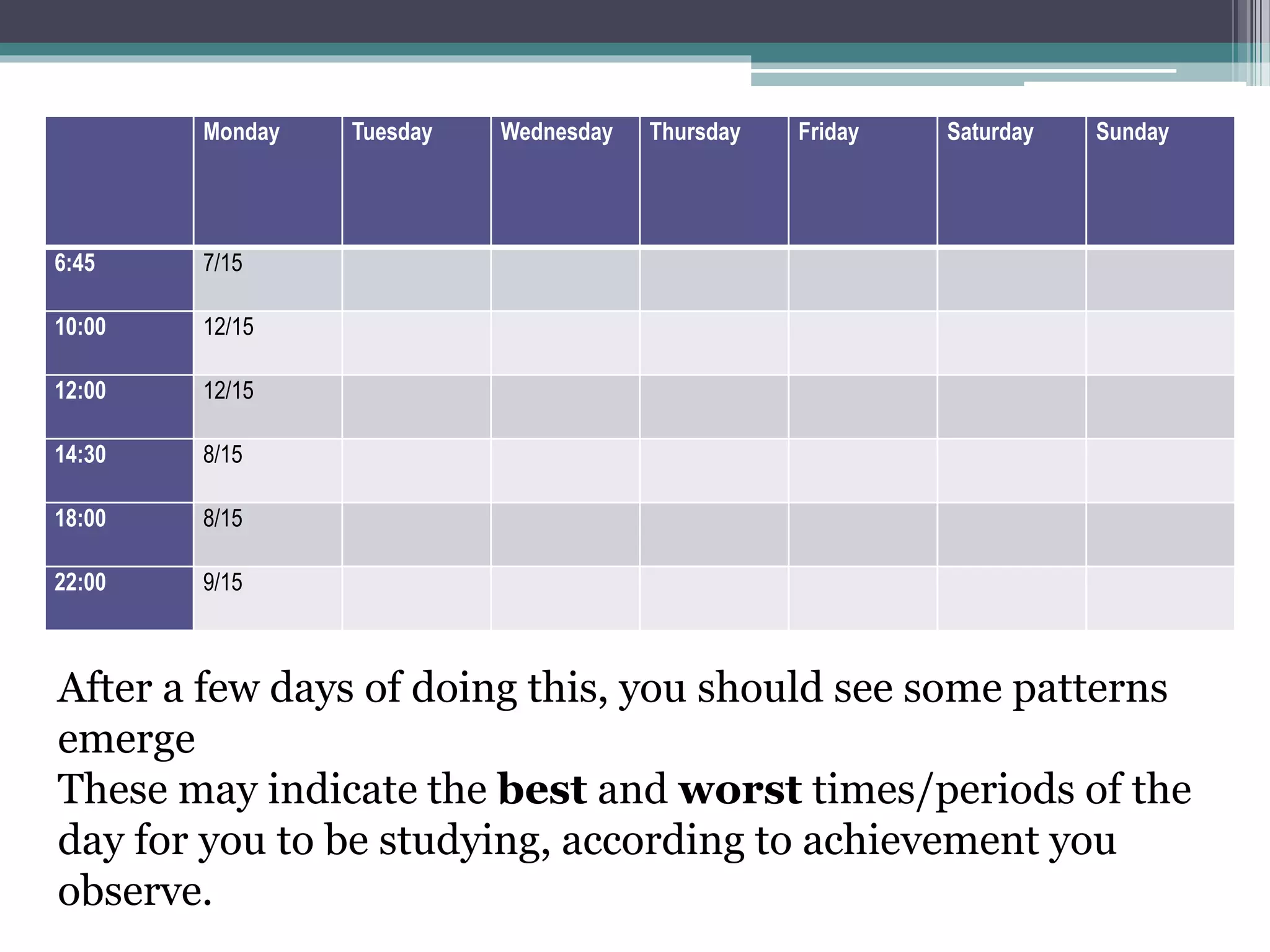
Monday Tuesday Wednesday Thursday Friday Saturday Sunday
6:45 7/15
10:00 12/15
12:00 12/15
14:30 8/15
18:00 8/15
22:00 9/15
After a few days of doing this, you should see some patterns
emerge
These may indicate the best and worst times/periods of the
day for you to be studying, according to achievement you
observe.
Write.
RE:presenting Units of Information
Taking the
Basic Structure Further
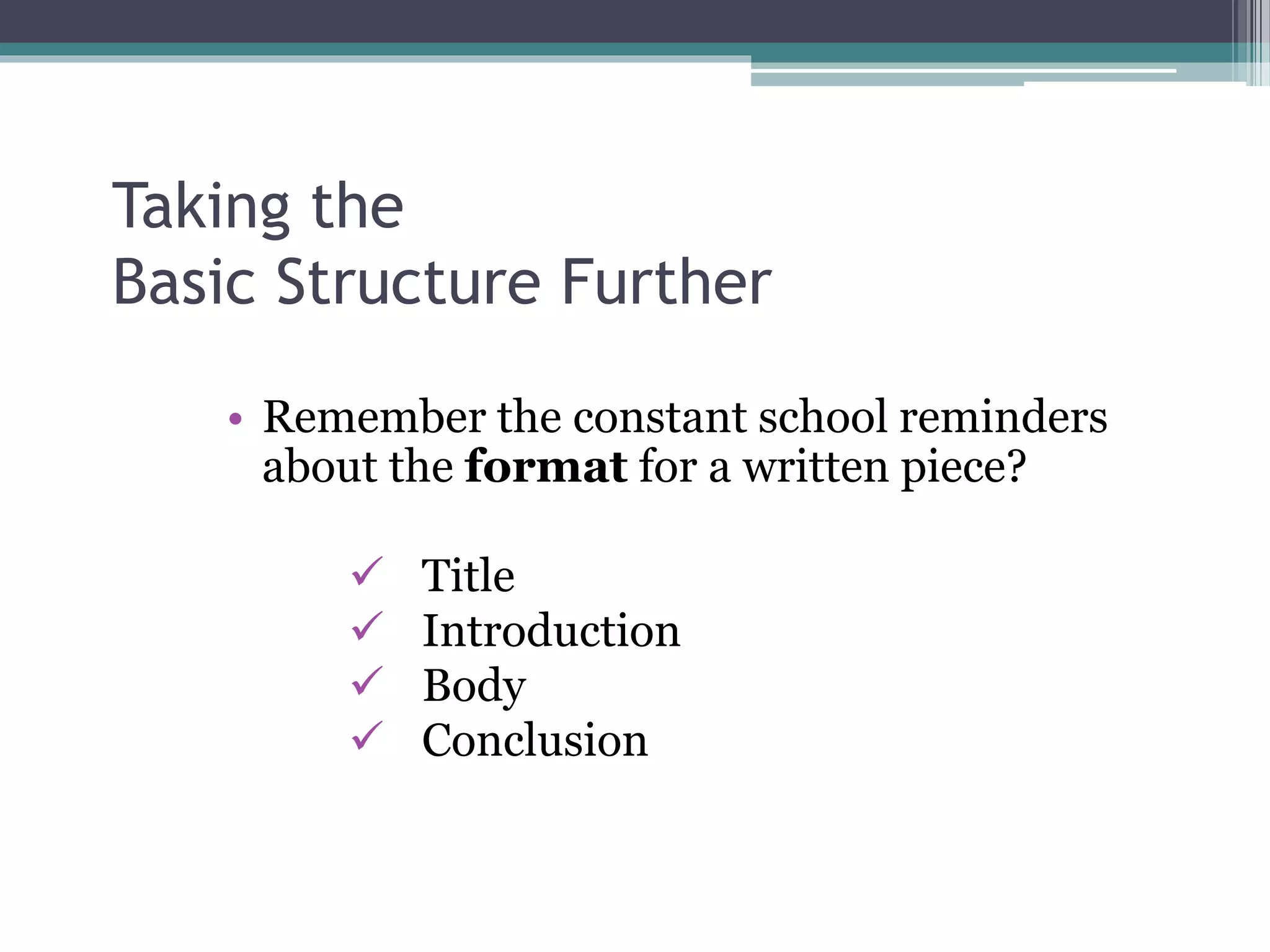
• Remember the constant school reminders
about the format for a written piece?
 Title
 Introduction
 Body
 Conclusion
Practical – Let’s Write.
Writing at School
Revisiting the Basics
for University
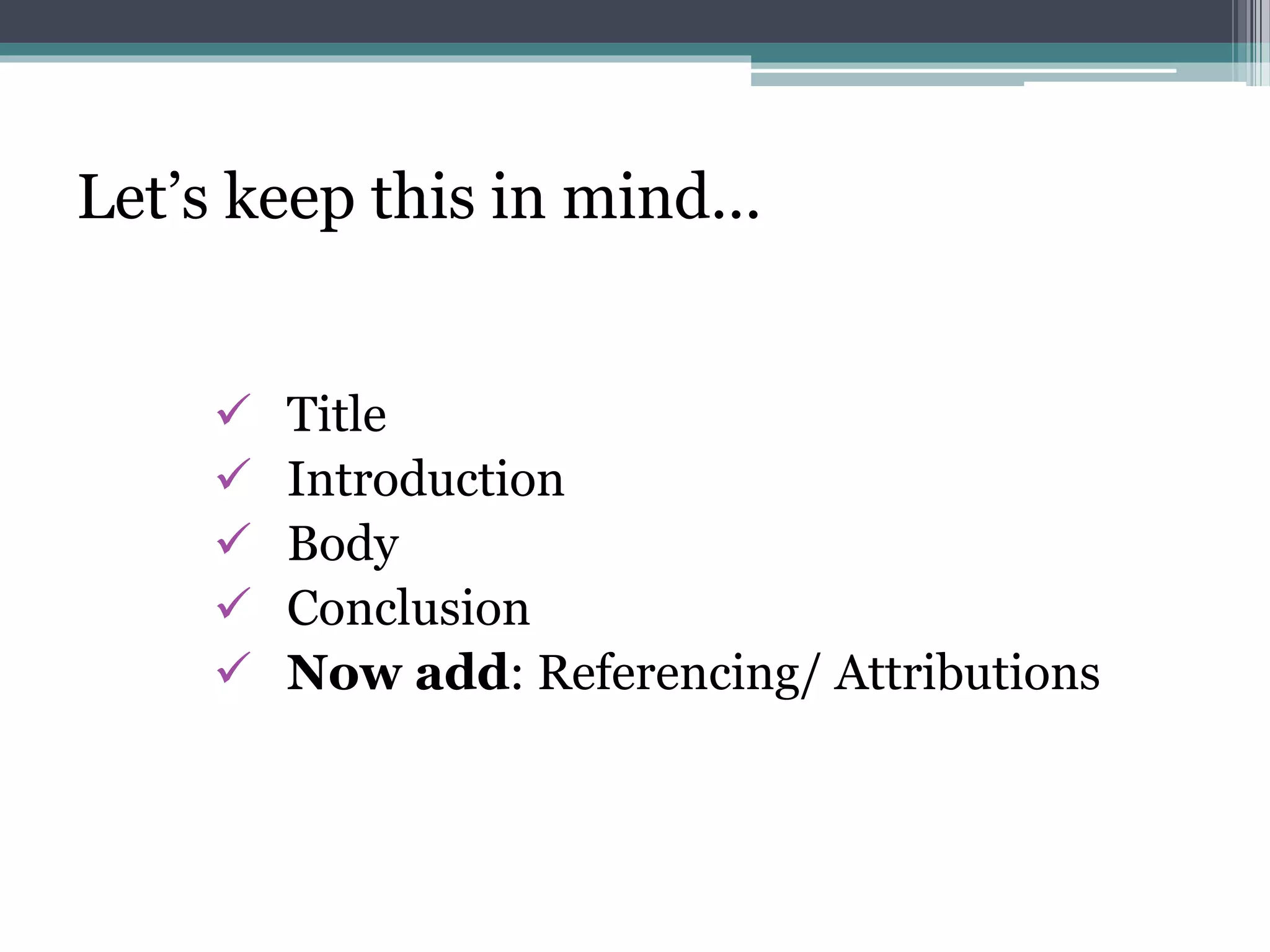
Let’s keep this in mind...
 Title
 Introduction
 Body
 Conclusion
 Now add: Referencing/ Attributions
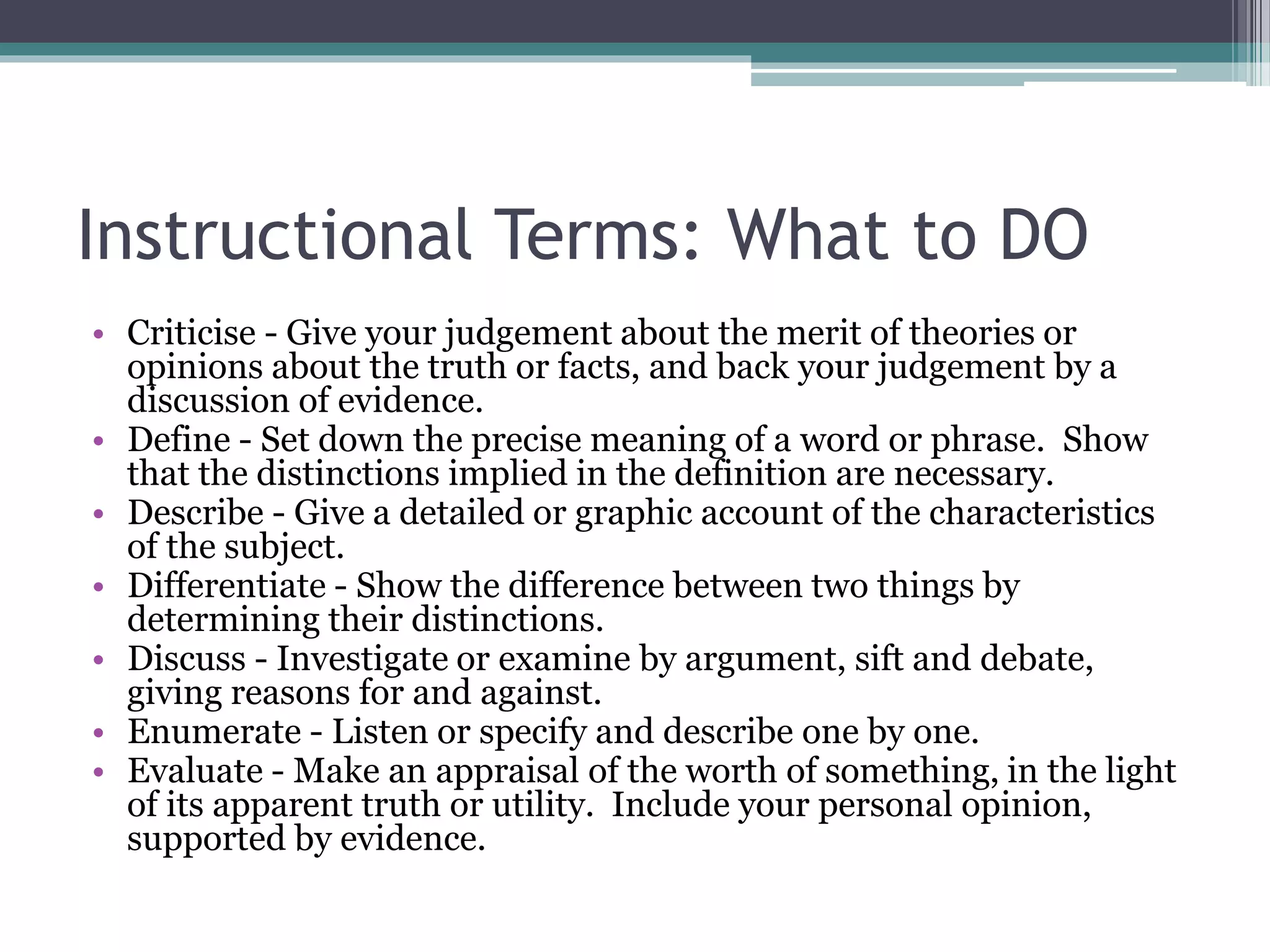
Instructional Terms: What to DO
• Criticise - Give your judgement about the merit of theories or
opinions about the truth or facts, and back your judgement by a
discussion of evidence.
• Define - Set down the precise meaning of a word or phrase. Show
that the distinctions implied in the definition are necessary.
• Describe - Give a detailed or graphic account of the characteristics
of the subject.
• Differentiate - Show the difference between two things by
determining their distinctions.
• Discuss - Investigate or examine by argument, sift and debate,
giving reasons for and against.
• Enumerate - Listen or specify and describe one by one.
• Evaluate - Make an appraisal of the worth of something, in the light
of its apparent truth or utility. Include your personal opinion,
supported by evidence.
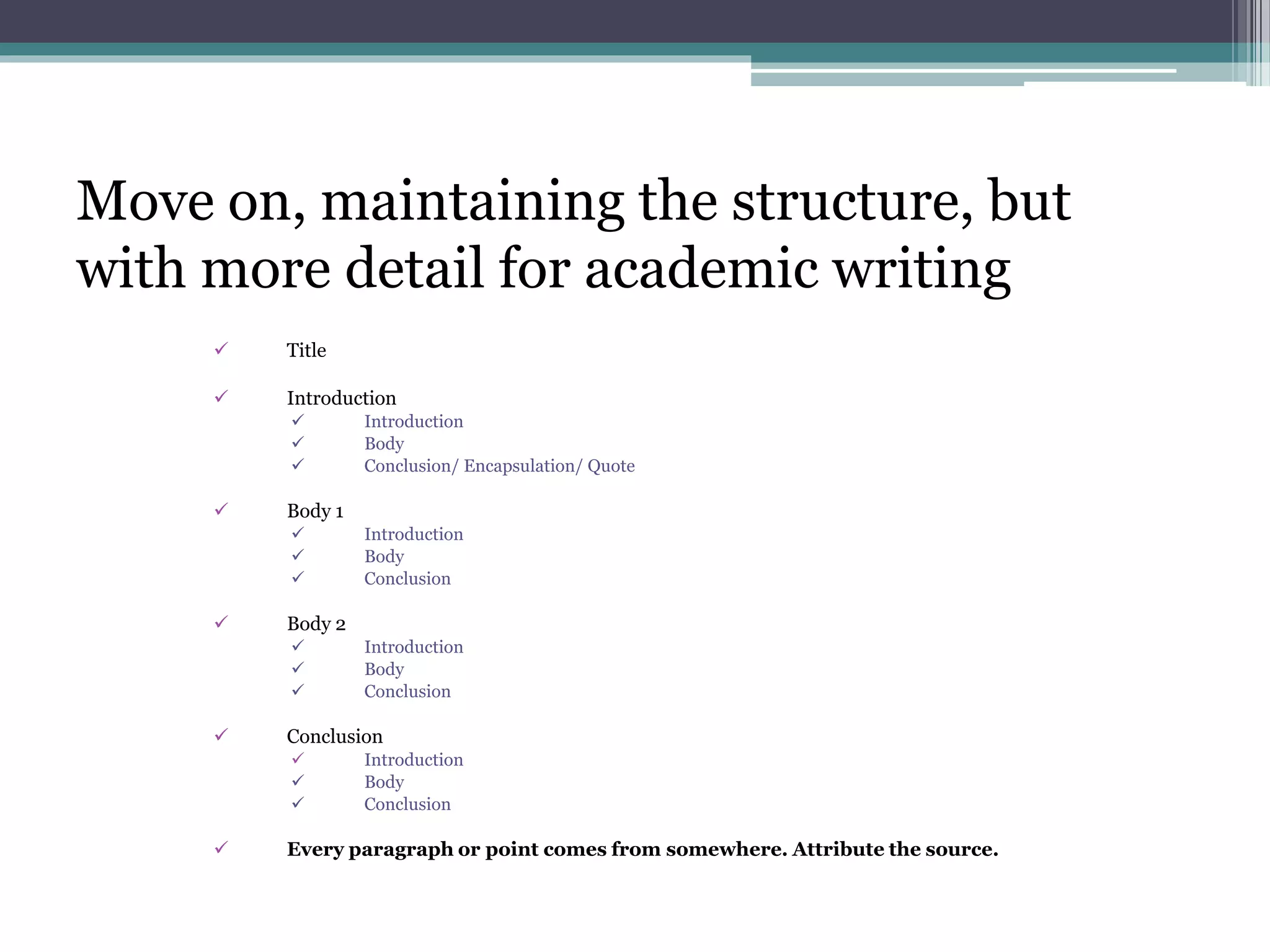
Move on, maintaining the structure, but
with more detail for academic writing
 Title
 Introduction
 Introduction
 Body
 Conclusion/ Encapsulation/ Quote
 Body 1
 Introduction
 Body
 Conclusion
 Body 2
 Introduction
 Body
 Conclusion
 Conclusion
 Introduction
 Body
 Conclusion
 Every paragraph or point comes from somewhere. Attribute the source.
Plagiarism and Referencing
Watch
https://www.youtube.com/watch?v=SEeTSaxCEQg
Academic Writing
Plagiarism and Referencing
Richard Galletly
Take Notes!
This video is available as part of a collection of shared open educational
resources for the FAVOR project and available in
languagebox.ac.uk/profile/1239.
What are your
questions about
plagiarism and
referencing?
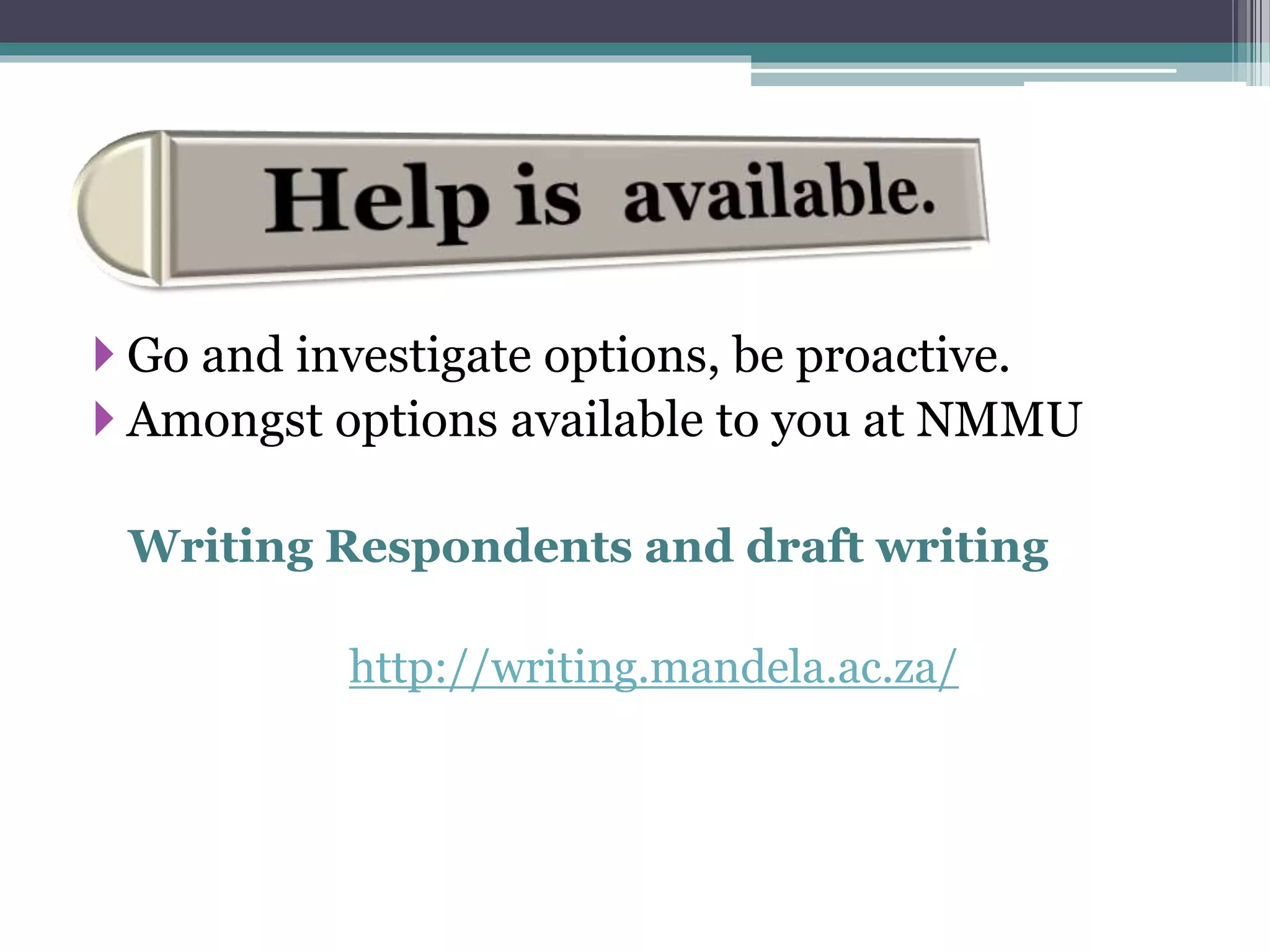
 Go and investigate options, be proactive.
 Amongst options available to you at NMMU
Writing Respondents and draft writing
http://writing.mandela.ac.za/
Process of submitting draft writing to the Writing Centre
http://forms.nmmu.ac.za/writingcentre/registration/
Select the correct campus, and fill in all the sections.
Visit
Academic Literacy Development Scoopit Site
http://www.scoop.it/t/academic-literacy-development
21st Century Graduate Literacies Scoopit Site
http://www.scoop.it/t/21st-century-graduate-literacies
gino.fransman@mandela.ac.za
Twitter: @ginofransman
Assignment Writing at University 2017 by Gino Fransman is licensed under a
Creative Commons Attribution-ShareAlike 4.0 International License
All Images Property Of G. Fransman Unless Otherwise Attributed

Assignment writing at university 2017 ginofransman

  • 1.
    Assignment Writing at University GinoFransman Academic Development Professional Nelson Mandela University 2017
  • 2.
  • 3.
    The Line-Up Remembering UniversityRequirements Types of Questions • Short Questions • - Definitions • -Multiple Choice Questions Basic Structure of Short Writing Responses Longer Writing Responses: Introductions Essays in Assignments and Exams
  • 4.
    Feel free togo online and visit resources referred to during the session. The aim is not to suggest that after this 1,5 hour session, you will be a better writer. But: I bet you’ll think about it more constructively.
  • 5.
    This is anintroduction. You should explore related materials located by clicking on the links to pages provided. They take you much further. Please note down questions you may have during any screened video clips for afterward.
  • 7.
    Types of Questions ShortQuestions Definitions/ Terminology Multiple Choice Questions Essays, or longer pieces of writing. These often test the language of your discipline... Can you speak it?
  • 8.
    What is ‘different’with writing at university? What are your writing challenges at university? Let’s write as many of each down as possible.
  • 9.
    o Learn tospeak the language of YOUR discipline o Make learning this language a daily exercise o Just a FEW goodies at a time, think of it like gym for words o Include instructional terms like ‘describe’, ‘compare’, ‘discuss’... o Prioritise content terms, or jargon, so you know what you are saying, and become able to confidently use the right terminology o Evaluate the terms, take 15 minute self-tests across the day o Here’s one way to try out for yourself, and also to share with others.
  • 10.
    Terms Instructional & Content Definitions(only from the prescribed readings or research!) Terms Definitions (only from the prescribed readings or research!) 1. Define 1. state or describe exactly the nature, scope, or meaning of. "the contract will seek to define the client's obligations" 1. Define. 1. ______________ ______________ ______________ ______________ ______________ ______________ ______________ ______________ 2. Photosynthesis 2. Xxxxxxxx Xxxxxxxxxx xxxxxxxxx 2. Photosynthesis 2. ______________ ______________ ______________ ______ 15. xxxxxx 15. xxxxxxx 15. xxxxxxx 15. ____________ Making a terminology test table: PRACTICAL Master copy Copies x1, 2, 3, 4, 5. 15 minute tests
  • 11.
    Monday Tuesday WednesdayThursday Friday Saturday Sunday 6:45 7/15 10:00 12/15 12:00 12/15 14:30 8/15 18:00 8/15 22:00 9/15 After a few days of doing this, you should see some patterns emerge These may indicate the best and worst times/periods of the day for you to be studying, according to achievement you observe.
  • 12.
  • 13.
    Taking the Basic StructureFurther • Remember the constant school reminders about the format for a written piece?  Title  Introduction  Body  Conclusion
  • 14.
    Practical – Let’sWrite. Writing at School Revisiting the Basics for University
  • 15.
    Let’s keep thisin mind...  Title  Introduction  Body  Conclusion  Now add: Referencing/ Attributions
  • 16.
    Instructional Terms: Whatto DO • Criticise - Give your judgement about the merit of theories or opinions about the truth or facts, and back your judgement by a discussion of evidence. • Define - Set down the precise meaning of a word or phrase. Show that the distinctions implied in the definition are necessary. • Describe - Give a detailed or graphic account of the characteristics of the subject. • Differentiate - Show the difference between two things by determining their distinctions. • Discuss - Investigate or examine by argument, sift and debate, giving reasons for and against. • Enumerate - Listen or specify and describe one by one. • Evaluate - Make an appraisal of the worth of something, in the light of its apparent truth or utility. Include your personal opinion, supported by evidence.
  • 17.
    Move on, maintainingthe structure, but with more detail for academic writing  Title  Introduction  Introduction  Body  Conclusion/ Encapsulation/ Quote  Body 1  Introduction  Body  Conclusion  Body 2  Introduction  Body  Conclusion  Conclusion  Introduction  Body  Conclusion  Every paragraph or point comes from somewhere. Attribute the source.
  • 18.
    Plagiarism and Referencing Watch https://www.youtube.com/watch?v=SEeTSaxCEQg AcademicWriting Plagiarism and Referencing Richard Galletly Take Notes! This video is available as part of a collection of shared open educational resources for the FAVOR project and available in languagebox.ac.uk/profile/1239.
  • 19.
    What are your questionsabout plagiarism and referencing?
  • 20.
     Go andinvestigate options, be proactive.  Amongst options available to you at NMMU Writing Respondents and draft writing http://writing.mandela.ac.za/
  • 21.
    Process of submittingdraft writing to the Writing Centre http://forms.nmmu.ac.za/writingcentre/registration/ Select the correct campus, and fill in all the sections.
  • 22.
    Visit Academic Literacy DevelopmentScoopit Site http://www.scoop.it/t/academic-literacy-development 21st Century Graduate Literacies Scoopit Site http://www.scoop.it/t/21st-century-graduate-literacies gino.fransman@mandela.ac.za Twitter: @ginofransman Assignment Writing at University 2017 by Gino Fransman is licensed under a Creative Commons Attribution-ShareAlike 4.0 International License All Images Property Of G. Fransman Unless Otherwise Attributed