
Subject: Building Services(3360309)
Topic: Fire resistive construction
Sr. no. Name Enrollment no.
1 Bhavesh Hathila 156300306047
2 Patel M. Jahir 156300306090
INDEX
 Introduction
 Types of construction
 Fire resistant building material
 Fire resistant glass for windows
 Concrete
 Stucco
 Gypsum
 Brick
INTRODUCTION
 Aim :
To provide better or more protection against building with the use of fire
resistive Construction materials to increase the safety of life and property.
 OBJECTIVE :
• To study the meaning of fire safety in a building.
• To enlist the various materials and techniques of fire resistance.
• To identify the fire resistive effect of different dimensions of materials.
• To understand the fire resistive ratings of different materials.
• To analyze the literature study and conclude the dissertation.
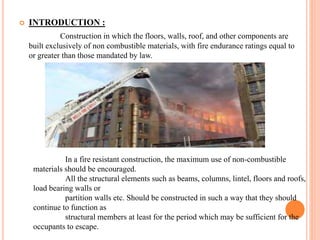
 INTRODUCTION :
Construction in which the floors, walls, roof, and other components are
built exclusively of non combustible materials, with fire endurance ratings equal to
or greater than those mandated by law.
In a fire resistant construction, the maximum use of non-combustible
materials should be encouraged.
All the structural elements such as beams, columns, lintel, floors and roofs,
load bearing walls or
partition walls etc. Should be constructed in such a way that they should
continue to function as
structural members at least for the period which may be sufficient for the
occupants to escape.
TYPES OF CONSTRUCTION
1. Fireproof construction
2. Non-combustible construction
3. Exterior protected construction
4. Wood construction
 Fireproof construction
 Construction of buildings that resist fire damage and prevent the spread of
fire.
 Fireproof building containing only no burning components, Such as steel,
terra-cotta,plaster, and concrete
 Fire-resistance requirements can range from 3 to 4 hour.
 Buildings may be used as high-rise office buildings, shopping centres, or
residential units.
 For buildings 15 m in height or above.
 Buildings may be used as high-rise office buildings, shopping centres, or
residential units.
 Fire-resistance requirements have the following ratings as a range.
 Exterior bearing walls: 3 to 4 hours.
 Interior bearing walls: 2 to 4 hours.
 Columns: 2 to 4 hours.
 Beams, girders, trusses, and arches: 2 to 4 hours.
 Floors: 2 to 3 hours.
 Roof: 1-1/2 to 2 hours.
 NONCOMBUSTIBLE CONSTRUCTION
 Construction using masonry materials, Brick or concrete, on the outside
walls of the structure,
 And non combustible materials for the roof and floor.
 For buildings 15 m in height or above
 Fire-resistance requirements can range from 2to 3 hour.
 Construction using masonry materials, Brick or concrete, on the outside
walls of the structure, And
 Non combustible materials for the roof and floor.
 Buildings may be used as office buildings.
 Fire-resistance requirements shall have, as a minimum, the following
ratings:
 Exterior bearing walls: 0 to 2 hours.
 Interior bearing walls: 0 to 2 hours.
 Columns: 0 to 2 hours.
 Beams, girders, trusses, arches: 0 to 2 hours.
 Floors: 0 to 2 hours.
 Roof: 0 to 1 hour.
 EXTERIOR PROTECTED CONSTRUCTION (Ordinary Building)
 Construction in which all structural elements of exterior walls are of non-
combustible materials
 Fire-resistance requirements for all elements can range from 0 to 1 hour.
 Buildings may be retail stores, mixed occupancy, dwellings, and apartment
buildings.
 Only the exterior load-bearing walls shall be non combustible or limited
combustible, and shall have as a
 minimum a 1-hour rating.
 They also may be required to be protected and to have the following
fire-resistance ratings:
 Interior bearing walls: 0 to 1 hour.
 Columns: 0 to 1 hour.
 Beams, girders, trusses, arches: 0 to 1 hour.
 Floors: 0 to 1 hour.
 Roof: 0 to 1 hour.
 WOOD CONSTRUCTION
 The construction in which the exterior wall or bearing wall, roof and floor
wholly or partially of wood
 Structural members are entirely or partially made from wood or other
approved combustible material.
 Fire-resistance requirements for all elements can range from 0 to 1 hour.
 Exterior and interior bearing walls shall have, as a minimum, the
following fire-resistance ratings:
 Exterior bearing walls: 2 hours.
 Interior bearing walls: 1 to 2 hours
FIRE RESISTANT BUILDING
MATERIAL
 FIRE-RESISTANT GLASS FOR WINDOWS
 CONCRETE
 STUCCO
 GYPSUM
 BRICK
FIRE-RESISTANT GLASS FOR WINDOWS
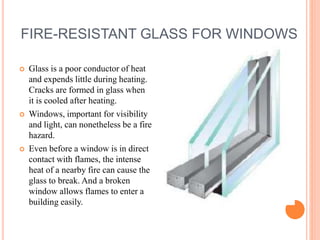
 Glass is a poor conductor of heat
and expends little during heating.
Cracks are formed in glass when
it is cooled after heating.
 Windows, important for visibility
and light, can nonetheless be a fire
hazard.
 Even before a window is in direct
contact with flames, the intense
heat of a nearby fire can cause the
glass to break. And a broken
window allows flames to enter a
building easily.
 In addition, the heat from a fire
outside might be enough to simply
ignite flammable items inside a
home without direct contact.
 To protect your house, consider
installing fire-resistant windows.
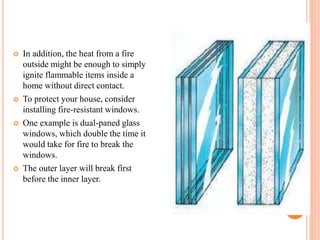
 One example is dual-paned glass
windows, which double the time it
would take for fire to break the
windows.
 The outer layer will break first
before the inner layer.
CONCRETE
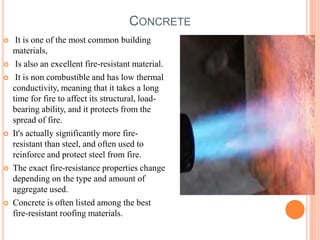
 It is one of the most common building
materials,
 Is also an excellent fire-resistant material.
 It is non combustible and has low thermal
conductivity, meaning that it takes a long
time for fire to affect its structural, load-
bearing ability, and it protects from the
spread of fire.
 It's actually significantly more fire-
resistant than steel, and often used to
reinforce and protect steel from fire.
 The exact fire-resistance properties change
depending on the type and amount of
aggregate used.
 Concrete is often listed among the best
fire-resistant roofing materials.
STUCCO
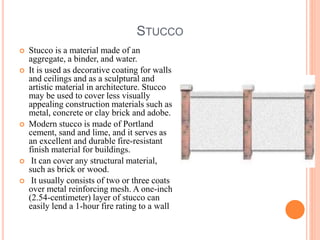
 Stucco is a material made of an
aggregate, a binder, and water.
 It is used as decorative coating for walls
and ceilings and as a sculptural and
artistic material in architecture. Stucco
may be used to cover less visually
appealing construction materials such as
metal, concrete or clay brick and adobe.
 Modern stucco is made of Portland
cement, sand and lime, and it serves as
an excellent and durable fire-resistant
finish material for buildings.
 It can cover any structural material,
such as brick or wood.
 It usually consists of two or three coats
over metal reinforcing mesh. A one-inch
(2.54-centimeter) layer of stucco can
easily lend a 1-hour fire rating to a wall
GYPSUM
 Many structural materials will require underlying
gypsum sheathing in order to achieve a good fire-
resistant rating, and gypsum board is the most
commonly used fire-resistant interior finish.
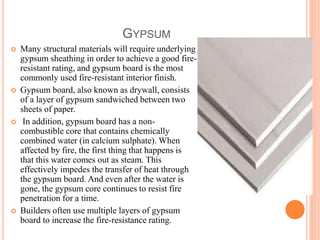
 Gypsum board, also known as drywall, consists
of a layer of gypsum sandwiched between two
sheets of paper.
 In addition, gypsum board has a non-
combustible core that contains chemically
combined water (in calcium sulphate). When
affected by fire, the first thing that happens is
that this water comes out as steam. This
effectively impedes the transfer of heat through
the gypsum board. And even after the water is
gone, the gypsum core continues to resist fire
penetration for a time.
 Builders often use multiple layers of gypsum
board to increase the fire-resistance rating.
BRICK
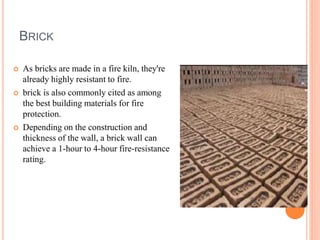
 As bricks are made in a fire kiln, they're
already highly resistant to fire.
 brick is also commonly cited as among
the best building materials for fire
protection.
 Depending on the construction and
thickness of the wall, a brick wall can
achieve a 1-hour to 4-hour fire-resistance
rating.
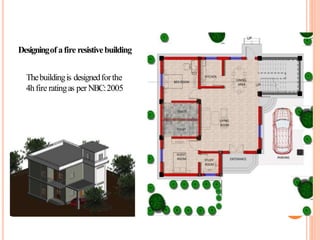
Thebuildingis designedforthe
4hfire ratingas perNBC:2005
Designingof afire resistivebuilding
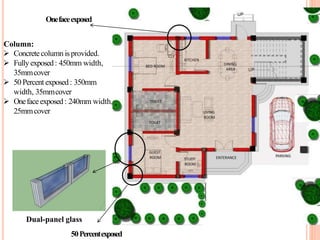
Onefaceexposed
50Percentexposed
Dual-panel glass
Column:
 Concretecolumn is provided.
 Fully exposed: 450mm width,
35mmcover
 50 Percent exposed: 350mm
width, 35mmcover
 Onefaceexposed: 240mm width,
25mmcover
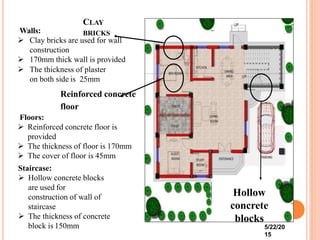
Staircase:
 Hollow concrete blocks
are used for
construction of wall of
staircase
 The thickness of concrete
block is 150mm 5/22/20
15
CLAY
BRICKS
Hollow
concrete
blocks
Walls:
 Clay bricks are used for wall
construction
 170mm thick wall is provided
 The thickness of plaster
on both side is 25mm
Reinforced concrete
floor
Floors:
 Reinforced concrete floor is
provided
 The thickness of floor is 170mm
 The cover of floor is 45mm
STAIR
CASE
CONTD.
 The vent
openings is
provided 5 m
above the
external wall
and top.
The vent
openings
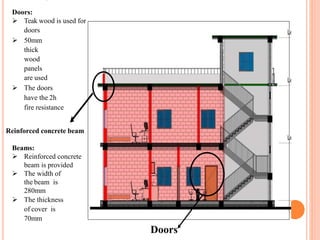
Doors
Doors:
 Teak wood is used for
doors
 50mm
thick
wood
panels
are used
 The doors
have the 2h
fire resistance
Reinforced concrete beam
Beams:
 Reinforced concrete
beam is provided
 The width of
the beam is
280mm
 The thickness
of cover is
70mm
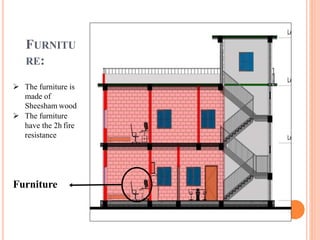
FURNITU
RE:
 The furniture is
made of
Sheesham wood
 The furniture
have the 2h fire
resistance
Furniture
Fire resistive construction

Fire resistive construction

  • 1.
    Subject: Building Services(3360309) Topic:Fire resistive construction
  • 2.
    Sr. no. NameEnrollment no. 1 Bhavesh Hathila 156300306047 2 Patel M. Jahir 156300306090
  • 3.
    INDEX  Introduction  Typesof construction  Fire resistant building material  Fire resistant glass for windows  Concrete  Stucco  Gypsum  Brick
  • 4.
    INTRODUCTION  Aim : Toprovide better or more protection against building with the use of fire resistive Construction materials to increase the safety of life and property.  OBJECTIVE : • To study the meaning of fire safety in a building. • To enlist the various materials and techniques of fire resistance. • To identify the fire resistive effect of different dimensions of materials. • To understand the fire resistive ratings of different materials. • To analyze the literature study and conclude the dissertation.
  • 5.
     INTRODUCTION : Constructionin which the floors, walls, roof, and other components are built exclusively of non combustible materials, with fire endurance ratings equal to or greater than those mandated by law. In a fire resistant construction, the maximum use of non-combustible materials should be encouraged. All the structural elements such as beams, columns, lintel, floors and roofs, load bearing walls or partition walls etc. Should be constructed in such a way that they should continue to function as structural members at least for the period which may be sufficient for the occupants to escape.
  • 6.
    TYPES OF CONSTRUCTION 1.Fireproof construction 2. Non-combustible construction 3. Exterior protected construction 4. Wood construction
  • 7.
     Fireproof construction Construction of buildings that resist fire damage and prevent the spread of fire.  Fireproof building containing only no burning components, Such as steel, terra-cotta,plaster, and concrete  Fire-resistance requirements can range from 3 to 4 hour.  Buildings may be used as high-rise office buildings, shopping centres, or residential units.  For buildings 15 m in height or above.  Buildings may be used as high-rise office buildings, shopping centres, or residential units.
  • 8.
     Fire-resistance requirementshave the following ratings as a range.  Exterior bearing walls: 3 to 4 hours.  Interior bearing walls: 2 to 4 hours.  Columns: 2 to 4 hours.  Beams, girders, trusses, and arches: 2 to 4 hours.  Floors: 2 to 3 hours.  Roof: 1-1/2 to 2 hours.
  • 9.
     NONCOMBUSTIBLE CONSTRUCTION Construction using masonry materials, Brick or concrete, on the outside walls of the structure,  And non combustible materials for the roof and floor.  For buildings 15 m in height or above  Fire-resistance requirements can range from 2to 3 hour.  Construction using masonry materials, Brick or concrete, on the outside walls of the structure, And  Non combustible materials for the roof and floor.  Buildings may be used as office buildings.
  • 10.
     Fire-resistance requirementsshall have, as a minimum, the following ratings:  Exterior bearing walls: 0 to 2 hours.  Interior bearing walls: 0 to 2 hours.  Columns: 0 to 2 hours.  Beams, girders, trusses, arches: 0 to 2 hours.  Floors: 0 to 2 hours.  Roof: 0 to 1 hour.
  • 11.
     EXTERIOR PROTECTEDCONSTRUCTION (Ordinary Building)  Construction in which all structural elements of exterior walls are of non- combustible materials  Fire-resistance requirements for all elements can range from 0 to 1 hour.  Buildings may be retail stores, mixed occupancy, dwellings, and apartment buildings.  Only the exterior load-bearing walls shall be non combustible or limited combustible, and shall have as a  minimum a 1-hour rating.
  • 12.
     They alsomay be required to be protected and to have the following fire-resistance ratings:  Interior bearing walls: 0 to 1 hour.  Columns: 0 to 1 hour.  Beams, girders, trusses, arches: 0 to 1 hour.  Floors: 0 to 1 hour.  Roof: 0 to 1 hour.
  • 13.
     WOOD CONSTRUCTION The construction in which the exterior wall or bearing wall, roof and floor wholly or partially of wood  Structural members are entirely or partially made from wood or other approved combustible material.  Fire-resistance requirements for all elements can range from 0 to 1 hour.  Exterior and interior bearing walls shall have, as a minimum, the following fire-resistance ratings:  Exterior bearing walls: 2 hours.  Interior bearing walls: 1 to 2 hours
  • 14.
    FIRE RESISTANT BUILDING MATERIAL FIRE-RESISTANT GLASS FOR WINDOWS  CONCRETE  STUCCO  GYPSUM  BRICK
  • 15.
    FIRE-RESISTANT GLASS FORWINDOWS  Glass is a poor conductor of heat and expends little during heating. Cracks are formed in glass when it is cooled after heating.  Windows, important for visibility and light, can nonetheless be a fire hazard.  Even before a window is in direct contact with flames, the intense heat of a nearby fire can cause the glass to break. And a broken window allows flames to enter a building easily.
  • 16.
     In addition,the heat from a fire outside might be enough to simply ignite flammable items inside a home without direct contact.  To protect your house, consider installing fire-resistant windows.  One example is dual-paned glass windows, which double the time it would take for fire to break the windows.  The outer layer will break first before the inner layer.
  • 17.
    CONCRETE  It isone of the most common building materials,  Is also an excellent fire-resistant material.  It is non combustible and has low thermal conductivity, meaning that it takes a long time for fire to affect its structural, load- bearing ability, and it protects from the spread of fire.  It's actually significantly more fire- resistant than steel, and often used to reinforce and protect steel from fire.  The exact fire-resistance properties change depending on the type and amount of aggregate used.  Concrete is often listed among the best fire-resistant roofing materials.
  • 18.
    STUCCO  Stucco isa material made of an aggregate, a binder, and water.  It is used as decorative coating for walls and ceilings and as a sculptural and artistic material in architecture. Stucco may be used to cover less visually appealing construction materials such as metal, concrete or clay brick and adobe.  Modern stucco is made of Portland cement, sand and lime, and it serves as an excellent and durable fire-resistant finish material for buildings.  It can cover any structural material, such as brick or wood.  It usually consists of two or three coats over metal reinforcing mesh. A one-inch (2.54-centimeter) layer of stucco can easily lend a 1-hour fire rating to a wall
  • 19.
    GYPSUM  Many structuralmaterials will require underlying gypsum sheathing in order to achieve a good fire- resistant rating, and gypsum board is the most commonly used fire-resistant interior finish.  Gypsum board, also known as drywall, consists of a layer of gypsum sandwiched between two sheets of paper.  In addition, gypsum board has a non- combustible core that contains chemically combined water (in calcium sulphate). When affected by fire, the first thing that happens is that this water comes out as steam. This effectively impedes the transfer of heat through the gypsum board. And even after the water is gone, the gypsum core continues to resist fire penetration for a time.  Builders often use multiple layers of gypsum board to increase the fire-resistance rating.
  • 20.
    BRICK  As bricksare made in a fire kiln, they're already highly resistant to fire.  brick is also commonly cited as among the best building materials for fire protection.  Depending on the construction and thickness of the wall, a brick wall can achieve a 1-hour to 4-hour fire-resistance rating.
  • 21.
    Thebuildingis designedforthe 4hfire ratingasperNBC:2005 Designingof afire resistivebuilding
  • 22.
    Onefaceexposed 50Percentexposed Dual-panel glass Column:  Concretecolumnis provided.  Fully exposed: 450mm width, 35mmcover  50 Percent exposed: 350mm width, 35mmcover  Onefaceexposed: 240mm width, 25mmcover
  • 23.
    Staircase:  Hollow concreteblocks are used for construction of wall of staircase  The thickness of concrete block is 150mm 5/22/20 15 CLAY BRICKS Hollow concrete blocks Walls:  Clay bricks are used for wall construction  170mm thick wall is provided  The thickness of plaster on both side is 25mm Reinforced concrete floor Floors:  Reinforced concrete floor is provided  The thickness of floor is 170mm  The cover of floor is 45mm
  • 24.
    STAIR CASE CONTD.  The vent openingsis provided 5 m above the external wall and top. The vent openings
  • 25.
    Doors Doors:  Teak woodis used for doors  50mm thick wood panels are used  The doors have the 2h fire resistance Reinforced concrete beam Beams:  Reinforced concrete beam is provided  The width of the beam is 280mm  The thickness of cover is 70mm
  • 26.
    FURNITU RE:  The furnitureis made of Sheesham wood  The furniture have the 2h fire resistance Furniture