Slack, Chambers and Johnston, Operations Management, 6th Edition,
© Nigel Slack, Stuart Chambers, and Robert Johnston 20104.1
4.1
Chapter 4
Process design
Shenval. Alamy
Slack, Chambers and Johnston, Operations Management, 6th Edition,
© Nigel Slack, Stuart Chambers, and Robert Johnston 20104.2
4.2
Nature and purpose of the design activity
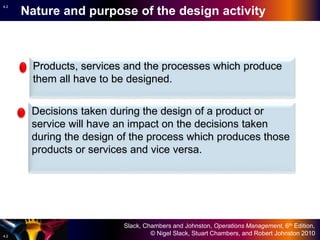
Products, services and the processes which produce
them all have to be designed.
Decisions taken during the design of a product or
service will have an impact on the decisions taken
during the design of the process which produces those
products or services and vice versa.
Slack, Chambers and Johnston, Operations Management, 6th Edition,
© Nigel Slack, Stuart Chambers, and Robert Johnston 20104.3
4.3 The design of products/services and processes are interrelated
and should be treated together
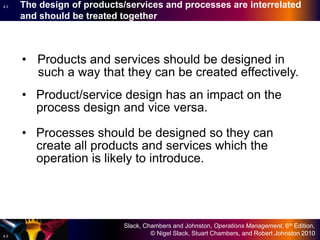
• Products and services should be designed in
such a way that they can be created effectively.
• Product/service design has an impact on the
process design and vice versa.
• Processes should be designed so they can
create all products and services which the
operation is likely to introduce.
Slack, Chambers and Johnston, Operations Management, 6th Edition,
© Nigel Slack, Stuart Chambers, and Robert Johnston 20104.4
4.4
Designing processes
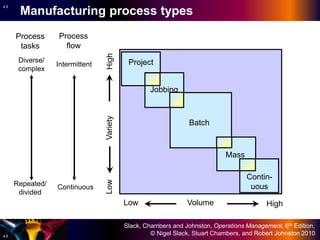
• There are different ‘process types’.
• Process types are defined by the volume and
variety of ‘items’ they process.
• Process types go by different names depending
on whether they produce products or services.
Slack, Chambers and Johnston, Operations Management, 6th Edition,
© Nigel Slack, Stuart Chambers, and Robert Johnston 20104.5
4.5
High
VolumeLow High
Variety
Project
Low
Manufacturing process types
Process
tasks
Process
flow
Diverse/
complex
Repeated/
divided
Intermittent
Continuous
Jobbing
Batch
Mass
Contin-
uous
Slack, Chambers and Johnston, Operations Management, 6th Edition,
© Nigel Slack, Stuart Chambers, and Robert Johnston 20104.6
4.6
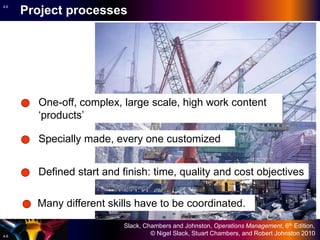
One-off, complex, large scale, high work content
‘products’
Specially made, every one customized
Defined start and finish: time, quality and cost objectives
Many different skills have to be coordinated.
Project processes
Slack, Chambers and Johnston, Operations Management, 6th Edition,
© Nigel Slack, Stuart Chambers, and Robert Johnston 20104.7
4.7
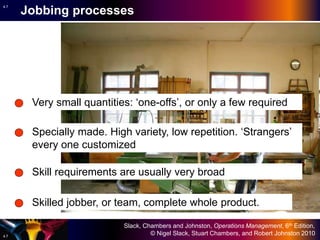
Very small quantities: ‘one-offs’, or only a few required
Specially made. High variety, low repetition. ‘Strangers’
every one customized
Skill requirements are usually very broad
Skilled jobber, or team, complete whole product.
Jobbing processes
Slack, Chambers and Johnston, Operations Management, 6th Edition,
© Nigel Slack, Stuart Chambers, and Robert Johnston 20104.8
4.8
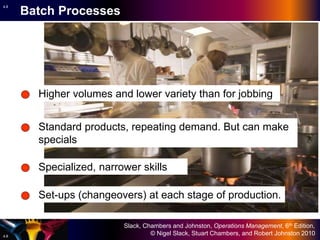
Higher volumes and lower variety than for jobbing
Standard products, repeating demand. But can make
specials
Specialized, narrower skills
Set-ups (changeovers) at each stage of production.
Batch Processes
Slack, Chambers and Johnston, Operations Management, 6th Edition,
© Nigel Slack, Stuart Chambers, and Robert Johnston 20104.9
4.9
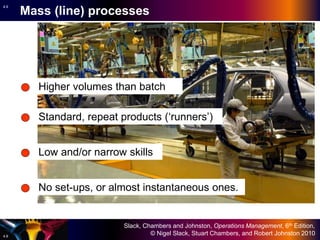
Higher volumes than batch
Standard, repeat products (‘runners’)
No set-ups, or almost instantaneous ones.
Low and/or narrow skills
Mass (line) processes
Slack, Chambers and Johnston, Operations Management, 6th Edition,
© Nigel Slack, Stuart Chambers, and Robert Johnston 20104.10
4.10
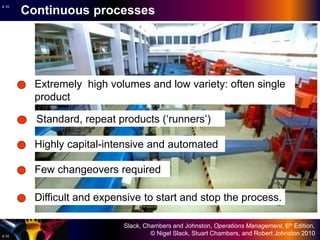
Extremely high volumes and low variety: often single
product
Standard, repeat products (‘runners’)
Highly capital-intensive and automated
Few changeovers required
Difficult and expensive to start and stop the process.
Continuous processes
Slack, Chambers and Johnston, Operations Management, 6th Edition,
© Nigel Slack, Stuart Chambers, and Robert Johnston 20104.11
4.11
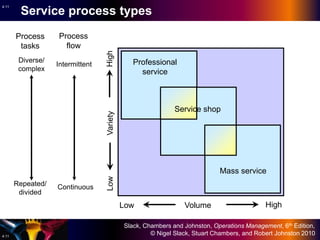
VolumeLow High
VarietyLowHigh
Service process types
Process
tasks
Process
flow
Diverse/
complex
Repeated/
divided
Intermittent
Continuous
Professional
service
Service shop
Mass service
Slack, Chambers and Johnston, Operations Management, 6th Edition,
© Nigel Slack, Stuart Chambers, and Robert Johnston 20104.12
4.12
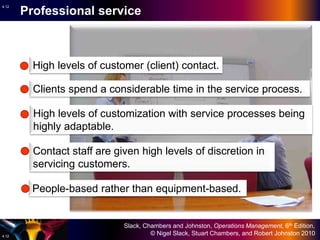
Professional service
High levels of customer (client) contact.
Clients spend a considerable time in the service process.
High levels of customization with service processes being
highly adaptable.
Contact staff are given high levels of discretion in
servicing customers.
People-based rather than equipment-based.
Slack, Chambers and Johnston, Operations Management, 6th Edition,
© Nigel Slack, Stuart Chambers, and Robert Johnston 20104.13
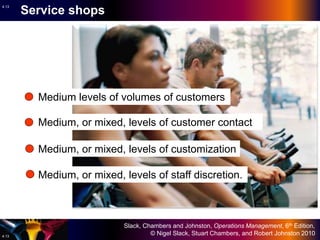
4.13
Medium levels of volumes of customers
Medium, or mixed, levels of customer contact
Medium, or mixed, levels of customization
Medium, or mixed, levels of staff discretion.
Service shops
Slack, Chambers and Johnston, Operations Management, 6th Edition,
© Nigel Slack, Stuart Chambers, and Robert Johnston 20104.14
4.14
High levels of volumes of customers
Low to medium levels of customer contact
Low, or mixed, levels of customization
Low, or mixed, levels of staff discretion.
Mass service
Slack, Chambers and Johnston, Operations Management, 6th Edition,
© Nigel Slack, Stuart Chambers, and Robert Johnston 20104.15
4.15
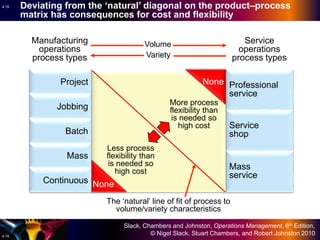
Variety
Volume
Deviating from the ‘natural’ diagonal on the product–process
matrix has consequences for cost and flexibility
None
None
The ‘natural’ line of fit of process to
volume/variety characteristics
Project
Jobbing
Batch
Mass
Continuous
Manufacturing
operations
process types
Professional
service
Service
shop
Mass
service
Service
operations
process types
More process
flexibility than
is needed so
high cost
Less process
flexibility than
is needed so
high cost
Slack, Chambers and Johnston, Operations Management, 6th Edition,
© Nigel Slack, Stuart Chambers, and Robert Johnston 20104.16
4.16
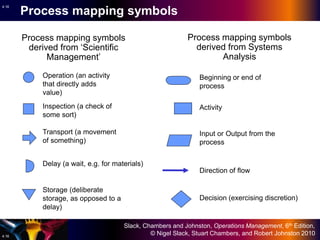
Delay (a wait, e.g. for materials)
Operation (an activity
that directly adds
value)
Inspection (a check of
some sort)
Transport (a movement
of something)
Storage (deliberate
storage, as opposed to a
delay)
Process mapping symbols
derived from ‘Scientific
Management’
Decision (exercising discretion)
Process mapping symbols
derived from Systems
Analysis
Direction of flow
Input or Output from the
process
Activity
Beginning or end of
process
Process mapping symbols
Slack, Chambers and Johnston, Operations Management, 6th Edition,
© Nigel Slack, Stuart Chambers, and Robert Johnston 20104.17
4.17
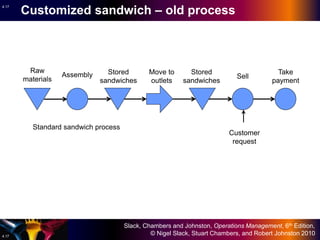
Standard sandwich process
Raw
materials
Assembly Stored
sandwiches
Move to
outlets
Stored
sandwiches
Customer
request
Sell
Take
payment
Customized sandwich – old process
Slack, Chambers and Johnston, Operations Management, 6th Edition,
© Nigel Slack, Stuart Chambers, and Robert Johnston 20104.18
4.18
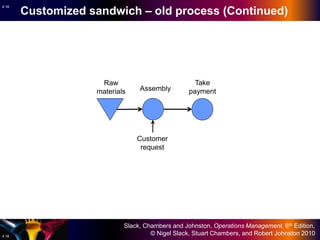
Raw
materials
Take
payment
Customer
request
Assembly
Customized sandwich – old process (Continued)
Slack, Chambers and Johnston, Operations Management, 6th Edition,
© Nigel Slack, Stuart Chambers, and Robert Johnston 20104.19
4.19
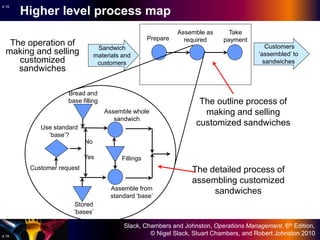
The operation of
making and selling
customized
sandwiches
The outline process of
making and selling
customized sandwiches
Prepare
Assemble as
required
Take
payment
Bread and
base filling
Stored
‘bases’
Fillings
Assemble whole
sandwich
Customer request
Use standard
‘base’?
Assemble from
standard ‘base’
No
Yes
The detailed process of
assembling customized
sandwiches
Sandwich
materials and
customers
Customers
‘assembled’ to
sandwiches
Higher level process map
Slack, Chambers and Johnston, Operations Management, 6th Edition,
© Nigel Slack, Stuart Chambers, and Robert Johnston 20104.20
4.20
Bread and
base filling
Assembly of
‘sandwich
bases’
Assemble from
standard ‘base’
Take
payment
Assemble whole
sandwich
Customer request
Use standard
‘base’?
No
Yes
Fillings
Stored ‘bases’
Customized sandwich - new process
Slack, Chambers and Johnston, Operations Management, 6th Edition,
© Nigel Slack, Stuart Chambers, and Robert Johnston 20104.21
4.21
Flow process charts for processing expense
Send to accounts receivable
Reports to batch control
Reports filed
Confirm payment
Report arrives
Stamp and date report
Send cash to receipt desk
Wait for processing
Check expenses report
Wait for processing
Check employee record
Check advance payment
Send to account payable
Wait for processing
Attach payment voucher
Collect retorts into batch
Check against rules
Wait for processing
Batch control number
Check payment voucher
Log report
Batch to audit desk
Wait for batching
Batch of reports logged
Copy of reports to filing
Description of activity
Totals
8
1
2
4
5
6
7
9
10
3
18
11
12
14
15
16
17
19
20
13
26
22
23
24
25
21
7 8 5 5 1
Payment voucher to keying
Before
Reports to batch control
Reports filed
Payment voucher to keying
Confirm payment
Report arrives
Stamp and date report
Check expenses report
Wait for processing
Check reports and vouchers
Attach payment voucher
Collect retorts into batch
Batch control number
Batch to audit desk
Wait for batching
Copy of reports to filing
Description of activity
Totals
8
1
2
4
5
6
7
9
10
3
11
12
14
15
13
5 5 2 2 1
After

04 process design_Operations Management

  • 1.
    Slack, Chambers andJohnston, Operations Management, 6th Edition, © Nigel Slack, Stuart Chambers, and Robert Johnston 20104.1 4.1 Chapter 4 Process design Shenval. Alamy
  • 2.
    Slack, Chambers andJohnston, Operations Management, 6th Edition, © Nigel Slack, Stuart Chambers, and Robert Johnston 20104.2 4.2 Nature and purpose of the design activity Products, services and the processes which produce them all have to be designed. Decisions taken during the design of a product or service will have an impact on the decisions taken during the design of the process which produces those products or services and vice versa.
  • 3.
    Slack, Chambers andJohnston, Operations Management, 6th Edition, © Nigel Slack, Stuart Chambers, and Robert Johnston 20104.3 4.3 The design of products/services and processes are interrelated and should be treated together • Products and services should be designed in such a way that they can be created effectively. • Product/service design has an impact on the process design and vice versa. • Processes should be designed so they can create all products and services which the operation is likely to introduce.
  • 4.
    Slack, Chambers andJohnston, Operations Management, 6th Edition, © Nigel Slack, Stuart Chambers, and Robert Johnston 20104.4 4.4 Designing processes • There are different ‘process types’. • Process types are defined by the volume and variety of ‘items’ they process. • Process types go by different names depending on whether they produce products or services.
  • 5.
    Slack, Chambers andJohnston, Operations Management, 6th Edition, © Nigel Slack, Stuart Chambers, and Robert Johnston 20104.5 4.5 High VolumeLow High Variety Project Low Manufacturing process types Process tasks Process flow Diverse/ complex Repeated/ divided Intermittent Continuous Jobbing Batch Mass Contin- uous
  • 6.
    Slack, Chambers andJohnston, Operations Management, 6th Edition, © Nigel Slack, Stuart Chambers, and Robert Johnston 20104.6 4.6 One-off, complex, large scale, high work content ‘products’ Specially made, every one customized Defined start and finish: time, quality and cost objectives Many different skills have to be coordinated. Project processes
  • 7.
    Slack, Chambers andJohnston, Operations Management, 6th Edition, © Nigel Slack, Stuart Chambers, and Robert Johnston 20104.7 4.7 Very small quantities: ‘one-offs’, or only a few required Specially made. High variety, low repetition. ‘Strangers’ every one customized Skill requirements are usually very broad Skilled jobber, or team, complete whole product. Jobbing processes
  • 8.
    Slack, Chambers andJohnston, Operations Management, 6th Edition, © Nigel Slack, Stuart Chambers, and Robert Johnston 20104.8 4.8 Higher volumes and lower variety than for jobbing Standard products, repeating demand. But can make specials Specialized, narrower skills Set-ups (changeovers) at each stage of production. Batch Processes
  • 9.
    Slack, Chambers andJohnston, Operations Management, 6th Edition, © Nigel Slack, Stuart Chambers, and Robert Johnston 20104.9 4.9 Higher volumes than batch Standard, repeat products (‘runners’) No set-ups, or almost instantaneous ones. Low and/or narrow skills Mass (line) processes
  • 10.
    Slack, Chambers andJohnston, Operations Management, 6th Edition, © Nigel Slack, Stuart Chambers, and Robert Johnston 20104.10 4.10 Extremely high volumes and low variety: often single product Standard, repeat products (‘runners’) Highly capital-intensive and automated Few changeovers required Difficult and expensive to start and stop the process. Continuous processes
  • 11.
    Slack, Chambers andJohnston, Operations Management, 6th Edition, © Nigel Slack, Stuart Chambers, and Robert Johnston 20104.11 4.11 VolumeLow High VarietyLowHigh Service process types Process tasks Process flow Diverse/ complex Repeated/ divided Intermittent Continuous Professional service Service shop Mass service
  • 12.
    Slack, Chambers andJohnston, Operations Management, 6th Edition, © Nigel Slack, Stuart Chambers, and Robert Johnston 20104.12 4.12 Professional service High levels of customer (client) contact. Clients spend a considerable time in the service process. High levels of customization with service processes being highly adaptable. Contact staff are given high levels of discretion in servicing customers. People-based rather than equipment-based.
  • 13.
    Slack, Chambers andJohnston, Operations Management, 6th Edition, © Nigel Slack, Stuart Chambers, and Robert Johnston 20104.13 4.13 Medium levels of volumes of customers Medium, or mixed, levels of customer contact Medium, or mixed, levels of customization Medium, or mixed, levels of staff discretion. Service shops
  • 14.
    Slack, Chambers andJohnston, Operations Management, 6th Edition, © Nigel Slack, Stuart Chambers, and Robert Johnston 20104.14 4.14 High levels of volumes of customers Low to medium levels of customer contact Low, or mixed, levels of customization Low, or mixed, levels of staff discretion. Mass service
  • 15.
    Slack, Chambers andJohnston, Operations Management, 6th Edition, © Nigel Slack, Stuart Chambers, and Robert Johnston 20104.15 4.15 Variety Volume Deviating from the ‘natural’ diagonal on the product–process matrix has consequences for cost and flexibility None None The ‘natural’ line of fit of process to volume/variety characteristics Project Jobbing Batch Mass Continuous Manufacturing operations process types Professional service Service shop Mass service Service operations process types More process flexibility than is needed so high cost Less process flexibility than is needed so high cost
  • 16.
    Slack, Chambers andJohnston, Operations Management, 6th Edition, © Nigel Slack, Stuart Chambers, and Robert Johnston 20104.16 4.16 Delay (a wait, e.g. for materials) Operation (an activity that directly adds value) Inspection (a check of some sort) Transport (a movement of something) Storage (deliberate storage, as opposed to a delay) Process mapping symbols derived from ‘Scientific Management’ Decision (exercising discretion) Process mapping symbols derived from Systems Analysis Direction of flow Input or Output from the process Activity Beginning or end of process Process mapping symbols
  • 17.
    Slack, Chambers andJohnston, Operations Management, 6th Edition, © Nigel Slack, Stuart Chambers, and Robert Johnston 20104.17 4.17 Standard sandwich process Raw materials Assembly Stored sandwiches Move to outlets Stored sandwiches Customer request Sell Take payment Customized sandwich – old process
  • 18.
    Slack, Chambers andJohnston, Operations Management, 6th Edition, © Nigel Slack, Stuart Chambers, and Robert Johnston 20104.18 4.18 Raw materials Take payment Customer request Assembly Customized sandwich – old process (Continued)
  • 19.
    Slack, Chambers andJohnston, Operations Management, 6th Edition, © Nigel Slack, Stuart Chambers, and Robert Johnston 20104.19 4.19 The operation of making and selling customized sandwiches The outline process of making and selling customized sandwiches Prepare Assemble as required Take payment Bread and base filling Stored ‘bases’ Fillings Assemble whole sandwich Customer request Use standard ‘base’? Assemble from standard ‘base’ No Yes The detailed process of assembling customized sandwiches Sandwich materials and customers Customers ‘assembled’ to sandwiches Higher level process map
  • 20.
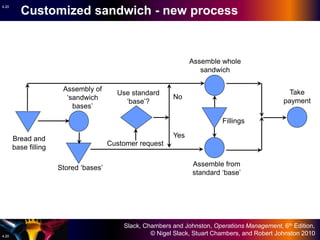
    Slack, Chambers andJohnston, Operations Management, 6th Edition, © Nigel Slack, Stuart Chambers, and Robert Johnston 20104.20 4.20 Bread and base filling Assembly of ‘sandwich bases’ Assemble from standard ‘base’ Take payment Assemble whole sandwich Customer request Use standard ‘base’? No Yes Fillings Stored ‘bases’ Customized sandwich - new process
  • 21.
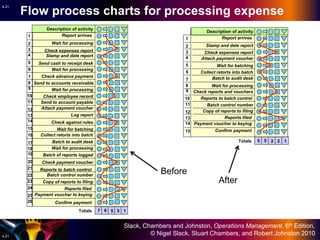
    Slack, Chambers andJohnston, Operations Management, 6th Edition, © Nigel Slack, Stuart Chambers, and Robert Johnston 20104.21 4.21 Flow process charts for processing expense Send to accounts receivable Reports to batch control Reports filed Confirm payment Report arrives Stamp and date report Send cash to receipt desk Wait for processing Check expenses report Wait for processing Check employee record Check advance payment Send to account payable Wait for processing Attach payment voucher Collect retorts into batch Check against rules Wait for processing Batch control number Check payment voucher Log report Batch to audit desk Wait for batching Batch of reports logged Copy of reports to filing Description of activity Totals 8 1 2 4 5 6 7 9 10 3 18 11 12 14 15 16 17 19 20 13 26 22 23 24 25 21 7 8 5 5 1 Payment voucher to keying Before Reports to batch control Reports filed Payment voucher to keying Confirm payment Report arrives Stamp and date report Check expenses report Wait for processing Check reports and vouchers Attach payment voucher Collect retorts into batch Batch control number Batch to audit desk Wait for batching Copy of reports to filing Description of activity Totals 8 1 2 4 5 6 7 9 10 3 11 12 14 15 13 5 5 2 2 1 After