Slack, Chambers and Johnston, Operations Management, 6th Edition,
© Nigel Slack, Stuart Chambers, and Robert Johnston 20103.1
3.1
Chapter 3
Operations strategy
Photodisc. Cartesia
Slack, Chambers and Johnston, Operations Management, 6th Edition,
© Nigel Slack, Stuart Chambers, and Robert Johnston 20103.2
3.2
Design
Planning and
control
Operation’s
performance
Operations
strategy
Improvement
Operations
management
Operations
strategy
Slack et al.’s model of operations management
Slack, Chambers and Johnston, Operations Management, 6th Edition,
© Nigel Slack, Stuart Chambers, and Robert Johnston 20103.3
3.3
Key operations questions
In Chapter 3 – Operations strategy – Slack et al.
identify the following key questions:
• What is strategy and what is operations strategy?
• What is the difference between a ‘top-down’ and a
‘bottom-up’ view of operations strategy?
• What is the difference between a ‘market
requirements’ and an ‘operations resources’ view
of operations strategy?
• How can an operations strategy be put together?
Slack, Chambers and Johnston, Operations Management, 6th Edition,
© Nigel Slack, Stuart Chambers, and Robert Johnston 20103.4
3.4
Operations strategy at Flextronics and Ryanair
For each of these companies:
• What do they have to be good at to compete in their
markets?
• How do their operations help them to achieve this?
Slack, Chambers and Johnston, Operations Management, 6th Edition,
© Nigel Slack, Stuart Chambers, and Robert Johnston 20103.5
3.5
Operations strategic
decisions
• Industrial parks, with
– low cost but close
locations
– and co-located
suppliers
Market
requirements
• Low costs
• Responsiveness
• Flexibility
Flextronics
Operations strategy at Flextronics
Slack, Chambers and Johnston, Operations Management, 6th Edition,
© Nigel Slack, Stuart Chambers, and Robert Johnston 20103.6
3.6
Operations strategic
decisions
• Stripped down service
• One technology
• Cheap airport
locations
• Fast turnround
Market
requirements
• Low prices
• Reliability
• Basic service
Ryanair
Operations strategy at Ryanair
Slack, Chambers and Johnston, Operations Management, 6th Edition,
© Nigel Slack, Stuart Chambers, and Robert Johnston 20103.7
3.7
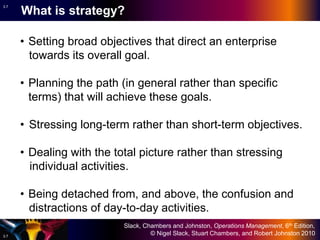
• Setting broad objectives that direct an enterprise
towards its overall goal.
• Planning the path (in general rather than specific
terms) that will achieve these goals.
• Stressing long-term rather than short-term objectives.
• Dealing with the total picture rather than stressing
individual activities.
• Being detached from, and above, the confusion and
distractions of day-to-day activities.
What is strategy?
Slack, Chambers and Johnston, Operations Management, 6th Edition,
© Nigel Slack, Stuart Chambers, and Robert Johnston 20103.8
3.8
Strategic decisions are those decisions which: are
widespread in their effect on the organization to
which the strategy refers, define the position of the
organization relative to its environment and move
the organization closer to its long-term goals.
Strategic decisions
Slack, Chambers and Johnston, Operations Management, 6th Edition,
© Nigel Slack, Stuart Chambers, and Robert Johnston 20103.9
3.9
‘Operations’ is not the same as ‘operational’
‘Operations’ are the resources that create products and
services.
‘Operational’ is the opposite of strategic, meaning day-to-
day and detailed.
So, one can examine both the operational and the
strategic aspects of operations.
Slack, Chambers and Johnston, Operations Management, 6th Edition,
© Nigel Slack, Stuart Chambers, and Robert Johnston 20103.10
3.10
How is operations strategy different to operations management?
The time
scale is
longer
Short-term
for example,
capacity decisions
1–12 months
Demand
Long-term
for example,
capacity decisions
1–10 years
Demand
Operations management Operations strategy
Slack, Chambers and Johnston, Operations Management, 6th Edition,
© Nigel Slack, Stuart Chambers, and Robert Johnston 20103.11
3.11
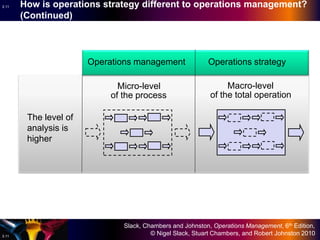
The level of
analysis is
higher
Operations management Operations strategy
Micro-level
of the process
Macro-level
of the total operation
How is operations strategy different to operations management?
(Continued)
Slack, Chambers and Johnston, Operations Management, 6th Edition,
© Nigel Slack, Stuart Chambers, and Robert Johnston 20103.12
3.12
The level of
aggregation
is higher
Operations management Operations strategy
Detailed
For example:
‘Can we give tax services
to the small business
market in Antwerp?’
Aggregated
For example:
‘What is our overall
business advice
capability compared with
other capabilities?’
How is operations strategy different to operations management?
(Continued)
Slack, Chambers and Johnston, Operations Management, 6th Edition,
© Nigel Slack, Stuart Chambers, and Robert Johnston 20103.13
3.13
The level of
abstraction
is higher
Operations management Operations strategy
Concrete
For example:
‘How do we improve out
purchasing procedures?’
Philosophical
For example:
‘Should we develop
strategic alliances with
suppliers?’
How is operations strategy different to operations management?
(Continued)
Slack, Chambers and Johnston, Operations Management, 6th Edition,
© Nigel Slack, Stuart Chambers, and Robert Johnston 20103.14
3.14
What is the role of the operations function?
Operations as
implementer of
strategy
Operations
implements strategy
Operations
drives strategy
Operations as
driver of strategy
Operations
supports strategy
Operations as
supporter of
strategy
Slack, Chambers and Johnston, Operations Management, 6th Edition,
© Nigel Slack, Stuart Chambers, and Robert Johnston 20103.15
3.15
The 3 key attributes
of operations strategy
Operations contribution
Implementing be Dependable
Operationalize strategy
explain Practicalities
Supporting be Appropriate
Understand strategy
Contribute to decisions
Driving be Innovative
provide Foundation of strategy
Develop long-term Capabilities
The strategic role of the operations function
Slack, Chambers and Johnston, Operations Management, 6th Edition,
© Nigel Slack, Stuart Chambers, and Robert Johnston 20103.16
3.16
The 4 stage model of operations contribution
Increasingstrategicimpact
Increasing operations capabilities
Externally
supportive
Redefining
industry
expectations
STAGE 4
Give an
operations
advantage
Driving
strategy
After Hayes and
Wheelwright
Internally
supportive
Clearly the
best in the
industry
STAGE 3
Link strategy
with
operations
Supporting
strategy
Externally
neutral
As good as
competitors
STAGE 2
Adopt best
practice
Implementing
strategy
Internally
neutral
STAGE 1
Correct the
worst
problems
Holding the
organization
back
Slack, Chambers and Johnston, Operations Management, 6th Edition,
© Nigel Slack, Stuart Chambers, and Robert Johnston 20103.17
3.17
Top-down
perspective
What the
business wants
operations to do
Operations
resources
perspective
What operations
resources can
do
What day-to-day
experience
suggests operations
should do
Bottom-up
perspective
Market
requirement
perspective
What the market
position requires
operations to do
Operations
strategy
The four perspectives on operations strategy
Slack, Chambers and Johnston, Operations Management, 6th Edition,
© Nigel Slack, Stuart Chambers, and Robert Johnston 20103.18
3.18
Corporate strategy
Business strategy
Emergent sense of what the
strategy should be
Operational experience
Top-down and bottom-up perspectives of strategy
Operations strategy
Slack, Chambers and Johnston, Operations Management, 6th Edition,
© Nigel Slack, Stuart Chambers, and Robert Johnston 20103.19
3.19
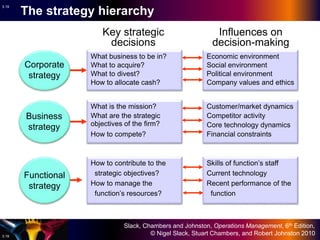
The strategy hierarchy
Key strategic
decisions
Influences on
decision-making
Business
strategy
What is the mission?
What are the strategic
objectives of the firm?
How to compete?
Customer/market dynamics
Competitor activity
Core technology dynamics
Financial constraints
Corporate
strategy
What business to be in?
What to acquire?
What to divest?
How to allocate cash?
Economic environment
Social environment
Political environment
Company values and ethics
Functional
strategy
How to contribute to the
strategic objectives?
How to manage the
function’s resources?
Skills of function’s staff
Current technology
Recent performance of the
function
Slack, Chambers and Johnston, Operations Management, 6th Edition,
© Nigel Slack, Stuart Chambers, and Robert Johnston 20103.20
3.20
Introduction Growth Maturity Decline
Sales
volume
Volume
Customers
Competitors
Variety of
product/
service
design
Slow growth
in sales
Innovators
Few/none
Customization
or frequent
design
changes
Rapid growth in
sales volume
Early adopters
Increasing
numbers
Increasingly
standardized
Sales slow and
level off
Bulk of market
Stable number
Emerging
dominant types
Market needs
largely met
Laggards
Declining
numbers
Possible move
to commodity
standardization
The effects of the product / service life cycle
Time
Slack, Chambers and Johnston, Operations Management, 6th Edition,
© Nigel Slack, Stuart Chambers, and Robert Johnston 20103.21
3.21
Introduction Growth Maturity Decline
Sales
volume
The effects of the product / service life cycle (Continued)
Time
Likely order
winners
Likely
qualifiers
Dominant
performance
objectives
Product/
service
characteristics
Quality
range
Flexibility
quality
Availability
quality
Price
range
Speed
dependability
quality
Low price
dependable
supply
Quality
range
Cost
dependability
Low price
Dependable
supply
Cost
Slack, Chambers and Johnston, Operations Management, 6th Edition,
© Nigel Slack, Stuart Chambers, and Robert Johnston 20103.22
3.22 Different competitive factors imply different performance
objectives
Competitive factors
If the customers value these …
Performance objectives
Then, the operations will need to
excel at these …
Low price Cost
High quality Quality
Fast delivery Speed
Reliable delivery Dependability
Innovative products and services Flexibility (products/services)
Wide range of products and
services Flexibility (mix)
The ability to change the timing
or quantity of products and
services
Flexibility (volume and/or delivery)
Slack, Chambers and Johnston, Operations Management, 6th Edition,
© Nigel Slack, Stuart Chambers, and Robert Johnston 20103.23
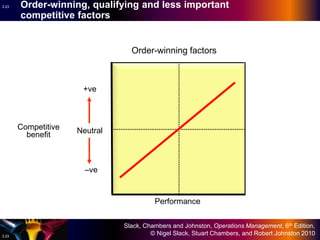
3.23 Order-winning, qualifying and less important
competitive factors
Neutral
+ve
–ve
Performance
Competitive
benefit
Order-winning factors
Slack, Chambers and Johnston, Operations Management, 6th Edition,
© Nigel Slack, Stuart Chambers, and Robert Johnston 20103.24
3.24 Order-winning, qualifying and less important
competitive factors (Continued)
Neutral
+ve
–ve
Performance
Competitive
benefit
Qualifying factors
Slack, Chambers and Johnston, Operations Management, 6th Edition,
© Nigel Slack, Stuart Chambers, and Robert Johnston 20103.25
3.25
Neutral
+ve
–ve
Performance
Competitive
benefit
Less important factors
Order-winning, qualifying and less important
competitive factors (Continued)
Slack, Chambers and Johnston, Operations Management, 6th Edition,
© Nigel Slack, Stuart Chambers, and Robert Johnston 20103.26
3.26
Intended
strategy
Realized
strategy
Deliberative
strategy
Mintzberg’s concept of emergent strategy
Unrealized
strategy
Emergent
strategy
Slack, Chambers and Johnston, Operations Management, 6th Edition,
© Nigel Slack, Stuart Chambers, and Robert Johnston 20103.27
3.27
What you
HAVE
in terms of
operations
capabilities
What you
NEED
to ‘compete’
in the
market
Operations
resources
Market
requirements
What you
WANT
from your
operations to
help you
‘compete’
What you
DO
to maintain
your
capabilities
and satisfy
markets
Strategic
reconciliation
Reconciling market requirements and operations resources
Slack, Chambers and Johnston, Operations Management, 6th Edition,
© Nigel Slack, Stuart Chambers, and Robert Johnston 20103.28
3.28
The challenge of operations strategy formulation
An operations strategy should be:
Appropriate…
Comprehensive…
Coherent…
Consistent over time…
Slack, Chambers and Johnston, Operations Management, 6th Edition,
© Nigel Slack, Stuart Chambers, and Robert Johnston 20103.29
3.29
An implementation agenda is needed
When to start?
Where to start?
How fast to proceed?
How to co-ordinate the implementation
programme?
Slack, Chambers and Johnston, Operations Management, 6th Edition,
© Nigel Slack, Stuart Chambers, and Robert Johnston 20103.30
3.30
The five P’s of operations strategy implementation
Purpose — a shared understanding of the motivation,
boundaries and context for developing the operations
strategy.
Point of Entry — the point in the organization where the
process of implementation starts.
Process — How the operations strategy formulation
process is made explicit.
Project Management — The management of the
implementation.
Participation — Who is involved in the implementation.

Power point presentations 3

  • 1.
    Slack, Chambers andJohnston, Operations Management, 6th Edition, © Nigel Slack, Stuart Chambers, and Robert Johnston 20103.1 3.1 Chapter 3 Operations strategy Photodisc. Cartesia
  • 2.
    Slack, Chambers andJohnston, Operations Management, 6th Edition, © Nigel Slack, Stuart Chambers, and Robert Johnston 20103.2 3.2 Design Planning and control Operation’s performance Operations strategy Improvement Operations management Operations strategy Slack et al.’s model of operations management
  • 3.
    Slack, Chambers andJohnston, Operations Management, 6th Edition, © Nigel Slack, Stuart Chambers, and Robert Johnston 20103.3 3.3 Key operations questions In Chapter 3 – Operations strategy – Slack et al. identify the following key questions: • What is strategy and what is operations strategy? • What is the difference between a ‘top-down’ and a ‘bottom-up’ view of operations strategy? • What is the difference between a ‘market requirements’ and an ‘operations resources’ view of operations strategy? • How can an operations strategy be put together?
  • 4.
    Slack, Chambers andJohnston, Operations Management, 6th Edition, © Nigel Slack, Stuart Chambers, and Robert Johnston 20103.4 3.4 Operations strategy at Flextronics and Ryanair For each of these companies: • What do they have to be good at to compete in their markets? • How do their operations help them to achieve this?
  • 5.
    Slack, Chambers andJohnston, Operations Management, 6th Edition, © Nigel Slack, Stuart Chambers, and Robert Johnston 20103.5 3.5 Operations strategic decisions • Industrial parks, with – low cost but close locations – and co-located suppliers Market requirements • Low costs • Responsiveness • Flexibility Flextronics Operations strategy at Flextronics
  • 6.
    Slack, Chambers andJohnston, Operations Management, 6th Edition, © Nigel Slack, Stuart Chambers, and Robert Johnston 20103.6 3.6 Operations strategic decisions • Stripped down service • One technology • Cheap airport locations • Fast turnround Market requirements • Low prices • Reliability • Basic service Ryanair Operations strategy at Ryanair
  • 7.
    Slack, Chambers andJohnston, Operations Management, 6th Edition, © Nigel Slack, Stuart Chambers, and Robert Johnston 20103.7 3.7 • Setting broad objectives that direct an enterprise towards its overall goal. • Planning the path (in general rather than specific terms) that will achieve these goals. • Stressing long-term rather than short-term objectives. • Dealing with the total picture rather than stressing individual activities. • Being detached from, and above, the confusion and distractions of day-to-day activities. What is strategy?
  • 8.
    Slack, Chambers andJohnston, Operations Management, 6th Edition, © Nigel Slack, Stuart Chambers, and Robert Johnston 20103.8 3.8 Strategic decisions are those decisions which: are widespread in their effect on the organization to which the strategy refers, define the position of the organization relative to its environment and move the organization closer to its long-term goals. Strategic decisions
  • 9.
    Slack, Chambers andJohnston, Operations Management, 6th Edition, © Nigel Slack, Stuart Chambers, and Robert Johnston 20103.9 3.9 ‘Operations’ is not the same as ‘operational’ ‘Operations’ are the resources that create products and services. ‘Operational’ is the opposite of strategic, meaning day-to- day and detailed. So, one can examine both the operational and the strategic aspects of operations.
  • 10.
    Slack, Chambers andJohnston, Operations Management, 6th Edition, © Nigel Slack, Stuart Chambers, and Robert Johnston 20103.10 3.10 How is operations strategy different to operations management? The time scale is longer Short-term for example, capacity decisions 1–12 months Demand Long-term for example, capacity decisions 1–10 years Demand Operations management Operations strategy
  • 11.
    Slack, Chambers andJohnston, Operations Management, 6th Edition, © Nigel Slack, Stuart Chambers, and Robert Johnston 20103.11 3.11 The level of analysis is higher Operations management Operations strategy Micro-level of the process Macro-level of the total operation How is operations strategy different to operations management? (Continued)
  • 12.
    Slack, Chambers andJohnston, Operations Management, 6th Edition, © Nigel Slack, Stuart Chambers, and Robert Johnston 20103.12 3.12 The level of aggregation is higher Operations management Operations strategy Detailed For example: ‘Can we give tax services to the small business market in Antwerp?’ Aggregated For example: ‘What is our overall business advice capability compared with other capabilities?’ How is operations strategy different to operations management? (Continued)
  • 13.
    Slack, Chambers andJohnston, Operations Management, 6th Edition, © Nigel Slack, Stuart Chambers, and Robert Johnston 20103.13 3.13 The level of abstraction is higher Operations management Operations strategy Concrete For example: ‘How do we improve out purchasing procedures?’ Philosophical For example: ‘Should we develop strategic alliances with suppliers?’ How is operations strategy different to operations management? (Continued)
  • 14.
    Slack, Chambers andJohnston, Operations Management, 6th Edition, © Nigel Slack, Stuart Chambers, and Robert Johnston 20103.14 3.14 What is the role of the operations function? Operations as implementer of strategy Operations implements strategy Operations drives strategy Operations as driver of strategy Operations supports strategy Operations as supporter of strategy
  • 15.
    Slack, Chambers andJohnston, Operations Management, 6th Edition, © Nigel Slack, Stuart Chambers, and Robert Johnston 20103.15 3.15 The 3 key attributes of operations strategy Operations contribution Implementing be Dependable Operationalize strategy explain Practicalities Supporting be Appropriate Understand strategy Contribute to decisions Driving be Innovative provide Foundation of strategy Develop long-term Capabilities The strategic role of the operations function
  • 16.
    Slack, Chambers andJohnston, Operations Management, 6th Edition, © Nigel Slack, Stuart Chambers, and Robert Johnston 20103.16 3.16 The 4 stage model of operations contribution Increasingstrategicimpact Increasing operations capabilities Externally supportive Redefining industry expectations STAGE 4 Give an operations advantage Driving strategy After Hayes and Wheelwright Internally supportive Clearly the best in the industry STAGE 3 Link strategy with operations Supporting strategy Externally neutral As good as competitors STAGE 2 Adopt best practice Implementing strategy Internally neutral STAGE 1 Correct the worst problems Holding the organization back
  • 17.
    Slack, Chambers andJohnston, Operations Management, 6th Edition, © Nigel Slack, Stuart Chambers, and Robert Johnston 20103.17 3.17 Top-down perspective What the business wants operations to do Operations resources perspective What operations resources can do What day-to-day experience suggests operations should do Bottom-up perspective Market requirement perspective What the market position requires operations to do Operations strategy The four perspectives on operations strategy
  • 18.
    Slack, Chambers andJohnston, Operations Management, 6th Edition, © Nigel Slack, Stuart Chambers, and Robert Johnston 20103.18 3.18 Corporate strategy Business strategy Emergent sense of what the strategy should be Operational experience Top-down and bottom-up perspectives of strategy Operations strategy
  • 19.
    Slack, Chambers andJohnston, Operations Management, 6th Edition, © Nigel Slack, Stuart Chambers, and Robert Johnston 20103.19 3.19 The strategy hierarchy Key strategic decisions Influences on decision-making Business strategy What is the mission? What are the strategic objectives of the firm? How to compete? Customer/market dynamics Competitor activity Core technology dynamics Financial constraints Corporate strategy What business to be in? What to acquire? What to divest? How to allocate cash? Economic environment Social environment Political environment Company values and ethics Functional strategy How to contribute to the strategic objectives? How to manage the function’s resources? Skills of function’s staff Current technology Recent performance of the function
  • 20.
    Slack, Chambers andJohnston, Operations Management, 6th Edition, © Nigel Slack, Stuart Chambers, and Robert Johnston 20103.20 3.20 Introduction Growth Maturity Decline Sales volume Volume Customers Competitors Variety of product/ service design Slow growth in sales Innovators Few/none Customization or frequent design changes Rapid growth in sales volume Early adopters Increasing numbers Increasingly standardized Sales slow and level off Bulk of market Stable number Emerging dominant types Market needs largely met Laggards Declining numbers Possible move to commodity standardization The effects of the product / service life cycle Time
  • 21.
    Slack, Chambers andJohnston, Operations Management, 6th Edition, © Nigel Slack, Stuart Chambers, and Robert Johnston 20103.21 3.21 Introduction Growth Maturity Decline Sales volume The effects of the product / service life cycle (Continued) Time Likely order winners Likely qualifiers Dominant performance objectives Product/ service characteristics Quality range Flexibility quality Availability quality Price range Speed dependability quality Low price dependable supply Quality range Cost dependability Low price Dependable supply Cost
  • 22.
    Slack, Chambers andJohnston, Operations Management, 6th Edition, © Nigel Slack, Stuart Chambers, and Robert Johnston 20103.22 3.22 Different competitive factors imply different performance objectives Competitive factors If the customers value these … Performance objectives Then, the operations will need to excel at these … Low price Cost High quality Quality Fast delivery Speed Reliable delivery Dependability Innovative products and services Flexibility (products/services) Wide range of products and services Flexibility (mix) The ability to change the timing or quantity of products and services Flexibility (volume and/or delivery)
  • 23.
    Slack, Chambers andJohnston, Operations Management, 6th Edition, © Nigel Slack, Stuart Chambers, and Robert Johnston 20103.23 3.23 Order-winning, qualifying and less important competitive factors Neutral +ve –ve Performance Competitive benefit Order-winning factors
  • 24.
    Slack, Chambers andJohnston, Operations Management, 6th Edition, © Nigel Slack, Stuart Chambers, and Robert Johnston 20103.24 3.24 Order-winning, qualifying and less important competitive factors (Continued) Neutral +ve –ve Performance Competitive benefit Qualifying factors
  • 25.
    Slack, Chambers andJohnston, Operations Management, 6th Edition, © Nigel Slack, Stuart Chambers, and Robert Johnston 20103.25 3.25 Neutral +ve –ve Performance Competitive benefit Less important factors Order-winning, qualifying and less important competitive factors (Continued)
  • 26.
    Slack, Chambers andJohnston, Operations Management, 6th Edition, © Nigel Slack, Stuart Chambers, and Robert Johnston 20103.26 3.26 Intended strategy Realized strategy Deliberative strategy Mintzberg’s concept of emergent strategy Unrealized strategy Emergent strategy
  • 27.
    Slack, Chambers andJohnston, Operations Management, 6th Edition, © Nigel Slack, Stuart Chambers, and Robert Johnston 20103.27 3.27 What you HAVE in terms of operations capabilities What you NEED to ‘compete’ in the market Operations resources Market requirements What you WANT from your operations to help you ‘compete’ What you DO to maintain your capabilities and satisfy markets Strategic reconciliation Reconciling market requirements and operations resources
  • 28.
    Slack, Chambers andJohnston, Operations Management, 6th Edition, © Nigel Slack, Stuart Chambers, and Robert Johnston 20103.28 3.28 The challenge of operations strategy formulation An operations strategy should be: Appropriate… Comprehensive… Coherent… Consistent over time…
  • 29.
    Slack, Chambers andJohnston, Operations Management, 6th Edition, © Nigel Slack, Stuart Chambers, and Robert Johnston 20103.29 3.29 An implementation agenda is needed When to start? Where to start? How fast to proceed? How to co-ordinate the implementation programme?
  • 30.
    Slack, Chambers andJohnston, Operations Management, 6th Edition, © Nigel Slack, Stuart Chambers, and Robert Johnston 20103.30 3.30 The five P’s of operations strategy implementation Purpose — a shared understanding of the motivation, boundaries and context for developing the operations strategy. Point of Entry — the point in the organization where the process of implementation starts. Process — How the operations strategy formulation process is made explicit. Project Management — The management of the implementation. Participation — Who is involved in the implementation.