Slack, Chambers and Johnston, Operations Management, 6th Edition,
© Nigel Slack, Stuart Chambers, and Robert Johnston 2010
6.1
6.1
Chapter 6
Supply network design
Digital Stock
Slack, Chambers and Johnston, Operations Management, 6th Edition,
© Nigel Slack, Stuart Chambers, and Robert Johnston 2010
6.2
6.2
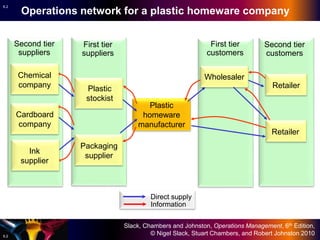
Plastic
homeware
manufacturer
Operations network for a plastic homeware company
First tier
suppliers
Packaging
supplier
Plastic
stockist
First tier
customers
Wholesaler
Second tier
suppliers
Ink
supplier
Cardboard
company
Chemical
company
Second tier
customers
Retailer
Retailer
Direct supply
Information
Slack, Chambers and Johnston, Operations Management, 6th Edition,
© Nigel Slack, Stuart Chambers, and Robert Johnston 2010
6.3
6.3
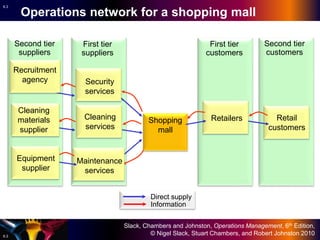
Operations network for a shopping mall
First tier
suppliers
Cleaning
services
Security
services
Maintenance
services
Shopping
mall
First tier
customers
Retailers
Second tier
customers
Retail
customers
Direct supply
Information
Second tier
suppliers
Recruitment
agency
Cleaning
materials
supplier
Equipment
supplier
Slack, Chambers and Johnston, Operations Management, 6th Edition,
© Nigel Slack, Stuart Chambers, and Robert Johnston 2010
6.4
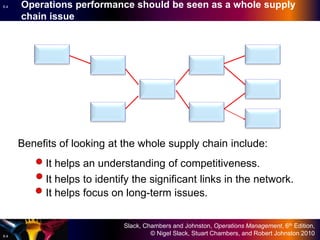
6.4 Operations performance should be seen as a whole supply
chain issue
Benefits of looking at the whole supply chain include:
It helps an understanding of competitiveness.
It helps to identify the significant links in the network.
It helps focus on long-term issues.
Slack, Chambers and Johnston, Operations Management, 6th Edition,
© Nigel Slack, Stuart Chambers, and Robert Johnston 2010
6.5
6.5
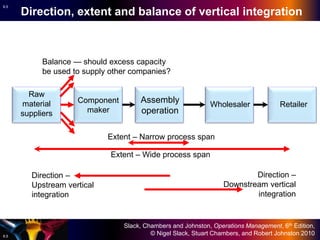
Direction, extent and balance of vertical integration
Extent – Narrow process span
Extent – Wide process span
Direction –
Upstream vertical
integration
Direction –
Downstream vertical
integration
Wholesaler
Raw
material
suppliers
Component
maker
Assembly
operation
Retailer
Balance — should excess capacity
be used to supply other companies?
Slack, Chambers and Johnston, Operations Management, 6th Edition,
© Nigel Slack, Stuart Chambers, and Robert Johnston 2010
6.6
6.6
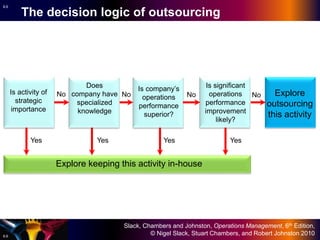
The decision logic of outsourcing
Is activity of
strategic
importance
Explore keeping this activity in-house
Yes Yes
Does
company have
specialized
knowledge
No
Is company’s
operations
performance
superior?
Yes
No
Is significant
operations
performance
improvement
likely?
Yes
No Explore
outsourcing
this activity
No
Slack, Chambers and Johnston, Operations Management, 6th Edition,
© Nigel Slack, Stuart Chambers, and Robert Johnston 2010
6.7
6.7
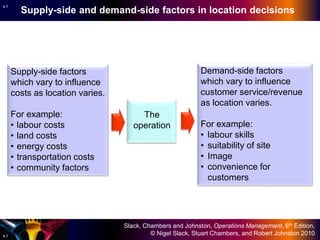
Supply-side and demand-side factors in location decisions
The
operation
Supply-side factors
which vary to influence
costs as location varies.
For example:
• labour costs
• land costs
• energy costs
• transportation costs
• community factors
Demand-side factors
which vary to influence
customer service/revenue
as location varies.
For example:
• labour skills
• suitability of site
• Image
• convenience for
customers
Slack, Chambers and Johnston, Operations Management, 6th Edition,
© Nigel Slack, Stuart Chambers, and Robert Johnston 2010
6.8
6.8
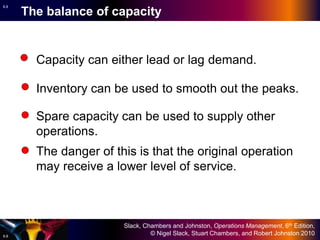
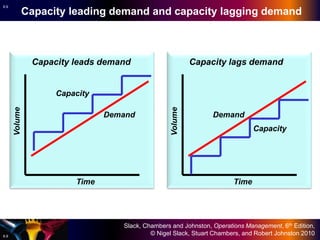
The balance of capacity
Capacity can either lead or lag demand.
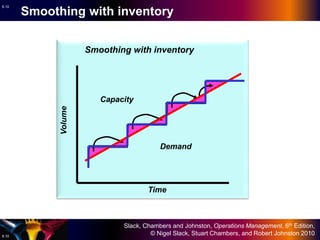
Inventory can be used to smooth out the peaks.
Spare capacity can be used to supply other
operations.
The danger of this is that the original operation
may receive a lower level of service.
Slack, Chambers and Johnston, Operations Management, 6th Edition,
© Nigel Slack, Stuart Chambers, and Robert Johnston 2010
6.9
6.9
Capacity lags demand
Volume
Time
Capacity leads demand
Volume
Time
Capacity leading demand and capacity lagging demand
Demand
Demand
Capacity
Capacity
Slack, Chambers and Johnston, Operations Management, 6th Edition,
© Nigel Slack, Stuart Chambers, and Robert Johnston 2010
6.10
6.10
Smoothing with inventory
Volume
Time
Smoothing with inventory
Demand
Capacity

06 supply network design_Operations Management

  • 1.
    Slack, Chambers andJohnston, Operations Management, 6th Edition, © Nigel Slack, Stuart Chambers, and Robert Johnston 2010 6.1 6.1 Chapter 6 Supply network design Digital Stock
  • 2.
    Slack, Chambers andJohnston, Operations Management, 6th Edition, © Nigel Slack, Stuart Chambers, and Robert Johnston 2010 6.2 6.2 Plastic homeware manufacturer Operations network for a plastic homeware company First tier suppliers Packaging supplier Plastic stockist First tier customers Wholesaler Second tier suppliers Ink supplier Cardboard company Chemical company Second tier customers Retailer Retailer Direct supply Information
  • 3.
    Slack, Chambers andJohnston, Operations Management, 6th Edition, © Nigel Slack, Stuart Chambers, and Robert Johnston 2010 6.3 6.3 Operations network for a shopping mall First tier suppliers Cleaning services Security services Maintenance services Shopping mall First tier customers Retailers Second tier customers Retail customers Direct supply Information Second tier suppliers Recruitment agency Cleaning materials supplier Equipment supplier
  • 4.
    Slack, Chambers andJohnston, Operations Management, 6th Edition, © Nigel Slack, Stuart Chambers, and Robert Johnston 2010 6.4 6.4 Operations performance should be seen as a whole supply chain issue Benefits of looking at the whole supply chain include: It helps an understanding of competitiveness. It helps to identify the significant links in the network. It helps focus on long-term issues.
  • 5.
    Slack, Chambers andJohnston, Operations Management, 6th Edition, © Nigel Slack, Stuart Chambers, and Robert Johnston 2010 6.5 6.5 Direction, extent and balance of vertical integration Extent – Narrow process span Extent – Wide process span Direction – Upstream vertical integration Direction – Downstream vertical integration Wholesaler Raw material suppliers Component maker Assembly operation Retailer Balance — should excess capacity be used to supply other companies?
  • 6.
    Slack, Chambers andJohnston, Operations Management, 6th Edition, © Nigel Slack, Stuart Chambers, and Robert Johnston 2010 6.6 6.6 The decision logic of outsourcing Is activity of strategic importance Explore keeping this activity in-house Yes Yes Does company have specialized knowledge No Is company’s operations performance superior? Yes No Is significant operations performance improvement likely? Yes No Explore outsourcing this activity No
  • 7.
    Slack, Chambers andJohnston, Operations Management, 6th Edition, © Nigel Slack, Stuart Chambers, and Robert Johnston 2010 6.7 6.7 Supply-side and demand-side factors in location decisions The operation Supply-side factors which vary to influence costs as location varies. For example: • labour costs • land costs • energy costs • transportation costs • community factors Demand-side factors which vary to influence customer service/revenue as location varies. For example: • labour skills • suitability of site • Image • convenience for customers
  • 8.
    Slack, Chambers andJohnston, Operations Management, 6th Edition, © Nigel Slack, Stuart Chambers, and Robert Johnston 2010 6.8 6.8 The balance of capacity Capacity can either lead or lag demand. Inventory can be used to smooth out the peaks. Spare capacity can be used to supply other operations. The danger of this is that the original operation may receive a lower level of service.
  • 9.
    Slack, Chambers andJohnston, Operations Management, 6th Edition, © Nigel Slack, Stuart Chambers, and Robert Johnston 2010 6.9 6.9 Capacity lags demand Volume Time Capacity leads demand Volume Time Capacity leading demand and capacity lagging demand Demand Demand Capacity Capacity
  • 10.
    Slack, Chambers andJohnston, Operations Management, 6th Edition, © Nigel Slack, Stuart Chambers, and Robert Johnston 2010 6.10 6.10 Smoothing with inventory Volume Time Smoothing with inventory Demand Capacity