Stephen P. Crane, CSCP Wacker Chemical Corporation Director Strategic Supply Chain Implementing an Integrated Sales & Operations Planning Process  August 11, 2009 An Executive S&OP Case Study Supply Chain & Operations Group Supply Side Demand Side
CONTENT What is Sales & Operations Planning  How Does S&OP Help Improve Business Profitability S&OP Case Study Key S&OP Success Factors
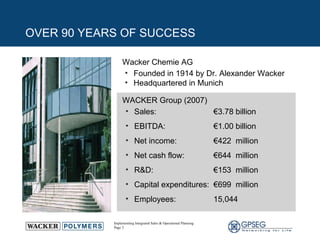
Wacker Chemie AG WACKER Group (2007) OVER 90 YEARS OF SUCCESS Founded in 1914 by Dr. Alexander Wacker  Headquartered in Munich Sales: €3.78 billion EBITDA: €1.00 billion Net income: €422  million Net cash flow: €644  million R&D: €153  million Capital expenditures: €699  million Employees: 15,044
WE ARE COMMITTED TO BENCHMARK-QUALITY PRODUCTS DESIGNED FOR OUR FOCUS INDUSTRIES Industries Adhesives Automotive and transport Construction chemicals  Gumbase Industrial coatings and printing inks Paper and ceramics Products:  Polymer powders and dispersions for the  construction industry Polyvinyl acetate solid resins, polyvinyl alcohol solutions, polyvinyl butyral and vinyl chloride co-  and terpolymers
CONTENT What is Sales & Operations Planning  How Does S&OP Help Improve Business Profitability S&OP Case Study Key S&OP Success Factors
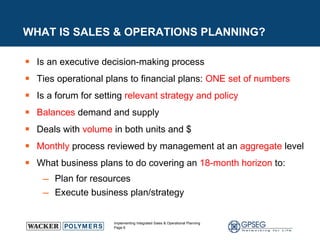
WHAT IS SALES & OPERATIONS PLANNING? Is an executive decision-making process Ties operational plans to financial plans:  ONE set of numbers Is a forum for setting  relevant strategy and policy  Balances  demand and supply Deals with  volume  in both units and $ Monthly  process reviewed by management at an  aggregate  level What business plans to do covering an  18-month horizon  to: Plan for resources Execute business plan/strategy
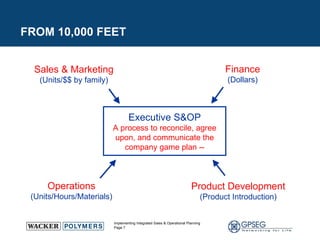
FROM 10,000 FEET Executive S&OP A process to reconcile, agree upon, and communicate the company game plan -- Operations (Units/Hours/Materials) Product Development (Product Introduction) Finance (Dollars) Sales & Marketing (Units/$$ by family)
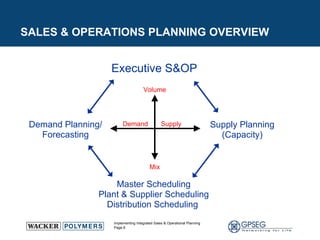
SALES & OPERATIONS PLANNING OVERVIEW Volume Mix Supply Demand Demand Planning/ Forecasting Supply Planning (Capacity) Master Scheduling Plant & Supplier Scheduling Distribution Scheduling  Executive S&OP
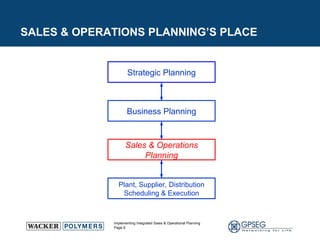
SALES & OPERATIONS PLANNING’S PLACE Strategic Planning Business Planning Sales & Operations Planning Plant, Supplier, Distribution Scheduling & Execution
TOP MANAGEMENT NEEDS To see the Big Picture (volume) Keep it SIMPLE Must see dollars as well as units Must tie to Annual Business Plan Separate significant from trivial To establish strategy, policy, and risk level
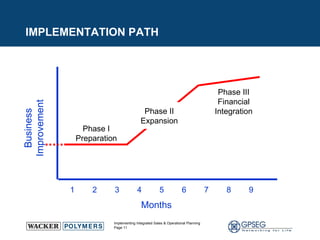
IMPLEMENTATION PATH Months Business Improvement 1  2  3  4  5  6  7  8  9 Phase I Preparation Phase II Expansion Phase III Financial Integration
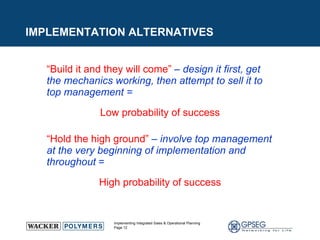
IMPLEMENTATION ALTERNATIVES “ Build it and they will come”   –  design it first, get the mechanics working, then attempt to sell it to top management = Low probability of success “ Hold the high ground”  –  involve top management at the very beginning of implementation and throughout  = High probability of success
CONTENT What is Sales & Operations Planning  How Does S&OP Help Improve Business Profitability S&OP Case Study Key S&OP Success Factors
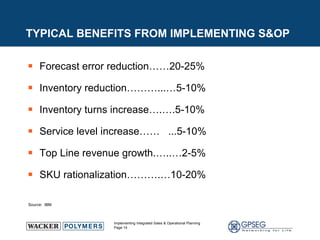
TYPICAL BENEFITS FROM IMPLEMENTING S&OP Forecast error reduction……20-25% Inventory reduction………...…5-10% Inventory turns increase….….5-10% Service level increase……  ...5-10% Top Line revenue growth.…..…2-5% SKU rationalization……….…10-20% Source:  IBM
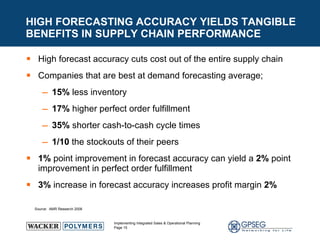
HIGH FORECASTING ACCURACY YIELDS TANGIBLE BENEFITS IN SUPPLY CHAIN PERFORMANCE High forecast accuracy cuts cost out of the entire supply chain Companies that are best at demand forecasting average; 15%  less inventory 17%  higher perfect order fulfillment 35%  shorter cash-to-cash cycle times 1/10  the stockouts of their peers 1%  point improvement in forecast accuracy can yield a  2%  point improvement in perfect order fulfillment  3%  increase in forecast accuracy increases profit margin  2% Source:  AMR Research 2008
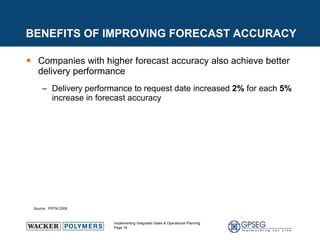
Companies with higher forecast accuracy also achieve better delivery performance Delivery performance to request date increased  2%  for each  5%  increase in forecast accuracy BENEFITS OF IMPROVING FORECAST ACCURACY Source:  PRTM 2008
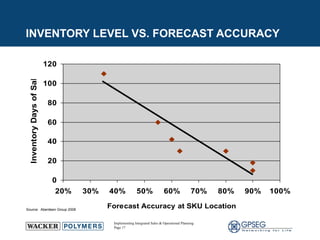
INVENTORY LEVEL VS. FORECAST ACCURACY Source:  Aberdeen Group 2008
BENCHMARKING OBSERVATIONS Emphasize S&OP as a first step S&OP is the most critical element to drive  supply chain benefits Demand planning and supply planning are  the largest profit drivers Supply chain benefits normally fall into the range of 3 to 5% of sales revenue on a sustainable basis through CI efforts Over 50% of increases in shareholder value over the past three years have come from supply chain improvements
CONTENT What is Sales & Operations Planning  How Does S&OP Help Improve Business Profitability S&OP Case Study Key S&OP Success Factors
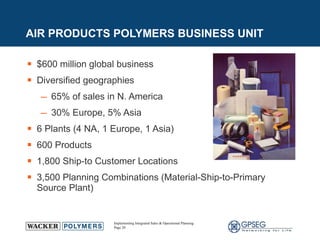
AIR PRODUCTS POLYMERS BUSINESS UNIT  $600 million global business Diversified geographies 65% of sales in N. America 30% Europe, 5% Asia 6 Plants (4 NA, 1 Europe, 1 Asia) 600 Products 1,800 Ship-to Customer Locations 3,500 Planning Combinations (Material-Ship-to-Primary Source Plant)
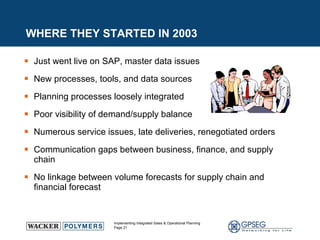
Just went live on SAP, master data issues New processes, tools, and data sources Planning processes loosely integrated Poor visibility of demand/supply balance Numerous service issues, late deliveries, renegotiated orders Communication gaps between business, finance, and supply chain  No linkage between volume forecasts for supply chain and financial forecast WHERE THEY STARTED IN 2003
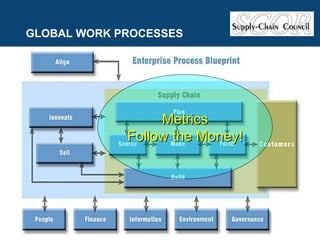
GLOBAL WORK PROCESSES Metrics Follow the Money!
S&OP PROCESS STEPS P1.1A – Identify, Prioritize, & Aggregate SC Requirements DAY 0 - 8 P1.4 – Establish &  Communicate SC Plans   DAY 13-15 P1.3A – Balance Supply Chain Requirements with SC  Resources   DAY 9 – 12 P1.2A – Identify, Prioritize, & Aggregate SC Resources DAY 0 - 8 Review Historical Sales Data Review Demand Metrics Apply Historical Sales Data Adjustments Apply Future Demand Change Notifications Run Forecast Model Agree & Communicate Approved Plans Communicate Implications to Financial & Sales Plans Review Supply Plan & Cost Projections Develop/Modify Supply Chain Plans Review Supply Planning Measures Adjust Supply Planning Constraints Load & Review Unconstrained Demand Plan Submit Supply Plan with Documented Options Approve & Publish Supply Plan Approve & Publish Unconstrained Demand Plan Gather Data [DAY0] Gather Data [DAY 0] Define Supply Capability [DAY 1 – 8] Develop Supply Plan Proposals  [DAY 9] Finalize & Approve Supply Plan  [DAY 10 -12] Aggregate All Sources of Supply Initiate Req Master Data Changes Review Inventory Available Review Supply Capability Create Demand Change Summary B A Partnership Meeting [DAY 13] Executive S&OP  [DAY 15] Summarize Supply Chain Plans Gather Collaborative Input (Future Function) Create Unconstrained Demand Plan [DAY 1 -8] Develop Unconstrained Revenue Projection Apply New Characteristic Combos Adjust Statistical Parameters  (if needed) Review and Validate Unconstrained Forecast Input Source, Make, Deliver Product & Capacity Plans Create Supply Change Summary Develop Supply Plan Proposal (Optimization) Review Alerts Assess Impact & Develop Options Review Excess Capacity, Supply Options, Demand Exceptions Issue Resolution Agree to Supply Plan Initiate any Master Data MOC Review Supply Chain Plans Review Revenue Projections A B C C BI
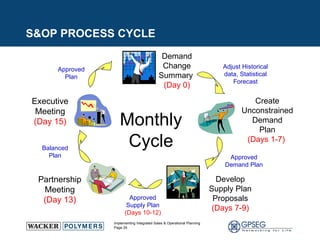
S&OP PROCESS CYCLE Monthly Cycle Create Unconstrained Demand Plan (Days 1-7)   Adjust Historical data, Statistical Forecast Develop Supply Plan Proposals (Days 7-9) Approved Demand Plan Partnership Meeting (Day 13) Approved Supply Plan (Days 10-12) Approved Plan Executive Meeting (Day 15) Balanced Plan Demand Change Summary  (Day 0)
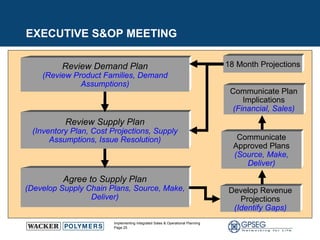
EXECUTIVE S&OP MEETING Review Demand Plan (Review Product Families, Demand Assumptions) Review Supply Plan (Inventory Plan, Cost Projections, Supply Assumptions, Issue Resolution) Agree to Supply Plan (Develop Supply Chain Plans, Source, Make, Deliver) Develop Revenue Projections (Identify Gaps) 18 Month Projections Communicate Approved Plans (Source, Make, Deliver) Communicate Plan Implications (Financial, Sales)
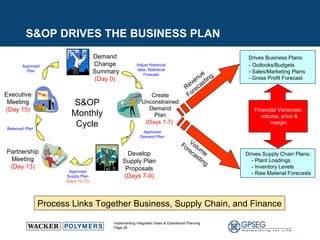
S&OP DRIVES THE BUSINESS PLAN Create Unconstrained Demand Plan (Days 1-7)   Revenue Forecasting Volume Forecasting Process Links Together Business, Supply Chain, and Finance Demand Change Summary (Day 0) Partnership Meeting (Day 13) Executive Meeting (Day 15) Develop Supply Plan Proposals (Days 7-9) S&OP Monthly Cycle Adjust Historical data, Statistical Forecast Approved Demand Plan Approved Supply Plan (Days 10-12) Approved Plan Balanced Plan Drives Business Plans: -   Outlooks/Budgets - Sales/Marketing Plans - Gross Profit Forecast Drives Supply Chain Plans: - Plant Loadings - Inventory Levels - Raw Material Forecasts Financial Variances: volume, price & margin
S&OP PROCESS KPIs Forecast Accuracy (%) Production Plan Adherence (%) Inventory Days of Supply Financial Forecast Accuracy (%)
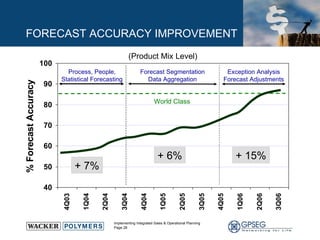
FORECAST ACCURACY IMPROVEMENT (Product Mix Level) Process, People, Statistical Forecasting Exception Analysis Forecast Adjustments Forecast Segmentation Data Aggregation World Class + 6% + 15% + 7%
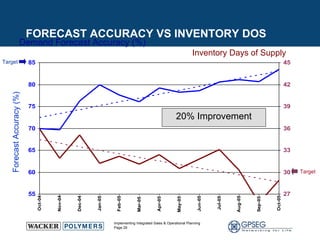
Demand Forecast Accuracy (%) Inventory Days of Supply 20% Improvement Forecast Accuracy (%) FORECAST ACCURACY VS INVENTORY DOS Target Target
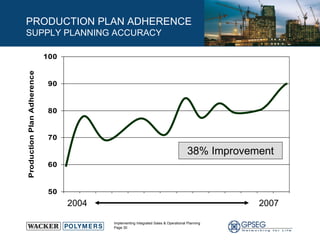
38% Improvement 2004  2007 PRODUCTION PLAN ADHERENCE SUPPLY PLANNING ACCURACY
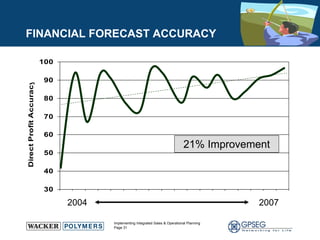
21% Improvement 2004  2007 FINANCIAL FORECAST ACCURACY
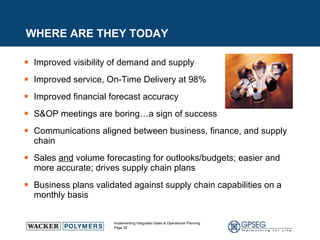
WHERE ARE THEY TODAY Improved visibility of demand and supply Improved service, On-Time Delivery at 98% Improved financial forecast accuracy S&OP meetings are boring…a sign of success Communications aligned between business, finance, and supply chain Sales  and  volume forecasting for outlooks/budgets; easier and more accurate; drives supply chain plans Business plans validated against supply chain capabilities on a monthly basis
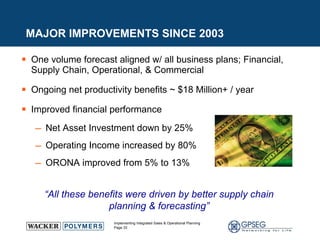
One volume forecast aligned w/ all business plans;  Financial, Supply Chain, Operational, & Commercial Ongoing net productivity benefits ~ $18 Million+ / year  Improved financial performance Net Asset Investment down by 25% Operating Income increased by 80% ORONA improved from 5% to 13% MAJOR IMPROVEMENTS SINCE 2003 “ All these benefits were driven by better supply chain planning & forecasting”
THE S&OP CHECK LIST Does your S&OP actively involve senior leadership? Are accountabilities clearly defined? Is the data accurate and timely? Does it cover a 18 month time horizon? Is volume expressed in units as well as $? Is financial difference between S&OP plan and financial plan evaluated monthly? Are proactive decisions made? Does it occur on a monthly cycle? Does it include a capacity review? Does it include actual vs forecasted sales?
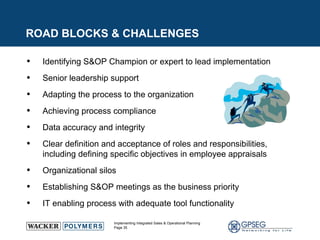
ROAD BLOCKS & CHALLENGES Identifying S&OP Champion or expert to lead implementation Senior leadership support Adapting the process to the organization Achieving process compliance Data accuracy and integrity Clear definition and acceptance of roles and responsibilities, including defining specific objectives in employee appraisals Organizational silos Establishing S&OP meetings as the business priority IT enabling process with adequate tool functionality
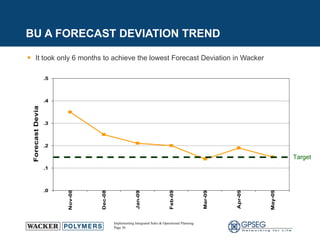
BU A FORECAST DEVIATION TREND  It took only 6 months to achieve the lowest Forecast Deviation in Wacker Target
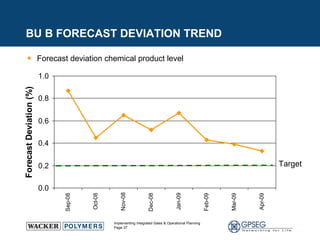
BU B FORECAST DEVIATION TREND  Forecast deviation chemical product level Target
“ The only sustainable competitive advantage any company can have is the ability to consistently react to market opportunities faster than the competition.  A company’s products, engineering, proprietary manufacturing processes or even a powerful brand simply no longer ensure long term, sustainable advantage” But those who can build superior, agile, and  responsive supply chains, have a real chance CONCLUSION
The WACKER Group THANK YOU FOR YOUR ATTENTION Stephen P. Crane Director Strategic Supply Chain Management [email_address] CREATING TOMORROW'S SOLUTIONS

Executive S&Op Case Study Gpseg

  • 1.
    Stephen P. Crane,CSCP Wacker Chemical Corporation Director Strategic Supply Chain Implementing an Integrated Sales & Operations Planning Process August 11, 2009 An Executive S&OP Case Study Supply Chain & Operations Group Supply Side Demand Side
  • 2.
    CONTENT What isSales & Operations Planning How Does S&OP Help Improve Business Profitability S&OP Case Study Key S&OP Success Factors
  • 3.
    Wacker Chemie AGWACKER Group (2007) OVER 90 YEARS OF SUCCESS Founded in 1914 by Dr. Alexander Wacker Headquartered in Munich Sales: €3.78 billion EBITDA: €1.00 billion Net income: €422 million Net cash flow: €644 million R&D: €153 million Capital expenditures: €699 million Employees: 15,044
  • 4.
    WE ARE COMMITTEDTO BENCHMARK-QUALITY PRODUCTS DESIGNED FOR OUR FOCUS INDUSTRIES Industries Adhesives Automotive and transport Construction chemicals Gumbase Industrial coatings and printing inks Paper and ceramics Products: Polymer powders and dispersions for the construction industry Polyvinyl acetate solid resins, polyvinyl alcohol solutions, polyvinyl butyral and vinyl chloride co- and terpolymers
  • 5.
    CONTENT What isSales & Operations Planning How Does S&OP Help Improve Business Profitability S&OP Case Study Key S&OP Success Factors
  • 6.
    WHAT IS SALES& OPERATIONS PLANNING? Is an executive decision-making process Ties operational plans to financial plans: ONE set of numbers Is a forum for setting relevant strategy and policy Balances demand and supply Deals with volume in both units and $ Monthly process reviewed by management at an aggregate level What business plans to do covering an 18-month horizon to: Plan for resources Execute business plan/strategy
  • 7.
    FROM 10,000 FEETExecutive S&OP A process to reconcile, agree upon, and communicate the company game plan -- Operations (Units/Hours/Materials) Product Development (Product Introduction) Finance (Dollars) Sales & Marketing (Units/$$ by family)
  • 8.
    SALES & OPERATIONSPLANNING OVERVIEW Volume Mix Supply Demand Demand Planning/ Forecasting Supply Planning (Capacity) Master Scheduling Plant & Supplier Scheduling Distribution Scheduling Executive S&OP
  • 9.
    SALES & OPERATIONSPLANNING’S PLACE Strategic Planning Business Planning Sales & Operations Planning Plant, Supplier, Distribution Scheduling & Execution
  • 10.
    TOP MANAGEMENT NEEDSTo see the Big Picture (volume) Keep it SIMPLE Must see dollars as well as units Must tie to Annual Business Plan Separate significant from trivial To establish strategy, policy, and risk level
  • 11.
    IMPLEMENTATION PATH MonthsBusiness Improvement 1 2 3 4 5 6 7 8 9 Phase I Preparation Phase II Expansion Phase III Financial Integration
  • 12.
    IMPLEMENTATION ALTERNATIVES “Build it and they will come” – design it first, get the mechanics working, then attempt to sell it to top management = Low probability of success “ Hold the high ground” – involve top management at the very beginning of implementation and throughout = High probability of success
  • 13.
    CONTENT What isSales & Operations Planning How Does S&OP Help Improve Business Profitability S&OP Case Study Key S&OP Success Factors
  • 14.
    TYPICAL BENEFITS FROMIMPLEMENTING S&OP Forecast error reduction……20-25% Inventory reduction………...…5-10% Inventory turns increase….….5-10% Service level increase…… ...5-10% Top Line revenue growth.…..…2-5% SKU rationalization……….…10-20% Source: IBM
  • 15.
    HIGH FORECASTING ACCURACYYIELDS TANGIBLE BENEFITS IN SUPPLY CHAIN PERFORMANCE High forecast accuracy cuts cost out of the entire supply chain Companies that are best at demand forecasting average; 15% less inventory 17% higher perfect order fulfillment 35% shorter cash-to-cash cycle times 1/10 the stockouts of their peers 1% point improvement in forecast accuracy can yield a 2% point improvement in perfect order fulfillment 3% increase in forecast accuracy increases profit margin 2% Source: AMR Research 2008
  • 16.
    Companies with higherforecast accuracy also achieve better delivery performance Delivery performance to request date increased 2% for each 5% increase in forecast accuracy BENEFITS OF IMPROVING FORECAST ACCURACY Source: PRTM 2008
  • 17.
    INVENTORY LEVEL VS.FORECAST ACCURACY Source: Aberdeen Group 2008
  • 18.
    BENCHMARKING OBSERVATIONS EmphasizeS&OP as a first step S&OP is the most critical element to drive supply chain benefits Demand planning and supply planning are the largest profit drivers Supply chain benefits normally fall into the range of 3 to 5% of sales revenue on a sustainable basis through CI efforts Over 50% of increases in shareholder value over the past three years have come from supply chain improvements
  • 19.
    CONTENT What isSales & Operations Planning How Does S&OP Help Improve Business Profitability S&OP Case Study Key S&OP Success Factors
  • 20.
    AIR PRODUCTS POLYMERSBUSINESS UNIT $600 million global business Diversified geographies 65% of sales in N. America 30% Europe, 5% Asia 6 Plants (4 NA, 1 Europe, 1 Asia) 600 Products 1,800 Ship-to Customer Locations 3,500 Planning Combinations (Material-Ship-to-Primary Source Plant)
  • 21.
    Just went liveon SAP, master data issues New processes, tools, and data sources Planning processes loosely integrated Poor visibility of demand/supply balance Numerous service issues, late deliveries, renegotiated orders Communication gaps between business, finance, and supply chain No linkage between volume forecasts for supply chain and financial forecast WHERE THEY STARTED IN 2003
  • 22.
    GLOBAL WORK PROCESSESMetrics Follow the Money!
  • 23.
    S&OP PROCESS STEPSP1.1A – Identify, Prioritize, & Aggregate SC Requirements DAY 0 - 8 P1.4 – Establish & Communicate SC Plans DAY 13-15 P1.3A – Balance Supply Chain Requirements with SC Resources DAY 9 – 12 P1.2A – Identify, Prioritize, & Aggregate SC Resources DAY 0 - 8 Review Historical Sales Data Review Demand Metrics Apply Historical Sales Data Adjustments Apply Future Demand Change Notifications Run Forecast Model Agree & Communicate Approved Plans Communicate Implications to Financial & Sales Plans Review Supply Plan & Cost Projections Develop/Modify Supply Chain Plans Review Supply Planning Measures Adjust Supply Planning Constraints Load & Review Unconstrained Demand Plan Submit Supply Plan with Documented Options Approve & Publish Supply Plan Approve & Publish Unconstrained Demand Plan Gather Data [DAY0] Gather Data [DAY 0] Define Supply Capability [DAY 1 – 8] Develop Supply Plan Proposals [DAY 9] Finalize & Approve Supply Plan [DAY 10 -12] Aggregate All Sources of Supply Initiate Req Master Data Changes Review Inventory Available Review Supply Capability Create Demand Change Summary B A Partnership Meeting [DAY 13] Executive S&OP [DAY 15] Summarize Supply Chain Plans Gather Collaborative Input (Future Function) Create Unconstrained Demand Plan [DAY 1 -8] Develop Unconstrained Revenue Projection Apply New Characteristic Combos Adjust Statistical Parameters (if needed) Review and Validate Unconstrained Forecast Input Source, Make, Deliver Product & Capacity Plans Create Supply Change Summary Develop Supply Plan Proposal (Optimization) Review Alerts Assess Impact & Develop Options Review Excess Capacity, Supply Options, Demand Exceptions Issue Resolution Agree to Supply Plan Initiate any Master Data MOC Review Supply Chain Plans Review Revenue Projections A B C C BI
  • 24.
    S&OP PROCESS CYCLEMonthly Cycle Create Unconstrained Demand Plan (Days 1-7) Adjust Historical data, Statistical Forecast Develop Supply Plan Proposals (Days 7-9) Approved Demand Plan Partnership Meeting (Day 13) Approved Supply Plan (Days 10-12) Approved Plan Executive Meeting (Day 15) Balanced Plan Demand Change Summary (Day 0)
  • 25.
    EXECUTIVE S&OP MEETINGReview Demand Plan (Review Product Families, Demand Assumptions) Review Supply Plan (Inventory Plan, Cost Projections, Supply Assumptions, Issue Resolution) Agree to Supply Plan (Develop Supply Chain Plans, Source, Make, Deliver) Develop Revenue Projections (Identify Gaps) 18 Month Projections Communicate Approved Plans (Source, Make, Deliver) Communicate Plan Implications (Financial, Sales)
  • 26.
    S&OP DRIVES THEBUSINESS PLAN Create Unconstrained Demand Plan (Days 1-7) Revenue Forecasting Volume Forecasting Process Links Together Business, Supply Chain, and Finance Demand Change Summary (Day 0) Partnership Meeting (Day 13) Executive Meeting (Day 15) Develop Supply Plan Proposals (Days 7-9) S&OP Monthly Cycle Adjust Historical data, Statistical Forecast Approved Demand Plan Approved Supply Plan (Days 10-12) Approved Plan Balanced Plan Drives Business Plans: - Outlooks/Budgets - Sales/Marketing Plans - Gross Profit Forecast Drives Supply Chain Plans: - Plant Loadings - Inventory Levels - Raw Material Forecasts Financial Variances: volume, price & margin
  • 27.
    S&OP PROCESS KPIsForecast Accuracy (%) Production Plan Adherence (%) Inventory Days of Supply Financial Forecast Accuracy (%)
  • 28.
    FORECAST ACCURACY IMPROVEMENT(Product Mix Level) Process, People, Statistical Forecasting Exception Analysis Forecast Adjustments Forecast Segmentation Data Aggregation World Class + 6% + 15% + 7%
  • 29.
    Demand Forecast Accuracy(%) Inventory Days of Supply 20% Improvement Forecast Accuracy (%) FORECAST ACCURACY VS INVENTORY DOS Target Target
  • 30.
    38% Improvement 2004 2007 PRODUCTION PLAN ADHERENCE SUPPLY PLANNING ACCURACY
  • 31.
    21% Improvement 2004 2007 FINANCIAL FORECAST ACCURACY
  • 32.
    WHERE ARE THEYTODAY Improved visibility of demand and supply Improved service, On-Time Delivery at 98% Improved financial forecast accuracy S&OP meetings are boring…a sign of success Communications aligned between business, finance, and supply chain Sales and volume forecasting for outlooks/budgets; easier and more accurate; drives supply chain plans Business plans validated against supply chain capabilities on a monthly basis
  • 33.
    One volume forecastaligned w/ all business plans; Financial, Supply Chain, Operational, & Commercial Ongoing net productivity benefits ~ $18 Million+ / year Improved financial performance Net Asset Investment down by 25% Operating Income increased by 80% ORONA improved from 5% to 13% MAJOR IMPROVEMENTS SINCE 2003 “ All these benefits were driven by better supply chain planning & forecasting”
  • 34.
    THE S&OP CHECKLIST Does your S&OP actively involve senior leadership? Are accountabilities clearly defined? Is the data accurate and timely? Does it cover a 18 month time horizon? Is volume expressed in units as well as $? Is financial difference between S&OP plan and financial plan evaluated monthly? Are proactive decisions made? Does it occur on a monthly cycle? Does it include a capacity review? Does it include actual vs forecasted sales?
  • 35.
    ROAD BLOCKS &CHALLENGES Identifying S&OP Champion or expert to lead implementation Senior leadership support Adapting the process to the organization Achieving process compliance Data accuracy and integrity Clear definition and acceptance of roles and responsibilities, including defining specific objectives in employee appraisals Organizational silos Establishing S&OP meetings as the business priority IT enabling process with adequate tool functionality
  • 36.
    BU A FORECASTDEVIATION TREND It took only 6 months to achieve the lowest Forecast Deviation in Wacker Target
  • 37.
    BU B FORECASTDEVIATION TREND Forecast deviation chemical product level Target
  • 38.
    “ The onlysustainable competitive advantage any company can have is the ability to consistently react to market opportunities faster than the competition. A company’s products, engineering, proprietary manufacturing processes or even a powerful brand simply no longer ensure long term, sustainable advantage” But those who can build superior, agile, and responsive supply chains, have a real chance CONCLUSION
  • 39.
    The WACKER GroupTHANK YOU FOR YOUR ATTENTION Stephen P. Crane Director Strategic Supply Chain Management [email_address] CREATING TOMORROW'S SOLUTIONS

Editor's Notes

  • #29 Major sources for forecast inaccuracy: Upside account assumptions Consignment billing issues Price increases Raw material supply allocations APO master data
  • #35 If you answer no to any of these questions, you have an opportunity to go back and make improvements to your current S&OP process. Hopefully you have heard a few key points this afternoon that you can take back to your company and apply to your S&OP process. Thank you.