Adapted from Investigative Journalism Manuals
                                       Konrad
                                     Adenauer
                                       Stiftung
One of the major duties of a
journalist is to be a civic watch
dog and achieving this often
demands investigation and in-
depth work.
Thus, in a way, all stories are
investigative
stories because they require
research, digging, interviewing
and writing.
According to
Itule and Anderson (2007:
397), all reporters are
investigators who are trained to
ask
questions, uncover information
and write the most complete
stories possible.
Nevertheless, some reporters
concentrate solely on
investigations of wrongdoings.
They
deal with reporter-adversary
relationships that are usually
not found in beat reporting or
other in-depth coverage.
Their aim is to ferret out well-
guarded information from often
hostile sources. This gives
them a chance to be
creative, to become part of
their reader‟s
emotional lives and sometimes
to uncover an injustice and
correct it
According to Ansell et al (2002:
4-5) investigative reporting has
the following elements:

   It’s about digging deeply into an issue or topic
   The issue or topic has to be of public interest
   It’s a process, not an event
   It’s original and proactive
   It should produce new information or put together previously
    available
   information in a new way to reveal its significance
   It should be multi-sourced
   Because of its in-depth nature, it calls for greater resources, team
    working
   and time than a routine news report
The core of investigative journalism
is to uncover information that is in
the
public’s interest.
Investigative journalism is a
form of journalism in which
reporters deeply investigate a
single topic of interest, often
involving crime, political
corruption, or corporate
wrongdoing.
University of Missouri
journalism professor Steve
Weinberg defined investigative
journalism as:
“Reporting, through one's own
initiative and work
product, matters of importance
to readers, viewers, or
listeners”
British media theorist Hugo de Burgh (2000)
states that: “An investigative journalist is a
man or woman whose profession it is to
discover the truth and to identify lapses from
it in whatever media may be available…
…the act of doing this
generally is called investigative
journalism and is distinct from
apparently similar work done
by police, lawyers, auditors,
and regulatory bodies in that it
is not limited as to target, not
legally founded and closely
connected to publicity.”
…any journalist becomes an
investigative journalist when
their story grows in scope and
depth beyond a routine report
So investigative journalism:
1- employs the toolkit of any good
reporter, but at a very high level of
skill;
2- uncovers both facts formally
defined as secret and issues
nobody wants to talk about; and
3- looks beyond individuals to
faulty systems and processes.
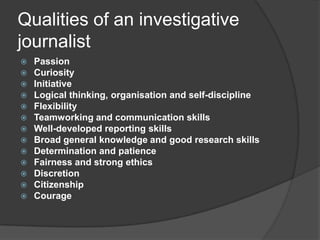
Qualities of an investigative
journalist
   Passion
   Curiosity
   Initiative
   Logical thinking, organisation and self-discipline
   Flexibility
   Teamworking and communication skills
   Well-developed reporting skills
   Broad general knowledge and good research skills
   Determination and patience
   Fairness and strong ethics
   Discretion
   Citizenship
   Courage
Story ideas:
 Your own experience and that of friends
  and neighbours
 Follow-ups on previous stories
 Reading and the Internet
 Street, café and taxi gossip
 Routine checks of public information and
  with contacts.
 Tip-offs
Tip-offs can produce
dramatic stories, but should
be handled very carefully.
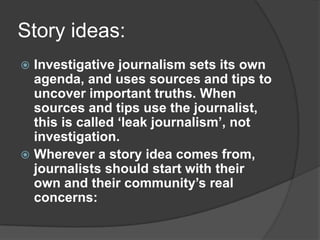
Story ideas:
 Investigative journalism sets its own
  agenda, and uses sources and tips to
  uncover important truths. When
  sources and tips use the journalist,
  this is called ‘leak journalism’, not
  investigation.
 Wherever a story idea comes from,
  journalists should start with their
  own and their community’s real
  concerns:
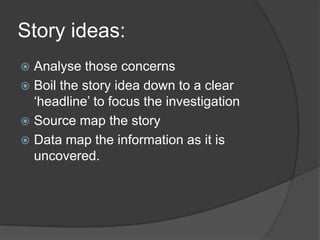
Story ideas:
 Analyse those concerns
 Boil the story idea down to a clear
  „headline‟ to focus the investigation
 Source map the story
 Data map the information as it is
  uncovered.
Planning the investigation
 You need a framework of structured
  questions that will allow you to move
  from a broad, theoretical story idea to
  a tightly-framed hypothesis or
  question your IJ project can prove or
  answer
 You need to plan your project,
  thinking about rationale, sources,
  obstacles, timeline and budget
Planning the investigation
 You need to base any story pitch on
  this plan
 Consider all sources: primary,
  secondary, paper, human and digital
 Be aware of the uses of each, and
  construct a methodology that allows
  you to dig for information from
  sources that are appropriate.
The first is the classic formula
for focusing a story:
   What’s been happening? So what? (Why
    should our readers care?)
   Who did it? How did they do it? What are
    the consequences? How can it be put
    right?
   What went wrong? How did it go wrong?
    Why did it go wrong? What are the
    consequences? How can it be put right?
   What’s the news? What’s the story? What’s
    the keyword?
   What’s the rationale? (Why are we doing
    this story?)
Everybody leaves a paper
trail in a modern society
Be careful when dealing with
biased sources
Sources and Spin Doctors
 The usefulness of sources depends
  not only on the sources
  themselves, but how skillfully you
  use them.
 Start with your subject, and then
  ‘map’ witnesses, people currently or
  previously involved, experts and
  relevant official and organisational
  contacts. Make your selection from
  these.
Sources and Spin Doctors
   Select and evaluate experts carefully, and find a
    way of dealing with differences in expert views
    without distorting arguments.
   Pay particular attention to organisational
    contacts who act as gate-keepers, surveyors and
    door-openers.
   Use covert techniques only after careful
    decision-making on important, public-interest
    stories.
   Evaluate sources and documents methodically.
    Use the two-source rule to try to ensure that
    each of your findings has independent back-up.
   Beware of spin. Question the origins and motives
    of everything
The most important principle
is that your relationship with
your sources is sacred. Do
not make promises you
cannot
keep. If you have made
promises, you must be
prepared to put your own
liberty or life on the line to
see they are kept.
Investigative Interviewing
   Interview preparation is key
   Set up the interview in a way that suits the story and
    circumstances.
   Lose the attitude.
   Have a strategy for the whole interview.
   Keep questions clear, simple and direct.
   Establish ground rules
   Follow-up, re-phrase or reflect back to get answers
    that are equally clear and direct.
   Handle reluctant or fearful interviewees kindly and
    carefully – but don’t let them off the hook.
   Establish support structures and strategies to help
    you deal with threats and intimidation.
   Never take interview answers out of context.
Writing the investigative
story
 This requires choices about: form,
  content, and style.
 The 7 stages of writing: choosing the
  subject, planning, news gathering, pre-
  writing, writing, re-writing and feedback.
 Good writing: accuracy, clarity,
  conciseness, coherence, conventionality
  and originality.
Writing the investigative
story
 Make sure the story is complete
 Make sure the story makes sense
 Make sure the story is written well, as
  well as time will allow.
Writing the investigative
story
   Descriptive story: who, what, where, &
    when.

   Analytical story: how & why.

   Consequential story: so what?
references
   Steve Weinberg, The Reporter's Handbook:
    An Investigator's Guide to Documents and
    Techniques, St. Martin's Press, 1996.
    Investigative Journalism: Context and
    Practice, Hugo de Burgh (ed), Routledge,
    London and New York, 2000.
   Ansell et al (2002) „Investigative Journalism in
    Africa: Walking through a Minefield at
    Midnight‟ Reporters without Borders.
   Itule, Bruce and Anderson, Douglas (2007):
    News Writing and Reporting for Today’s Media
    7th edition. McGraw Hill New York U.S.A.

Investigative reporting

  • 1.
    Adapted from InvestigativeJournalism Manuals Konrad Adenauer Stiftung
  • 2.
    One of themajor duties of a journalist is to be a civic watch dog and achieving this often demands investigation and in- depth work.
  • 3.
    Thus, in away, all stories are investigative stories because they require research, digging, interviewing and writing.
  • 4.
    According to Itule andAnderson (2007: 397), all reporters are investigators who are trained to ask questions, uncover information and write the most complete stories possible.
  • 5.
    Nevertheless, some reporters concentratesolely on investigations of wrongdoings.
  • 6.
    They deal with reporter-adversary relationshipsthat are usually not found in beat reporting or other in-depth coverage.
  • 7.
    Their aim isto ferret out well- guarded information from often hostile sources. This gives them a chance to be creative, to become part of their reader‟s emotional lives and sometimes to uncover an injustice and correct it
  • 8.
    According to Ansellet al (2002: 4-5) investigative reporting has the following elements:  It’s about digging deeply into an issue or topic  The issue or topic has to be of public interest  It’s a process, not an event  It’s original and proactive  It should produce new information or put together previously available  information in a new way to reveal its significance  It should be multi-sourced  Because of its in-depth nature, it calls for greater resources, team working  and time than a routine news report
  • 9.
    The core ofinvestigative journalism is to uncover information that is in the public’s interest.
  • 10.
    Investigative journalism isa form of journalism in which reporters deeply investigate a single topic of interest, often involving crime, political corruption, or corporate wrongdoing.
  • 11.
    University of Missouri journalismprofessor Steve Weinberg defined investigative journalism as: “Reporting, through one's own initiative and work product, matters of importance to readers, viewers, or listeners”
  • 12.
    British media theoristHugo de Burgh (2000) states that: “An investigative journalist is a man or woman whose profession it is to discover the truth and to identify lapses from it in whatever media may be available…
  • 13.
    …the act ofdoing this generally is called investigative journalism and is distinct from apparently similar work done by police, lawyers, auditors, and regulatory bodies in that it is not limited as to target, not legally founded and closely connected to publicity.”
  • 14.
    …any journalist becomesan investigative journalist when their story grows in scope and depth beyond a routine report
  • 15.
    So investigative journalism: 1-employs the toolkit of any good reporter, but at a very high level of skill; 2- uncovers both facts formally defined as secret and issues nobody wants to talk about; and 3- looks beyond individuals to faulty systems and processes.
  • 16.
    Qualities of aninvestigative journalist  Passion  Curiosity  Initiative  Logical thinking, organisation and self-discipline  Flexibility  Teamworking and communication skills  Well-developed reporting skills  Broad general knowledge and good research skills  Determination and patience  Fairness and strong ethics  Discretion  Citizenship  Courage
  • 17.
    Story ideas:  Yourown experience and that of friends and neighbours  Follow-ups on previous stories  Reading and the Internet  Street, café and taxi gossip  Routine checks of public information and with contacts.  Tip-offs
  • 18.
    Tip-offs can produce dramaticstories, but should be handled very carefully.
  • 19.
    Story ideas:  Investigativejournalism sets its own agenda, and uses sources and tips to uncover important truths. When sources and tips use the journalist, this is called ‘leak journalism’, not investigation.  Wherever a story idea comes from, journalists should start with their own and their community’s real concerns:
  • 20.
    Story ideas:  Analysethose concerns  Boil the story idea down to a clear „headline‟ to focus the investigation  Source map the story  Data map the information as it is uncovered.
  • 21.
    Planning the investigation You need a framework of structured questions that will allow you to move from a broad, theoretical story idea to a tightly-framed hypothesis or question your IJ project can prove or answer  You need to plan your project, thinking about rationale, sources, obstacles, timeline and budget
  • 22.
    Planning the investigation You need to base any story pitch on this plan  Consider all sources: primary, secondary, paper, human and digital  Be aware of the uses of each, and construct a methodology that allows you to dig for information from sources that are appropriate.
  • 23.
    The first isthe classic formula for focusing a story:  What’s been happening? So what? (Why should our readers care?)  Who did it? How did they do it? What are the consequences? How can it be put right?  What went wrong? How did it go wrong? Why did it go wrong? What are the consequences? How can it be put right?  What’s the news? What’s the story? What’s the keyword?  What’s the rationale? (Why are we doing this story?)
  • 24.
    Everybody leaves apaper trail in a modern society
  • 25.
    Be careful whendealing with biased sources
  • 26.
    Sources and SpinDoctors  The usefulness of sources depends not only on the sources themselves, but how skillfully you use them.  Start with your subject, and then ‘map’ witnesses, people currently or previously involved, experts and relevant official and organisational contacts. Make your selection from these.
  • 27.
    Sources and SpinDoctors  Select and evaluate experts carefully, and find a way of dealing with differences in expert views without distorting arguments.  Pay particular attention to organisational contacts who act as gate-keepers, surveyors and door-openers.  Use covert techniques only after careful decision-making on important, public-interest stories.  Evaluate sources and documents methodically. Use the two-source rule to try to ensure that each of your findings has independent back-up.  Beware of spin. Question the origins and motives of everything
  • 28.
    The most importantprinciple is that your relationship with your sources is sacred. Do not make promises you cannot keep. If you have made promises, you must be prepared to put your own liberty or life on the line to see they are kept.
  • 29.
    Investigative Interviewing  Interview preparation is key  Set up the interview in a way that suits the story and circumstances.  Lose the attitude.  Have a strategy for the whole interview.  Keep questions clear, simple and direct.  Establish ground rules  Follow-up, re-phrase or reflect back to get answers that are equally clear and direct.  Handle reluctant or fearful interviewees kindly and carefully – but don’t let them off the hook.  Establish support structures and strategies to help you deal with threats and intimidation.  Never take interview answers out of context.
  • 30.
    Writing the investigative story This requires choices about: form, content, and style.  The 7 stages of writing: choosing the subject, planning, news gathering, pre- writing, writing, re-writing and feedback.  Good writing: accuracy, clarity, conciseness, coherence, conventionality and originality.
  • 31.
    Writing the investigative story Make sure the story is complete  Make sure the story makes sense  Make sure the story is written well, as well as time will allow.
  • 32.
    Writing the investigative story  Descriptive story: who, what, where, & when.  Analytical story: how & why.  Consequential story: so what?
  • 33.
    references  Steve Weinberg, The Reporter's Handbook: An Investigator's Guide to Documents and Techniques, St. Martin's Press, 1996.  Investigative Journalism: Context and Practice, Hugo de Burgh (ed), Routledge, London and New York, 2000.  Ansell et al (2002) „Investigative Journalism in Africa: Walking through a Minefield at Midnight‟ Reporters without Borders.  Itule, Bruce and Anderson, Douglas (2007): News Writing and Reporting for Today’s Media 7th edition. McGraw Hill New York U.S.A.