Business Ethics and Social Responsibility What is Business?  Business  is a complex activity that involves major activities like production, manufacturing, marketing, advertising, selling, and the like. Is business an integral part of society? Yes, business is an activity that is part and parcel of human society, therefore, its activities must be examined from the  ethical perspective.
What is the fundamental reason for examining the activities of business from the moral perspective? Ans.  For the promotion of the common goods, protection of the individual’s interests, and the preservation of human society in  general.
The Importance of Ethics in Business The study of Ethics paves the way for common  ground in our understanding of the fundamental idea of what is good and what is bad in our human conduct.  Without Ethics, people, especially businessmen, will set their own moral standards, moral rules and moral principles .
Ethics  as a  science  does not only evaluate  the morality of our human conduct but also provides us with a common understanding of the  universal, objective, and irreversible moral principles   that govern our human conduct and guide our moral decisions.
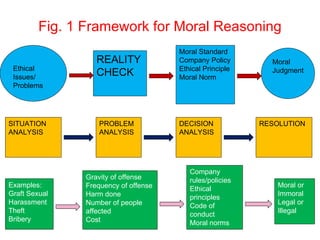
Moral Reasoning in Business The essence of studying Business Ethics is  to provide managers and decision makers with a framework for the resolution of moral issues and problems affecting business activities and the organization.
What is Moral Reasoning? Moral reasoning is a process in which ethical issues and problems are benchmarked against a moral standard so that a moral judgment is made possible.
Responsibility of Managers Since managers are tasked to solve problems in the organization and its activities, it is also the responsibility of managers to help in the resolution, if not, prevention of moral problems in business activities and the enterprise.
Fig. 1 Framework for Moral Reasoning Ethical Issues/ Problems REALITY CHECK Moral Standard Company Policy Ethical Principle Moral Norm Moral Judgment SITUATION ANALYSIS PROBLEM ANALYSIS DECISION ANALYSIS RESOLUTION Examples: Graft Sexual Harassment Theft  Bribery Gravity of offense Frequency of offense Harm done  Number of people affected  Cost Company rules/policies Ethical principles  Code of conduct  Moral norms Moral or Immoral Legal or Illegal
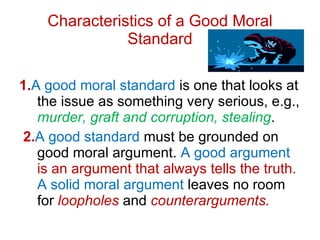
Characteristics of a Good Moral Standard 1. A   good moral standard  is one that looks at the issue as something very serious, e.g.,  murder, graft and corruption, stealing . 2. A   good standard  must be grounded on good moral argument.  A good argument  is an argument that always tells the truth.  A solid moral argument  leaves no room for  loopholes  and  counterarguments.
3.   A good standard  should be  objective  and  not   subjective.  It should be  universally   accepted and should apply to all.   What is good for one person should be at the same time good for everybody. 4.   A good standard,  when violated, brings about  feelings of guilt ,  shame, and remorse of conscience.
Characteristics of a Good Moral Judgment 1 .  A good moral judgment must be logical .  This means, that the decisions maker must arrive at an informed resolution of the issue based on logical reasoning.  2 .   A good moral judgment must be based on facts and solid evidence.  The information used in the process of moral reasoning must not come from weak sources like, hearsay, rumors and grapevine.
The Morality of Good Moral Judgment 1.Why people go into business?  People go into business for a numbers of reasons like,  personal satisfaction ,  to earn a livelihood ,   to serve the society through the goods and services they offer to the customers,   but the most common, if not, the most dominant motive why people go into business is  to make a profit. 2. How do businessmen viewed profit through their eyes? Businessmen consider profit as a form of anticipated reward or a  compensation for the efforts they spend, skills they apply, and returns for the capital they invested in organizing the business.
Milton Friedman , a  noted economist , says that the  “ only responsibility of business is to make profit so long as it stays within the rules of the game, which is to say, engage in open and free competition without deception or fraud. Peter Drucker , a  famous management guru , on the other hand, disagrees with this view by saying, that the  enterprise is an organ of the society and therefore, its actions and decisions have a great impact on society and people.”
Reading   between   the line Drucker  is simply hinting that albeit, profit is an important aspect of business, there are other factors that the businessman must consider in doing business such as:  customer satisfaction ,  fair treatment of the employees ,  and   respect for the environment.
Because of these differences of opinion, the issue of profit-motive is a subject matter that needs to be considered in the study of business Ethics .  Is profit motive in business  good or bad ?  Is it moral or immoral? Understanding the nature and morality of profit motive starts with the examination of some given factors and assumptions in which the idea of profit motive operates. These factors are the following: 1. Profit-motive in business is an ethical issue. Since business is an integral part of society, its activities including profit-making, must be examined from the perspective of morality.
2. Profit-motive is an ethical issue operates within two important aspects of our human conduct-freedom and the structure of business. The element of freedom implies that businessmen have the right to decide on the amount of profit they want to earn in the process of  selling goods and services to customers .
The  Good  and the  Bad Sides  of  Profit-Motive 1. Profit motive  motivates people to do something meaningful , e.g., it gives human life a goal to pursue and something to live for. 2.  Profit-motive  promotes ingenuity and cleverness in running a business , e.g., business leaders and entrepreneurs have to struggle to overcome obstacles in order to achieve success. 3.  Profit-motive  makes people productive . Because of their desire for money businessmen have become productive and some of their products have been useful and have enhanced human life. 4.  Profit-motive  generates potential capital for the business . Profit  is potential capital, something that can be invested to establish new businesses. In this way, profit also results in more jobs and more goods and services for the public and the society as a whole.
The  Bad Side  of  Profit-Motive 1.  Profit-motive promotes rivalry among competitors. Sometimes the competition becomes stiff  that it results into a “dog-eat-dog” world of business where sources is achieved by competing with others and pushing them down in order that one’s own business might succeed. This certainty dramatizes business as an important human activity. 2.  Profit-motive makes people focus only on making money, that is, to sell as many goods as possible without considering whether or not these products satisfy the needs and wants of consumers and end users.
3.  Profit-motive turns businessman from being a reflective and a questioning person because it focuses his attention on the practical activity of making money. Thus, a life centered on profit results into  a narrow existence, deficient in many important human dimensions. 4. Profit-motive promotes self-interest rather than the common good. The profit-motive, has to some extent, benefited some businessmen  but it has also created some social costs that many people, if not the majority have to bear, e.g., depletion of the natural resources, toxic waster being thrown into the rivers, pollution of the environment, and disregard for the next generation  to come
Business Ethics Defined Business Ethics is the study of what is right and wrong human behavior and conduct in business . Business Ethics is a study of the perceptions of people about morality, moral norms, moral rules, and ethical principles as they apply and institutions in business.  Business Ethics is the study, evaluation, analysis and questioning of ethical standards, policies, moral norms and ethical theories that managers and decision makers use in resolving moral issues and ethical dilemmas  affecting business .
Explain the phrase “Not all that is legal is moral, but what is moral is worth legalizing.”

Business ethics and social responsibility

  • 1.
    Business Ethics andSocial Responsibility What is Business? Business is a complex activity that involves major activities like production, manufacturing, marketing, advertising, selling, and the like. Is business an integral part of society? Yes, business is an activity that is part and parcel of human society, therefore, its activities must be examined from the ethical perspective.
  • 2.
    What is thefundamental reason for examining the activities of business from the moral perspective? Ans. For the promotion of the common goods, protection of the individual’s interests, and the preservation of human society in general.
  • 3.
    The Importance ofEthics in Business The study of Ethics paves the way for common ground in our understanding of the fundamental idea of what is good and what is bad in our human conduct. Without Ethics, people, especially businessmen, will set their own moral standards, moral rules and moral principles .
  • 4.
    Ethics asa science does not only evaluate the morality of our human conduct but also provides us with a common understanding of the universal, objective, and irreversible moral principles that govern our human conduct and guide our moral decisions.
  • 5.
    Moral Reasoning inBusiness The essence of studying Business Ethics is to provide managers and decision makers with a framework for the resolution of moral issues and problems affecting business activities and the organization.
  • 6.
    What is MoralReasoning? Moral reasoning is a process in which ethical issues and problems are benchmarked against a moral standard so that a moral judgment is made possible.
  • 7.
    Responsibility of ManagersSince managers are tasked to solve problems in the organization and its activities, it is also the responsibility of managers to help in the resolution, if not, prevention of moral problems in business activities and the enterprise.
  • 8.
    Fig. 1 Frameworkfor Moral Reasoning Ethical Issues/ Problems REALITY CHECK Moral Standard Company Policy Ethical Principle Moral Norm Moral Judgment SITUATION ANALYSIS PROBLEM ANALYSIS DECISION ANALYSIS RESOLUTION Examples: Graft Sexual Harassment Theft Bribery Gravity of offense Frequency of offense Harm done Number of people affected Cost Company rules/policies Ethical principles Code of conduct Moral norms Moral or Immoral Legal or Illegal
  • 9.
    Characteristics of aGood Moral Standard 1. A good moral standard is one that looks at the issue as something very serious, e.g., murder, graft and corruption, stealing . 2. A good standard must be grounded on good moral argument. A good argument is an argument that always tells the truth. A solid moral argument leaves no room for loopholes and counterarguments.
  • 10.
    3. A good standard should be objective and not subjective. It should be universally accepted and should apply to all. What is good for one person should be at the same time good for everybody. 4. A good standard, when violated, brings about feelings of guilt , shame, and remorse of conscience.
  • 11.
    Characteristics of aGood Moral Judgment 1 . A good moral judgment must be logical . This means, that the decisions maker must arrive at an informed resolution of the issue based on logical reasoning. 2 . A good moral judgment must be based on facts and solid evidence. The information used in the process of moral reasoning must not come from weak sources like, hearsay, rumors and grapevine.
  • 12.
    The Morality ofGood Moral Judgment 1.Why people go into business? People go into business for a numbers of reasons like, personal satisfaction , to earn a livelihood , to serve the society through the goods and services they offer to the customers, but the most common, if not, the most dominant motive why people go into business is to make a profit. 2. How do businessmen viewed profit through their eyes? Businessmen consider profit as a form of anticipated reward or a compensation for the efforts they spend, skills they apply, and returns for the capital they invested in organizing the business.
  • 13.
    Milton Friedman ,a noted economist , says that the “ only responsibility of business is to make profit so long as it stays within the rules of the game, which is to say, engage in open and free competition without deception or fraud. Peter Drucker , a famous management guru , on the other hand, disagrees with this view by saying, that the enterprise is an organ of the society and therefore, its actions and decisions have a great impact on society and people.”
  • 14.
    Reading between the line Drucker is simply hinting that albeit, profit is an important aspect of business, there are other factors that the businessman must consider in doing business such as: customer satisfaction , fair treatment of the employees , and respect for the environment.
  • 15.
    Because of thesedifferences of opinion, the issue of profit-motive is a subject matter that needs to be considered in the study of business Ethics . Is profit motive in business good or bad ? Is it moral or immoral? Understanding the nature and morality of profit motive starts with the examination of some given factors and assumptions in which the idea of profit motive operates. These factors are the following: 1. Profit-motive in business is an ethical issue. Since business is an integral part of society, its activities including profit-making, must be examined from the perspective of morality.
  • 16.
    2. Profit-motive isan ethical issue operates within two important aspects of our human conduct-freedom and the structure of business. The element of freedom implies that businessmen have the right to decide on the amount of profit they want to earn in the process of selling goods and services to customers .
  • 17.
    The Good and the Bad Sides of Profit-Motive 1. Profit motive motivates people to do something meaningful , e.g., it gives human life a goal to pursue and something to live for. 2. Profit-motive promotes ingenuity and cleverness in running a business , e.g., business leaders and entrepreneurs have to struggle to overcome obstacles in order to achieve success. 3. Profit-motive makes people productive . Because of their desire for money businessmen have become productive and some of their products have been useful and have enhanced human life. 4. Profit-motive generates potential capital for the business . Profit is potential capital, something that can be invested to establish new businesses. In this way, profit also results in more jobs and more goods and services for the public and the society as a whole.
  • 18.
    The BadSide of Profit-Motive 1. Profit-motive promotes rivalry among competitors. Sometimes the competition becomes stiff that it results into a “dog-eat-dog” world of business where sources is achieved by competing with others and pushing them down in order that one’s own business might succeed. This certainty dramatizes business as an important human activity. 2. Profit-motive makes people focus only on making money, that is, to sell as many goods as possible without considering whether or not these products satisfy the needs and wants of consumers and end users.
  • 19.
    3. Profit-motiveturns businessman from being a reflective and a questioning person because it focuses his attention on the practical activity of making money. Thus, a life centered on profit results into a narrow existence, deficient in many important human dimensions. 4. Profit-motive promotes self-interest rather than the common good. The profit-motive, has to some extent, benefited some businessmen but it has also created some social costs that many people, if not the majority have to bear, e.g., depletion of the natural resources, toxic waster being thrown into the rivers, pollution of the environment, and disregard for the next generation to come
  • 20.
    Business Ethics DefinedBusiness Ethics is the study of what is right and wrong human behavior and conduct in business . Business Ethics is a study of the perceptions of people about morality, moral norms, moral rules, and ethical principles as they apply and institutions in business. Business Ethics is the study, evaluation, analysis and questioning of ethical standards, policies, moral norms and ethical theories that managers and decision makers use in resolving moral issues and ethical dilemmas affecting business .
  • 21.
    Explain the phrase“Not all that is legal is moral, but what is moral is worth legalizing.”